Journal · Collector’s Guide
Engraved Korth Revolver: Wall Street in Steel and Gold
This engraved Korth revolver is a one-of-one: a Korth .44 Magnum, hand-engraved in Germany with the story of Wall Street. The right side runs from Peter Stuyvesant’s New Amsterdam in 1647 to Federal Hall and the Bill of Rights; the left side is the Wall Street everyone knows, with a gold bull, the New York Stock Exchange and a Dow Jones chart. The grips are made with U.S. currency, and the case is lined with real banknotes. It is part of the Old Steel Arsenal collection.
Who made this engraved Korth revolver
Korth is a small German maker of high-end revolvers and pistols. Willi Korth, a railway engineer, founded the company in 1954, starting in a basement workshop with gas revolvers that fired blanks or tear gas cartridges before moving on to firearms. The company went through a bankruptcy in 1999, was taken over in 2000 by Armurerie Freylinger of Luxembourg, announced in November 2008 that it was closing its factory, and in April 2009 moved its headquarters to Lollar, near Giessen, where it said it would resume production. According to Wikipedia, each Korth revolver takes about four months and is roughly 70 percent hand work.
The engraving on ours was done by hand in Germany. We have not confirmed who the engraver was, so we don’t credit the engraving to the Korth factory itself. It covers both sides of the frame and barrel, the cylinder and the top strap.
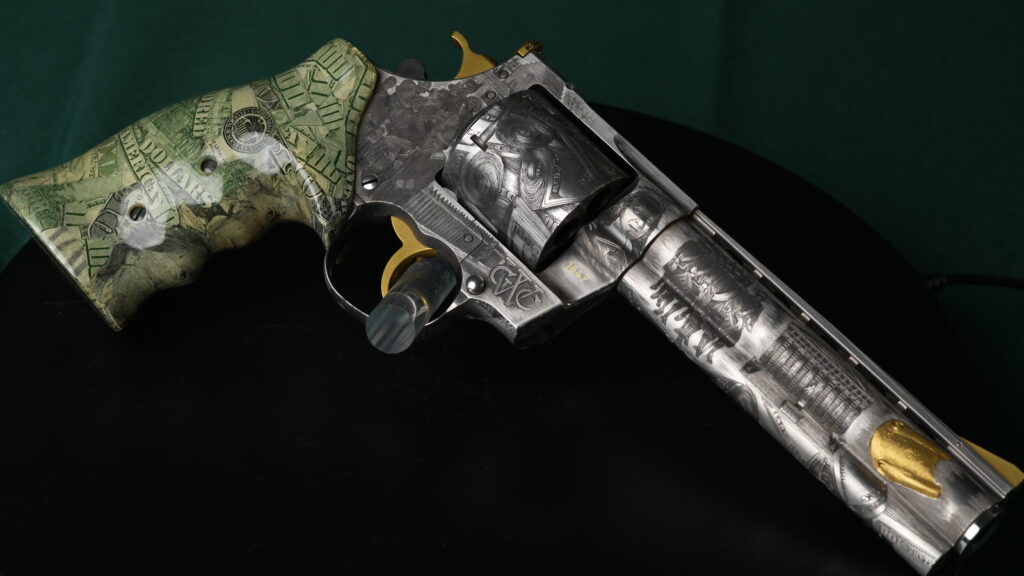
The right side: New Amsterdam and the wall
The story starts on the frame, beside the cylinder. There is a portrait of Peter Stuyvesant with his long hair, the year 1647 in gold, and the monogram GWC. Stuyvesant arrived in New Amsterdam in May 1647 as Director-General of New Netherland for the Dutch West India Company, whose Dutch name, Geoctrooieerde Westindische Compagnie, gives the initials GWC.
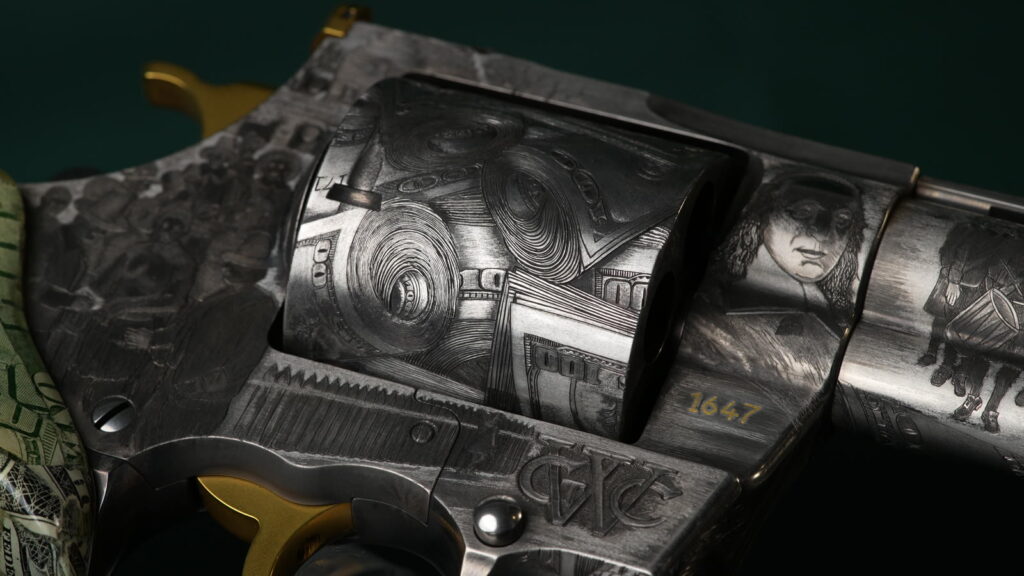
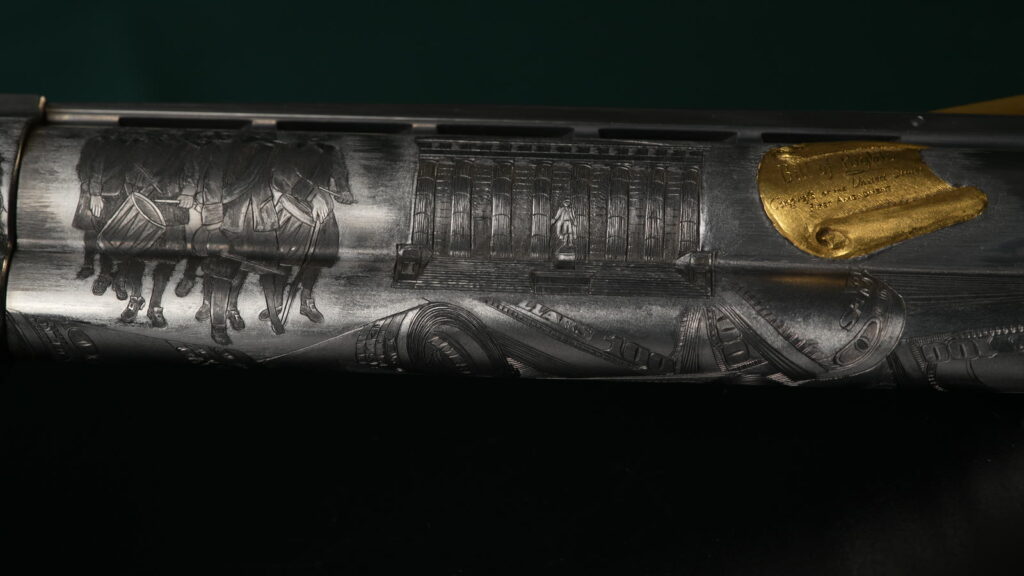
Along the lower edge of the frame runs a row of wooden stakes, and on the barrel a line of drummers marches past. The stakes are the wall. In 1653, during the First Anglo-Dutch War, Stuyvesant ordered a ditch and a wooden palisade built across the island against a feared English attack overland. The wall stood from 1653 to 1699, when it was taken down because the city had grown past it. The street along it kept the name.
Federal Hall and the gold scroll
Further along the barrel stands Federal Hall, with the statue of George Washington in front of its columns, cut in steel. The First Congress met on this site. Washington took the oath of office there on April 30, 1789, and on September 25, 1789, the Bill of Rights was proposed there. The building on the barrel is not the hall of 1789 but the one that stands on Wall Street today: the Greek Revival building put up in 1842 as the Custom House on the site of the original hall, with John Quincy Adams Ward’s bronze Washington, which went up on its steps in 1883.
Next to it is a scroll in 24-karat gold, engraved Bill of Rights, Congress of the United States, First Amendment.
Currency grips and a banknote cylinder
Look at the grips. They are made with pieces of U.S. currency, and the notes still show through: numerals, seals, lettering.
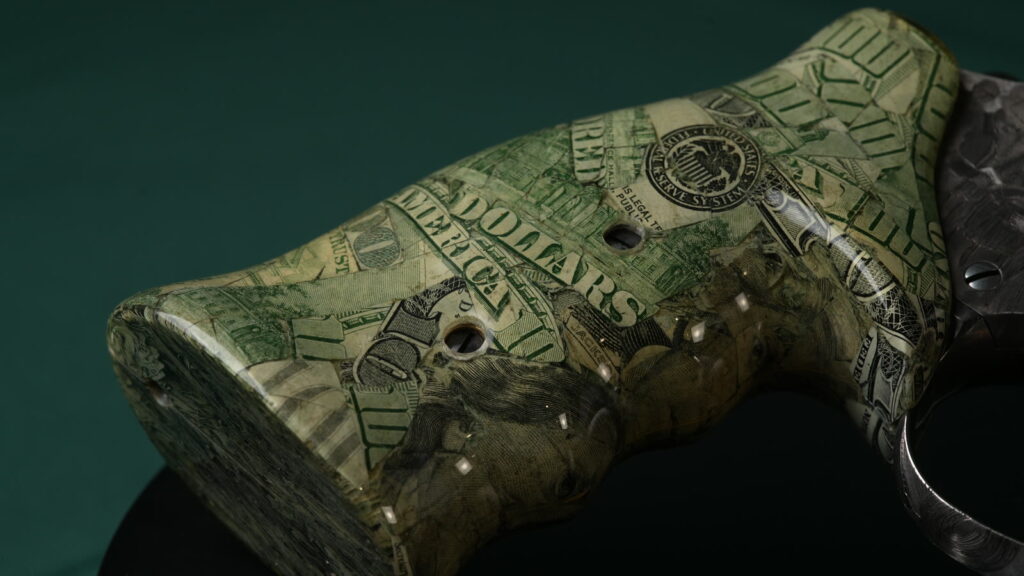
The cylinder is engraved with rolled U.S. banknotes, and one of them carries a full serial number, JB86899353A. More rolled notes are cut along the lower half of the barrel on both sides.
Even the case is lined with real U.S. banknotes. The face values of the notes in the lining add up to 92, a nod to 1792, the year the Stock Exchange was born: on May 17, 1792, 24 stockbrokers signed the Buttonwood Agreement, the founding document of the New York Stock Exchange.

The left side: the gold bull and the Exchange
On the left side, the gold words Wall Street sit on an engraved brick wall on the barrel, and beside them stands a gold bull.

A bull is the market’s symbol, and the best known on Wall Street is Arturo Di Modica’s Charging Bull, made after the 1987 crash. Overnight in December 1989, Di Modica brought it on the back of a truck and dropped it outside the New York Stock Exchange without permission. Police soon removed it, and within days it was installed at Bowling Green, where it still stands on Broadway.

The top strap reads NEW YORK STOCK EXCHANGE, the words DOW JONES are cut upside down on top, and the frame carries the words Wall St and the Exchange building itself.

The Dow number: 36,582.68
A gold Dow Jones line climbs across a scale that starts at 35000 and rises in steps of 300, and just ahead of the cylinder is one number, written the German way with a period and a comma: 36.582,68. In American notation that is 36,582.68.
We haven’t been able to tie it to a particular close, or to anything else. If you know what it stands for, tell us.

Specifications
| Item | This Korth, Wall Street engraving |
|---|---|
| Maker | Korth, Germany |
| Model | Not confirmed |
| Cartridge | .44 Magnum |
| Type | Double-action revolver |
| Engraving | By hand, in Germany: both sides, barrel, frame, cylinder and top strap; engraver not confirmed |
| Gold | 1647, Bill of Rights scroll (24-karat), Wall Street lettering, bull, Dow line |
| Grips | Made with U.S. currency |
| Case | Lined with real U.S. banknotes |
| Made | One of one |
What we know and what we don’t
The scenes we have identified line up with the history of the street. What we have not confirmed: who engraved the revolver, the Korth model it was built on, what the Dow figure refers to, and what the crowd scene by the grip on the right side shows.
On the floor at OSA
The Korth in these photos is part of the Old Steel Arsenal collection. These pieces in our case come from the same corner of collecting, guns with special finishes, editions or custom work:
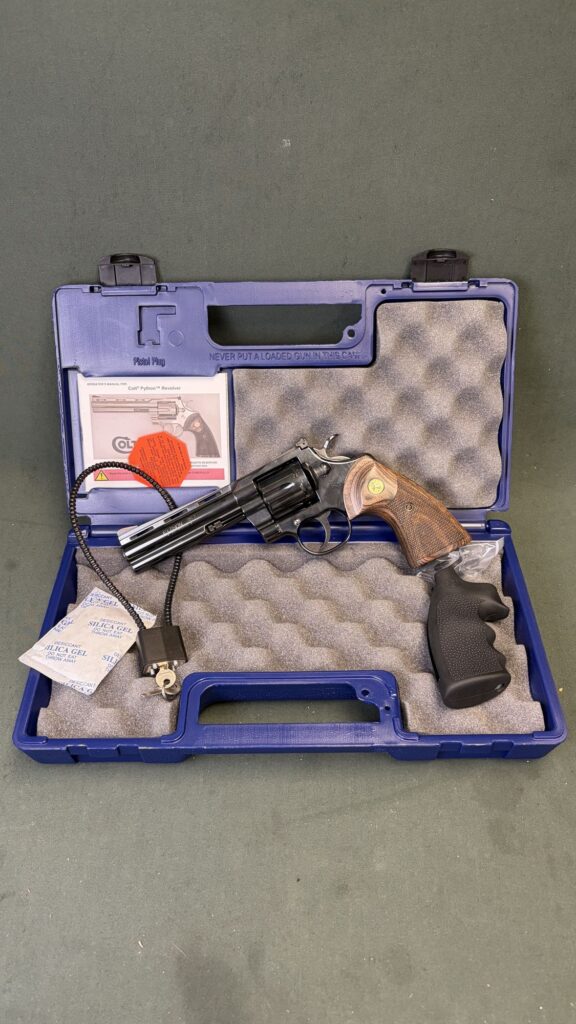
- Colt Python .357 Magnum, 5-inch, blued: another double-action revolver, with its factory box.
- Kimber 45th Anniversary 1911 .45 ACP: a 45th Anniversary edition 1911, with its case.
- Nighthawk Custom Lady Hawk 1911 9mm: a custom-shop 1911.
- 1963 Browning Baby .25 ACP, factory chrome with pearl grips: a small pistol with factory chrome and pearl grips, in its case.
The grid below updates by itself as pieces come and go.
The short version is on our Instagram. Watch it on Instagram.
General information for collectors, not legal advice. Historical dates come from the sources below; the description of the engraving comes from our own photographs of the revolver.
Common Questions
Where are Korth revolvers made?
In Germany. Korth was founded in 1954 by Willi Korth and has been based in Lollar, near Giessen, since 2009. According to Wikipedia, much of the work on each revolver is done by hand.Why is it called Wall Street?
The street follows the line of a wall. In 1653 Peter Stuyvesant had a ditch and wooden palisade built across lower Manhattan against a feared English attack; the wall came down in 1699, and the street kept the name.How did the Charging Bull get to Wall Street?
Arturo Di Modica dropped the bronze Charging Bull outside the New York Stock Exchange overnight in December 1989, without permission. Police soon removed it, and within days it was installed at Bowling Green, where it still stands on Broadway.Was the Bill of Rights passed at Federal Hall?
It was proposed there. On September 25, 1789, the First Congress, meeting at the original Federal Hall on Wall Street, sent twelve amendments to the states; the ten that the states ratified became the Bill of Rights. The building now on the site dates from 1842.What does GWC stand for?
Geoctrooieerde Westindische Compagnie, the Dutch name of the Dutch West India Company, which ran New Netherland and sent Peter Stuyvesant to New Amsterdam in 1647.When was the New York Stock Exchange founded?
The Buttonwood Agreement, the founding document of the New York Stock Exchange, was signed by 24 stockbrokers on May 17, 1792.Sources
- Wikipedia, “Korth” — https://en.wikipedia.org/wiki/Korth (founded 1954 by Willi Korth, railway engineer, gas revolvers, 1999 bankruptcy, Freylinger 2000, factory closing announced November 2008, Lollar from April 2009, about four months and 70 percent manual labor per revolver)
- Wikipedia, “Peter Stuyvesant” — https://en.wikipedia.org/wiki/Peter_Stuyvesant (arrived New Amsterdam May 1647, Director-General of New Netherland)
- Wikipedia, “Dutch West India Company” — https://en.wikipedia.org/wiki/Dutch_West_India_Company (Geoctrooieerde Westindische Compagnie, GWC)
- Wikipedia, “Wall Street” — https://en.wikipedia.org/wiki/Wall_Street (wall 1653 to 1699, First Anglo-Dutch War, ditch and wooden palisade ordered by Stuyvesant, removed 1699)
- Wikipedia, “Federal Hall” — https://en.wikipedia.org/wiki/Federal_Hall (Washington’s inauguration April 30, 1789, Bill of Rights proposed September 25, 1789, present building 1842 as the Custom House, Ward’s Washington statue 1883)
- Wikipedia, “Charging Bull” — https://en.wikipedia.org/wiki/Charging_Bull (Arturo Di Modica, made after the 1987 crash, December 14, 1989, dropped outside the NYSE, removed by police, installed at Bowling Green December 20, 1989)
- Wikipedia, “Buttonwood Agreement” — https://en.wikipedia.org/wiki/Buttonwood_Agreement (May 17, 1792, 24 stockbrokers, founding document of the NYSE)
- National Archives, “The Bill of Rights” — https://www.archives.gov/milestone-documents/bill-of-rights (twelve amendments proposed September 25, 1789; the ten ratified became the Bill of Rights)