
Journal · Collector’s Guide
Saving Private Ryan Sniper Rifle: Jackson’s Scope Swap
The Saving Private Ryan sniper rifle starts the film with a short scope. Private Jackson, an Army sniper, then carries a long Unertl in a can on his pack and swaps it on to take out a German sniper in a bell tower. On the real rifles, that swap is not so simple. The Army’s M1903A4 carried a short Weaver on one base, right on the receiver. The Marine Corps set up its long 8-power Unertl on two separate blocks, one on the receiver and one on the barrel. We have one of each, and both are part of our own collection.
Jackson’s two scopes in Saving Private Ryan
For the first part of the film, Jackson’s rifle wears a short scope. For the bell tower duel he swaps on a long target-style scope of the kind made under Marine Corps contract during the Second World War.
Forgotten Weapons identifies the short scope in the opening scenes as a Lyman Alaskan, which it calls wrong for the rifle, and the long one as an 8x Unertl. On the swap it is blunt: the Unertl “was used by Marine Corps snipers,” but “it is not interchangeable with the M1903A4’s Weaver M73B1 scope.” We wanted to show that with the real rifles.

The Army rifle: M1903A4 with a short Weaver
From the mid-1920s until the Second World War, American Rifleman writes, the Army had no telescopic-sighted sniper rifles in its inventory. After Pearl Harbor it needed one quickly. A scoped M1 Garand was the goal, but the Garand loads from the top, which made mounting a scope over the receiver a problem. The Ordnance Department turned to the M1903A3 instead.
Sniper Central gives the official adoption date of the M1903A4 as 14 January 1943. Shooting Illustrated describes how Remington built it: a Weaver M73B1 telescopic sight on an A3 receiver, held by a Redfield Junior base, with the bolt handle modified to clear the scope’s eyepiece. The government first ordered 20,000 and, by the end of production in June 1944, had received 28,365.
The M73B1 was the military version of Weaver’s commercial 330 hunting scope. American Rifleman lists it at 2.5x; Shooting Illustrated and Captain Stevens put it at 2.75 power. Either way it is under 3 power. Captain Stevens also records that the plan had been to fit the Lyman Alaskan, but those scopes could not be had in time, so the Weaver became the main scope.

Our A4 wears an M73B1, and the whole arrangement is visible at a glance: one base on the receiver, two rings, a short tube. Nothing reaches forward onto the barrel.
How to read an M1903A4 receiver
The left side of our A4’s receiver reads:
U.S. REMINGTON MODEL 03-A3

That is normal for the type. Shooting Illustrated notes that the receiver markings on the A4 “had to be shifted out of the way of the scope base to remain visible.” Captain Stevens writes that the rifles were stamped 1903A3 even though they were A4s, apparently so that a rifle that did not work out as a sniper could have its scope and mount removed and become a standard A3. He adds that a very few were overstamped “A4” by the military after issue.
The other feature to check is the front of the barrel. Shooting Illustrated says no front sight was installed on the A4, though the barrel kept the milling cuts for one, and Captain Stevens makes the same point: the iron sights were never fitted, rather than removed. The bolt handle, modified to clear the eyepiece, is a third. None of these proves a rifle is right on its own; they are things to check together.
Our rifle also carries the FJA inspector’s initials on the stock above the trigger guard. Captain Stevens identifies FJA as Frank J. Atwood. It is a Remington acceptance mark, not something only A4s carry.

The Marine rifle: M1903A1 with a long Unertl
The Marine Corps went a different way. Its Equipment Board tested sniper rigs in late 1940 and, as American Rifleman tells it, recommended a Winchester Model 70 with an 8x target scope from the J. Unertl Optical Co. The Model 70 was not approved, and the Unertl went onto the M1903 instead, using National Match and Special Target rifles already tuned for competition. The first Unertls reached the Marines in late 1942, and by mid-1943 the rifles were in use in the Pacific.
The setup is simple to describe. American Rifleman: the front scope mount was screwed to the barrel and the rear scope mount to the receiver ring, and the handguard was milled out to make room. Two separate blocks, with the long tube riding between them.
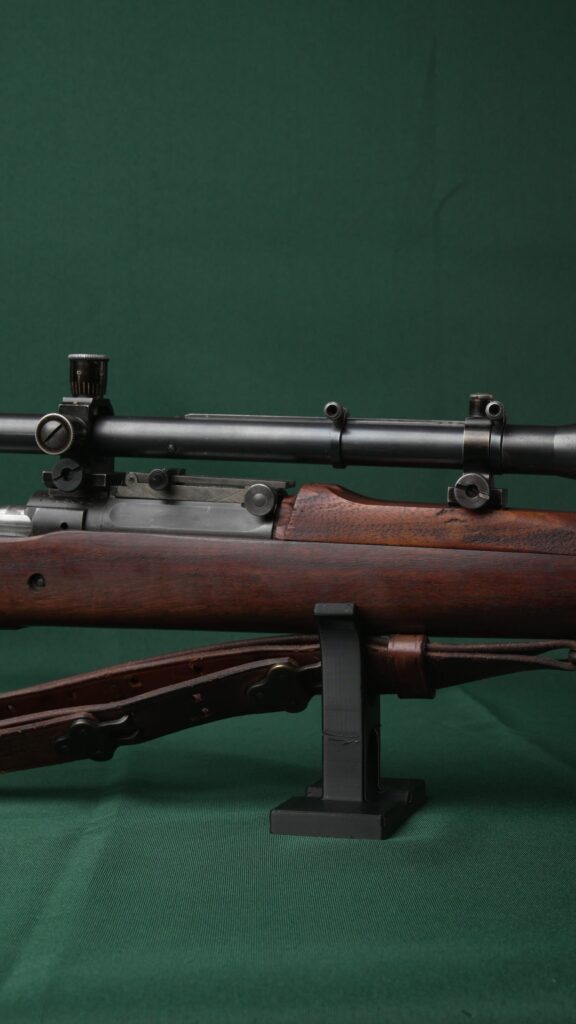
Scopes made under Marine contract were marked on top of the tube “J. UNERTL” over “USMC-SNIPER”, then a serial number. Ours carries that marking. American Rifleman notes the scope was called and marked 8x but was actually 7.8x, and that Marine documents called the rig the “M1903A1 Rifle, Sniper, with Telescope Sight, Unertl 8X.”

That is the history of the type. On our own rifle we describe what you can see: the Unertl marked USMC-SNIPER and the two-block Marine setup. Unlike the A4, the Marine rifle kept its iron sights, and ours still has its front sight near the muzzle, ahead of the scope’s objective.
Why the scopes don’t swap
The Weaver’s rings clamp to one base on top of the receiver. The Unertl needs a block on the receiver and another on the barrel, spaced for its long tube, and an A4 barrel has no front block. A rifle set up for one scope is not set up for the other; the mounts would have to change too.
That is why an Army sniper carrying a Marine scope stands out. The Army’s issue rig was the A4 and its Weaver. The long Unertl was a Marine Corps scope.
Things moved the other way as well. In February 1944, after poor early reports, the Marine Commandant asked to cancel the Unertl contracts and substitute the Army’s M1903A4 once depot stocks ran out. American Rifleman notes that the Unertl rifles stayed in use anyway, did well on Saipan, Peleliu and Okinawa, and were the primary Marine sniper rifle through the end of the war. Sniper Central adds that the A4 was used by both the Army and the Marine Corps until the war ended, and that both rifles saw service again in Korea.
Did Marine Unertl scopes have a return spring?
No. A Unertl’s tube can slide in its mounts. When the rifle fires, the rifle moves back and the tube ends up forward of where it started. The Firearm Blog’s review of a modern Unertl-style scope explains that letting the scope slide reduced the shock of recoil on it, and describes pulling the scope back after each shot.
According to American Rifleman, Unertl’s similar civilian competition scopes had a spring to return the tube, but the Marine scopes did not, because it was believed sand or dirt could lodge in the spring and score the tube. So the Marine sniper pulled the scope back into position by hand after every shot. Some, the same article reports, cut a slice of truck inner tube into a big rubber band stretched between the front clamping ring and the rear mount to do the job.

Ours has no return spring either. In our video we show this by hand on an unloaded rifle, no firing: the tube pushed forward toward the muzzle, then pulled back, the way the sniper did it between shots.
To protect the scope off the rifle, American Rifleman says the Marines had a cylindrical Micarta carrying case with cartridge belt hooks.
Handling the long Unertl
We have always been interested in sniper rifles, and we noticed the scope change right away in the bell tower scene. The Unertl is long and slim, but it is actually heavy, and the field of view is narrow.

Old sniper rifles attract fakes. American Rifleman makes the same point about the Marine rifles: surplus USMC Unertl scopes were later fitted to standard M1903A1s to create fake sniper rifles, and a well-done one can be hard to tell from a real one without convincing documentation. It also notes there were only 1,047 National Match and Special Target rifles on hand for conversion, and only a relatively small number were actually converted and issued.
Specifications (the types as issued)
| Item | Army M1903A4 | USMC M1903A1 / Unertl |
|---|---|---|
| Basis | M1903A3, made by Remington | M1903 National Match or Special Target rifles |
| Timeline | Adopted 14 January 1943; production ended June 1944 | First Unertls delivered late 1942; in Pacific use by mid-1943 |
| Number | 28,365 delivered | Up to 1,750 scopes delivered; relatively few rifles converted |
| Cartridge | .30-06 Springfield | .30-06 Springfield |
| Scope | Weaver 330 / M73B1 | J. Unertl, USMC contract |
| Power | 2.5x to 2.75x, by source | Marked 8x, actually 7.8x |
| Mount | One Redfield Junior base on the receiver | Two blocks: rear on the receiver ring, front on the barrel |
| Front sight | Not installed | Kept |
| Return spring | Not applicable | None; tube pulled back by hand |
After the war
The A4 was a stopgap. American Rifleman’s history of the M1C explains that by the end of the war the M1C, a scoped Garand, was the standardized U.S. sniping rifle, with the M1D designated “Substitute Standard.” The Unertl had a longer life: when the United States became involved in Vietnam, a favored Marine sniper rifle was the Winchester Model 70 with a Unertl 8x USMC scope, the rig the Equipment Board had recommended in 1940. For a much later Marine rifle, see our article on the DARPA XM3 sniper rifle. For the federal rules on older firearms, see our curio and relic guide.
On the floor at OSA
The M1903A4 and the USMC M1903A1 in these photos are part of our own collection, and neither is on the floor. If they are your kind of rifle, these pieces in our case are related:
- Smith-Corona M1903A3 with an S C 3-42 marked barrel: the M1903A3 is the model the A4 was built on; this one was made by Smith-Corona rather than Remington.
- M1 Garand listed in M1D configuration: the M1D was the Garand sniper version designated Substitute Standard as the war ended.
- 1944 Springfield Armory M1 Garand rig with bayonet, belt and scabbard: a wartime M1, the rifle the Army first wanted to fit with a scope.
The grid below updates by itself as pieces come and go.
 1944 Springfield Armory M1 Garand 30-06 Rig with Bayonet Belt and Scabbard$1,795.00
 1943 Springfield M1 Garand 7.62 NATO, MK 2 MOD 1 Configuration, H&R$1,785.00
 1943 Springfield Armory M1 Garand .30-06 SA 4-51 Barrel, Mechanically Excellent$1,325.00
 All H&R parts M1 Garand .30-06 Rifle with July 1955 HRA Barrel, Excellent Condition$1,885.00
 Springfield Armory M1 Garand Type 2 National Match .30-06 Unfired Glass Bedded$3,150.00
 Springfield Armory M1 Garand .30-06 CMP Rifle with Box, Manual and Paperwork$1,600.00
The short version is on our Instagram. Watch it on Instagram.
General information for collectors, not legal advice. Specifications and dates come from the published sources listed below; details vary between individual rifles.
Common Questions
What sniper rifle does Jackson use in Saving Private Ryan?
An M1903A4, the Army’s wartime Springfield sniper rifle, according to Forgotten Weapons. It appears first with a short Lyman Alaskan scope and later with a long 8x Unertl, a Marine Corps scope that does not fit the A4’s mount.Can a Unertl scope be swapped onto an M1903A4?
Not as a simple scope swap. The A4’s Weaver sits in rings on one base on the receiver, while the USMC Unertl rides on two separate blocks, one on the receiver and one on the barrel.What scope did the M1903A4 use?
Mainly the Weaver M73B1, the military version of Weaver’s 330 hunting scope, rated about 2.5x to 2.75x and held by a Redfield Junior base.Why is an M1903A4 receiver marked 03-A3?
The A4 was built on an M1903A3 receiver and kept the 03-A3 designation, with the markings shifted so the scope base would not cover them. Captain Stevens suggests the reason was so a rifle that failed as a sniper could be turned back into a standard A3.How many M1903A4 rifles were made?
Shooting Illustrated gives 28,365 delivered by the end of production in June 1944, up from an initial order of 20,000.Why did Marine snipers pull the Unertl scope back after every shot?
The Unertl tube slides in its mounts when the rifle fires. Civilian Unertls had a return spring, but the Marine contract scopes did not, so the sniper pulled the tube back by hand.What power was the USMC Unertl scope?
It was called and marked 8x, but American Rifleman reports it was actually 7.8x. Marine contract scopes are marked J. UNERTL over USMC-SNIPER and a serial number.Sources
- Forgotten Weapons, “What’s Wrong with Private Jackson’s Sniper Rifle? (Saving Private Ryan)” — https://www.forgottenweapons.com/whats-wrong-with-private-jacksons-sniper-rifle-saving-private-ryan/ (film rifle shown as an M1903A4, Lyman Alaskan at first and called wrong, 8x Unertl used by Marine snipers and not interchangeable with the Weaver M73B1)
- Bruce N. Canfield, American Rifleman, “The M1903A1/Unertl USMC Sniper Rifle” — https://www.americanrifleman.org/articles/2019/10/24/the-m1903a1unertl-usmc-sniper-rifle/ (Army without scoped rifles mid-1920s to WWII, Garand top loading, Weaver 330C 2.5x, Equipment Board recommending Model 70 and Unertl 8x, first Unertls late 1942, use by mid-1943, mounts on barrel and receiver ring, handguard milled, tube markings, 7.8x, Marine designation, no return spring and why, pulled back by hand, inner tube band, Micarta case, February 1944 memo, use through the war, 1,047 rifles on hand, 1,750 scopes, fakes, Model 70 with Unertl in Vietnam)
- Martin K.A. Morgan, Shooting Illustrated, “Classic Guns: PFC Ray Register’s Springfield M1903A4 Sniper Rifle” — https://www.shootingillustrated.com/articles/2019/1/31/classic-guns-pfc-ray-registers-springfield-m1903a4-sniper-rifle (Weaver M73B1 2.75x on an A3 receiver with a Redfield Junior base, bolt handle modified, receiver markings shifted to stay visible, front sight not installed, milling cuts kept, 20,000 ordered and 28,365 delivered by June 1944)
- Captain Stevens, “U.S. M1903A4 sniper rifle” — https://captainstevens.com/?p=5499 (Lyman Alaskan planned but not to be had, M73B1 as military Weaver 330 at 2-3/4 power, rifles stamped 1903A3 and the apparent reason, a very few overstamped A4, iron sights never installed, FJA as Frank J. Atwood)
- Sniper Central, “US M1903-A4 & USMC M1903-A1/Unertl” — https://snipercentral.com/m1903a4.htm (adopted 14 January 1943, .30-06, A4 used by Army and USMC until the end of the war, A1/Unertl with iron sights, both used in Korea)
- American Rifleman, “The M1C Garand Sniper Rifle” — https://www.americanrifleman.org/articles/2014/8/29/the-m1c-garand-sniper-rifle/ (M1C standardized by the end of the war, M1D as Substitute Standard)
- Daniel Y, The Firearm Blog, “TFB Review: Hi-Lux Optics Malcolm USMC 8X Gen II Scope” — https://www.thefirearmblog.com/blog/2023/03/30/tfb-review-hi-lux-optics-malcolm-usmc-8x-gen-ii-scope/ (Unertl-style scope slides in its mounts, sliding reduced recoil shock, scope pulled back after each shot)