
Journal · Collector’s Guide
DARPA XM3 Sniper Rifle: The Marines’ Short .308
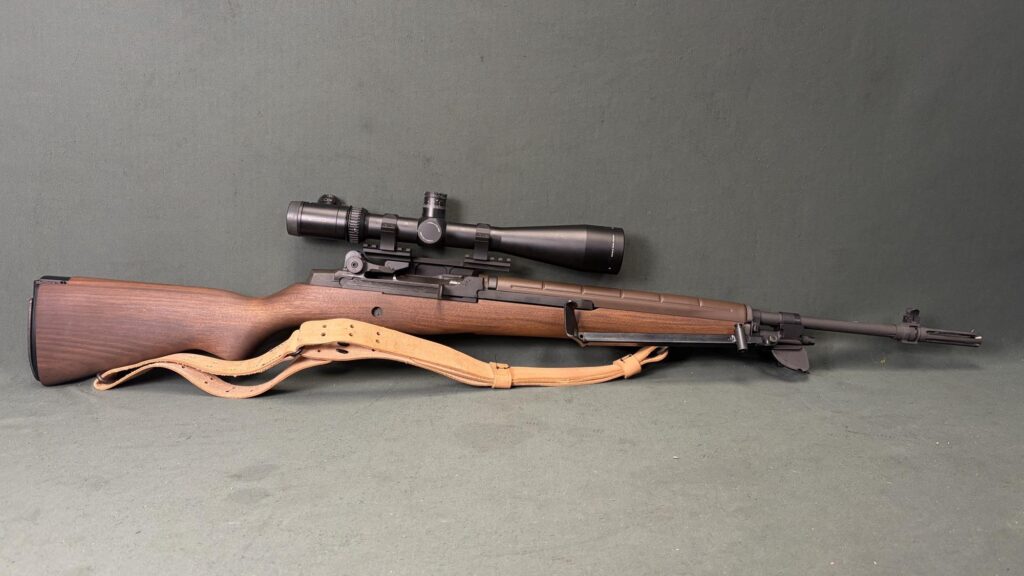
The DARPA XM3 sniper rifle was built because Marine snipers in Iraq needed something shorter and lighter than the M40A3. DARPA paid for it, Iron Brigade Armory built it on a Remington 700 action, and by 2012 the Marine Corps had just 52 of them. The one in these photos served two and a half years in Iraq and still wears its original Marine paint.
Why the Marines needed a shorter sniper rifle
Marine scout snipers took the M40A3 to war after 2001. The M40A3 is a Remington 700 short action with a 25-inch barrel, and it weighs about 16.5 pounds. Steve Reichert, then the senior NCO of the 2nd Marine Division’s precision weapons section and one of the people who worked on the XM3, writes that the front lines needed rifles that were “shorter and lighter,” with a better field of view, and quiet. Insurgent snipers were also hunting Marine snipers in their hide sites.
Normal procurement would have taken years. DARPA, the Defense Advanced Research Projects Agency, is the same agency whose ARPANET work led to the early internet. According to Reichert, DARPA held a conference with Marine snipers in 2004, and in mid-2005 it supplied a deploying Marine Expeditionary Unit with off-the-shelf spotting scopes, night vision and suppressors, using Iron Brigade Armory (IBA) to get the gear to the Marines. That working relationship is why DARPA picked IBA when it contracted for a lightweight sniper rifle in 2005.
The rifle had to be lighter and smaller than the M40s, more accurate, carry clip-on night vision that did not need a re-zero, use a better scope and stock, and run suppressed. Funding covered three prototypes, the XM1 through the XM3, and 56 complete systems. IBA tested barrels from 16 to 20 inches, and each barrel length got its own XM number. The 18-inch barrels kept up with the 20s, and the rifle that went to the Marines got an 18.5-inch barrel in a modified #7 contour.
From DARPA’s first call to the first rifle shipped took 12 months, Reichert writes. The prototype went to Naval Surface Warfare Center Crane in Indiana for safety certification and a side-by-side test against the Mk 13 Mod 5 and the Mk 11 Mod 0. The Marine Corps started taking delivery in 2006.

A shorter barrel, about 100 fps slower
A shorter barrel usually means less velocity, and velocity matters at distance. The XM3’s barrel is 18.5 inches against the M40A3’s 25. By Reichert’s numbers, muzzle velocity dropped by only about 100 feet per second on average, and the rifle “was mostly able to keep up accuracy-wise” with the longer M40A3s. The trade-off he names is that, depending on conditions, the bullet could go transonic before 1,000 yards.
Reichert also reports what happened when I Marine Expeditionary Force received the first shipment at Camp Pendleton. The rifles had been zeroed at IBA and were within half an MOA of point of aim out of the cases. That night the Marines mounted AN/PVS-22 night sights and, using their prior data, more than three out of four made first-round hits at 900 yards, suppressed.
The XM3 system
An XM3 was issued as a full kit, not only a rifle. The list Reichert gives includes the rifle in a Hardigg iM3200 Storm case, a SureFire FA762SS suppressor, a Nightforce NXS 3.5-15×50 day scope, an AN/PVS-22 night vision unit, a Harris bipod, and cleaning gear with a torque wrench set to 68 inch-pounds.
According to Reichert, it was the first time those Marines had in-line night vision that did not need to be zeroed to one rifle, the first time they had variable-power scopes, and the first time they could shoot their sniper rifles suppressed. One sniper school instructor he quotes put it plainly: “At the time, none of our 40s were set up with suppressors.”
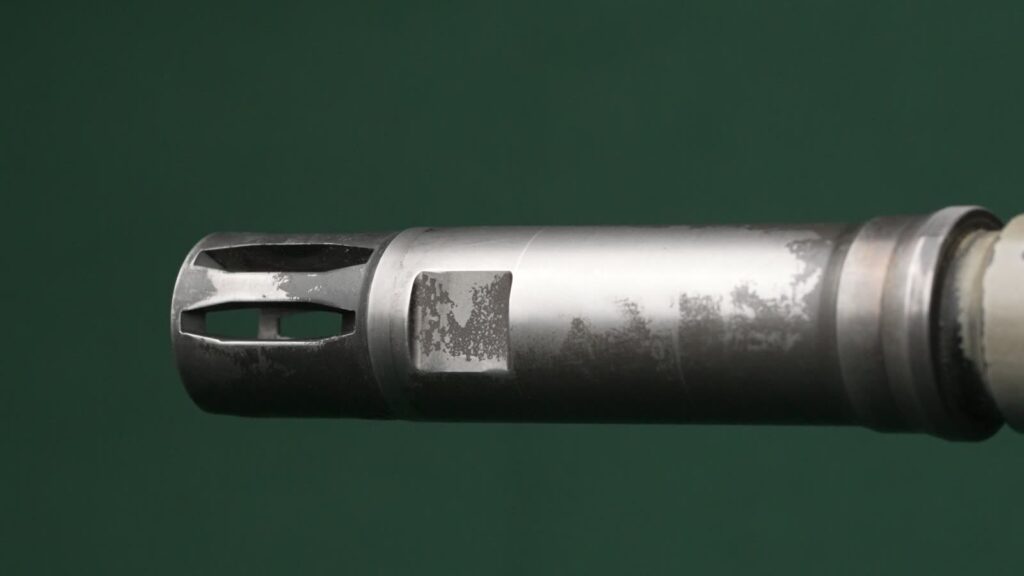
Ours came to us without the suppressor. Its suppressor-ready muzzle wears a slotted flash hider.
How to read XM3 sniper rifle markings
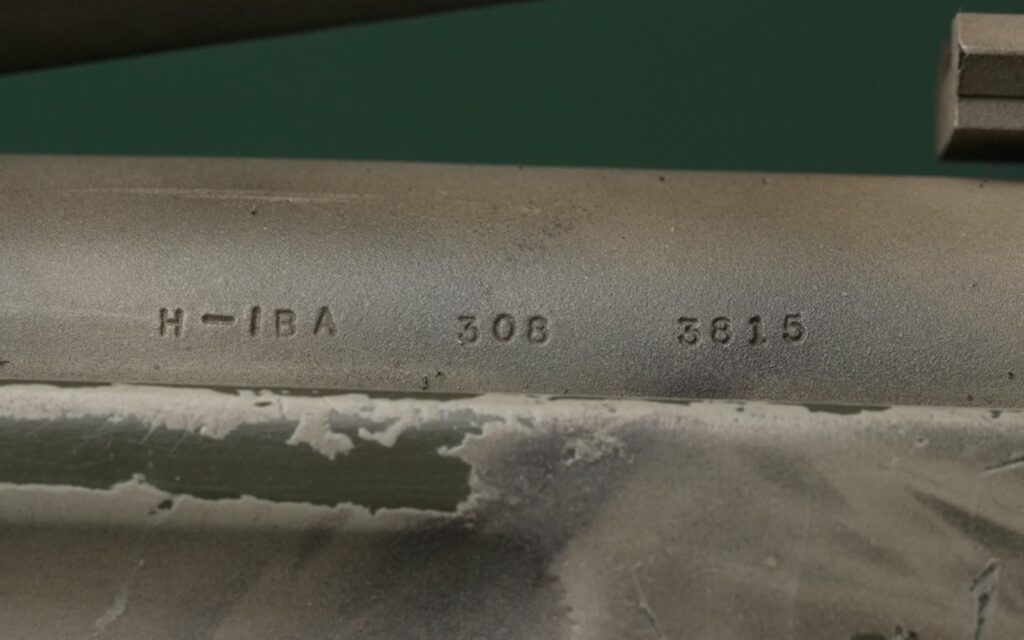
Our XM3 carries the last four digits of its serial, 3815, on the barrel and on the bolt handle. Those are the only two places it shows on the outside. We haven’t taken the rifle apart, so there may be more inside.
On the barrel, below the scope, the stamp reads H-IBA 308 3815. IBA is Iron Brigade Armory, 308 is the caliber, and 3815 is the last four of the serial. We have not confirmed what the H stands for, so we leave it unexplained.
The same 3815 is stamped on the bolt handle, so on ours the barrel and bolt match.
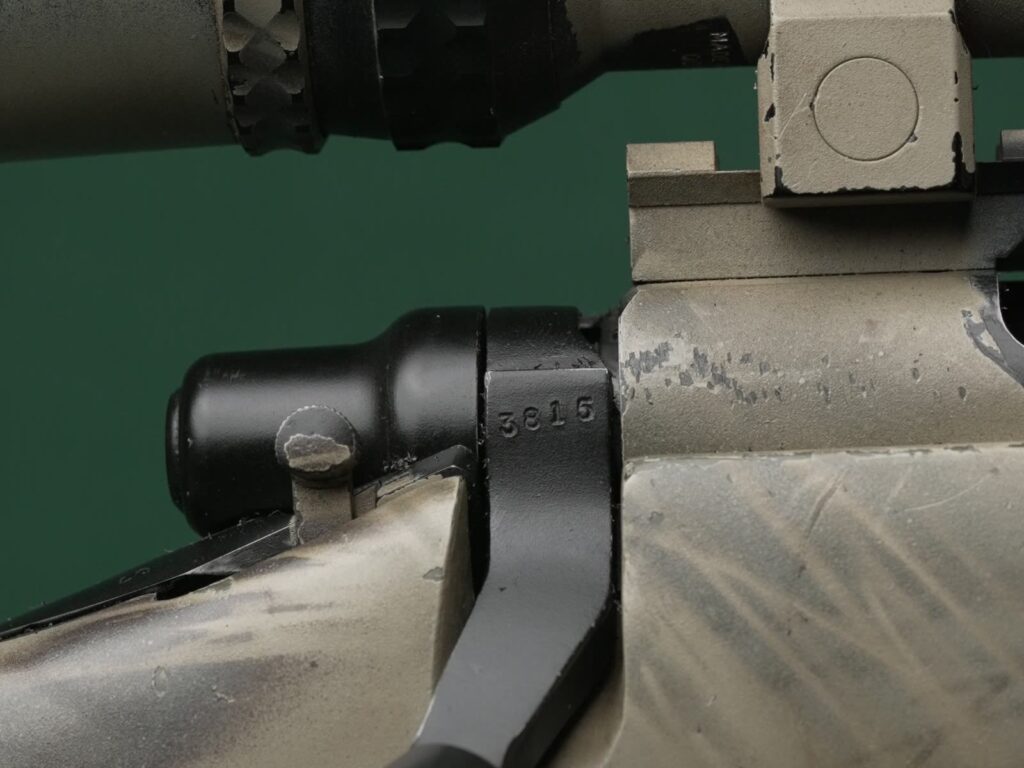
Under the bolt handle there is a circled S stamped into the steel. We have not confirmed what it marks.

The rail section ahead of the scope, where an in-line night sight sits in front of the day optic, is engraved IRON BRIGADE ARMORY over JACKSONVILLE, NC.

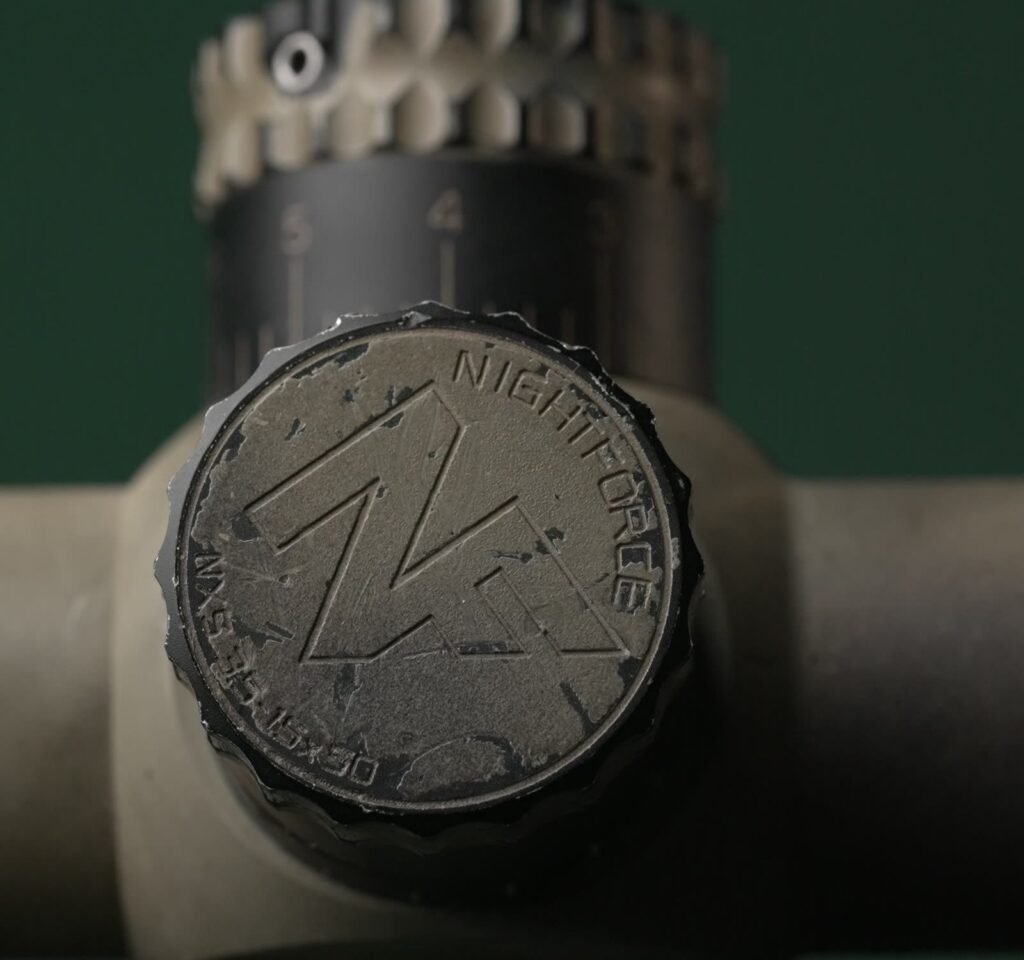
The scope on ours is a Nightforce NXS 3.5-15×50, the same model as on the issue list, and the turret cap still reads it. The scope, rings, bipod and flash hider are original to this rifle. Reichert writes that Nightforce built these with 1 MOA elevation adjustments and 1/4 MOA windage. He also lists two drawbacks: Marines trained on mil scopes had to learn MOA, and the reticle was not in the first focal plane, so mil readings and moving-target leads only worked at full power.
What IBA changed on the Remington 700
IBA started with a standard Remington 700 action and reworked the parts. From Reichert’s list:
- The receivers were slotted to take a titanium Picatinny rail of IBA’s design.
- The receiver threads were opened up to 1.070 inches to line the bolt face up with the chamber and bore.
- The chamber was cut for M118LR ammunition.
- A titanium recoil lug was ground true.
- The stainless magazine box was hand fitted and welded.
- The barreled actions were bedded in titanium Devcon and Marine-Tex.
The stock was custom made for the project. Reichert describes asking McMillan for an A1 rear with the comb raised half an inch and an A3 forend wide enough for the in-line night vision mounts. McMillan called it the A6 at the time; it is now the A1-3.
Original Marine paint
The camouflage on our XM3 is the Marines’ paint, worn through in places. We left it as it came.

From Iraq to the scrap list
By mid-2006, Reichert writes, there were dozens of XM3s in Iraq. Most became theater assets: they stayed in the combat zone and passed from unit to unit, so a sniper arriving in country could be handed one with data someone else had gathered. Ours served two and a half years in Iraq. That figure comes from the rifle’s own records, not from the published sources below.
The XM3 was never a program of record, and that hurt it. No structured training or maintenance plan was put in place, and Marine Corps Systems Command would not officially let Marine armorers work on the rifles, so a rifle that went down was usually finished. Most XM3s ended up at the Marine Corps Logistics Base in Albany, Georgia. Reichert wrote that the 48 there were slated for destruction in August 2012, with four still in the fleet. That is the 52.
His article was published by Soldier of Fortune magazine. According to his 2014 update, a former Army logistician read it and got the Marine Corps to transfer the XM3s to the U.S. Army instead of destroying them.
How it shoots
We took ours to the range with the slotted flash hider and no suppressor. The trigger was light and broke really clean. Not much recoil, and it came right back on target. We’d give it close to a ten.
Specifications
| Item | DARPA XM3 |
|---|---|
| Funded by | DARPA, contract to IBA in 2005 |
| Maker | Iron Brigade Armory, Jacksonville, NC |
| Action | Remington 700, reworked by IBA |
| Caliber | .308, chambered for M118LR |
| Barrel | 18.5 in, modified #7 contour (M40A3: 25 in) |
| Velocity versus M40A3 | About 100 fps slower on average |
| Muzzle | Slotted flash hider, suppressor-ready |
| Scope | Nightforce NXS 3.5-15×50 |
| Issued suppressor | SureFire FA762SS (not with ours) |
| Issued night vision | AN/PVS-22, clip-on (not with ours) |
| First deliveries | 2006 |
| Marine Corps count in 2012 | 52 (48 in storage, 4 in the fleet) |
For another military bolt action that tells its story through its markings, see our 1934 Kriegsmarine K98k. For another U.S. service arm from a war in the Middle East, see General Schwarzkopf’s M9.
On the floor at OSA
The XM3 in these photos is part of our own collection. If military precision rifles are your thing, these pieces in our case share something with it:
- French MAS FR-F2 sniper rifle in 7.62 NATO with its APX L806 scope: another bolt-action military sniper rifle in the same cartridge family.
- Springfield Armory M1A Loaded .308 with a National Match barrel: a scoped .308, semi-automatic, built on a U.S. service-rifle design.
- 1943 Springfield M1 Garand in 7.62 NATO, MK 2 MOD 1 configuration: an American service rifle set up for 7.62 NATO.
The grid below updates by itself as pieces come and go.
The short version is on our Instagram. Watch it on Instagram.
General information for collectors, not legal advice. Program history comes from published accounts, mainly by a participant; check the markings on any individual rifle.
Common Questions
What is the DARPA XM3 sniper rifle?
It is a short, suppressor-ready .308 bolt-action sniper rifle that DARPA funded for Marine snipers in Iraq. Iron Brigade Armory built it on a Remington 700 action with an 18.5-inch barrel, and the Marine Corps took its first deliveries in 2006.How many XM3 sniper rifles did the Marine Corps have?
DARPA funding covered 56 complete systems. In 2012 the Marine Corps count was 52, according to Steve Reichert: 48 in storage at Albany, Georgia, and four still in the fleet.Who made the XM3?
Iron Brigade Armory of Jacksonville, North Carolina, under a 2005 DARPA contract, working from a Remington 700 action.How long is the XM3 barrel?
18.5 inches, in a modified #7 contour. IBA tested barrels from 16 to 20 inches before settling on that length.How does the XM3 compare with the M40A3?
The XM3’s barrel is 18.5 inches against the M40A3’s 25. According to Steve Reichert, who worked on the program, it lost only about 100 feet per second on average and mostly kept up with the M40A3 for accuracy.What scope and night vision came with the XM3?
The issue list Steve Reichert gives includes a Nightforce NXS 3.5-15×50 day scope with 1 MOA elevation and 1/4 MOA windage adjustments, and an AN/PVS-22 night sight that clipped on in front of it without a re-zero.Why were XM3 rifles almost destroyed?
The XM3 was never an official program of record, so there was no maintenance plan. Steve Reichert wrote that 48 stored rifles were slated for destruction in August 2012; after his article ran in Soldier of Fortune, the Marine Corps transferred the rifles to the U.S. Army instead.Sources
- Steve Reichert, “DARPA XM-3 Sniper Rifle” (participant’s account, with 2014 update) — https://stevereichert.com/blog/darpa-xm-3-sniper-rifle (front-line needs, 2004 conference and mid-2005 equipment through IBA, 2005 IBA contract, design brief, XM1–XM3 prototypes and 56 systems, 16–20 inch barrel tests, 18.5 in modified #7 contour, 12 months to first rifle, NSWC Crane testing against Mk 13 Mod 5 and Mk 11 Mod 0, 2006 delivery, issue kit, scope adjustments and drawbacks, Remington 700 rework list, McMillan A6/A1-3 stock, 100 fps and accuracy, transonic before 1,000 yards, Camp Pendleton zero and 900-yard night hits, theater assets, no program of record or maintenance plan, Albany, 48 slated for destruction in August 2012 and four in the fleet, Soldier of Fortune and the transfer to the Army)
- Wikipedia, “M40 rifle” — https://en.wikipedia.org/wiki/M40_rifle (M40A3 Remington 700 short action, 25 in barrel, 16.5 lb)
- DARPA, “ARPANET” — https://www.darpa.mil/news/features/arpanet (DARPA’s role in the early internet)