
Journal · Collector’s Guide
1934 Kriegsmarine K98k: Reading an S/42K Mauser
Navy-marked 98ks are some of the most faked rifles out there, so this Kriegsmarine K98k is one we describe carefully. Its receiver was made by Mauser in 1934, before the Wehrmacht officially adopted the rifle, and it carries the early S/42K code instead of a maker’s name and a year. The stock carries a small eagle over an M, the stamp read as the mark of the Kriegsmarine, the German navy. We have not authenticated that marking. The serial 2089 matches on the receiver, the barrel band and the bolt, and we found no serial number on the stock. This rifle is part of our own collection, and it is our owner’s favorite rifle.
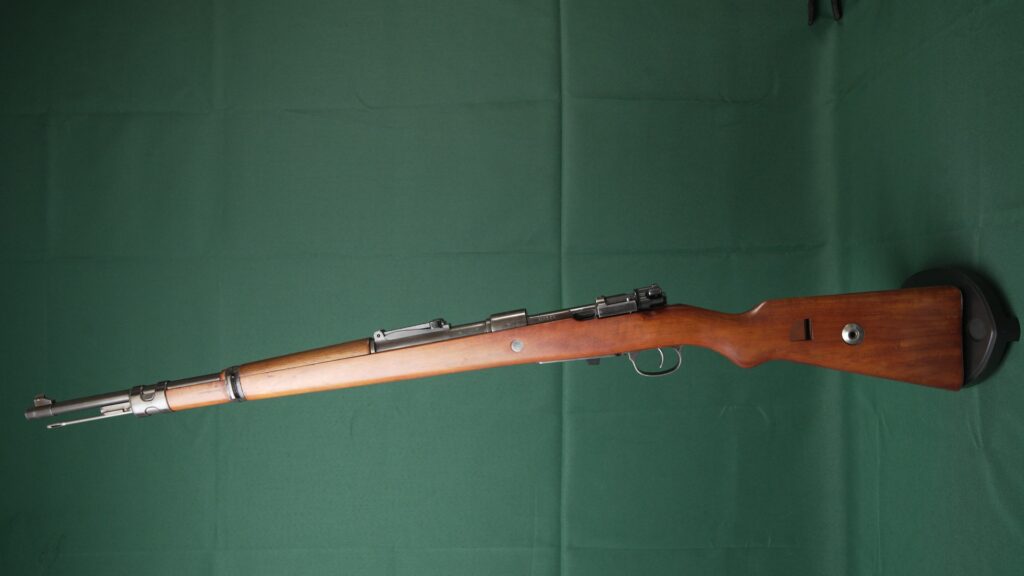
What does S/42K mean on a K98k?
The Karabiner 98k, Karabiner 98 kurz or “carbine 98 short”, is a bolt-action rifle in 7.92×57mm Mauser. According to Wikipedia, it was adopted on 21 June 1935 as the standard service rifle of the German Wehrmacht, and production ran from 1934 to 1945. This rifle’s receiver was made in 1934, the year before that adoption date.
Early K98k receivers did not carry a maker’s name and a four-digit year. They carried a code. Wikipedia explains that the first codes began with “S/”, had a number for the factory in the middle, and ended with a letter for the year: K for 1934, G for 1935. The number 42 stood for Mauser in Oberndorf am Neckar. So S/42K reads as Mauser, Oberndorf, 1934. The oldmilitarymarkings.com list of rifle codes gives the same reading: S/42K is Mauser-Werke AG, Oberndorf, production in 1934, and S/42G is the 1935 version.
After 1935 the year of manufacture went on the receiver ring instead of a year letter. Letter codes for the factories began in 1937, though Wikipedia notes some makers kept the numeric codes past that date. Mauser Oberndorf’s letter code was byf. Our guide to K98k maker codes covers the later codes in detail.

The Kriegsmarine K98k marking: eagle over M
On the right side of the butt, next to the round stock disc, is a small eagle over an M. That stamp is read as the Kriegsmarine mark. Wikipedia describes the stock disc as a bolt disassembly tool.

What makes this one interesting is the combination of early production and naval markings. Two cautions go with that. First, the receiver date does not tell us when the stock or its marking was applied. Second, our owner looked at the eagle closely and says the wear on it is old and aged together with the wood. That is an observation, not proof. Wear alone won’t authenticate a naval marking; it has to be compared with documented examples.
Why German markings get faked
German markings draw interest, and Ian McCollum of Forgotten Weapons, writing in 2013, called faked German markings one of the most widespread gun forgeries around. His article walks through one specific fake, Steyr M95 carbines with added German stamps, and makes the point that genuine Waffenamt acceptance stamps were applied during production by inspectors at the factory, not added later because a weapon was used by the German military. His case is about army acceptance stamps on a different rifle, not navy marks on a K98k, so we cite it for the general warning only, not as a test for this rifle.
How to read the markings on this rifle
The receiver. The left wall of the receiver is stamped MOD.98. The receiver ring and the barrel just ahead of it each carry a small eagle stamp and the number 2089, and a small letter is stamped below each number.

The serial numbers. Here, 2089 appears on the receiver, the barrel band and the bolt. Matching numbers matter, but they are only part of the picture.


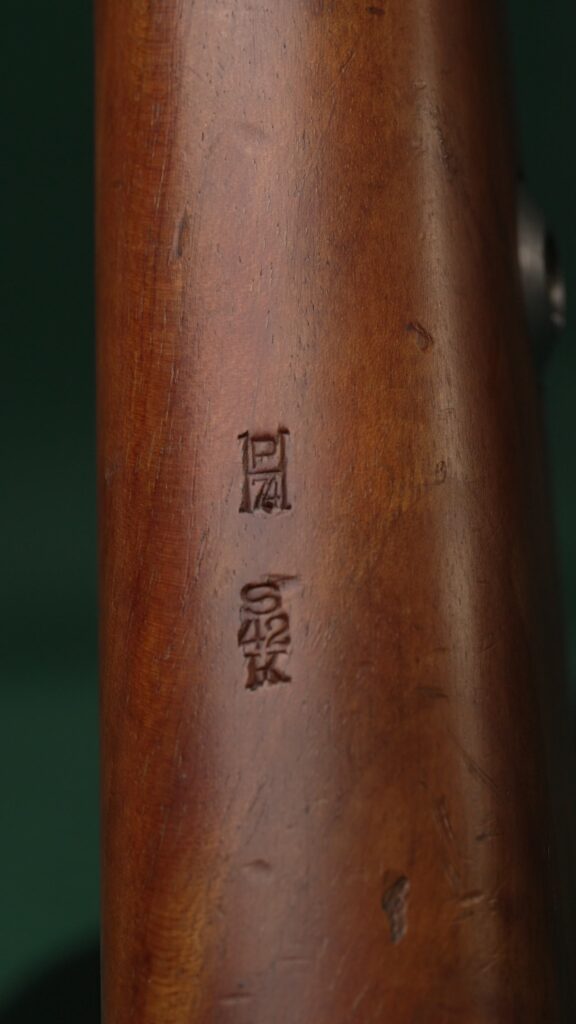
The stock. We found no serial number on the stock. Besides the eagle over M on the right, its left side carries P74 in a box, with S over 42 over K stacked below it. The top of the handguard carries P74 as well. We have not established what P74 stands for on this rifle, so we record it rather than explain it. The stacked S, 42 and K on the wood repeat the receiver code.
The buttplate. The steel buttplate carries a small eagle over WaA1, with a separate 1 stamped below it. The eagle over WaA with a number is the Waffenamt acceptance stamp, and oldmilitarymarkings.com explains that the number indicates which Waffenamt office accepted the piece.

The stock and buttplate were likely replaced at a naval depot. That is our reading, not an established fact, and the stacked S/42/K on the wood is part of the evidence to weigh along with it. The missing number alone doesn’t tell us whether the naval marking is genuine. An unnumbered stock is one detail. It has to be considered alongside the rest of the rifle.
The old splice under the bolt handle
There is an old repair too: a rectangular piece of wood spliced into the stock under the bolt handle. The joint lines around the insert are plain to see in a close-up.

Why it is our owner’s favorite
This rifle has always been kept as a treasured piece in our owner’s collection. In our owner’s words: “Honestly, this is my favorite rifle, period. I like the wear on the metal and the old repair in the stock, and every time I pick it up, I can’t help grinning.”
Specifications
| Item | Our 1934 K98k |
|---|---|
| Model | Karabiner 98k (receiver marked MOD.98.) |
| Maker code | S/42K: Mauser, Oberndorf am Neckar, 1934 |
| Cartridge | 7.92×57mm Mauser (8mm Mauser) |
| Action | Bolt action, five-round internal magazine loaded from stripper clips |
| Serial | 2089 on receiver, barrel band and bolt |
| Stock | No serial found; eagle over M, P74, stacked S 42 K; old splice under the bolt handle |
| Navy marking | Not authenticated |
| Buttplate | Eagle over WaA1, and a 1 |
| Length | 1,110 mm (43.7 in), per Wikipedia for the type |
| Barrel length | 600 mm (23.6 in), per Wikipedia for the type |
| Weight | 3.7–4.1 kg (8.2–9.0 lb), per Wikipedia for the type |
| Status | Part of our own collection |
On the floor at OSA
The 1934 S/42K rifle in this article is part of our own collection and stays there. These related rifles are in our case:
- 1937 Portuguese contract Mauser Kar98k, all matching: a Mauser-Werke rifle from Portugal’s m/937 program, three years younger than ours.
- 1937 Portuguese contract K98k with matching bayonet: a second rifle from the same Portuguese program, with its bayonet.
- BYF 41 Mauser K98k: a later Mauser Oberndorf rifle under the byf letter code.
- 1941 bnz Steyr K98k: a wartime K98k from Steyr, which Wikipedia lists as 660 under the numeric codes and bnz under the letter codes.
- G33/40 in 8mm: the short mountain carbine built at Brno, covered in our G33/40 mountain carbine article.
For a broader look at the type, see our K98k Mauser collector’s guide. The grid below updates by itself as pieces come and go.
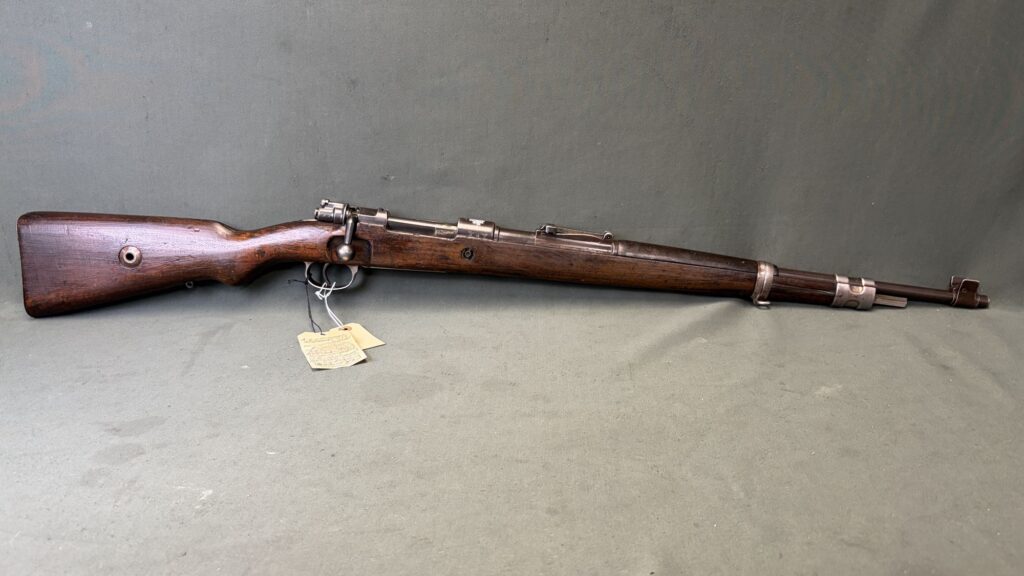 1937 Portuguese Contract Mauser Kar98k 8mm All Matching Portuguese Crest Waffenamt Marked$1,300.00
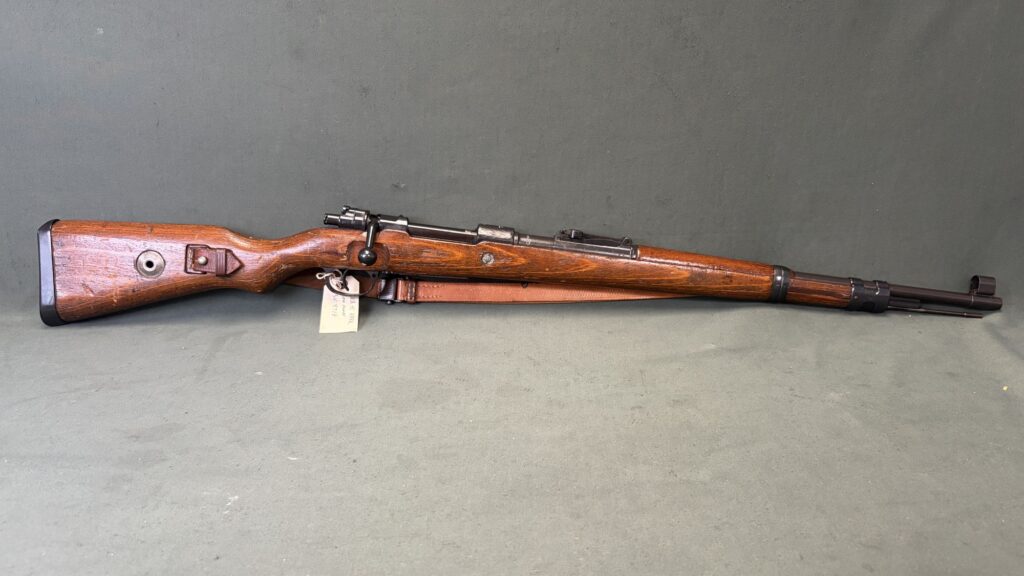 1941 bnz Steyr K98k 8mm Mauser Complete with Sight Hood Cleaning Kit and Sling$1,265.00
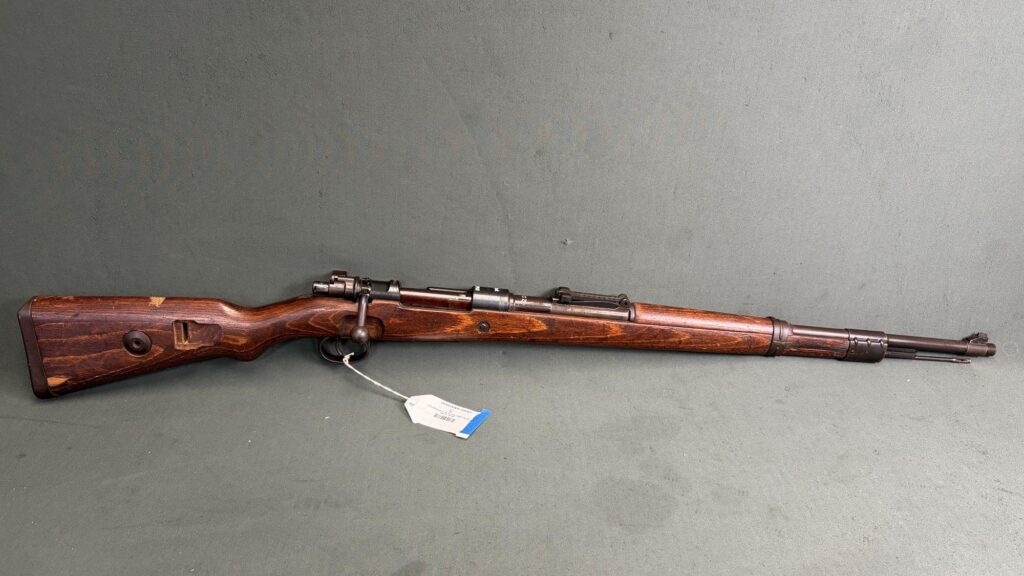 German K98k 8mm — ‘dot’ 1943 Brünn, Non-Import$1,345.00
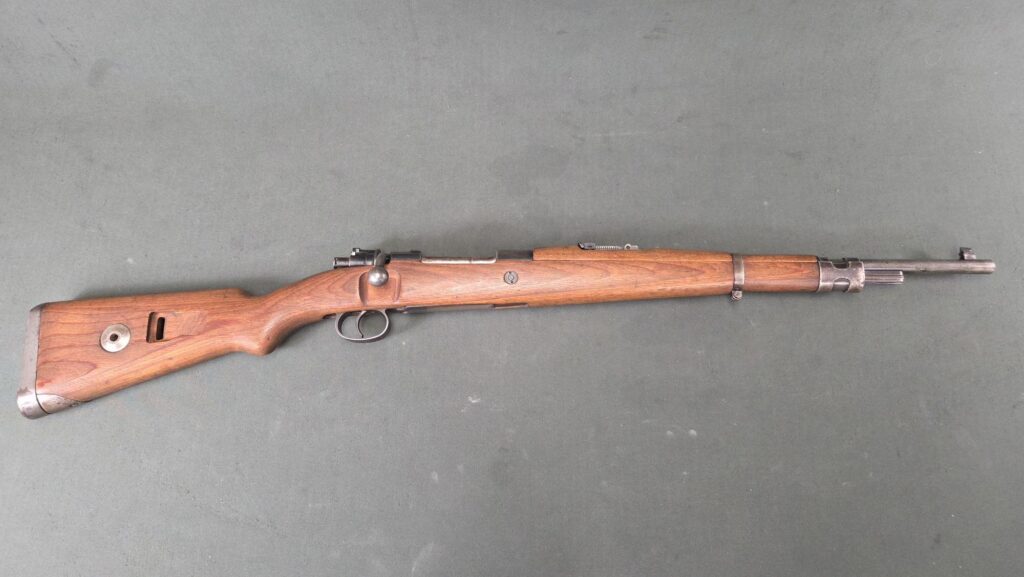 G33/40 8MM$3,750.00
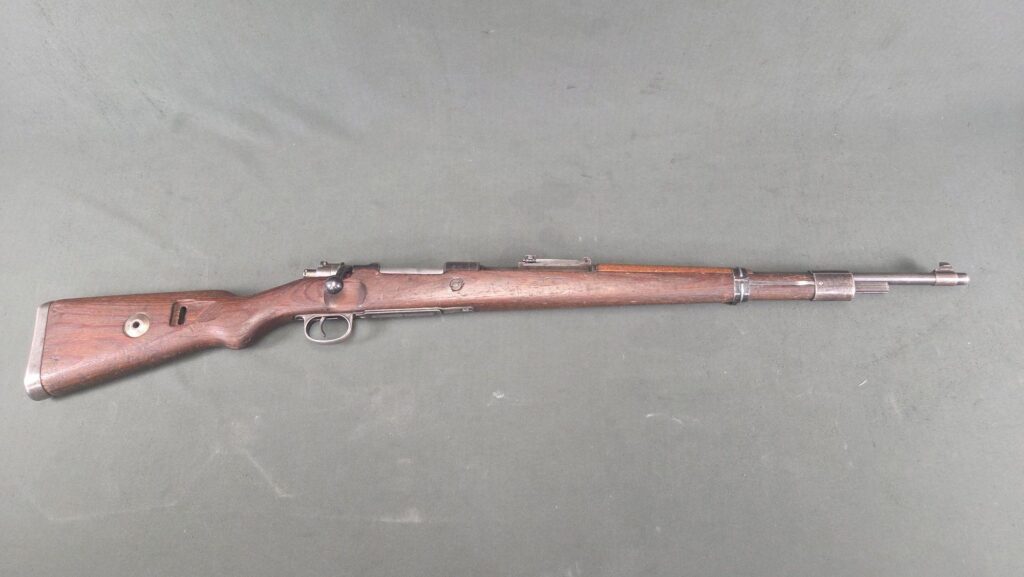 DOT 44 K98k rifle 8mm Mauser$1,285.00
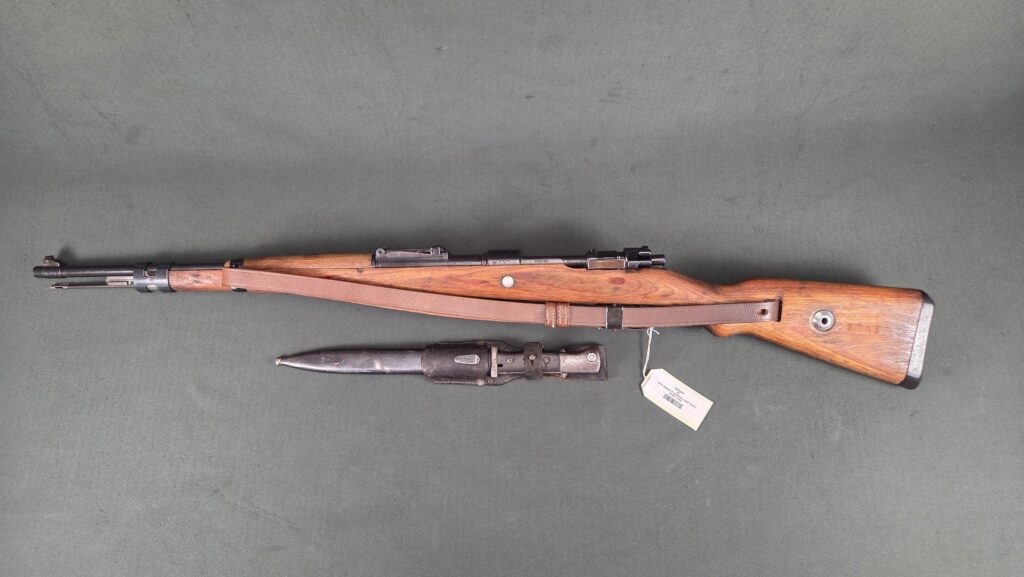 BYF 41 Mauser K98k$1,585.00
The short version is on our Instagram. Watch it on Instagram.
General information for collectors, not legal advice. Markings alone do not authenticate a rifle.
Common Questions
What does S/42K mean on a K98k?
S/42K is an early receiver code for Mauser-Werke in Oberndorf am Neckar, with the K standing for 1934. Early K98k codes put a factory number after “S/” and a year letter at the end: K for 1934 and G for 1935.What does an eagle over M mean on a K98k stock?
A small eagle over an M on a K98k stock is read as the mark of the Kriegsmarine, the German navy. The stamp alone does not authenticate a rifle; it has to be compared with documented examples.When was the K98k adopted?
According to Wikipedia, the Karabiner 98k was adopted as the standard service rifle of the German Wehrmacht on 21 June 1935. Production began in 1934, so the earliest receivers, coded S/42K at Mauser Oberndorf, predate the official adoption.Are navy-marked K98ks faked?
Navy-marked 98ks are some of the most faked rifles out there, in our experience, and Forgotten Weapons has described faked German markings in general as one of the most widespread gun forgeries. Wear on a stamp does not prove it is original.What does WaA mean on a German rifle?
WaA stands for Waffenamt. An eagle over WaA and a number is an acceptance stamp applied during production, and the number indicates which Waffenamt office accepted the part.Why does this K98k stock have no serial number?
We found no serial number on the stock of our 1934 rifle, while the receiver, barrel band and bolt all read 2089. Our reading is that the stock and buttplate were likely replaced at a naval depot, but that is not established, and an unnumbered stock is one detail to weigh alongside the rest of the rifle.Sources
- Wikipedia, “Karabiner 98k” — https://en.wikipedia.org/wiki/Karabiner_98k (adopted 21 June 1935 as the Wehrmacht’s standard service rifle; produced 1934–1945; 7.92×57mm Mauser; 1,110 mm length, 600 mm barrel, 3.7–4.1 kg; five-round stripper clip, internal magazine; stock disc as a bolt disassembly tool; receiver codes with “S/” prefix and K for 1934, G for 1935; 42 for Mauser Oberndorf, 660 for Steyr; year on the receiver ring after 1935; letter codes from 1937, some makers keeping numeric codes, byf and bnz; Portuguese m/937 rifles by Mauser Werke)
- oldmilitarymarkings.com, “German rifle codes” — https://www.oldmilitarymarkings.com/codes_rifle.html (S/42K = Mauser-Werke AG, Oberndorf, production in 1934; S/42G = 1935; Waffenamt eagle over WaA with a number indicating which Waffenamt accepted the piece)
- Forgotten Weapons, Ian McCollum, “Fake Nazi Marked Steyr M95” (2013) — https://www.forgottenweapons.com/fake-nazi-marked-steyr-m95/ (faked German markings one of the most widespread gun forgeries; Waffenamt stamps applied during production by inspectors, not because a weapon was used by the military)