
Journal · Collector’s Guide
G33/40 Mountain Carbine: History and Markings
The G33/40 mountain carbine is the short Mauser that Germany built in occupied Czechoslovakia for its mountain troops, and the quickest way to recognize one is a steel plate screwed to the left side of the butt. The usual explanation is that mountain soldiers used their rifles as climbing aids and walking sticks, and the metal nails in their boots chewed up the wood; the plate took the wear instead. About 130,000 were made between 1940 and 1942, against more than fourteen million Kar98ks. The rifle in our photos, receiver stamped 945 over 1940 with a solid walnut stock, is part of the Old Steel Arsenal collection.
From a Czech gendarmerie carbine to a German mountain rifle
The G33/40 began as a Czech design. Československá zbrojovka in Brno built the vz. 33, the Model 1933, a short Mauser-type carbine meant to replace the old Mannlicher vz. 1895 carbines of the Czechoslovak gendarmerie; the factory called it the vz. 16/33. Most went to the gendarmerie, and a smaller share to the Finance Guard, the customs and border service.
When Germany took over the Czechoslovak arms industry, it needed time to decide what the Brno works should mass-produce. In the meantime, Forgotten Weapons explains, the Germans restarted the vz. 33 as the Gewehr 33/40 for their mountain troops, the Gebirgsjäger. German lists of foreign-origin weapons record it as the Gewehr 33/40(t). The 33 is the Czech Model 1933; the 40 most likely marks 1940, the year German production began.
Germany had fielded a short carbine before the First World War, and with pointed spitzer ammunition the short barrel was judged too harsh, in both blast and recoil, to justify the saved length. For troops who carried their rifles up mountains, Forgotten Weapons notes, that calculation came out differently.
Production ran from 1940 until 1942. Forgotten Weapons gives about 130,000; other published figures range from 120,000 to 131,503, and the year-by-year numbers differ by source. G33/40 production ended in 1942, when the factory turned to the standard Kar98k. After the war, captured G33/40s served with the Norwegian police.
Why the G33/40 mountain carbine has a steel plate on its stock
The plate is a steel panel screwed to the left side of the butt, just ahead of a cupped steel buttplate. Neil Grant’s Osprey volume Mauser Military Rifles, as summarized on Wikipedia, explains it as protection against the metal nails in mountaineering boots when the rifle was used as a climbing tool or hiking stick. Forgotten Weapons describes it simply as a plate added to protect the stock in mountain use.
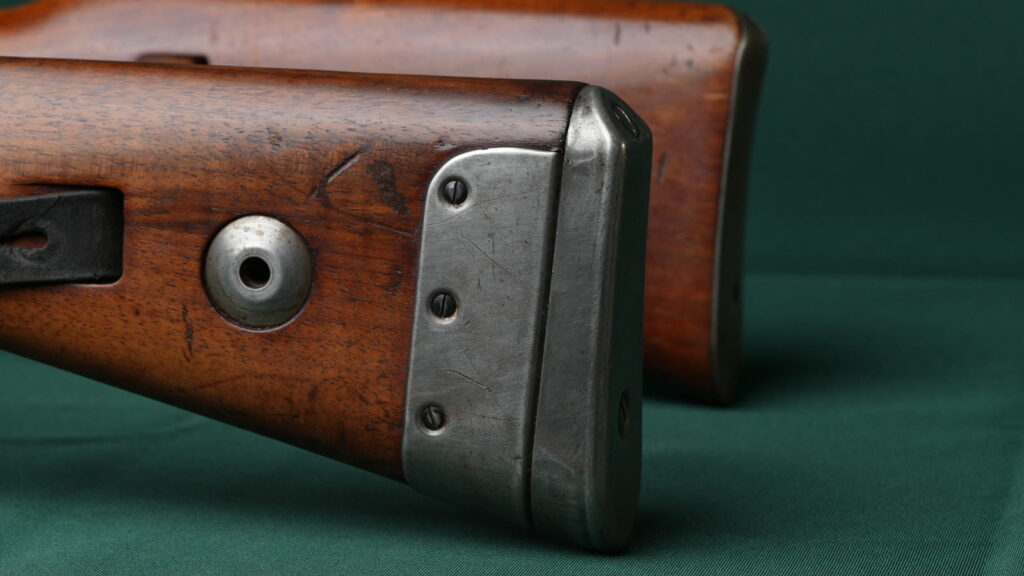
Next to a Kar98k butt, the difference is plain to see: the Kar98k is bare wood on that side.
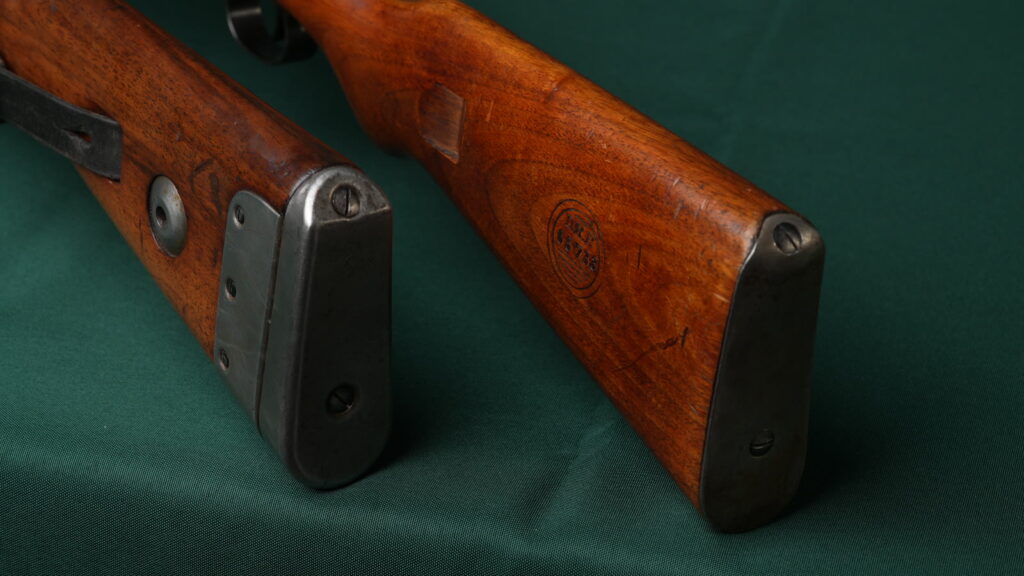
Shorter than a Kar98k, but called a rifle
The G33/40 is 1,000 mm long overall, the Kar98k 1,110 mm, so the G33/40 is about 110 mm, or 4.3 inches, shorter. Its barrel is 490 mm, about 19.3 inches, against the Kar98k’s 600 mm.

The names do not follow the lengths. The Kar in Kar98k is short for Karabiner, carbine, and the k for kurz, short: Karabiner 98 kurz, carbine 98 short. Yet the shorter G33/40 is officially a Gewehr, a rifle, even though it is one of the shortest Mausers the Germans used.
Compared with the Czech vz. 33, the German version gained the steel cupped buttplate and side plate, a continuous wooden upper handguard so the soldier’s hand stayed off a hot barrel, and German-style markings. The Germans did not shorten the Czech carbine to make it; the short length came with the design.
How to read G33/40 mountain carbine markings
The receiver ring carries the maker code and the year. Ours reads 945 over 1940. The number 945 was the code for Waffenwerke Brünn, the German name for the Brno works. Regular production was marked 945 in 1940 and switched to the letter code dot in 1941 and 1942. A dot-marked receiver tells you the same factory, a later year.

The designation G.33/40 is stamped on the left side of the receiver. On ours the serial number 3725 sits on the ring beside it, with a small letter d below, and a small eagle stamp sits next to the serial. German maker codes and dates on the ring, 945 and later dot, took the place of the Czech rampant lion.

Wood is a second clue, but a weaker one. Our rifle has a solid walnut stock, like the early ones; later G33/40s went to laminated wood. Stocks get swapped over eighty years, though, so the receiver code is what dates the rifle. The code system is the same one used on the Kar98k, which we cover in Mauser K98k Maker Codes Explained.
Mechanism and sights
The G33/40 is a Mauser turn-bolt in 7.92×57mm, the 8mm Mauser, feeding from a five-round internal magazine loaded with stripper clips. What sets it apart from a Kar98k is the action size. The Czech carbine uses a “small ring” action, with a slightly smaller receiver ring than the standard Model 98, to save weight. Most small-ring Mausers have no step between the ring and the left receiver wall, but the vz. 33 family has a thinner left wall, so the step is there and the action looks like a standard large ring at first glance.
The rear sight is a tangent sight graduated from 100 to 1,000 meters; the Kar98k’s goes to 2,000. On ours the leaf reads 1 to 10, in hundreds of meters.

What our owner says about shooting it
We took ours to the range and fired seven rounds of 8mm Mauser at a steel plate 100 meters out.
Our owner says it kicks noticeably harder than a Kar98k: the same full-power round, in a shorter, lighter rifle. Soldiers noticed it too. German troops who used the G33/40 in the mountains often complained about the heavy recoil.
He worried the short barrel would hurt accuracy. At 100 meters, six of the seven shots hit the steel. He loves how it handles, short and comfortable to hold, and the bolt is as smooth as a Kar98k’s, with a crisp trigger.
Specifications
| Item | G33/40 |
|---|---|
| Maker | Waffenwerke Brünn (Brno works, occupied Czechoslovakia) |
| Based on | Czechoslovak vz. 33 (factory designation vz. 16/33) |
| Production | 1940 to 1942 |
| Number made | About 130,000 (figures run 120,000 to 131,503) |
| Maker codes | 945 (1940), dot (1941 to 1942) |
| Cartridge | 7.92×57mm Mauser (8mm Mauser) |
| Action | Mauser turn-bolt, small ring |
| Magazine | 5-round internal, stripper-clip loaded |
| Barrel | 490 mm (19.3 in) |
| Overall length | 1,000 mm (39.4 in); Kar98k 1,110 mm |
| Weight | About 3.45 kg (7.6 lb) |
| Rear sight | Tangent, 100 to 1,000 m |
| Ours | 945 over 1940, serial 3725 d, walnut stock |
On the floor at OSA
The 945/1940 G33/40 in our photos is part of the Old Steel Arsenal collection. These related rifles from the same factory are in our case:
- A dot 1942 G33/40 from the same Brno works, two years later than ours, with a dot 1942 receiver and a laminated stock, the later style.
- A Kar98k marked dot 1943, made in Brünn: what the same factory built after G33/40 production ended.
- A dot 1944 Kar98k, a later Brno rifle under the same letter code.
- A byf 41 Mauser Kar98k from Mauser’s Oberndorf plant, the standard German service rifle.
The grid below updates by itself as pieces come and go.
 1937 Portuguese Contract Mauser Kar98k 8mm All Matching Portuguese Crest Waffenamt Marked$1,300.00
 1941 bnz Steyr K98k 8mm Mauser Complete with Sight Hood Cleaning Kit and Sling$1,265.00
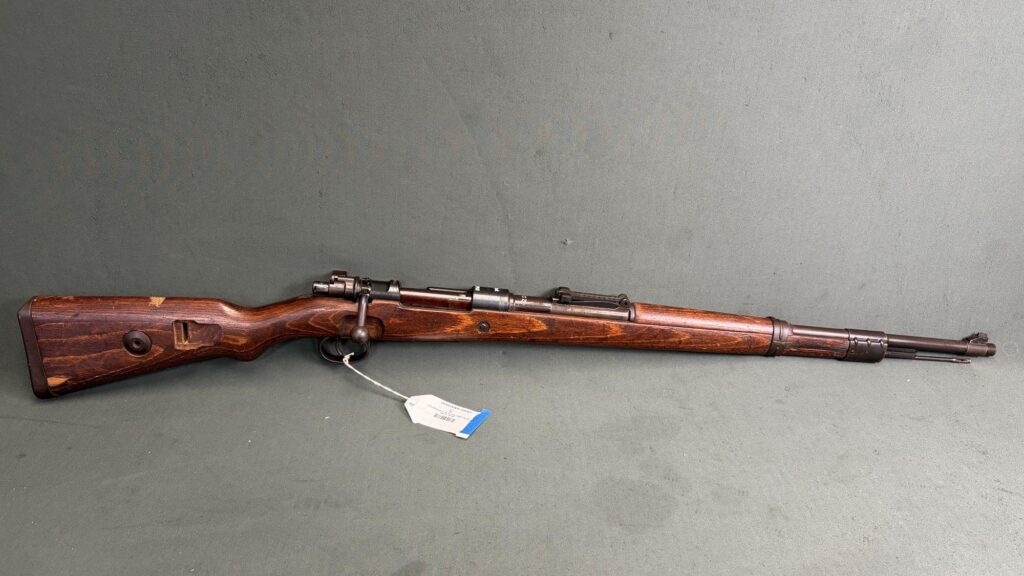 German K98k 8mm — ‘dot’ 1943 Brünn, Non-Import$1,345.00
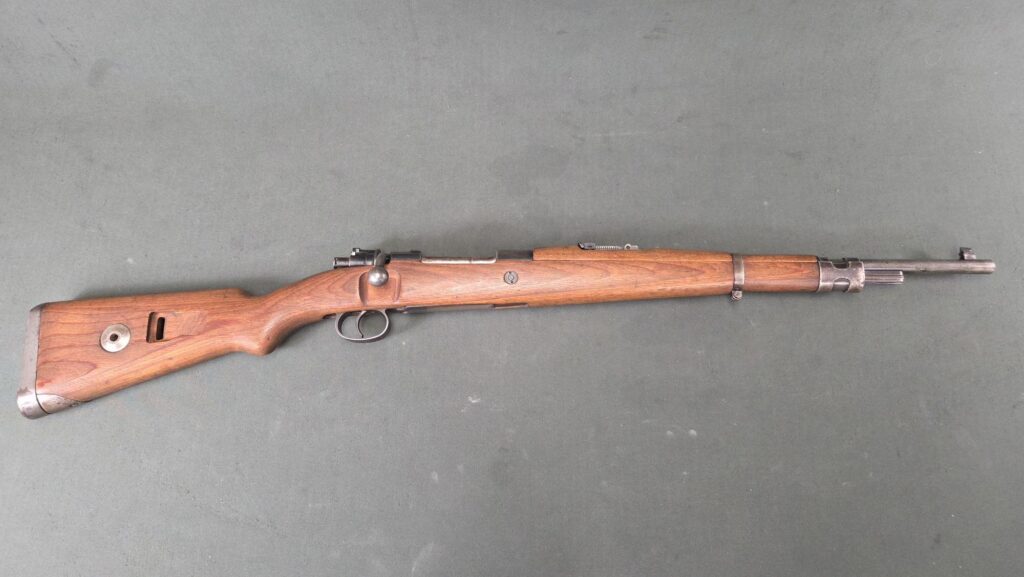 G33/40 8MM$3,750.00
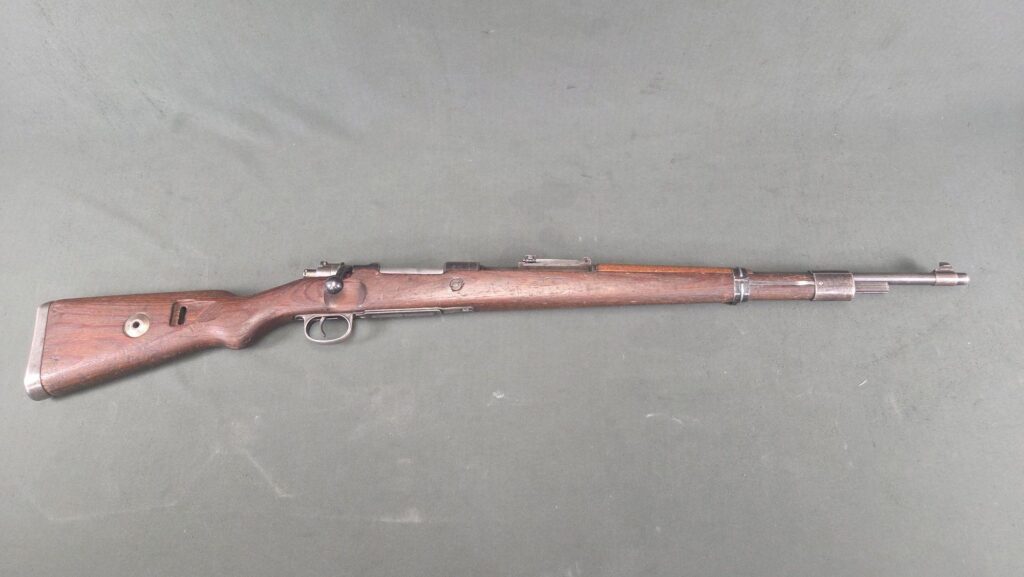 DOT 44 K98k rifle 8mm Mauser$1,285.00
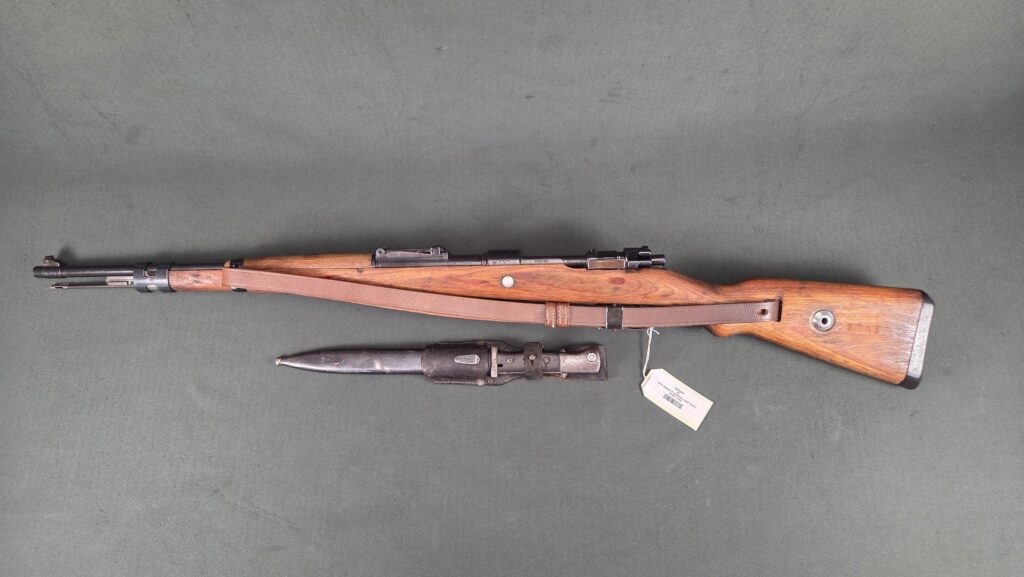 BYF 41 Mauser K98k$1,585.00
The short version is on our Instagram. Watch it on Instagram.
General information for collectors, not legal advice. Production figures vary by source; check the markings on the individual rifle.
Common Questions
What is a G33/40?
The Gewehr 33/40 is a short Mauser bolt-action carbine in 8mm Mauser that Germany built at the Brno works in occupied Czechoslovakia from 1940 to 1942 for its mountain troops, based on the Czechoslovak vz. 33.Why does the G33/40 have a metal plate on the stock?
The steel plate on the left side of the butt protected the wood from the metal nails of mountain boots when soldiers used the rifle as a climbing aid or walking stick.What does Gewehr mean in G33/40?
Gewehr is German for rifle. The G33/40 carries that designation even though it is about 110 mm shorter than the Kar98k, whose name means Karabiner 98 kurz, carbine 98 short.What do 945 and dot mean on a G33/40?
Both are maker codes for Waffenwerke Brünn, the Brno works. Regular production was marked 945 in 1940 and dot in 1941 and 1942.How many G33/40 rifles were made?
About 130,000, according to Forgotten Weapons; published figures range from 120,000 to 131,503.Does the G33/40 kick harder than a Kar98k?
Our owner finds ours noticeably harder-kicking than a Kar98k. It fires the same full-power 8mm Mauser round from a shorter, lighter rifle, and German soldiers often complained about its recoil.Is a G33/40 a curio and relic firearm?
A wartime G33/40 qualifies by age under the federal definition, which covers firearms manufactured at least 50 years ago, other than replicas. State rules differ.Sources
- Forgotten Weapons, “G33/40: Special Carbine for the Gebirgsjager” — https://www.forgottenweapons.com/g33-40-special-carbine-for-the-gebirgsjager/ (German takeover of the Brno factory, restart of the vz. 33 for mountain troops, pre-WWI short carbines judged too harsh with spitzer ammunition, side plate, 1940 to 1942 production, about 130,000, 945 then dot codes, change to K98k)
- Wikipedia, “Vz. 33” (citing Ball 2011, Grant 2015 and Smith 1969) — https://en.wikipedia.org/wiki/Vz._33 (Model 1933, vz. 16/33, gendarmerie and Finance Guard, small-ring action with a thinned left receiver wall, Gewehr designation, steel plate and boot nails, German changes, 1,000 mm length, 490 mm barrel, 3.45 kg, 120,000 to 131,503, recoil complaints, production ending in 1942 with the change to the Kar98k, Norwegian police, German markings in place of the Czech lion)
- Wikipedia, “Karabiner 98k” — https://en.wikipedia.org/wiki/Karabiner_98k (Karabiner 98 kurz, 1,110 mm length, 100 to 2,000 m rear sight, Gewehr 33/40(t) designation, 600 mm barrel, 14,600,000+ built, 945 and dot codes for Waffenwerke Brünn in Brno)
- 27 CFR 478.11, definition of curios or relics — https://www.law.cornell.edu/cfr/text/27/478.11 (firearms manufactured at least 50 years prior)