Journal · Collector’s Guide
Savage No.4 Lee-Enfield: A 1943 Rifle Cut to an SBR
This Savage No.4 Lee-Enfield was made in Chicopee Falls, Massachusetts, in 1943, as part of America’s help to Britain in the war against Hitler. It left the factory as a full-length service rifle of about 44 inches. Somewhere along the way, somebody we call Bubba sawed off the buttstock at the wrist and took the barrel down. Today it measures 24 inches overall with a 12-inch barrel, and it is registered as a short-barreled rifle. The markings still tell you where it was made and under what arrangement.
Why Savage built Lee-Enfields in Massachusetts
In 1940 Britain needed rifles faster than its own factories could make them. American Rifleman explains that the British contracted with Savage Arms Corp. to build 200,000 Enfield No. 4 Mk I rifles at the J. Stevens Arms Co. factory in Chicopee Falls, Massachusetts. The United States was officially neutral, so the deal started out on a “cash and carry” basis.
That changed in March 1941, when Congress passed the Lend-Lease Act. Under its terms, according to the same article, the U.S. government took over existing British contracts for arms made by American companies, and arms provided to an ally had to be marked to show that they were technically the property of the United States. The first few thousand Savage rifles were made before that rule and do not carry the mark.
So the rifle in our photos is an American-made British service rifle. American Rifleman notes these rifles were not intended for issue to American troops; the U.S. PROPERTY marking was there to satisfy the technicalities of Lend-Lease.
How to read Savage No.4 Lee-Enfield markings
Three stamps on our rifle identify where and when it was made.
On top of the receiver, ahead of the bolt, it reads U.S. PROPERTY. That is the Lend-Lease marking.

On the left side, on the butt socket just above the trigger guard, is the serial number, then a squared S, then the year. Wikipedia’s table of Lee-Enfield maker codes lists “Squared S and US property” for Savage Arms, so the two marks together are the Savage combination. The year on ours is 1943.

The model marking on ours reads No4 Mk I*. Wikipedia describes the Mk I* as a wartime simplification introduced in 1942: the bolt release catch was replaced by a simpler notch on the bolt track of the receiver. Only two makers built it, Small Arms Limited at Long Branch in Canada and Stevens-Savage in the United States. A No.4 Mk I* with U.S. PROPERTY and a squared S was made by Savage in Massachusetts.
What Bubba changed
“Bubba” is what gun people call the anonymous home gunsmith who takes a saw to a military rifle. Here is the rifle as it is now.
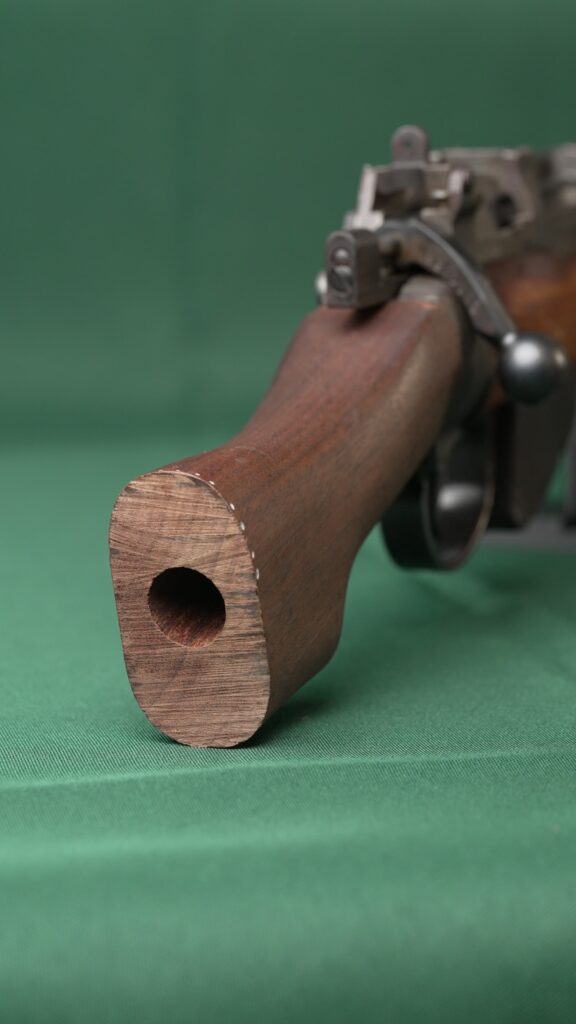
The buttstock is gone, cut off at the wrist. In the cut end you can see a hole that looks like the old stock-bolt hole.
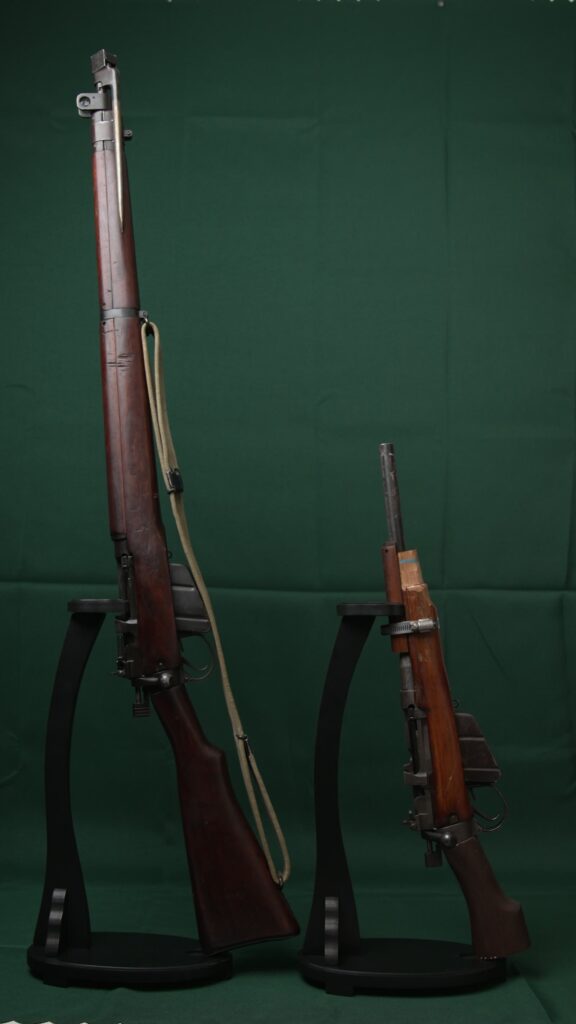
The barrel has been cut way down, to 12 inches. A standard No.4 Mk I barrel is 25.2 inches long, according to Wikipedia, so more than half of it is gone. What is left ends in a plain tube with no front sight on it.

The woodwork up front is short too. The stainless hose clamp around the handguard is not Bubba’s, though. One of our guys put it on.

What we can show is the result next to a complete one.
The No.4 and the mad minute
The No.4 fires the .303 British cartridge from a ten-round box magazine, loaded from the top with five-round chargers, as Wikipedia describes.
The Lee-Enfield is known as a fast rifle to work. Before the First World War, British riflemen trained for the “mad minute”: under the Musketry Regulations of 1909, Wikipedia notes, the drill called for 15 aimed rounds at a target 300 yards away within one minute. Our owner’s own number is not that drill. In his words: “With a full-length No.4, though, I once fired ten rounds in under ten seconds.” That was a different rifle, not this one.
Why this cut-down Lee-Enfield falls under the NFA
For a weapon made from a rifle, federal law defines the category by length. The National Firearms Act definition in 26 U.S.C. § 5845 covers “a rifle having a barrel or barrels of less than 16 inches in length” and “a weapon made from a rifle if such weapon as modified has an overall length of less than 26 inches or a barrel or barrels of less than 16 inches in length.”
Ours is 24 inches overall with a 12-inch barrel, under both lines. That puts it under the NFA, and ours is registered as a short-barreled rifle. State law can add its own rules on top of the federal definition.
What it is like to shoot
In the opening shot of our video, the rifle fires from a sandbag and the upper handguard lifts off, clamp and all. Our owner describes shooting it like this: “When I shoot it, it stings my hand. If my other hand’s not on the handguard, the whole thing wants to fly up.”
For a short bolt-action rifle built that way on purpose, see our piece on the DARPA XM3 sniper rifle. For American wartime bolt-action rifles, see the Saving Private Ryan sniper rifle scope swap.
Specifications
| Item | Our cut-down rifle | Standard No.4 Mk I (Wikipedia) |
|---|---|---|
| Model marking | No4 Mk I* | No. 4 Mk I |
| Maker | Savage Arms, J. Stevens plant, Chicopee Falls, Massachusetts | Several British, Canadian and U.S. makers |
| Year | 1943 | No. 4 mass production from 1941 |
| Markings | U.S. PROPERTY, squared S, 1943 | Varies by maker |
| Cartridge | .303 British | .303 British |
| Magazine | 10-round box | 10-round box, loaded with 5-round chargers |
| Overall length | 24 inches | 44.45 inches |
| Barrel length | 12 inches | 25.2 inches |
| Buttstock | Removed at the wrist | Full wooden stock |
| Status | Registered short-barreled rifle | Standard rifle |
On the floor at OSA
The cut-down Savage in this article is part of our own collection, and it stays there. We do not have a Lee-Enfield on the floor right now, but these pieces in our case are close relatives in time and place:
- 1943 Springfield Armory M1 Garand: made the same year as our Savage, in Springfield, Massachusetts, the city next door to Chicopee Falls.
- 1943 Standard Products M1 Carbine: the same year again, and a factory answer to the idea of a short, handy shoulder arm.
- 1937 Portuguese contract Mauser Kar98k: the Kar98k was Germany’s standard bolt-action rifle of the Second World War; this one was made in 1937 for Portugal.
- 1943 SAKO Civil Guard M39 Mosin-Nagant: another bolt-action rifle from 1943, made in Finland.
The grid below updates by itself as pieces come and go.
 1944 Springfield Armory M1 Garand 30-06 Rig with Bayonet Belt and Scabbard$1,795.00
 1943 Springfield M1 Garand 7.62 NATO, MK 2 MOD 1 Configuration, H&R$1,785.00
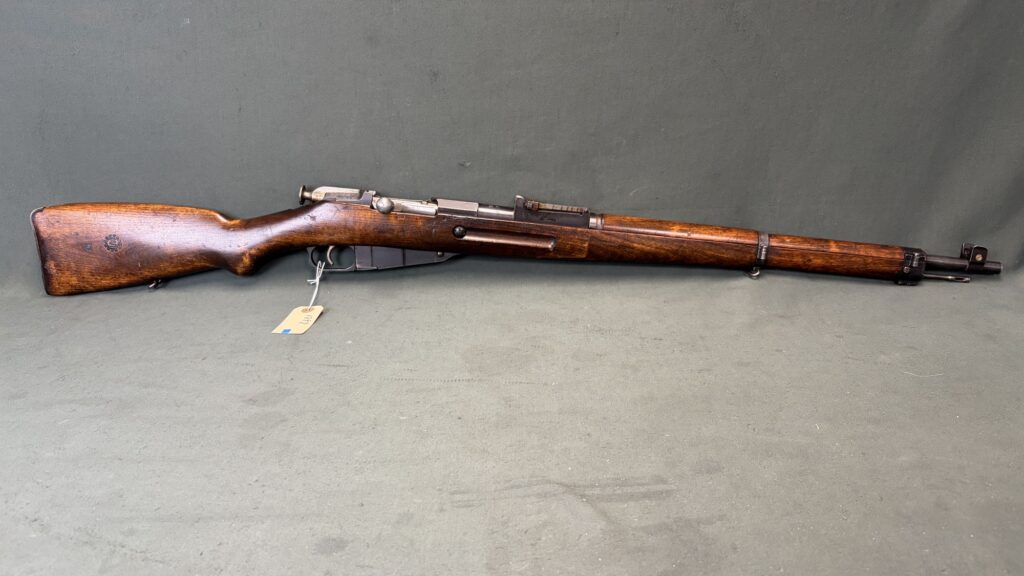 SAKO Sk.Y Civil Guard M39 Finnish Mosin Nagant 7.62x54R 1943 All Matching$1,185.00
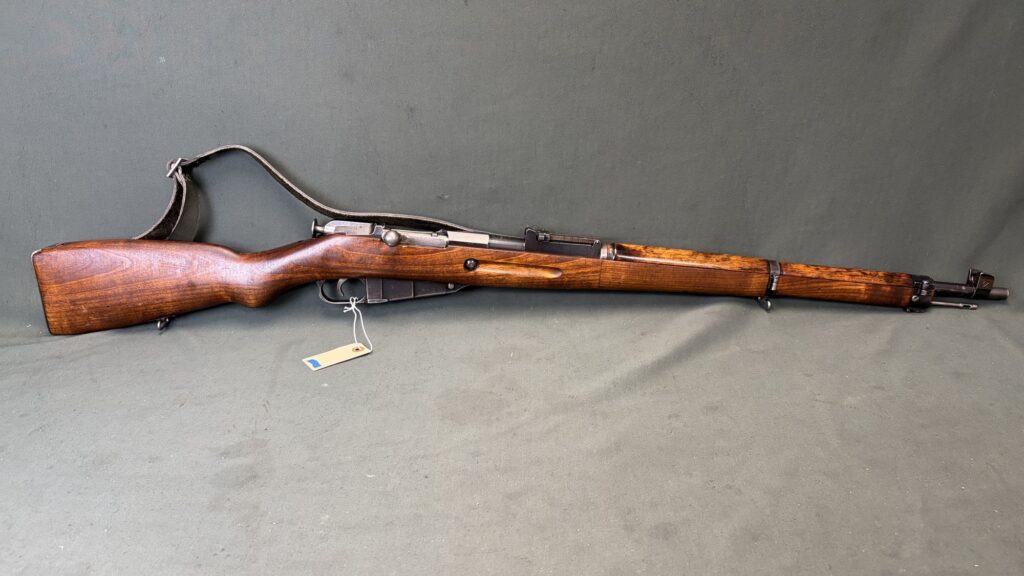 1942 VKT Finnish M39 Mosin Nagant 7.62x54R 1905 Izhevsk Receiver Finn Matching$1,150.00
 1942 VKT Finnish M39 Mosin Nagant 7.62x54R 1905 Izhevsk Receiver Bright Bore$1,050.00
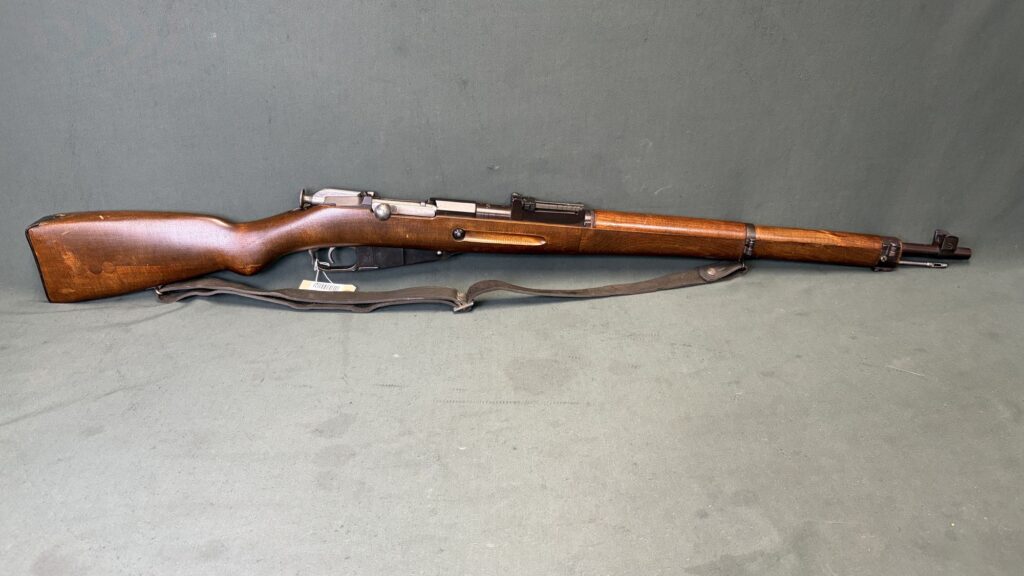 1944 SAKO Finnish M39 Mosin Nagant 7.62x54R Finn Matching Mirror Bore$1,085.00
The short version is on our Instagram. Watch it on Instagram.
General information for collectors, not legal advice. Federal and state firearm laws change; check the current rules where you live. Historical details come from the sources listed below.
Common Questions
Who made Lee-Enfield rifles in the United States?
Savage Arms Corp., at the J. Stevens Arms Co. factory in Chicopee Falls, Massachusetts, under a British contract for No. 4 rifles that the U.S. government took over under Lend-Lease in 1941.Why does a Savage Lee-Enfield say U.S. PROPERTY?
Lend-Lease required arms supplied to allies to be marked as technically the property of the United States. Savage No. 4 rifles were made for Britain and were not intended for issue to American troops; the first few thousand, made before Lend-Lease, lack the mark.How can you tell a Lee-Enfield No.4 was made by Savage?
Look for a squared S maker mark with the date, plus U.S. PROPERTY on the receiver. Wikipedia’s maker-code table lists that combination for Savage Arms, which built its No.4s at the Stevens plant in Massachusetts.What is the difference between a No.4 Mk I and a No.4 Mk I*?
The Mk I* was a 1942 simplification for mass production: the bolt release catch was replaced by a notch on the bolt track. Only Long Branch in Canada and Stevens-Savage in the United States built the Mk I*.How short can a rifle be before it falls under the NFA?
Under 26 U.S.C. § 5845, a rifle with a barrel under 16 inches, or a weapon made from a rifle with an overall length under 26 inches or a barrel under 16 inches, is covered by the National Firearms Act. State law may add more rules.How long is a standard Lee-Enfield No.4 Mk I?
About 44.45 inches overall with a 25.2-inch barrel. Ours, at 24 inches with a 12-inch barrel, is little more than half that.Sources
- American Rifleman, “Rifleman Q&A: Did Savage Arms Make Lee-Enfields?” — https://www.americanrifleman.org/articles/2020/4/14/rifleman-qa-did-savage-arms-make-lee-enfields/ (British contract for 200,000 No. 4 Mk I rifles at the J. Stevens factory in Chicopee Falls, cash and carry, Lend-Lease Act of March 1941, U.S. takeover of British contracts, U.S. property marking, first few thousand unmarked, not intended for issue to American troops)
- Wikipedia, “Lee–Enfield” — https://en.wikipedia.org/wiki/Lee%E2%80%93Enfield (Squared S and US property maker code for Savage Arms, Mk I* simplification in 1942 made only by Long Branch and Stevens-Savage, No. 4 Mk I length 44.45 in and barrel 25.2 in, .303 British, 10-round magazine with 5-round chargers)
- Wikipedia, “Mad minute” — https://en.wikipedia.org/wiki/Mad_minute (Musketry Regulations 1909, 15 rounds at 300 yards in one minute)
- Cornell Law School LII, 26 U.S. Code § 5845 — https://www.law.cornell.edu/uscode/text/26/5845 (NFA definitions: rifle with barrel under 16 inches; weapon made from a rifle under 26 inches overall or barrel under 16 inches)