
Journal · Collector’s Guide
Remington Rolling Block .45-70: How It Works
The Remington rolling block works with two main moving parts, a breechblock and a hammer. The block rolls back on a pin to open the chamber, and when the hammer falls it rolls in behind the block and props it shut. That simple idea armed Sweden, Norway and Denmark from 1867, went on to Spain, Egypt and France, and was carried by buffalo hunters on the plains. The rifle in our photos is a faithful copy in .45-70, made by Pedersoli in Italy, and it is part of the Old Steel Arsenal collection.
Where the rolling block came from
The action grew out of a Civil War design. Leonard Geiger patented a split-breech action in 1863, and Remington built it late in the war as a carbine for the U.S. Cavalry, firing the same cartridges as the Spencer; Joseph Rider worked on that design with Geiger. Rider, a Remington engineer, then reworked it in the mid-1860s into the rolling-block action, which Remington called the “Remington System.”
The first rifle on the new action appeared at the Paris Exposition of 1867. Within a year it was a standard military rifle in several countries.
The armies that carried it
Sweden and Norway, then united under one crown, adopted the rolling block as their standard rifle in 1867. Sweden built around 250,000 military rifles and carbines under license at Carl Gustafs Stad and Husqvarna, and Kongsberg built about 53,000 in Norway. It stayed Sweden’s service rifle until the Swedish Mauser replaced it in the mid-1890s, and Norway’s until the Jarmann in the mid-1880s.
Denmark adopted it the same year, 1867, first ordering 40,000 rifles and 1,800 carbines from the United States and then building more in Copenhagen. Danish production stopped in 1888, and the last Danish rolling blocks were decommissioned in 1940.
Spain followed: the rolling block in .43 Spanish was the Spanish Army’s main service arm from 1869 to 1893. Egypt tested it in 1869 against Martini and Henry rifles, and, according to author John P. Dunn, Remington shipped Egypt a little under 250,000 rifles and carbines between 1869 and 1880.
During the Franco-Prussian War, France, short of its standard Chassepot and Tabatière rifles, acquired 210,000 Egyptian rolling-block rifles. In 1914 France ordered the rifle again, in 8mm Lebel, as the Fusil Remington modèle 1914, and took 100,291 of them by 1916 for rear-line troops.
Buffalo hunters and Creedmoor
At home the rolling block was a civilian rifle as much as a military one. Along with the Sharps, it was probably one of the two rifles most used by the buffalo hunters of the 1870s and 1880s.
It also shot for America at long range. In 1874 an American team won the international long-range match at Creedmoor, on Long Island, against the Irish team, with half its shooters using Remington’s rolling-block Creedmoor match rifles and the other half Sharps Model 1874 long-range rifles. Those were purpose-built match rifles, not the service rifles above.
How the Remington rolling block action works
There are two parts to watch, each turning on its own pin through the receiver: the breechblock in front, the hammer behind it. The trigger, firing pin and extractor do their usual jobs; these two do the locking.
To load, pull the hammer back to full cock. With the hammer out of the way, roll the block open with your thumb on its spur, and the chamber is exposed. Drop in a round, then roll the block shut.
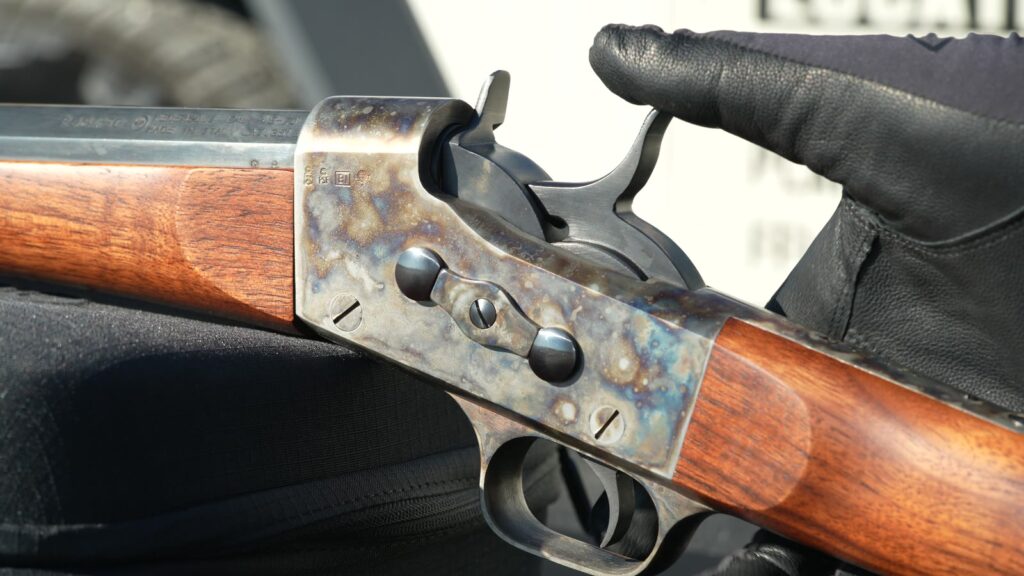

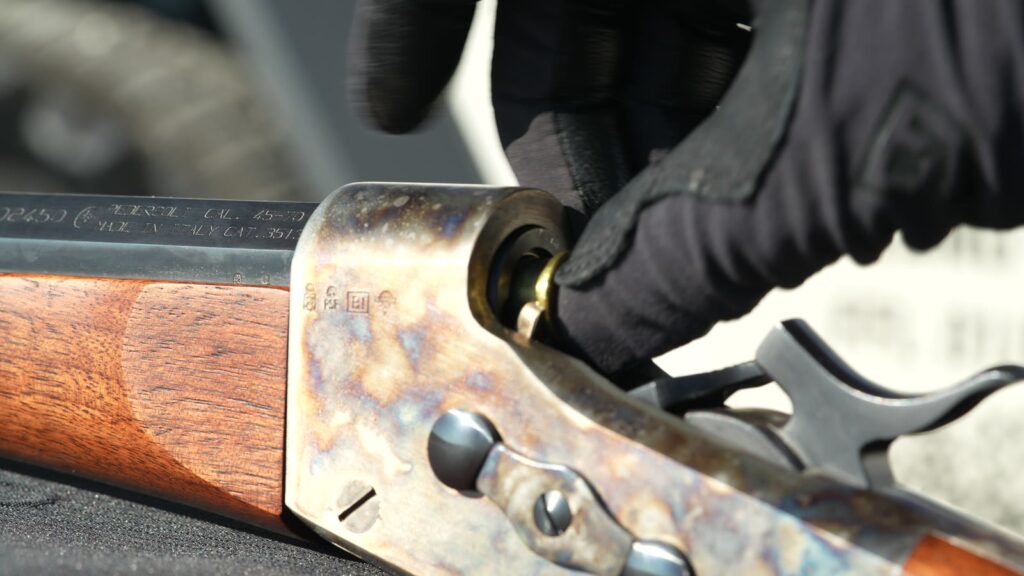
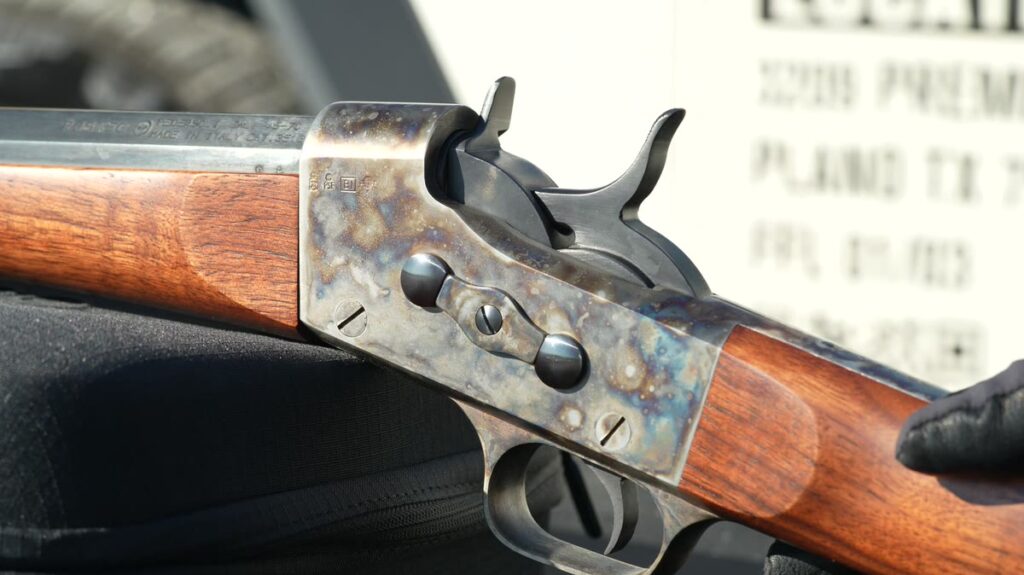
What holds it closed when it fires is the hammer. When it falls, it rolls in under the back of the breechblock and props it shut. When the round fires, the block shoves back against the hammer, and the hammer can’t give. The breechblock is shaped like a section of a circle, and with the hammer down behind it, the cartridge cannot push the block back at the moment of firing.
Carrying it safe
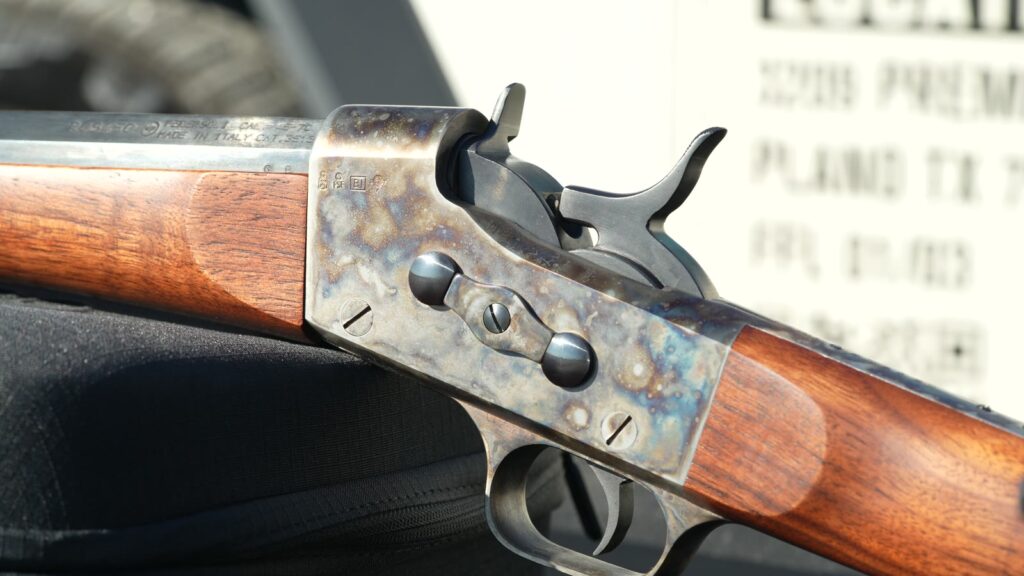
Our Pedersoli has a safety notch for the hammer. To set it, hold the hammer, press the trigger, and ease the hammer down to the safety notch. On ours, the hammer and the trigger are then both locked: the trigger won’t release the hammer from that notch. To fire, pull the hammer back to full cock. Read the manual for your own rifle and practice with it unloaded.
The .45-70
The .45-70 was the U.S. Army’s cartridge from 1873, developed at Springfield Armory for the Springfield Model 1873, the rifle collectors call the Trapdoor Springfield. The name tells you the original load: a .45-caliber bullet over 70 grains of black powder. The full designation of that original Army load, .45-70-405, added the weight of the lead bullet, 405 grains, which left the muzzle at about 1,350 feet per second.
In our video we fired three rounds from this rifle at a car. The first sent fragments into the cab; the last didn’t make it through the door. Our take: on penetration, it can’t match a modern rifle round, but that big, slow bullet has real stopping power.
Reading the markings on our Pedersoli
Our rifle is a modern reproduction, not an original Remington. The barrel reads PEDERSOLI, CAL. 45-70, MADE IN ITALY, CAT.3513, with the serial number ahead of it. The CAT number is the rifle’s entry in Italy’s national firearms registry, which the maker stamps on rifled guns. The small stamps on the receiver are Italian proof marks from the Gardone Val Trompia proof house; among them, the boxed BI is a date code that, by the Italian proof-house table, stands for 1997, the year of proof.

Specifications
| Item | Our rifle |
|---|---|
| Type | Single-shot rolling-block rifle |
| Pattern | Remington rolling block |
| Maker | Pedersoli, Italy (reproduction) |
| Cartridge | .45-70 Government |
| Main moving parts | Breechblock and hammer |
| Hammer positions shown | Full cock, safety notch |
| Proof date code | BI (1997) |
On the floor at OSA
The rolling block in these photos is part of the Old Steel Arsenal collection. These pieces in our case connect to its story:
- Pedersoli Springfield Trapdoor Carbine in .45-70: a reproduction of the carbine version of the Springfield Model 1873, the Army rifle the .45-70 was developed for, from the same Italian maker as ours.
- 1942 Kongsberg M/1914 .45 ACP: from Kongsberg, the Norwegian arsenal that built about 53,000 rolling blocks.
- 1943 Swedish Ag m/42B Ljungman 6.5×55: a later Swedish service rifle; Sweden carried rolling blocks from 1867 to the 1890s.
- 1957 Egyptian Hakim 8mm: a later Egyptian service rifle; Egypt’s army had carried Remingtons in the 1870s.
The grid below updates by itself as pieces come and go.
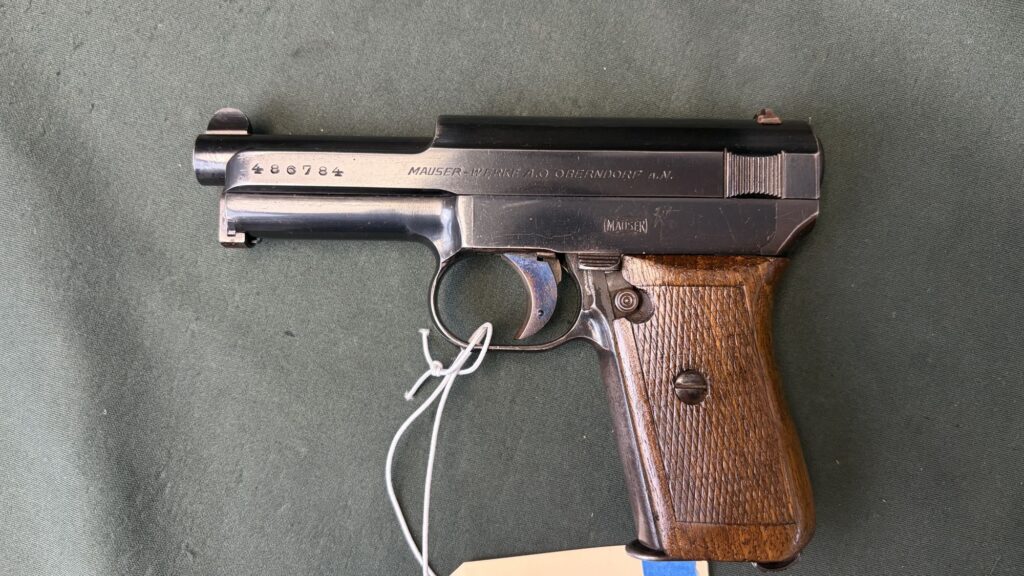 Mauser Model 1914 Pistol .32 ACP 7.65mm Excellent with Leather Holster$745.00
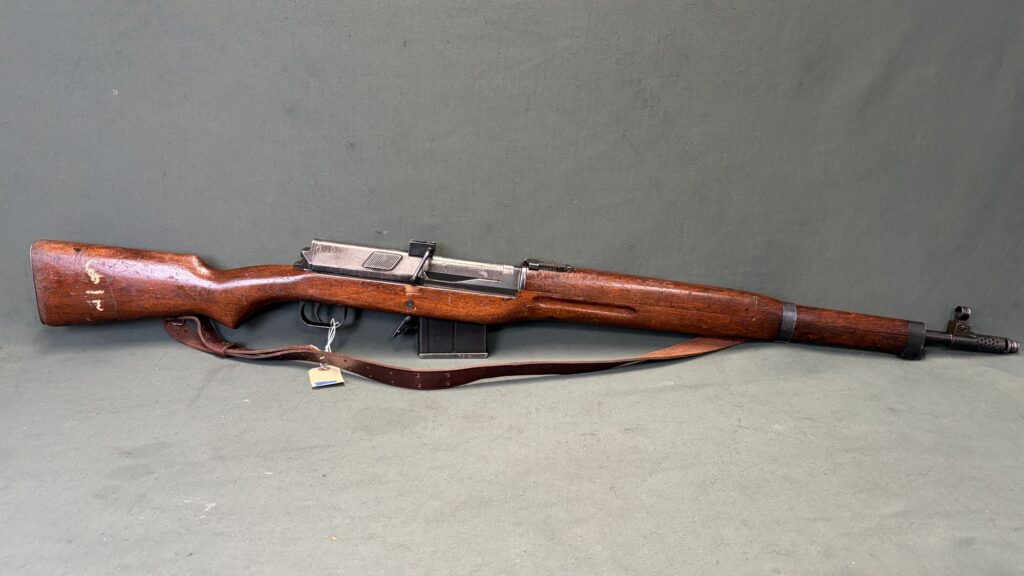 1957 Egyptian Hakim 8mm Mauser Semi-Automatic Rifle Matching Bright Bore With Sling$1,250.00
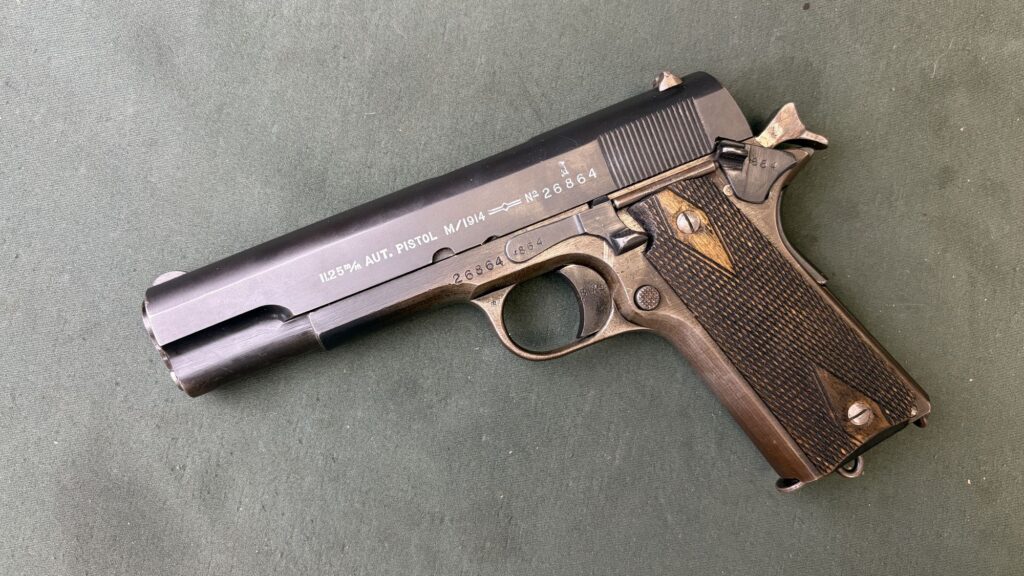 1942 Kongsberg M/1914 .45 ACP Matching with Signed Factory Archive Letter$4,950.00
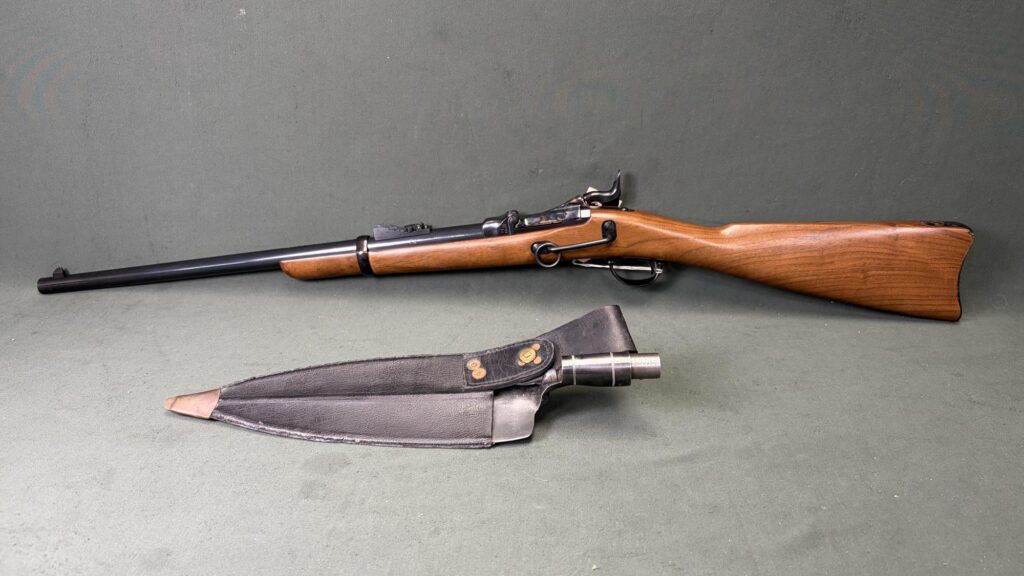 Pedersoli Springfield Trapdoor Carbine .45-70 22 Inch New in Box with Bayonet Original price was: $2,089.00.$1,635.00Current price is: $1,635.00.
 1943 Swedish Ag m/42B Ljungman 6.5×55 All Matching Mirror Bore Original price was: $2,285.00.$1,985.00Current price is: $1,985.00.
Would you hunt with this rifle, in .45-70? Yes or no? Tell us on our Instagram. Watch it on Instagram.
General information for collectors, not legal advice. Adoption and production figures come from secondary sources.
Common Questions
How does a rolling block action work?
The breechblock and the hammer each turn on a pin. With the hammer cocked, the block rolls back to open the chamber; when the hammer falls, it rolls in behind the block and props it shut, so the block cannot move back when the round fires.Who invented the Remington rolling block?
It grew out of Leonard Geiger’s 1863 split-breech design, which Remington engineer Joseph Rider reworked in the mid-1860s into the rolling-block action, the “Remington System.”Which countries used the Remington rolling block?
Sweden, Norway and Denmark adopted it in 1867, Spain used it as its main service arm from 1869 to 1893, Egypt took a little under 250,000, and France acquired 210,000 during the Franco-Prussian War, among many others.Did buffalo hunters use the Remington rolling block?
Yes. Along with the Sharps, it was probably one of the two rifles most used by buffalo hunters on the American plains in the 1870s and 1880s.What does .45-70 mean?
The name describes the original load: a .45-caliber bullet over 70 grains of black powder. The original U.S. Army load, the .45-70-405, used a 405-grain lead bullet, adopted in 1873 for the Springfield Model 1873.What is the safety notch on a rolling block?
On rifles that have one, such as our Pedersoli, it is a hammer position between down and full cock. On ours, with the hammer eased down to that notch, the trigger won’t release it; pulling the hammer back to full cock readies it to fire. Follow your own rifle’s manual.Sources
- Wikipedia, “Remington Rolling Block rifle” — https://en.wikipedia.org/wiki/Remington_Rolling_Block_rifle (Geiger and Rider, split-breech origin, mid-1860s Remington System, adoption by Sweden-Norway, Denmark, Spain and Egypt with figures, French 210,000 and the 1914 contract, buffalo hunters, 1874 Creedmoor match)
- Wikipedia, “Rolling block” — https://en.wikipedia.org/wiki/Rolling_block (circle-section breechblock locked by the hammer, 1863 patent, Rider’s 1865 rework, Paris Exposition 1867, standard rifle in Sweden, Norway and Denmark within a year)
- Wikipedia, “.45-70” — https://en.wikipedia.org/wiki/.45-70 (U.S. Army cartridge from 1873, Springfield Armory and Model 1873, 70 grains of black powder, .45-70-405 load and velocity)
- ConArmI (Italian arms makers’ association), “Banco Nazionale di Prova” — https://www.conarmi.org/banchi_ita.jsp (national registry number stamped on rifled arms, Gardone proof marks including smokeless-powder proof, date code BI = 1997)