
Journal · Collector’s Guide
Mauser M712 Schnellfeuer: History and Markings
The Mauser M712 Schnellfeuer is the broomhandle Mauser made into a select-fire pistol, with a selector marked N and R and a detachable magazine in place of the C96’s fixed one. The one in our photos is fully transferable, and it is part of the Old Steel Arsenal collection. This guide covers where the Schnellfeuer came from, how it was named, and how to read the markings on ours.
From the C96 to the Schnellfeuer
The C96, the “broomhandle” for its grip, was designed by the Feederle brothers at Mauser and made from 1896 to 1937, about a million of them. Its signature layout puts a box magazine in front of the trigger guard, under a long barrel. In China, European embargoes on exporting rifles to the warlords made the C96 a mainstay of their armies, and Chinese arsenals copied it in large numbers.
In the late 1920s, the Spanish makers Beistegui Hermanos and Astra began building select-fire versions of the C96 in 1927 and 1928, aimed at the Far East. Forgotten Weapons calls the Schnellfeuer Mauser’s answer to those Spanish guns. Joseph Nickl designed a select-fire conversion of the M1930 in 1930, and Wikipedia records about 4,000 made in 1930 and 1931; it had problems that a later design addressed. Mauser put Karl Westinger’s design into production as the Schnellfeuer, German for “rapid fire.”
Production and names
Production began in 1932, hence the collector name M1932; Wikipedia gives 1936 as the end. The two sources we used count it differently: Wikipedia says around 98,000 were made, with their own serial number series, and Forgotten Weapons says just over 100,000.
In America the pistol is best known as the M712. Wikipedia attributes the number to the German Wehrmacht, which received small numbers during the Second World War, but the origin of the name is debated among collectors. Collectors sometimes call the semi-automatic M1930 the M711.
Where the Schnellfeuer went
Most were meant for export, to South America, to China, and later to both sides in the Spanish Civil War. From 1932 to 1935, Yugoslavia tested batches in 7.63mm and 9mm Parabellum for its mountain troops and special units. Brazil took 500 for its Federal District military police. In Germany, Forgotten Weapons notes use by the SS as well as the Wehrmacht.
The broomhandle in China
Forgotten Weapons says most Schnellfeuers went to China. There the C96 family was known as the “box cannon,” and it was widely used by Chinese armies and police. Pistols came from Germany and from Spain, including the Astra 900, and Chinese arsenals also produced large numbers of C96-pattern pistols of their own. The Taiyuan Arsenal in Shanxi even built a .45 ACP version, the Type 17, from 1928 to 1931.
Mauser M712 Schnellfeuer markings
The difference from a C96 is on the left side of the frame: a selector with a ribbed knob, marked N and R. N is for Normalfeuer, normal fire, meaning single shots. R is for Reihenfeuer, series fire, the automatic setting. Next to it is the Mauser banner.

The frame carries the maker’s address, WAFFENFABRIK MAUSER, OBERNDORF A. NECKAR, with the patent line D.R.P. u. A.P. beneath. A shorter three-line inscription, WAFFENFABRIK / MAUSER / OBERNDORF A/N, appears on top of the barrel extension, ahead of the rear sight.


The rear sight is the C96’s tangent sight, a V-notch that adjusts in steps up to 1,000 meters. The graduations on ours run from 50 to 1000.

The detachable magazine
A standard C96 is loaded from the top with a stripper clip into a fixed magazine. The Schnellfeuer takes a detachable box magazine of ten or twenty rounds. Ours has the Mauser banner on the magazine floorplate.

It keeps the C96 family’s short-recoil operating principle and its 7.63×25mm cartridge.
Specifications
| Item | Mauser Schnellfeuer (M712) |
|---|---|
| Maker | Waffenfabrik Mauser, Oberndorf am Neckar, Germany |
| Made | From 1932 (Wikipedia: to 1936) |
| Number made | Around 100,000 (sources differ), in their own serial range |
| Designer | Karl Westinger |
| Based on | Mauser C96 (M1930) |
| Cartridge | 7.63×25mm Mauser |
| Action | Short recoil, select fire (N / R) |
| Magazine | Detachable box, 10 or 20 rounds |
| Rear sight | V-notch tangent, to 1,000 m |
| Common names | Schnellfeuer, M712, M1932 |
Can you own a Mauser M712 in the US?
In the United States, federal law has barred the transfer and possession of machine guns since 18 U.S.C. 922(o) took effect on May 19, 1986, with an exception for machine guns lawfully possessed before that date. A Schnellfeuer counts as a machine gun under the National Firearms Act. A transferable example is a pre-cutoff, lawfully registered one that is still eligible to move between qualified private owners, with ATF approval and where state and local law allow it. Whether a particular gun qualifies depends on its own registration record, not on its age alone. Ours is fully transferable.
On the floor at OSA
The Schnellfeuer in these photos is part of the Old Steel Arsenal collection. These pieces in our case connect to it:
- WWI Imperial German Mauser C96 Broomhandle: an earlier, semi-automatic member of the C96 family the Schnellfeuer belongs to.
- Mauser Model 1914 in .32 ACP: another Mauser Oberndorf pistol, a pocket design from the same factory.
- 1911 DWM Luger P08 9mm: the German army’s service pistol of the C96’s era.
The grid below updates by itself as pieces come and go.
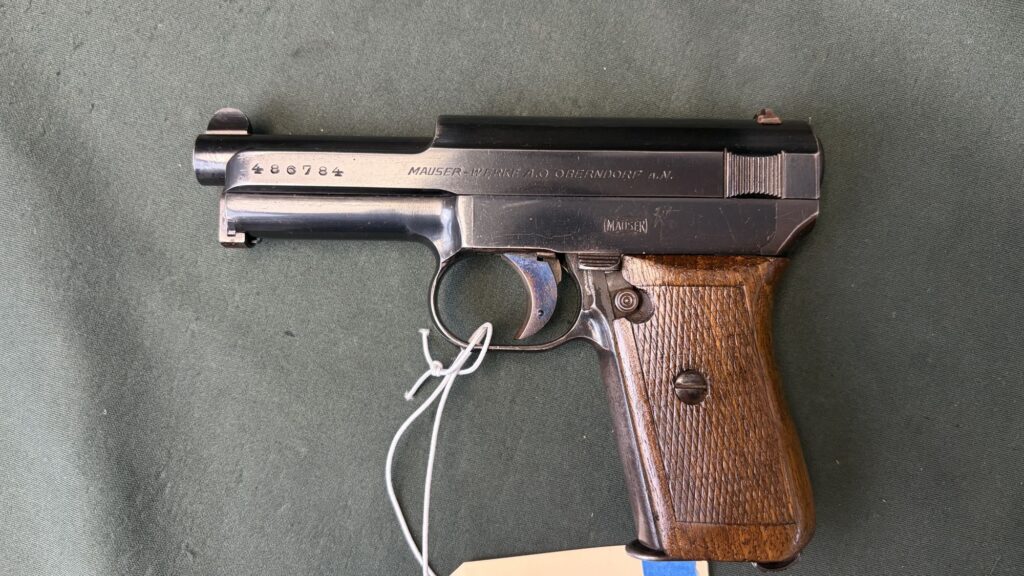 Mauser Model 1914 Pistol .32 ACP 7.65mm Excellent with Leather Holster$745.00
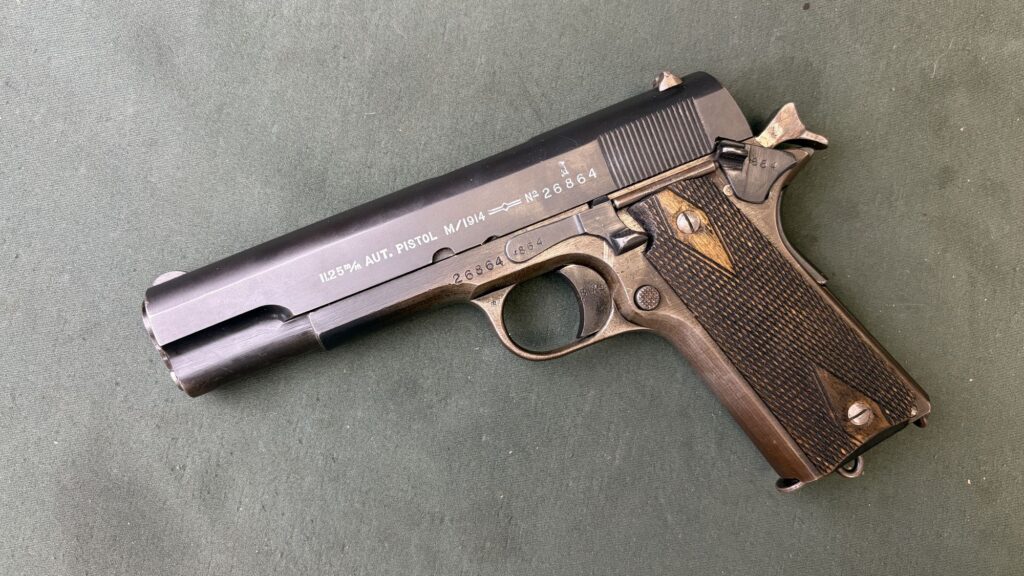 1942 Kongsberg M/1914 .45 ACP Matching with Signed Factory Archive Letter$4,950.00
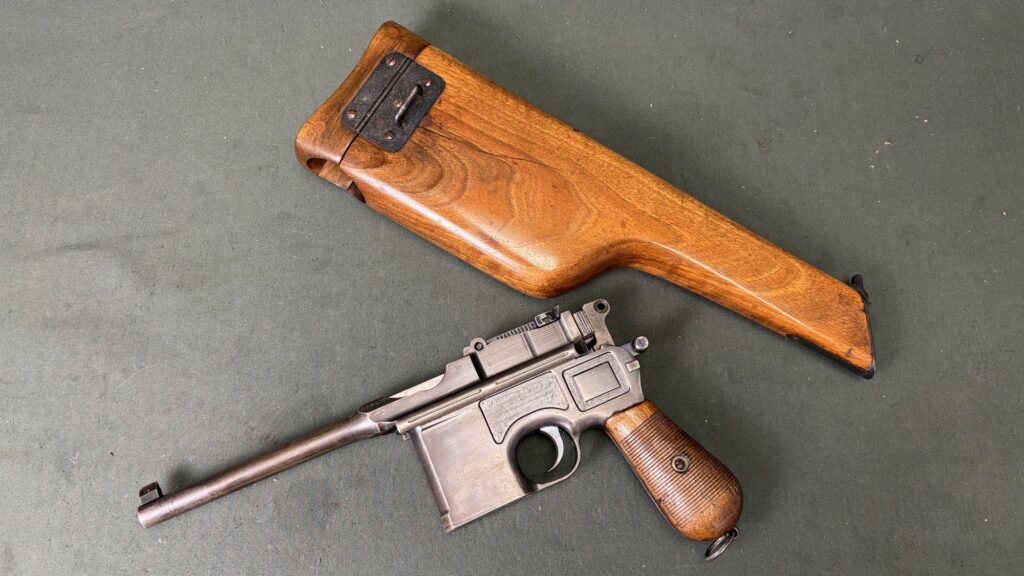 WWI Imperial German Mauser C96 Broomhandle All Matching NS Hammer$3,589.00
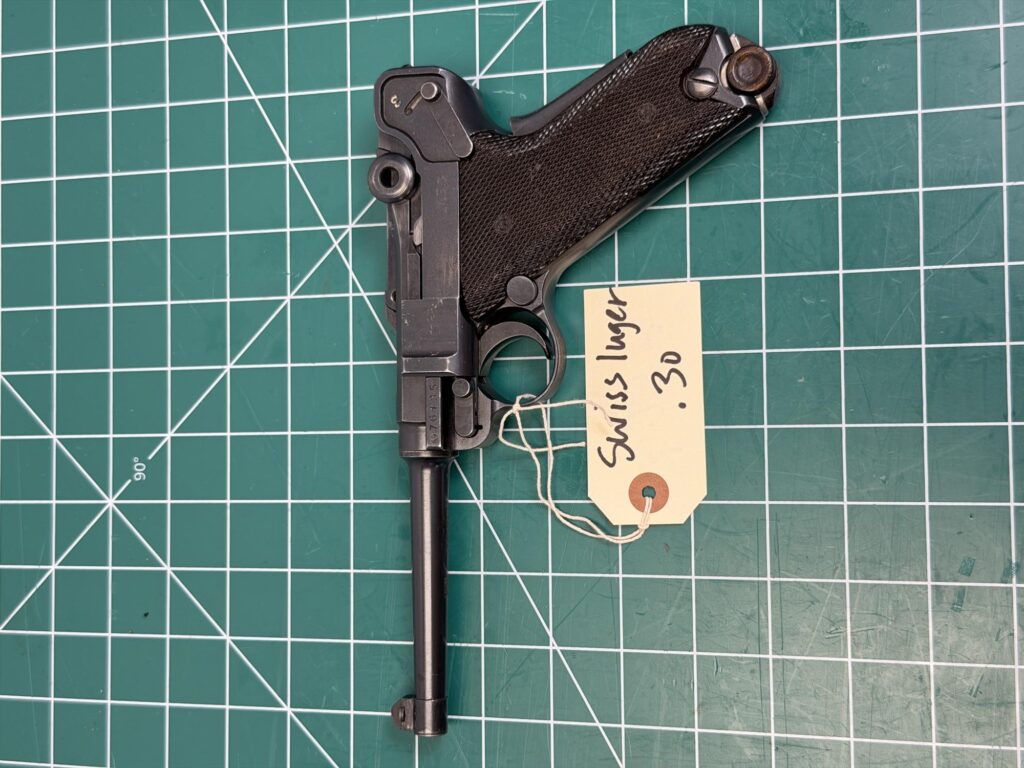 Waffenfabrik Bern Swiss Luger 06/29 pistol chambered in .30 Luger$2,379.00
The short version is on our Instagram. Watch it on Instagram.
General information for collectors, not legal advice. Machine guns are tightly regulated under federal and state law; check the rules before acquiring or transferring one.
Common Questions
What do N and R mean on a Mauser Schnellfeuer?
N stands for Normalfeuer, semi-automatic single shots, and R for Reihenfeuer, automatic fire. The selector sits on the left side of the frame.Why is it called the M712?
Mauser called it the Schnellfeuer. M712 is the name most American collectors use; Wikipedia ties it to the German Wehrmacht, but its origin is debated. It is also called the M1932 after the year production began.How many Mauser Schnellfeuer pistols were made?
Around 100,000. Wikipedia puts it at around 98,000 and Forgotten Weapons at just over 100,000, in their own serial number series.What is the difference between a C96 and an M712?
The M712 Schnellfeuer is a select-fire C96 in 7.63×25mm Mauser, made by Mauser from 1932. It adds a selector marked N and R on the left of the frame and takes a detachable 10- or 20-round magazine. A standard C96 is semi-automatic, with a fixed magazine loaded from the top with a stripper clip.Can a civilian own a Mauser M712 in the United States?
Only a transferable example: one lawfully registered as a machine gun before May 19, 1986, that is still eligible for transfer to a qualified private owner through the National Firearms Act process with ATF approval, and only where state and local law allow it.Sources
- Wikipedia, “Mauser C96” — https://en.wikipedia.org/wiki/Mauser_C96 (Feederle brothers, 1896–1937, about one million made, China and the embargoes, Spanish select-fire copies 1927–28, Nickl conversion 1930 and 4,000 made, M711 name, Westinger’s Schnellfeuer from 1932, end in 1936, about 98,000 in their own serial range, export markets, Yugoslav trials, Wehrmacht and the M712 name, Brazil’s 500, box cannon, Chinese use, Astra 900, Chinese copies, Taiyuan Type 17, 10- or 20-round detachable magazine, tangent sight to 1,000 m, short recoil, 7.63×25mm)
- Forgotten Weapons, “Mauser ‘Schnellfeuer’, or Model 712 Machine Pistol” — https://www.forgottenweapons.com/mauser-schnellfeuer-or-model-712-machine-pistol/ (Mauser’s answer to Spanish select-fire C96s, just over 100,000 made, mostly to China, SS use, 10- and 20-round magazines)
- 18 U.S.C. 922(o), via Cornell LII — https://www.law.cornell.edu/uscode/text/18/922 (ban on transfer and possession of machine guns, exception for those lawfully possessed before the effective date)
- Wikipedia, “Firearm Owners Protection Act” — https://en.wikipedia.org/wiki/Firearm_Owners_Protection_Act (effective May 19, 1986)