
Journal · Collector’s Guide
Black Widow Luger: The byf 41 Mauser P.08
A Black Widow Luger is a Mauser P.08 from 1941 or 1942 wearing black plastic grips, usually paired with magazines that have black plastic bases. Ours is a byf-coded Mauser dated 1941, every number on it matches, and we keep it with two black-base magazines and an original holster dated 1942. It is part of the Old Steel Arsenal collection.
The Luger P.08 in brief
The Luger began at DWM, Deutsche Waffen- und Munitionsfabriken, around 1900. Switzerland adopted it in 1900, the Imperial German Navy in 1904, and the German Army in 1908 as the Pistole 1908, P.08 for short, in 9×19mm Parabellum. It locks with a toggle joint on top of the frame: when the pistol fires, barrel and toggle recoil together, then the toggle strikes a cam in the frame and breaks upward at its hinge, unlocking the breech and throwing out the empty case.
By the Second World War the Luger was slow to build; by Wikipedia’s account the Walther P38 took almost half the time. Germany chose the P38 as its replacement in 1938, but moving production over took longer than expected. The last chamber date on Mauser’s wartime army Lugers is 42, though Wikipedia records Mauser still assembling P.08s until December 1943.
Mauser and the byf code
Mauser in Oberndorf was building the P.08 by the mid-1930s, and over the next few years marked its toggles with three different codes. Our guide to Luger P08 markings sets out the sequence: S/42 from late 1934, 42 from early 1939 to early 1941, and from 1941 the three-letter code byf. A byf Luger is a wartime gun with 41 or 42 over the chamber.
Here the front toggle link reads byf, and the chamber ahead of it reads 41.
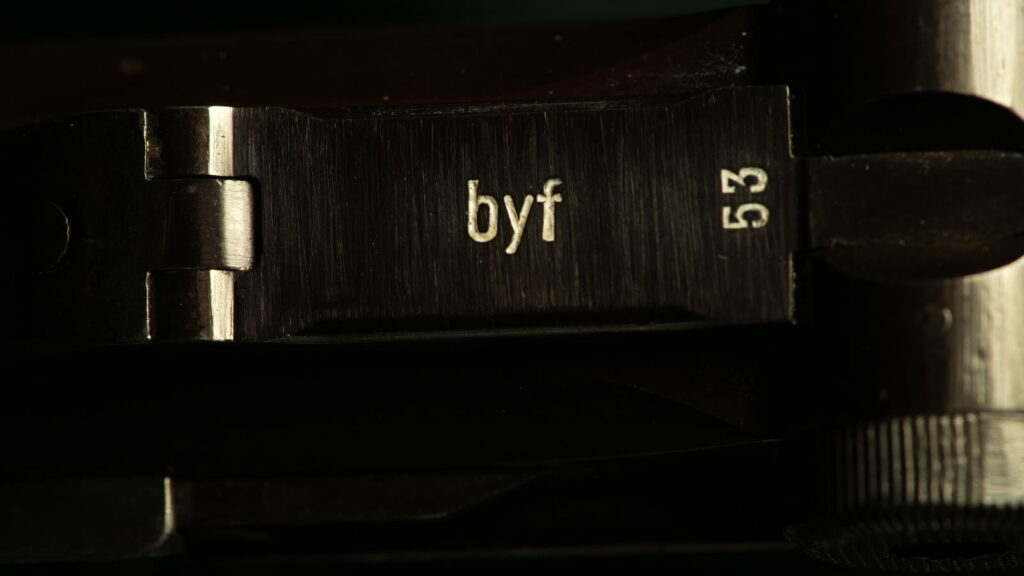
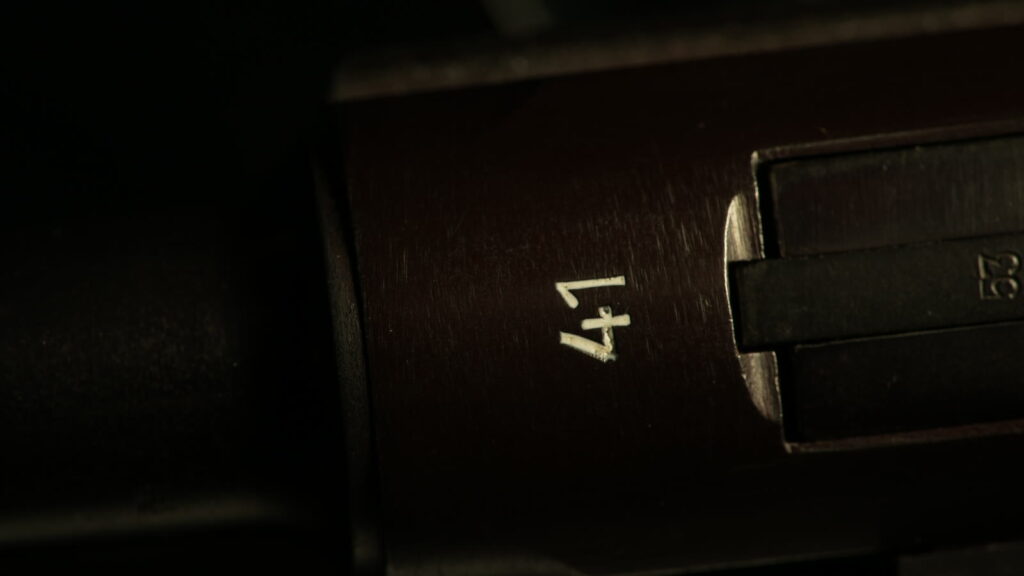
Why is it called the Black Widow Luger?
In a LugerForum thread on Black Widow years and codes, longtime forum contributor Dwight Gruber explains that wood for pistol grips and rifle stocks became scarce in Germany late in 1940, and the army accepted plastic as a substitute for P.08 grips. Plastic grips appear sporadically from 1940 and in earnest from 1941. In his account, black bakelite grips went onto byf 41 and byf 42 Lugers as they came to hand on the assembly line, and no serial range or block has been tied to them. Wikipedia gives a second reason: in 1941 some pistols were fitted with black Bakelite grip panels to save production time.
Magazines changed in the same period. Gruber writes that Haenel made Luger magazines with black bakelite bases and that these were the standard Luger magazines of 1941 and 1942; another longtime member of the forum describes them as the second-issue magazine for some 41s and most 42s.
The name came after the war. Gruber credits the American Luger collector Ralph Shattuck with coining “Black Widow” for the plastic-gripped guns, to set them apart from the more common wood-gripped Lugers, and Wikipedia also calls it a postwar American marketing name. Mauser had no model by that name; the term covers a byf 41 or 42 P.08 with black grips, usually with black-base magazines. A moderator on that forum calls it not a true variation, meaning it is not a factory model.
Plastic grips were the minority. Gruber cites Jan Still’s reference book Third Reich Lugers as putting the share of byf 41 and 42 production that wore them at about 20 percent; the same thread quotes Still that perhaps 2 percent of 1940 Lugers coded 42 already had black plastic grips.

How to read the markings on a Black Widow Luger
Start with the toggle and the chamber: byf and 41 or 42. Then look at the right side of the receiver, at the front.
Our pistol has two of the same small stamp there, an eagle over the number 655. That is the army’s Waffenamt acceptance stamp, the mark that the army took delivery of the pistol. On Mauser P.08s, 655 replaced the earlier 63 before the byf code came in, so it fits a byf 41 like this one. Acceptance numbers were not fixed for the whole war, so read the stamp against the date rather than expecting 655 on every byf. Beside them is the eagle test proof, the mark that says the pistol was fired and passed. The barrel carries a small eagle as well.

The frame reads P.08 on the left side above the grip.
Read the finish by period. Earlier Lugers had small parts heat-treated to a straw color, but according to Wikipedia, from the end of 1937 Mauser dropped the straw-finished small parts and salt-blued the whole pistol. On a late Mauser such as a byf, blued small parts with no straw color are what you expect; on their own they are not a sign of refinishing.
Matching numbers
Lugers were numbered part by part. The full serial number goes on the front of the frame, often with a letter suffix that is part of the serial, and the small parts, among them the breechblock, the toggle links, the side plate, the takedown lever and the trigger, carry its last two digits. On this pistol those digits are 53, and every number on it matches. Two digits are a clue rather than proof, because unrelated parts share them by coincidence and replacement parts were sometimes renumbered; the photos here show only some of the numbered parts.


Are the black grips original?
Two questions hide in this one: are the grips genuine wartime bakelite, and did they leave the factory on this pistol? The first can be studied, since wartime grips have known characteristics. The second is the hard one. In the same LugerForum thread, Gruber writes that there is no way to determine which Lugers originally had bakelite grips, that original grips can be moved from pistol to pistol, and that reproductions are made. Without a documented history, the grips on a given byf Luger cannot be proven to be the ones it left the factory with.
What you can check on the pistol itself: the byf code and a 41 or 42 date, a Waffenamt acceptance stamp that fits the date, the test proofs, the P.08 on the frame, and the numbers on the parts against the serial. The magazines should be of the black-base type of 1941–42. Those checks can show whether the pistol is consistent with a byf 41 or 42 and catch obvious mismatches. They do not by themselves rule out replaced or renumbered parts, and they cannot settle the grips.
The magazines and 1942 holster
We keep the pistol together with two black-base magazines of the 1941–42 type and an original holster dated 1942. The holster and the second magazine are not shown in the video.
Specifications
| Item | Mauser P.08, byf 41 |
|---|---|
| Maker | Mauser, Oberndorf am Neckar |
| Toggle code | byf |
| Chamber date | 41 (1941) |
| Cartridge | 9×19mm Parabellum |
| Action | Short recoil, toggle locked |
| Grips | Black plastic, checkered |
| Acceptance | Waffenamt eagle over 655 |
| Numbers | All matching; small parts carry 53, the last two serial digits |
| Magazine | 8-round detachable box |
| Barrel | 100 mm (3.9 in), standard P.08 |
| With it | Two black-base magazines, 1942 holster |
Is a byf Luger a curio and relic?
A byf 41 Luger is more than 50 years old, so an original falls in the federal curio and relic category by age; our curio and relic guide explains what that means.
On the floor at OSA
The Black Widow in these photos is part of the Old Steel Arsenal collection. If you collect Lugers, three of these pieces in our case show the P.08 at other points in its life, and one comes from the same Oberndorf factory:
- 1911 DWM Luger P08, German Army accepted: a prewar army P.08 from DWM, where the Luger began.
- DWM 1915 LP.08 Artillery Luger: the long-barreled First World War version.
- DWM P.08, 1918, Weimar police: a 1918 DWM later marked for Weimar-era police.
- Mauser Model 1914 pistol in .32 ACP: a pocket pistol from the same Oberndorf factory.
The grid below updates by itself as pieces come and go.
 Mauser byf 41 Black Widow Luger P08 9mm All Matching Rig with 1942 Holster Original price was: $3,950.00.$3,650.00Current price is: $3,650.00.
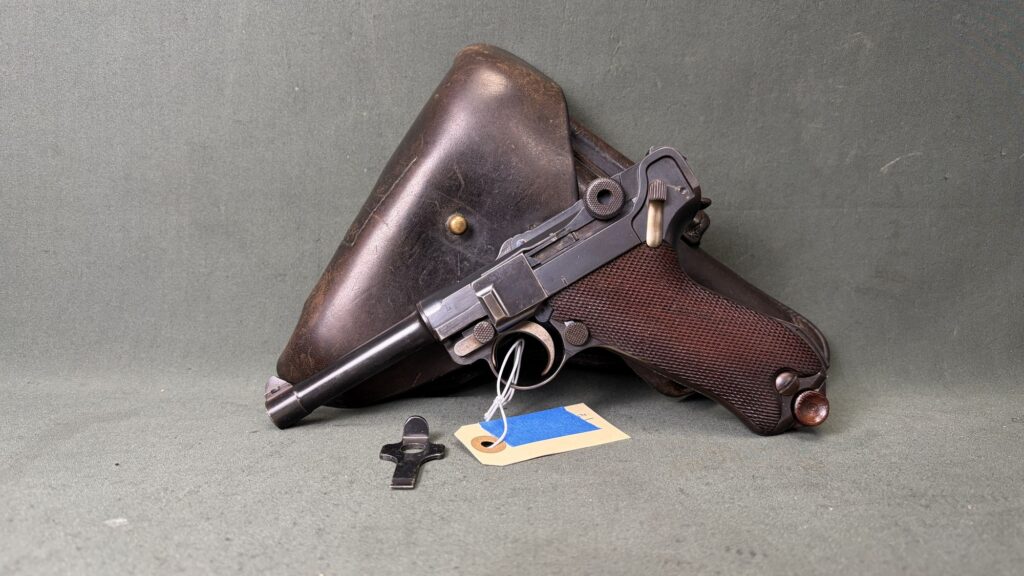 DWM Police Luger P08 9mm Unit Marked with 1933 Robert Larsen Berlin Holster$2,650.00
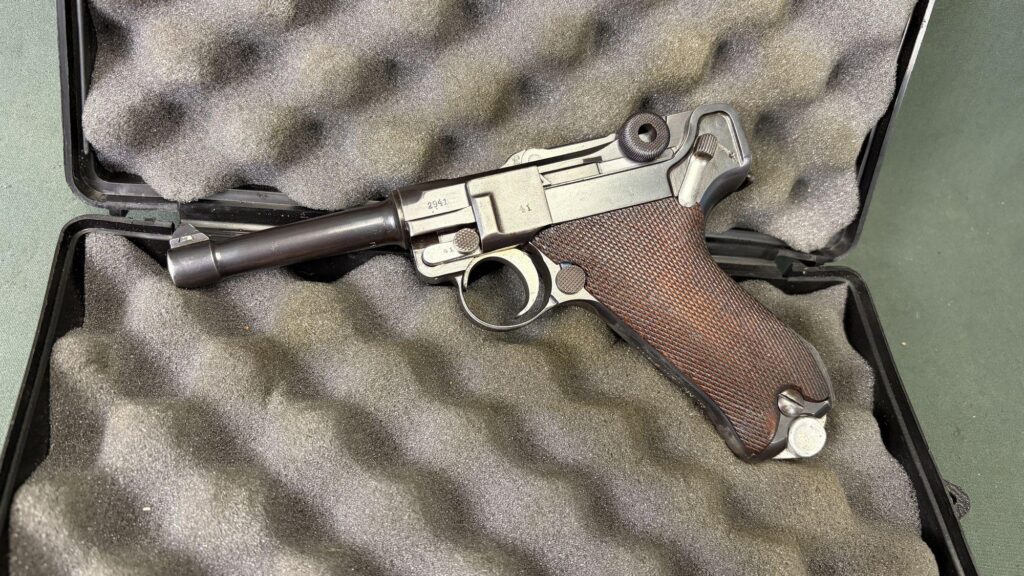 DWM P.08 Luger 9mm — 1918, Weimar Police, Matching$2,365.00
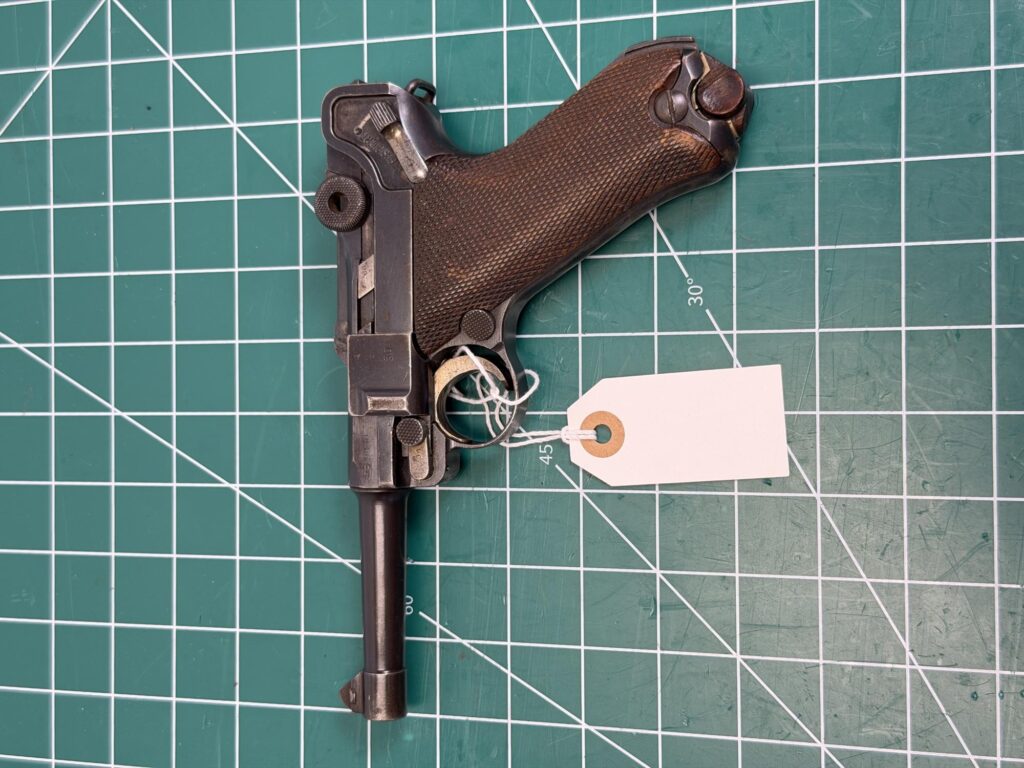 DWM commercial Luger P08 pistol$1,549.00
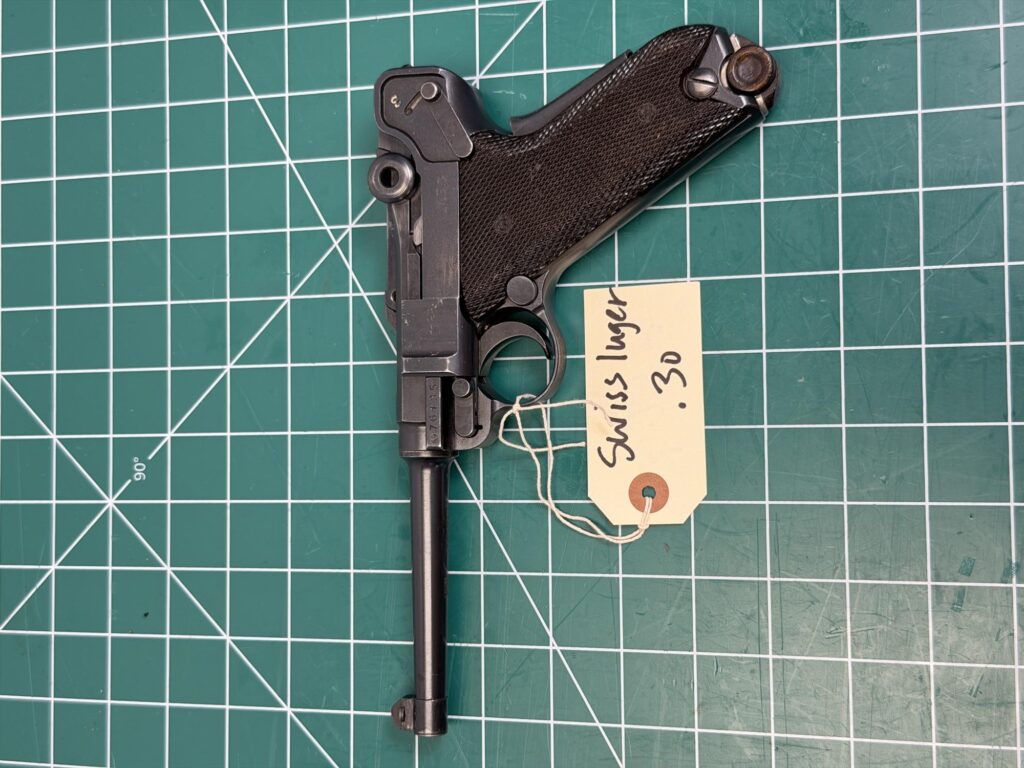 Waffenfabrik Bern Swiss Luger 06/29 pistol chambered in .30 Luger$2,379.00
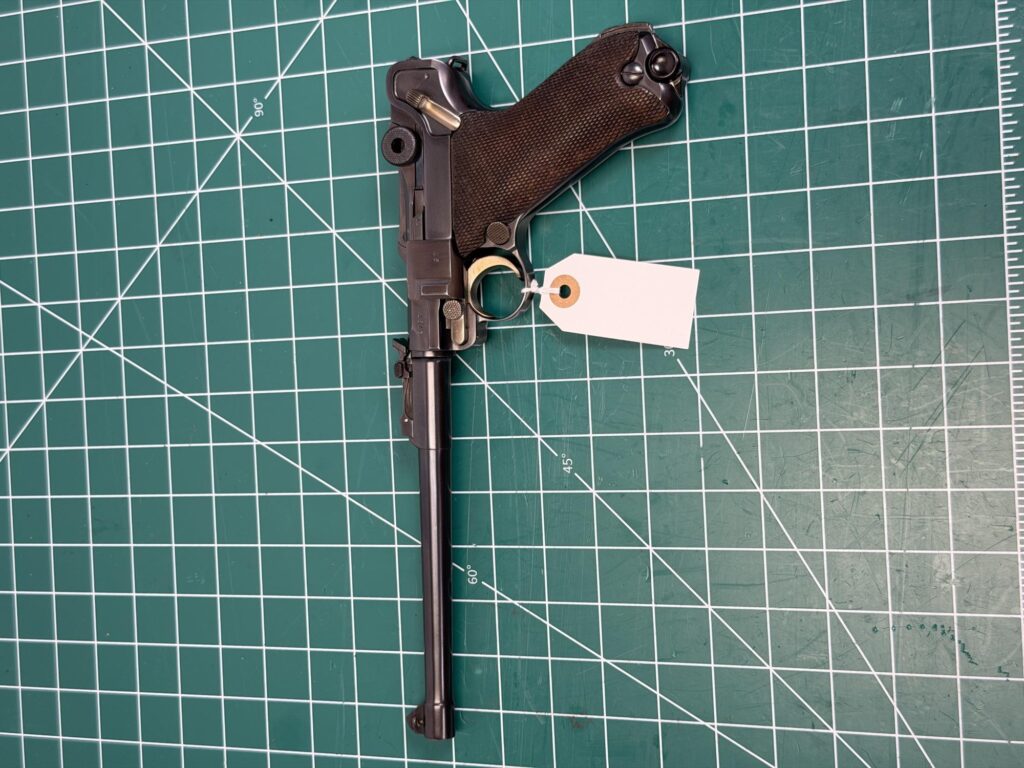 DWM 1915 LP.08 Artillery Luger pistol chambered in 9x19mm$2,799.00
The short version is on our Instagram. Watch it on Instagram.
General information for collectors, not legal advice. Production details come from secondary sources; check the individual pistol.
Common Questions
What is a Black Widow Luger?
It is a Mauser P.08 Luger from 1941 or 1942, code byf, fitted with black plastic grips and usually black-based magazines. The name is a postwar American collector term, not a Mauser model name.Why does a Black Widow Luger have plastic grips?
According to Luger researcher Dwight Gruber, wood for grips ran short in Germany from late 1940 and the army accepted plastic as a substitute; Wikipedia adds that bakelite grips saved production time. Black bakelite grips went onto byf 41 and byf 42 Lugers as they came to hand.Who named the Black Widow Luger?
According to Luger researcher Dwight Gruber, Luger collector Ralph Shattuck coined the term after the war to set plastic-gripped Lugers apart from wood-gripped ones.What does byf mean on a Luger?
byf is the code Mauser of Oberndorf used on its Lugers from 1941. A byf Luger is a wartime gun with 41 or 42 over the chamber.What does 655 mean on a Luger?
An eagle over 655 is a Waffenamt acceptance stamp used on Mauser P.08s around the start of the war and on early byf pistols, the mark that the German army accepted the pistol. It replaced the earlier 63; read it against the pistol’s date rather than expecting it on every wartime Luger.Are Black Widow Luger grips original?
Whether a set of grips is genuine wartime bakelite can be judged from the grips themselves, and reproductions exist. Whether those grips left the factory on that particular pistol is much harder: original grips can be moved between pistols, so without a documented history it cannot be proven.When did Mauser stop making the P.08 for the German army?
Germany chose the Walther P38 as the Luger’s replacement in 1938, but Mauser kept building the P.08 into the war. Its army Lugers carry chamber dates up to 42, and Wikipedia records assembly continuing until December 1943. Lugers were also assembled after the war, which is a separate story.Sources
- LugerForum, “‘Black Widow’ Years/Codes,” post by Dwight Gruber — https://forum.lugerforum.com/forum/showthread.php?p=81115 (wood shortage late 1940, plastic accepted, bakelite grips on byf 41 and 42 as they came to hand, Haenel black-base magazines standard 1941–42, about 20 percent and 2 percent of 1940 per Still’s Third Reich Lugers, Ralph Shattuck coined the name, not a true variation, no way to determine factory grips, reproductions, second-issue magazine for some 41s and most 42s)
- Wikipedia, “Luger pistol” — https://en.wikipedia.org/wiki/Luger_pistol (DWM origin, Swiss 1900, Army 1908, 9×19mm, toggle lock and cam, 1941 Bakelite grips to save production time, postwar American marketing name, Navy Pistole 1904, P38 chosen 1938 and quicker to make, changeover longer than expected, Mauser production to December 1943, salt blue from late 1937, 8-round magazine, 100 mm barrel)
- Old Steel Arsenal, “Luger P08 Markings Explained” — https://oldsteelarsenal.com/luger-p08-markings-explained/ (S/42, 42 and byf code dates, E/63 to E/655 change in 1939, proof versus acceptance stamps, which parts carry the last two serial digits, serial suffix, two digits a clue not proof, straw-colored small parts)
- 27 CFR 478.11, definition of curios or relics — https://www.ecfr.gov/current/title-27/chapter-II/subchapter-B/part-478/subpart-B/section-478.11 (firearms manufactured at least 50 years prior)