
Journal · Collector’s Guide
G43 Overgassing: Two Risks Every Owner Should Know
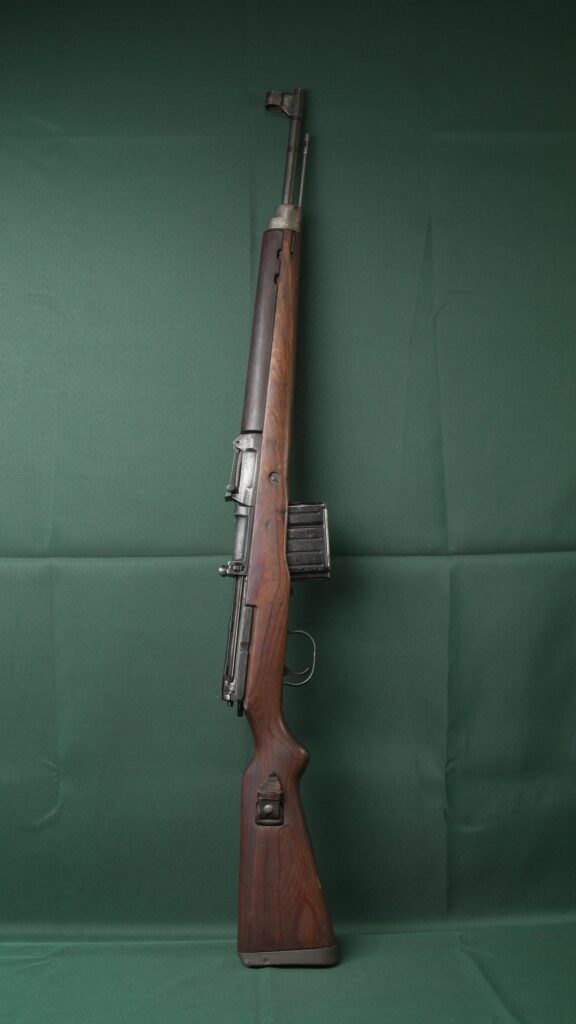
G43 overgassing is the first thing to understand before you shoot or strip one of these rifles. Walther’s wartime semi-auto was built to run hard in mud and cold, so its gas system drives the bolt group back harder than it needs to, and the rear of the action takes the blow. Over time, that can crack the stamped sheet-metal bolt housing or bend the rear of the receiver. The second risk shows up at the bench: the bolt group comes out under spring tension, and small parts can fly. In the video we point out both on our own K43, marked K.43 qve 4.
Why the G43 was built overgassed
The Gewehr 43 grew out of Germany’s first try at a semi-auto service rifle. Wikipedia describes it as based on the earlier G41(W), with a new gas system. Forgotten Weapons describes a flap-locking system copied directly from the Walther Gewehr 41, coupled with a gas piston system derived from the Soviet SVT-38/40. Mauser’s competing design from the same program lost out to Walther; see our guide to the Mauser G41(M).
According to Wikipedia, the rifle entered service as the Gewehr 43 and was renamed Karabiner 43 in April 1944, with production of both models put at roughly 400,000 by the end of the war. The Firearm Blog sums up the two names as same gun, different designations.
The gas setting was a deliberate choice. Forgotten Weapons writes that most G43s were significantly over-gassed when they left the factories, because reliable operation in the cold and mud of Russia was much more important than a long service lifespan. The Firearm Blog says the rifle was designed to be extremely overgassed for reliability purposes, and that over time the extra gas wears the rifle out. It also points out the contrast with the SVT-40 the design borrowed from: the Soviet rifle has an adjustable gas regulator, and the K43 does not.
Wikipedia adds the ammunition side. The original system was set up for German wartime service ammunition in heavy fouling or icing, and it cannot be adjusted for anything else, so ammunition with a different pressure behavior can drive the action harder than intended.
Risk 1: the rear of the bolt housing
At the back of the G43 action sits the bolt housing, called the Schloßhülse in German parts lists. When the rifle fires, the bolt carrier is driven back toward it. espeholt.dk explains how the housing is made: it is rolled from sheet metal, the back end is folded over, and a cup-shaped reinforcement is welded against it from the inside.
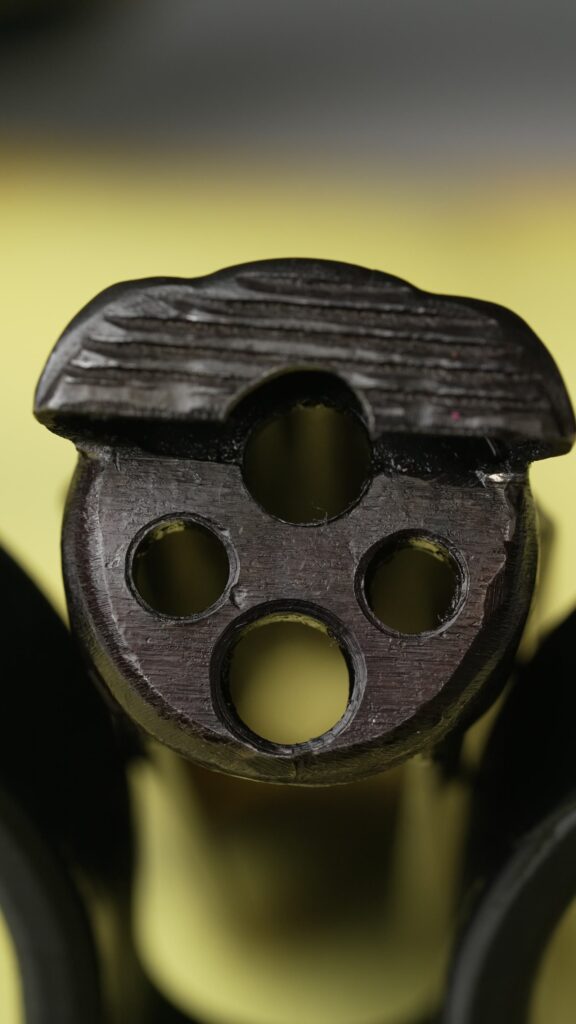
The G43 taps gas from a port near the muzzle and runs a short-stroke piston system that sends the bolt back to the end of the receiver, as The Firearm Blog describes it. With too much gas, that stroke ends in a hammer blow at the rear.
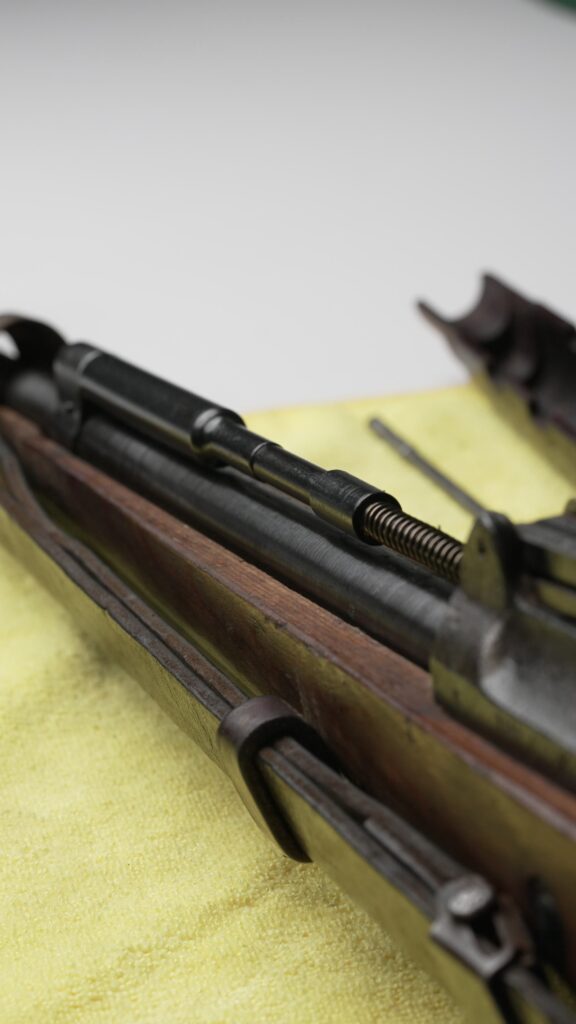
Frontline Militaria, which makes replacement gas parts for these rifles, says what it can do: if the gas flow is not controlled, the bolt and bolt carrier can slam back so violently that they bend the receiver or crack the bolt housing cover.
Wikipedia notes that in worse cases this kind of damage can endanger the shooter. The rear of the action sits close to the shooter’s face, which is why we say to check this area before you shoot.
Crack or seam? What a normal line looks like
Many G43 bolt housings show a line at the back that looks like a crack and is not one. espeholt.dk explains that the “crack” is where the folded parts of the sheet metal overlap. It also notes that the hole near that line has no supporting function; it is only there to let the firing pin extension pass through while the rifle cycles.
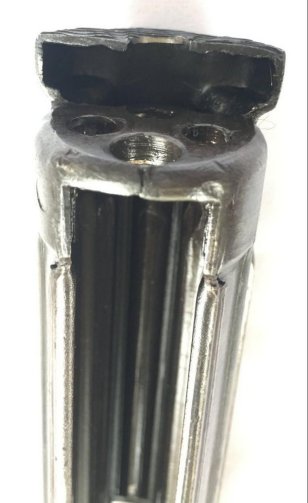
So a line at the back does not prove the part is cracked, and a seam there does not prove the part is sound either. When you cannot tell what you are looking at, have a specialist inspect it before you fire the rifle.
The fix for shooting: a reduced-gas system
For a G43 that will be shot regularly, a reduced-gas system can cut down that battering. The Firearm Blog calls a shooter’s kit necessary for recreational shooters to preserve the gun, and Forgotten Weapons warns that without such a modification, parts can break with extended shooting.
According to Frontline Militaria, its shooter’s kit replaces the original gas piston with one threaded for three drilled inserts, so the shooter can choose how much gas reaches the action. The Firearm Blog explains why that helps: an insert with a smaller hole lets less gas through, which lessens the force of the bolt slamming into the receiver. Wikipedia describes commercial shooters kits the same way, a new gas cup and gas plug threaded for different sized orifices.
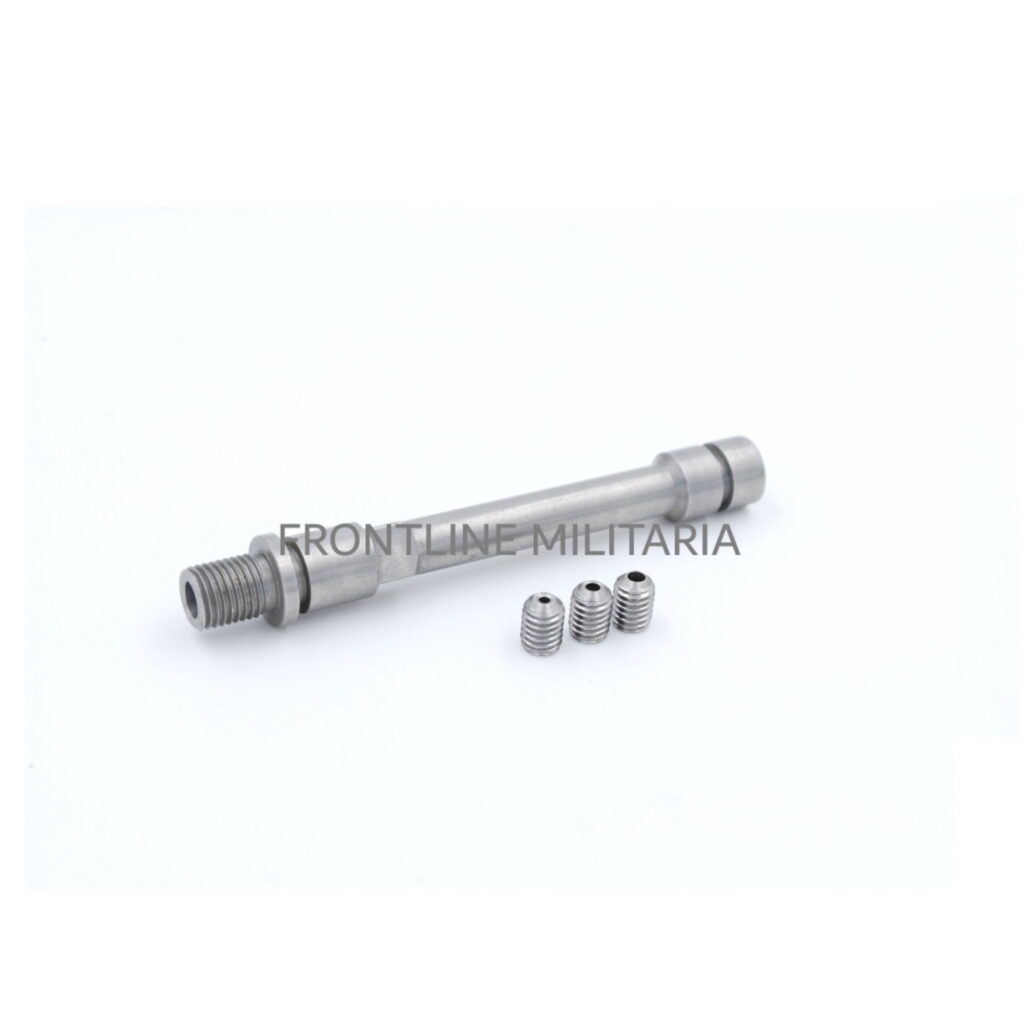
A reduced-gas system lowers the battering from here on; it does not repair a housing that is already cracked or a receiver that is already bent. And fitting and tuning one is gunsmith work. We are not giving fitting or setup instructions here.
Risk 2: disassembly and flying springs
The second risk comes at the bench, when the bolt group comes out of the rifle. Unload it first: magazine out, chamber checked.
espeholt.dk is blunt about this step: the parts are under spring tension, they can fly, and you should always protect your face. Details also vary between production versions of the rifle.
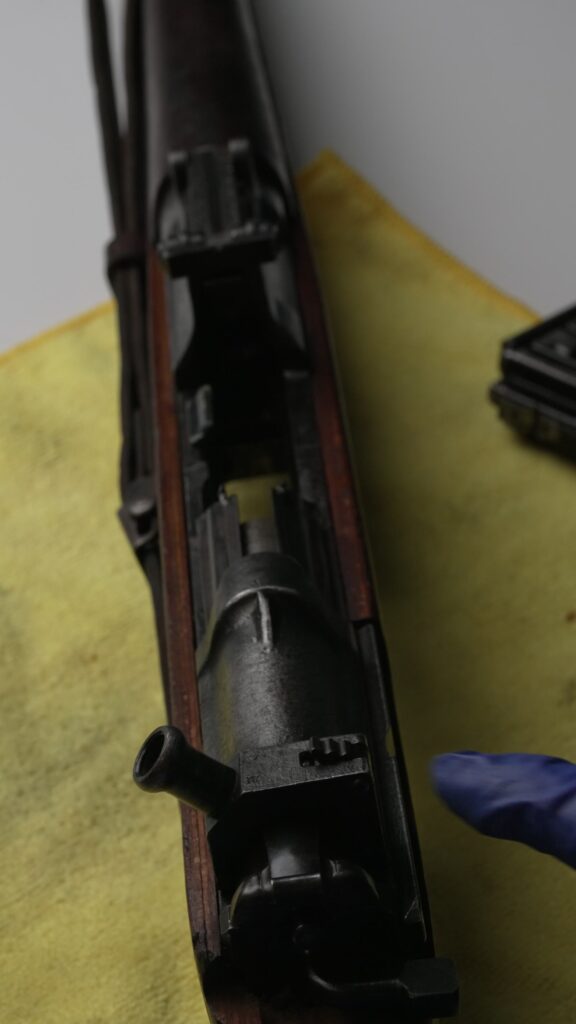
Wear eye protection. If you have not taken a G43 apart before, read up on it first, or leave the job to a specialist. The video is not a disassembly guide, and neither is this article.
The maker code on our K43
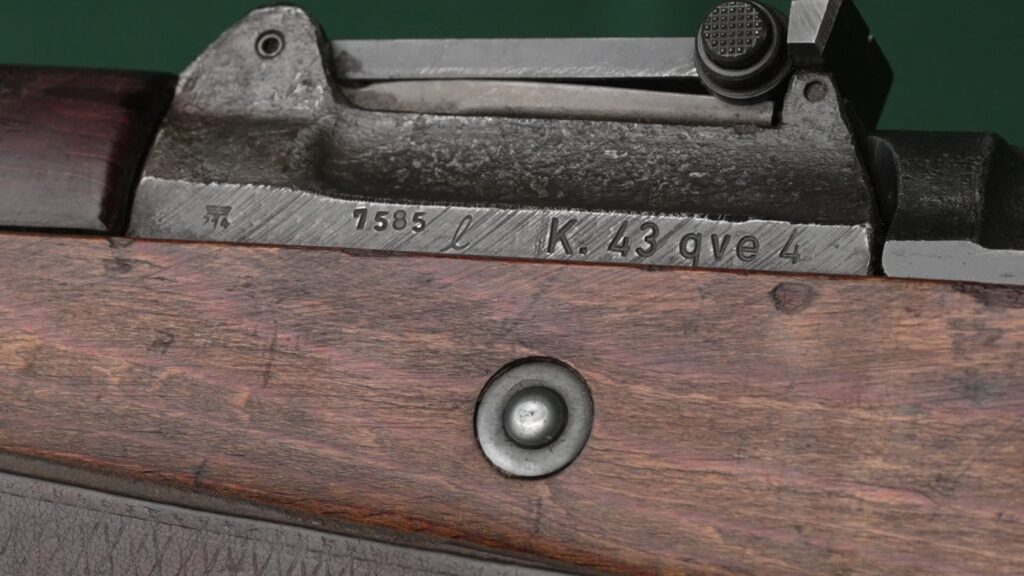
The rifle in our photos is marked 7585 l and K.43 qve 4 on the side of the receiver. Wikipedia lists the makers of the G43: Berlin-Lübecker Maschinenfabrik in Lübeck (coded duv, later qve), Walther (ac) and the Wilhelm Gustloff Stiftung (bcd). So qve on ours points to Berlin-Lübecker. For more on these three-letter codes, see our guide to K98k maker codes.
Specifications
| Item | Gewehr 43 / Karabiner 43 |
|---|---|
| Designer | Walther, according to Wikipedia |
| Makers | Walther (ac), Berlin-Lübecker (duv, qve), Gustloff (bcd) |
| Our rifle’s marking | 7585 l, K.43 qve 4 |
| Years made | 1943 to 1945 |
| Number built | Roughly 400,000, both models |
| Cartridge | 7.92x57mm Mauser |
| Magazine | 10-round detachable box |
| Operation | Short-stroke gas piston, flap-locking bolt |
| Gas adjustment | None on the original rifle |
| Bolt housing | Stamped sheet metal, folded at the rear |
On the floor at OSA
The K43 in these photos is part of our own collection, and it is not on the floor. These pieces in our case are related:
- 1943 byf Mauser K98k: the bolt-action Kar98k, the rifle the G43 was meant to replace as the standard infantry rifle, according to Forgotten Weapons.
- G33/40: another German wartime rifle in the same 7.92x57mm cartridge.
- 1957 Egyptian Hakim: a postwar semi-auto chambered in 8mm Mauser, the same cartridge as the G43.
- 1945 Springfield Armory M1 Garand: the American semi-auto of the same war.
The grid below updates by itself as pieces come and go.
 1950s Harrington and Richardson M1 Garand 30-06 with LMR 11-54 Barrel$1,185.00
 1944 Springfield M1 Garand 30-06 Letterkenny 1965 Arsenal Rebuild$1,525.00
 1942 Springfield M1 Garand 30-06 Danish Return with 1966 VAR Barrel$1,695.00
 1942 Springfield Armory M1 Garand 30-06 with Springfield Barrel and Sling$1,585.00
 1944 Springfield Armory M1 Garand 30-06 Rig with Bayonet Belt and Scabbard$1,795.00
 1943 Springfield M1 Garand 7.62 NATO, MK 2 MOD 1 Configuration, H&R$1,785.00
The short version is on our Instagram. Watch it on Instagram.
General information for collectors, not legal advice. Have a qualified gunsmith inspect any military surplus rifle before you fire it; details vary between individual rifles.
Common Questions
Why is the G43 overgassed?
The G43 was built with more gas than it needs so it would keep running in cold, mud and heavy fouling on the Eastern Front. Its original gas system has no adjustment, so the extra force goes into the action on every shot.Where should I check a G43 for cracks?
Look at the rear of the stamped bolt housing, which takes the blow when the bolt group is driven back. Overgassing can also bend the rear of the receiver, so check that area too.Is the line on the back of my G43 bolt housing a crack?
Not always. The bolt housing is rolled from sheet metal and folded at the back, and the overlap leaves a seam that looks like a crack. If you cannot tell a seam from a break in the metal, have a specialist inspect it before firing.What is a G43 shooter's kit?
A G43 shooter’s kit is a replacement gas piston or gas system that takes interchangeable inserts with different hole sizes. An insert with a smaller hole lets less gas through, so the bolt hits the rear of the receiver with less force. Fitting one does not replace a full inspection of the rifle.Does a shooter's kit fix a cracked G43 bolt housing?
No. A reduced-gas system lowers the battering from then on, but it does not repair a part that is already cracked or bent. Damaged parts need a specialist’s assessment.Is it dangerous to take a G43 apart?
The bolt group is under spring tension, and small parts can fly out when it is released. Unload the rifle first, wear eye protection, and leave it to a specialist if you are not familiar with the procedure.Are the G43 and K43 the same rifle?
Essentially, yes. The Gewehr 43 was renamed Karabiner 43 in April 1944, and the design carried on under the new name.Sources
- The Firearm Blog, “Gas Systems of the Eastern Front – 1945” — https://www.thefirearmblog.com/blog/2024/01/09/gas-systems-eastern-front-1945/ (same gun, different designations; designed to be extremely overgassed for reliability; beats itself to death over time; SVT-40 adjustable regulator, K43 none; port near the muzzle, short-stroke piston, bolt recoils to the end of the receiver; shooter’s kit necessary; smaller plug lessens force)
- Ian McCollum, Forgotten Weapons, “Slow Motion: Gewehr 43” — https://www.forgottenweapons.com/slow-motion-gewehr-43/ (meant to replace the Kar98k; flap-locking from the G41 and gas system from the SVT; most significantly over-gassed for cold and mud; parts breakage likely with extended shooting without a shooter’s kit)
- espeholt.dk, “G43 – Exploded View” — https://www.espeholt.dk/exploded_view_g43.html (Schloßhülse name; sheet-metal housing folded with welded cup; seam is not a crack; hole near seam for firing pin extension; parts under spring tension can fly, protect your face; versions with and without hold-open)
- Frontline Militaria, “Gas system for the G43 and K43” — https://www.frontline-militaria.com/us/g43-shooters-kit-gas-system.html (original gas flow not adjustable; uncontrolled gas can bend the receiver or crack the bolt housing cover)
- Frontline Militaria, “Gaspiston set for the G43 and K43” — https://www.frontline-militaria.com/us/g43-gaspiston-set.html (stainless gas piston threaded for three drilled inserts to control gas flow)
- Wikipedia, “Gewehr 43” — https://en.wikipedia.org/wiki/Gewehr_43 (based on the G41(W); renamed Karabiner 43 in April 1944; production of 402,713, just over 400,000; makers and codes duv/qve, ac, bcd; designer Walther; 10-round detachable magazine; short-stroke piston and flapper locking; gas system built for wartime service ammunition and not adjustable; damage can endanger shooters; shooters kits)