
Journal · Collector’s Guide
Mauser G41(M): Germany’s Semi-Auto With a Bolt Backup
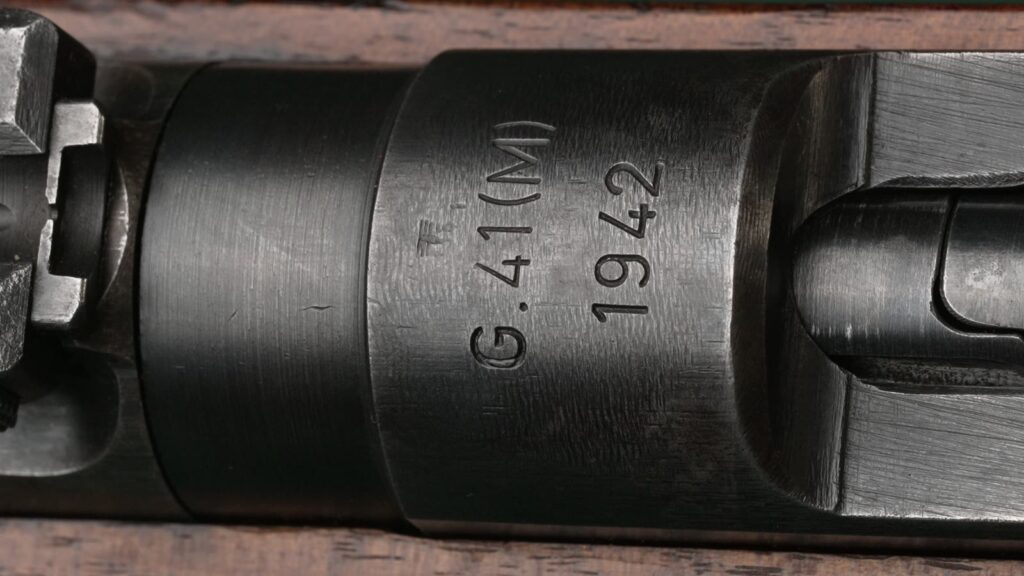
The Mauser G41(M) is a semi-automatic rifle with a bolt-action backup built in. The German Army wanted a self-loader that a soldier could still work like his Kar98k if the automatic system failed, so Mauser gave it a handle that turns up 90 degrees and runs the bolt by hand. In May 1943, U.S. intelligence described the G41 as “Germany’s reply to the M1.” Ours is marked G.41(M) 1942 on top of the receiver, and it is part of our own collection. In the video we show the handle up close, take the action apart, and run the rifle at the range, clearing dummy rounds by hand.
Germany’s reply to the M1
When the Second World War started, German infantry still carried bolt-action Mausers much like the ones their fathers had used. Across the Atlantic, the U.S. Army already had the semi-automatic M1 Garand, and according to Wikipedia, German firearms publications had pictured and described it.
In 1940, Wikipedia records, the Army high command opened a competition for a semi-auto rifle, with Mauser and Walther as the main entrants. The ordnance office attached conditions. American Rifleman lists three: no gas port or holes in the barrel, no moving parts on the outside, and a bolt action added in case the self-loading mechanism failed. Forgotten Weapons words the last one as a rule that the rifle had to work with the same manual of arms as the K98k in case of malfunction. The invasion of the Soviet Union in June 1941 raised the stakes: the NRA Museum notes that German soldiers there faced Red Army units armed with the semi-automatic Tokarev.
According to American Rifleman, only Mauser respected the restrictions, and the result was overly complex, unreliable and bulky. Forgotten Weapons says Walther simply ignored the requirement for no moving parts on top of the rifle.
The U.S. noticed. Tactical and Technical Trends No. 24, a War Department intelligence publication dated May 6, 1943, ran a single paragraph: “Germany’s reply to the M1 is reported to be a 10-shot, rather heavy, gas-operated rifle, known as the Gewehr 41, using the regular 7.92-mm cartridge.” The report speaks of the G41 in general, not of one maker’s version. Ours is the Mauser.
How to read the Mauser G41(M) receiver
The marking is on top of the receiver ring: G.41(M) over 1942. The (M) is for Mauser. During trials, the NRA Museum explains, the two competing rifles were designated 41(M) and 41(W), for Mauser and Walther. Forgotten Weapons dates G41(M) production to 1941 and 1942, mostly 1942, with assembly running until March 1943 or a little later.
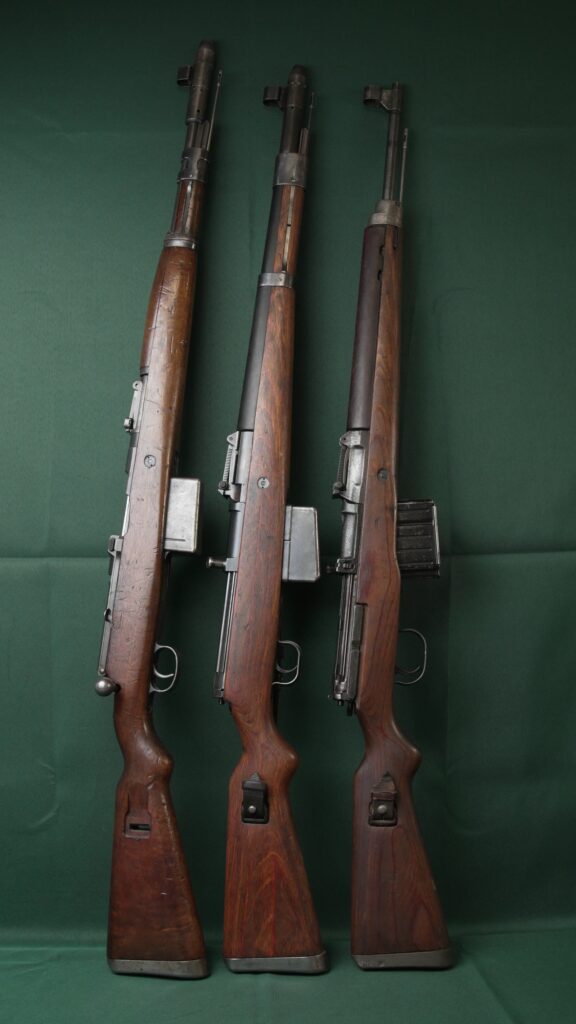
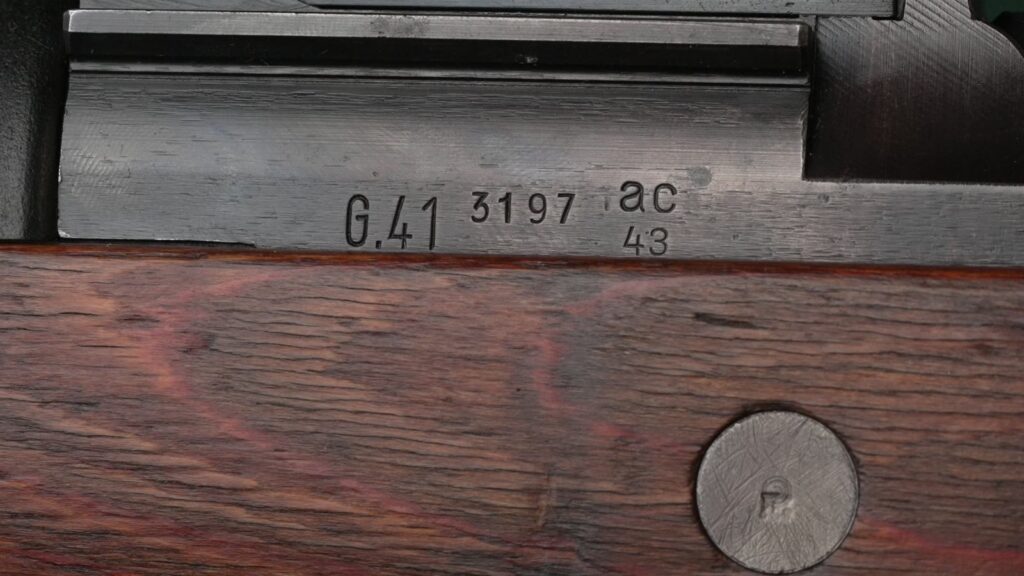
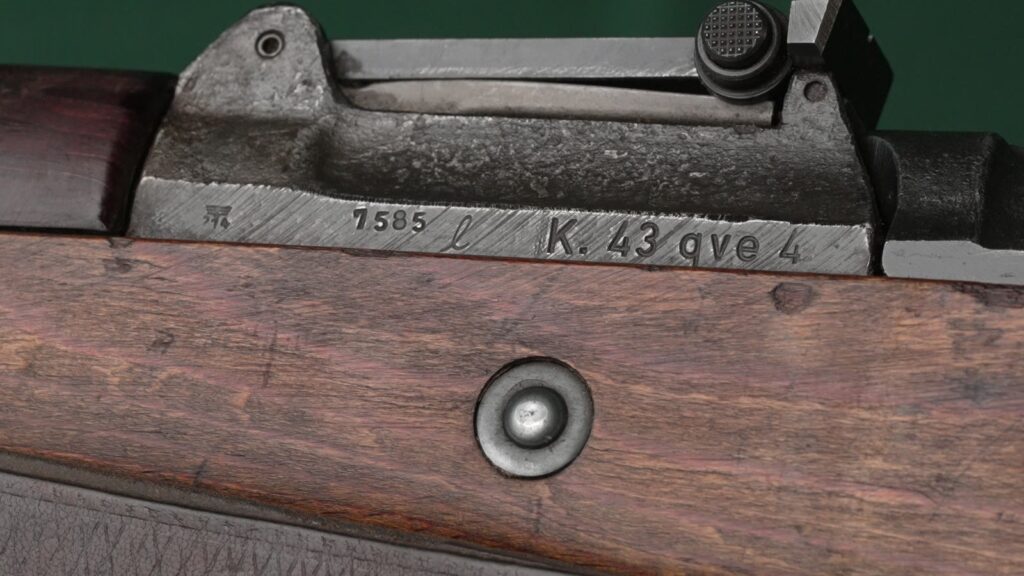
For comparison, the left side of our Walther G41’s receiver reads G.41, 3197, and ac over 43. Wikipedia lists ac as Walther’s code. The third rifle in our photos reads 7585 l and K.43 qve 4. Wikipedia lists qve as a code used by Berlin-Lübecker Maschinenfabrik, which had earlier used duv. For more on German three-letter codes, see our guide to K98k maker codes.
How the G41(M) works: a turn-up handle
Both G41 designs trapped gas at the muzzle instead of drilling the barrel. Forgotten Weapons says they used virtually identical nose caps and gas pistons of the Bang type, and an Army AL&T history of the Garand agrees that both the G41(M) and G41(W) used gas trap designs similar to the early Garand. In the Bang system, a cone-shaped trap at the muzzle catches propellant gas and turns it back to drive a small piston. On the G41(M), a connecting rod pushes a block under the barrel, which drives a pair of bars along the sides of the receiver against the bolt carrier. That arrangement kept the moving parts off the top of the rifle.
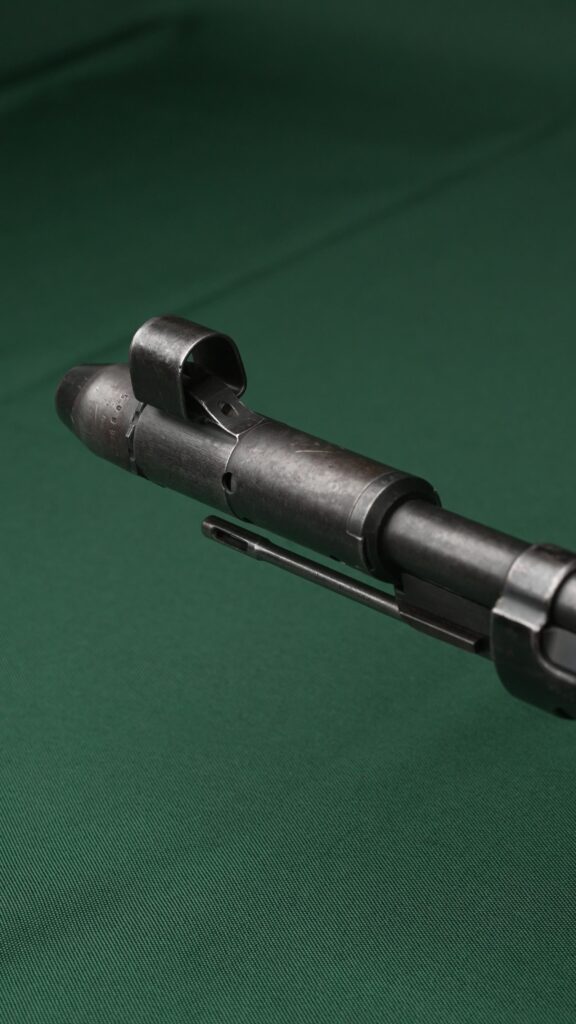
The bolt rotates and locks with two lugs at the front. Forgotten Weapons explains how: a spiral cam on the outside of the bolt rides in a matching groove in the bolt carrier, so when the carrier is driven back after a shot, it turns the bolt to unlock it and then pulls it rearward. It counts at least eight moving parts, plus springs, just to cycle the action.
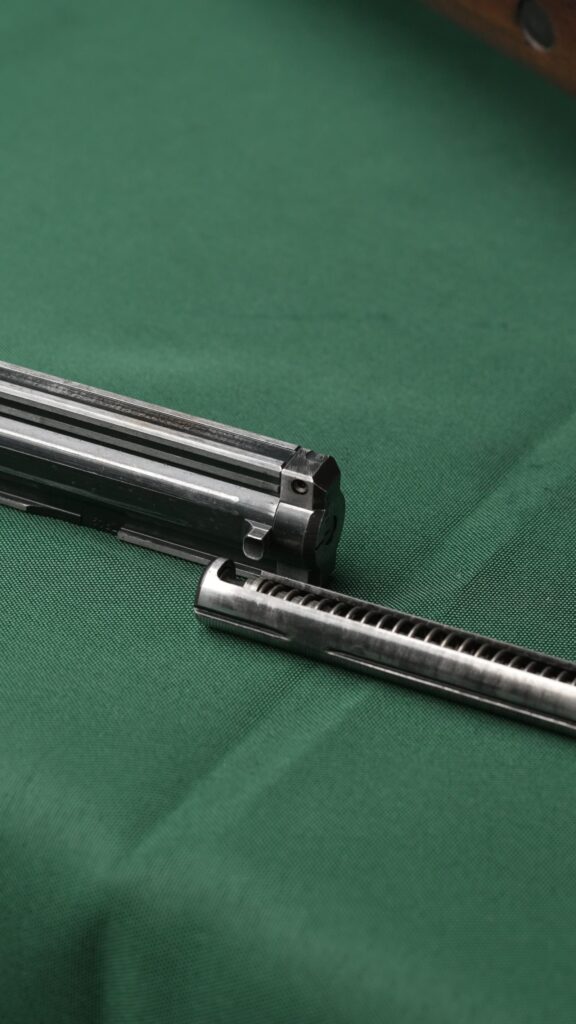
Then there is the handle, a round-knob handle in the Kar98k style. During semi-auto fire, it stays put while the bolt cycles; the NRA Museum notes the handle “did not cycle when the rifle was fired.” On our rifle, with the handle lying flat, you cannot pull the bolt back by hand. Lift it 90 degrees first, and then you work the bolt by hand, the way you would on a Kar98k. Forgotten Weapons describes the same thing: a bolt handle that had to be rotated 90 degrees and pulled back to cycle the gun manually.
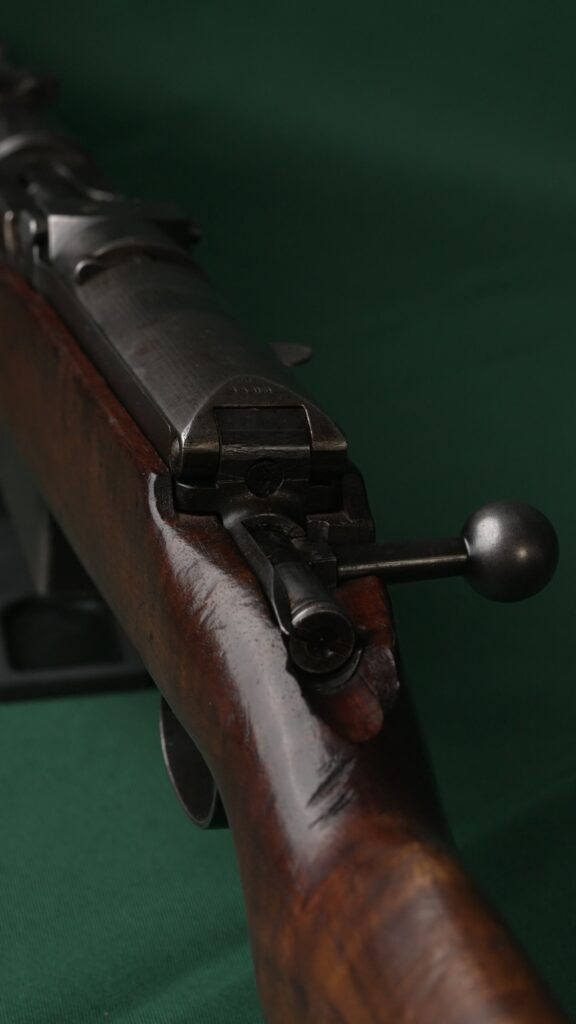
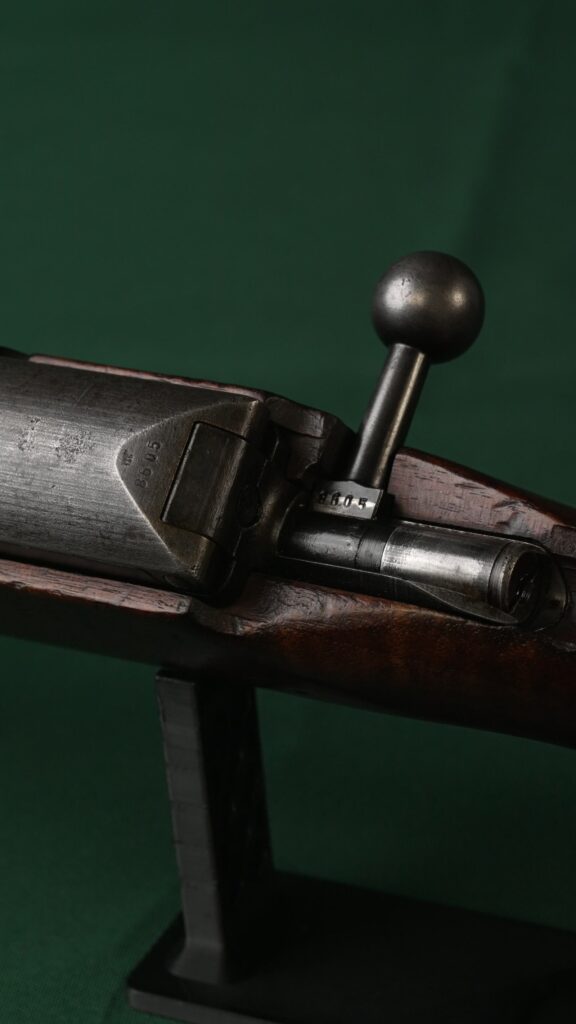
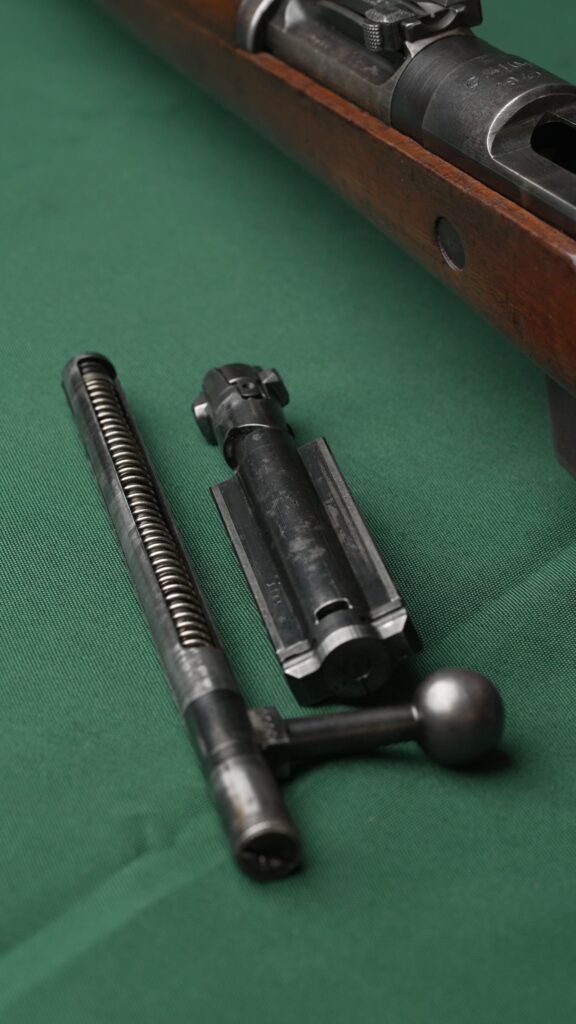
On our rifle, the return spring sits inside the handle rod. In manual mode, the bolt disengages from it. American Rifleman describes the same thing: the handle automatically disconnected the bolt assembly from the recoil spring when the rifle was used in manual mode. So in manual mode you pull the bolt back, and you also push it forward. The spring is not doing that return stroke for you.
At the range: dummies, live rounds and a hangfire warning
At the range we loaded the rifle from stripper clips and mixed dummy rounds with live ammunition, in random order. A dummy has no powder and no primer, so it produces no gas and the action does not cycle. Each one had to come out by hand: lift the handle, pull the bolt back, push it forward again. That is the rifle’s manual mode at work. The live rounds went off and rang steel.
A live round that won’t fire is different, and a click alone does not tell you which one you have. Keep the muzzle pointed downrange and wait before opening the action. It could be a hangfire, a delayed ignition.
Handling it
In our hands the G41(M) is a bit heavy, and working the bolt is not as smooth as on a Kar98k. The bolt and bolt head are slim. Forgotten Weapons gives the weight as 11.5 pounds and calls the rifle long and poorly balanced.
Specifications
| Item | Mauser G41(M) |
|---|---|
| Maker | Mauser |
| Our rifle’s marking | G.41(M) 1942, top of the receiver ring |
| Years made | 1941 and 1942, assembly into 1943 |
| Cartridge | 7.92x57mm Mauser |
| Magazine | Fixed 10-round box |
| Gas system | Muzzle gas trap (Bang type) |
| Bolt | Rotating, two locking lugs |
| Manual operation | Handle turned up 90 degrees and pulled back; bolt disconnected from the return spring |
| Weight | 11.5 lb, according to Forgotten Weapons |
Why Walther won, and the move to a barrel port
Walther built a G41 too. You can work it by hand, but it has no turn-up handle: Forgotten Weapons describes a simpler handle mounted on the bolt carrier itself. Walther’s design won out. The NRA Museum says the Walther rifle proved the better of the two and was selected, and Forgotten Weapons dates its formal adoption to December 29, 1942. Mauser’s design, the NRA Museum adds, was abandoned within two years of its introduction.
Neither rifle had an easy life. Forgotten Weapons calls the G41(M) exceedingly complex and susceptible to fouling and malfunction, and writes that it was unpopular in the field, that captured Tokarev SVT-40s were much preferred, and that most were lost or destroyed in Russia. Of the Model 41 in service, the NRA Museum reports that troops complained about its weight and handling and its tendency to foul and corrode. Walther’s answer was the Gewehr 43, which used a top-mounted gas port with an operating system based on the Soviet Tokarev, and a detachable magazine. The G43 was officially renamed Karabiner 43 in April 1944, and our third rifle carries the later K.43 name.
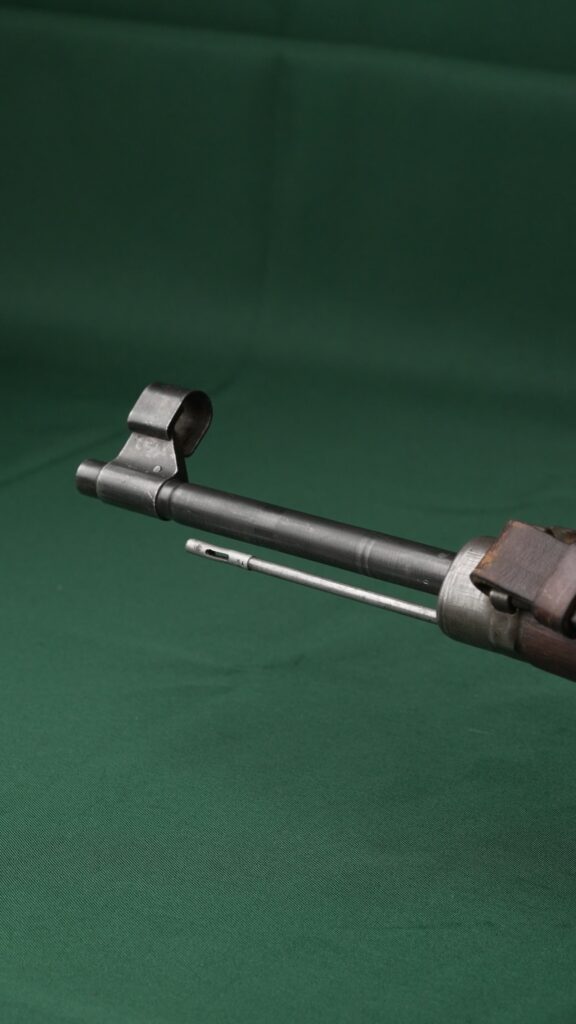
The U.S. had already made that change. The original M1 Garand used a fixed muzzle cap to trap gas. According to Army AL&T, Springfield Armory made roughly 50,000 gas trap rifles between 1936 and 1940, and starting in 1940 all new production used the gas port design. Existing rifles were to get the new parts when the barrel or gas trap assembly became unserviceable, and a small number of gas trap rifles saw service in the Second World War. For the bolt-action Mauser the G41 was meant to replace, see our article on a 1934 Kriegsmarine K98k.
On the floor at OSA
The G41(M), the Walther G41 and the K43 in these photos are part of our own collection. None of them is on the floor. These pieces in our case are related:
- 1943 Springfield Armory M1 Garand: a wartime gas port M1, the rifle the 1943 report measured the G41 against.
- BYF 41 Mauser K98k: the Kar98k, the rifle whose manual of arms the G41(M) had to keep.
- 1943 Swedish Ag m/42B Ljungman: another semi-automatic rifle from the war years, dated 1943.
- 1957 Egyptian Hakim: a postwar semi-auto chambered in 8mm Mauser, the same 7.92x57mm cartridge as the G41.
The grid below updates by itself as pieces come and go.
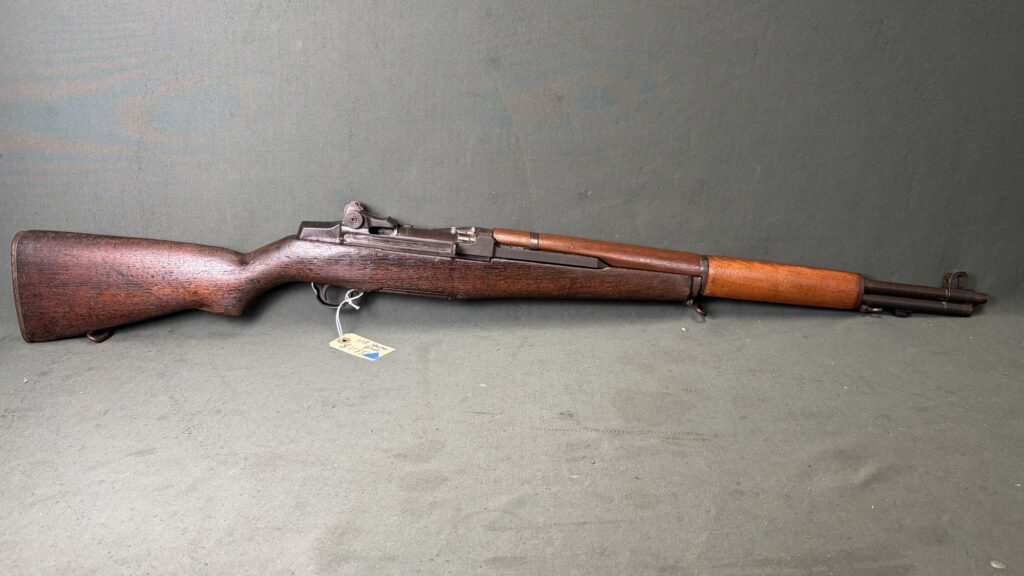 1950s Harrington and Richardson M1 Garand 30-06 with LMR 11-54 Barrel$1,185.00
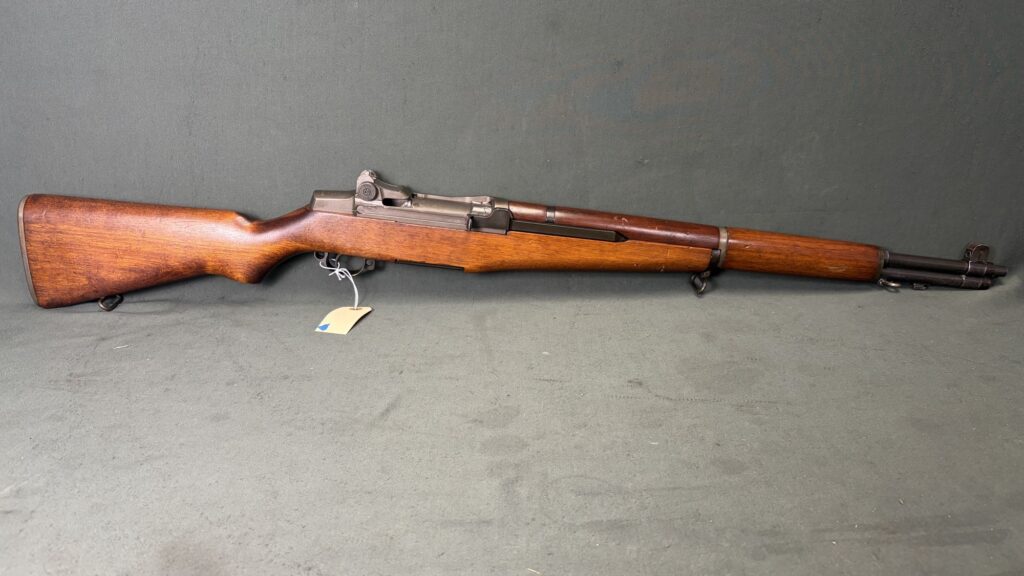 1944 Springfield M1 Garand 30-06 Letterkenny 1965 Arsenal Rebuild$1,525.00
 1942 Springfield M1 Garand 30-06 Danish Return with 1966 VAR Barrel$1,695.00
 1942 Springfield Armory M1 Garand 30-06 with Springfield Barrel and Sling$1,585.00
 1944 Springfield Armory M1 Garand 30-06 Rig with Bayonet Belt and Scabbard$1,795.00
 1943 Springfield M1 Garand 7.62 NATO, MK 2 MOD 1 Configuration, H&R$1,785.00
The short version is on our Instagram. Watch it on Instagram.
General information for collectors, not legal advice. History and specifications come from the published sources listed below; details vary between individual rifles.
Common Questions
What is the Mauser G41(M)?
A German semi-automatic rifle that Mauser built for the Army’s self-loading rifle program of the early 1940s. It traps gas at the muzzle and has a handle that turns up 90 degrees so the rifle can be worked by hand like a Kar98k.How does the G41(M) bolt-action backup work?
On the G41(M), the handle stays put during semi-auto fire. Lifted 90 degrees, it lets the shooter work the bolt by hand, and the bolt is disconnected from the return spring, so it has to be pushed forward by hand as well.What is the difference between the G41(M) and the G41(W)?
The G41(M) was Mauser’s design and the G41(W) was Walther’s. Both trapped gas at the muzzle, but the Walther used a simpler handle mounted on the bolt carrier instead of Mauser’s turn-up handle. Walther’s rifle was selected and Mauser’s was dropped.What cartridge does the G41(M) use?
The G41(M) is chambered for the standard German 7.92x57mm Mauser cartridge and holds 10 rounds in a fixed magazine.Why did the G41 use a muzzle gas trap?
The German ordnance requirements ruled out a gas port or holes in the barrel, so both G41 designs caught gas at the muzzle with a cone-shaped trap. Walther’s later G43 moved to a gas port in the barrel.What did U.S. intelligence say about the G41?
Tactical and Technical Trends No. 24, dated May 6, 1943, called the G41 “Germany’s reply to the M1” and described a 10-shot, rather heavy, gas-operated rifle using the regular 7.92mm cartridge.Did the M1 Garand also use a gas trap?
Yes. Early M1 Garands trapped gas with a fixed muzzle cap. From 1940 all new production used a gas port, and older rifles were converted as their parts wore out.Sources
- War Department, Tactical and Technical Trends No. 24 (May 6, 1943), “German Semi-Automatic Rifle,” via Lone Sentry — https://www.lonesentry.com/articles/ttt/ww2-german-semi-automatic-rifle.html (“Germany’s reply to the M1,” 10-shot, rather heavy, gas-operated, 7.92mm)
- NRA National Firearms Museum, “Gewehr 41 Semi Automatic Rifle” — https://www.nramuseum.org/guns/the-galleries/wwii,-korea,-vietnam-and-beyond-1940-to-present/case-37-wwii-the-axis,-germany-italy/berliner-luebecker-maschinenfabrik-gewehr-41-semi-automatic-rifle.aspx (Tokarev after June 1941, 41(M) and 41(W) trial designations, fixed 10-round magazines, 7.92x57mm, Mauser handle did not cycle when fired, Walther selected, Mauser design abandoned within two years, complaints about weight, handling, fouling and corrosion, G43 top gas port, Tokarev-based system, detachable magazine)
- Ian McCollum, Forgotten Weapons, “Mauser Gewehr 41(M) Manual” — https://www.forgottenweapons.com/mauser-gewehr-41m-manual/ (identical Bang-type nose caps, connecting rod and side bars, Walther ignoring the no-moving-parts-on-top rule, rotating bolt with two lugs and spiral cam, eight moving parts, K98k manual of arms, handle rotated 90 degrees, simpler handle on the G41(W) bolt carrier, made 1941 to 1942 and assembled until March 1943, Walther adopted December 29, 1942, complex, fouling and malfunction, unpopular, 11.5 lb, SVT-40 preferred, lost in Russia)
- American Rifleman, “Video—I Have This Old Gun: German G41 (M) Rifle” — https://www.americanrifleman.org/articles/2018/7/6/video-i-have-this-old-gun-german-g41-m-rifle/ (three restrictions, only Mauser respected them, overly complex, unreliable and bulky, handle disconnected the bolt from the recoil spring in manual mode)
- Army AL&T, “Perseverance Pays Off” — https://asc.army.mil/web/news-perseverance-pays-off/ (G41(M) and G41(W) both gas trap designs, M1 fixed muzzle cap, about 50,000 gas trap rifles 1936 to 1940, gas port in all new production from 1940, conversion when parts became unserviceable, a small number in WWII service)
- Wikipedia, “Gewehr 41” — https://en.wikipedia.org/wiki/Gewehr_41 (German publications on the M1, 1940 competition, Bang system cone-shaped muzzle trap)
- Wikipedia, “Gewehr 43” — https://en.wikipedia.org/wiki/Gewehr_43 (renamed Karabiner 43 in April 1944, maker codes ac for Walther and duv/qve for Berlin-Lübecker Maschinenfabrik)