
Journal · Collector’s Guide
Colt Thompson 9997 and 9998: One Serial Number Apart
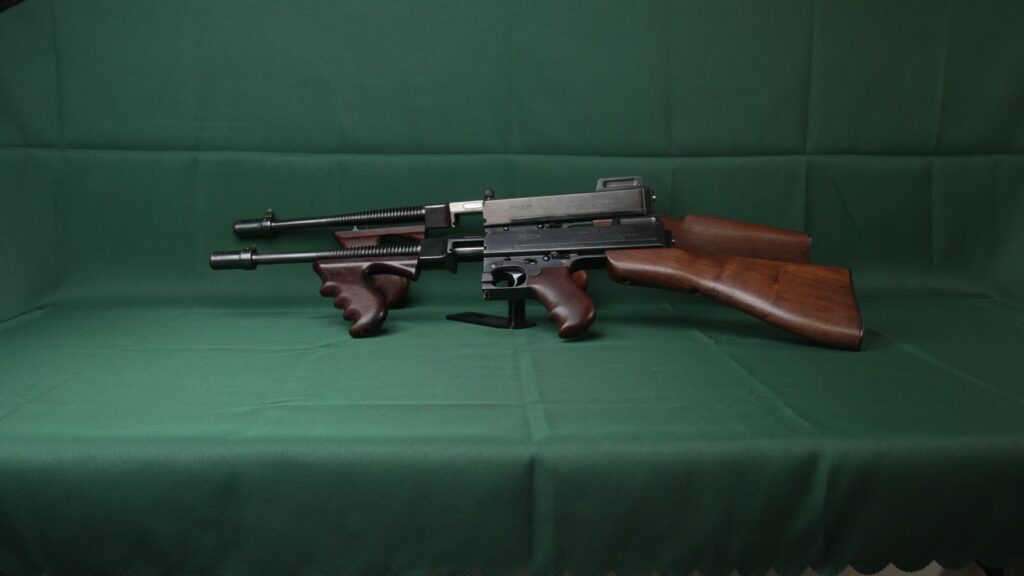
These two Colt Thompson submachine guns carry serial numbers 9997 and 9998, one number apart. They came out of the same Colt production run in the early 1920s and left years apart: 9997 to the Illinois Division of Highways in 1931, 9998 to a chief of police in Waterloo in 1934. One still reads Model of 1921. The other was converted to the slower U.S. Navy Model of 1928. And 9997 carries British proof marks whose place in its history we haven’t been able to trace. The two came to us together, as a pair, and today they sit side by side at Old Steel Arsenal as part of our own collection.
Colt Thompson production: 15,000 guns and a slow start
The Thompson began as a rifle idea. John T. Thompson, a former U.S. Army ordnance officer, set out to build a self-loading service rifle and formed the Auto-Ordnance Corporation in 1916 to develop it. His engineers found that the breech lock he had chosen, based on John Blish’s patent, would not work with a full rifle cartridge, but it did work with the .45 ACP pistol round. Thompson changed course to a compact .45 automatic weapon, and the submachine gun took his name.
Auto-Ordnance had no factory of its own, so it contracted Colt to build the guns. Colt made 15,000 of them, and every one left the factory as the Model of 1921. According to Small Arms Review, the first production gun came off the line in March 1921, after the First World War had ended.
Demand was slow. Small Arms Review says it took almost twenty years for Auto-Ordnance to place all of the original 15,000. By late 1938, according to American Rifleman, some 4,700 Colt-made Thompsons were still on hand. That is how two guns with neighboring numbers could leave years apart.
The Thompson’s gangster image is bigger than its record. Forgotten Weapons notes that the gun was not used in particularly large numbers by the bandits of the 1920s and 1930s, nor in great numbers by police; the FBI acquired only 115, and not until 1935. The famous dates below are coincidences of timing, not links in either gun’s record.
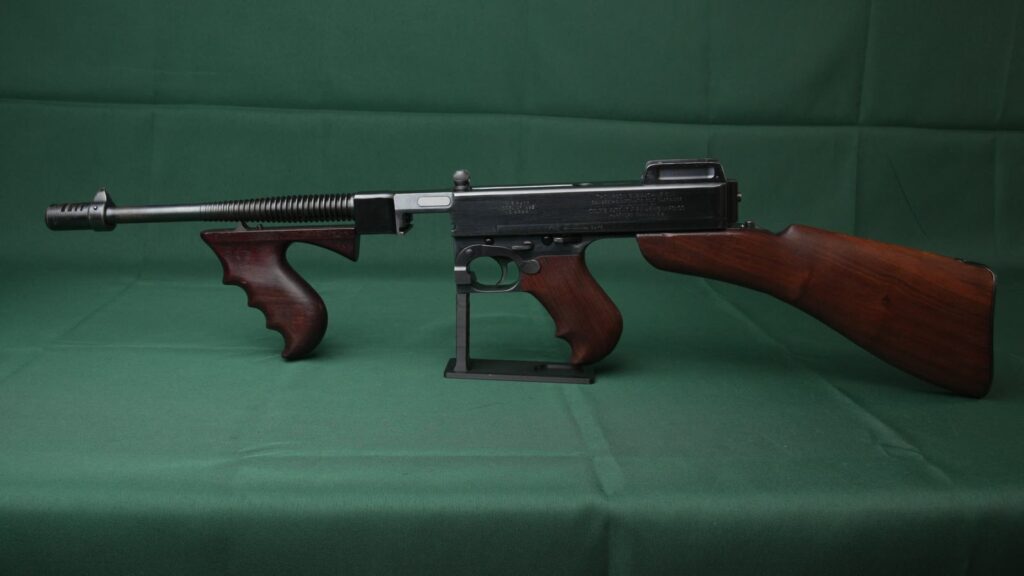
9997: Illinois, February 14, 1931
The standard serial-number reference for these guns is Gordon Herigstad’s two-volume Colt Thompson Submachine Gun: Serial Numbers & Histories. We are working from a quoted transcription of the entries for 9997 and 9998 in Volume 1, not from the printed page. As quoted, the entry lists 9997 going to the Illinois Division of Highways on February 14, 1931. That is two years to the day after the St. Valentine’s Day Massacre in Chicago, the February 14, 1929 killing of seven men in a garage on North Clark Street, in which two Thompsons were used. The date is a coincidence. Nothing in the record we have says why the state ordered the gun.
The Illinois State Police trace their founding to 1922, as the Illinois Highway Maintenance Police, and their official history notes that around 1931 gas guns and machine guns were kept as a small emergency arsenal in Springfield as gang crime continued across the state. We have not confirmed how the Division of Highways related to that force, and nothing ties 9997 to that arsenal.
9998: Waterloo, June 18, 1934
9998 waited even longer. It wears U.S. Navy on its receiver, but the quoted entry lists it going on June 18, 1934 to the chief of police in Waterloo. The entry doesn’t identify the state, and there is more than one Waterloo in America, including towns in Iowa and in Illinois.
If it was Waterloo, Iowa, the dates line up in a striking way. Eleven days earlier, on June 7, 1934, Waterloo detectives shot Tommy Carroll, a member of John Dillinger’s gang, after spotting his car parked across from the police garage. Carroll died that evening.
Eight days after 9998 went out, on June 26, 1934, the National Firearms Act was signed. It defined the machine gun in federal law and put a federal tax on machine guns. Again, that is a coincidence of dates; nothing we have ties the delivery to the new law. Our article on what “transferable” means for machine guns today picks up the story from there.
How to read Colt Thompson receiver markings
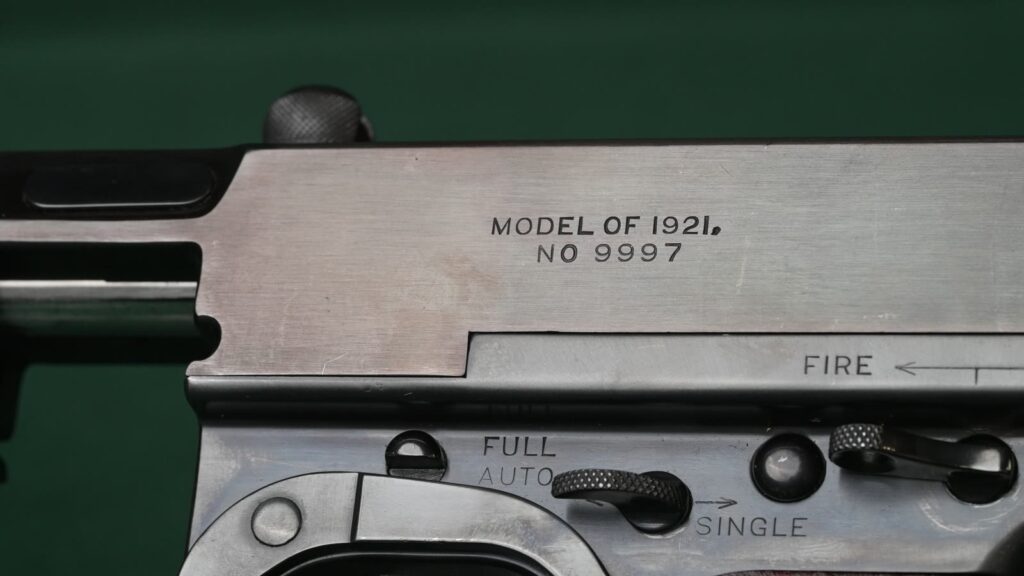
The model designation and serial number are stamped on the left side of the receiver, above the selector and safety.
On 9997 the stamp reads MODEL OF 1921 and NO 9997. That is the original Colt designation. 9997 has been refinished at some point in its life, so its blue is not the factory finish.
On 9998 the stamp reads U.S. NAVY, MODEL OF 1928, NO 9998. Look closely at the last digit of the year and you can see an 8 struck over a 1. Small Arms Review describes exactly this: every 1928 Navy conversion had the 1 in 1921 overstamped with an 8, and the words U.S. Navy were added on virtually all of them, more lightly than the factory markings. Collectors call these the 1921/28 overstamp or 28 Navy.
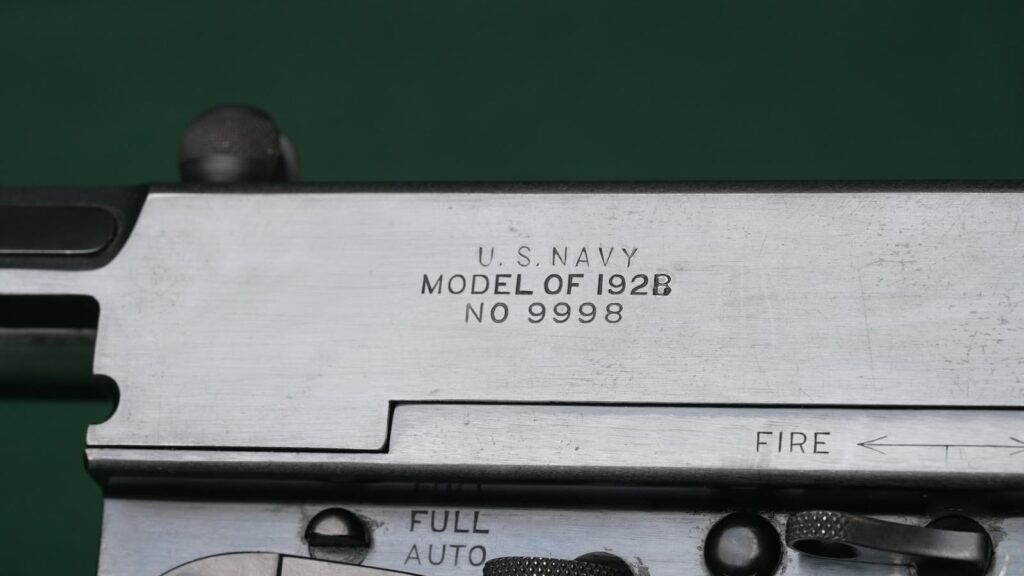
The Navy marking does not mean a gun served in the Navy. According to Small Arms Review, few 1928 Navy guns actually went to the U.S. Navy, and many went to police departments and foreign governments. 9998, listed to a city police chief, fits that pattern.
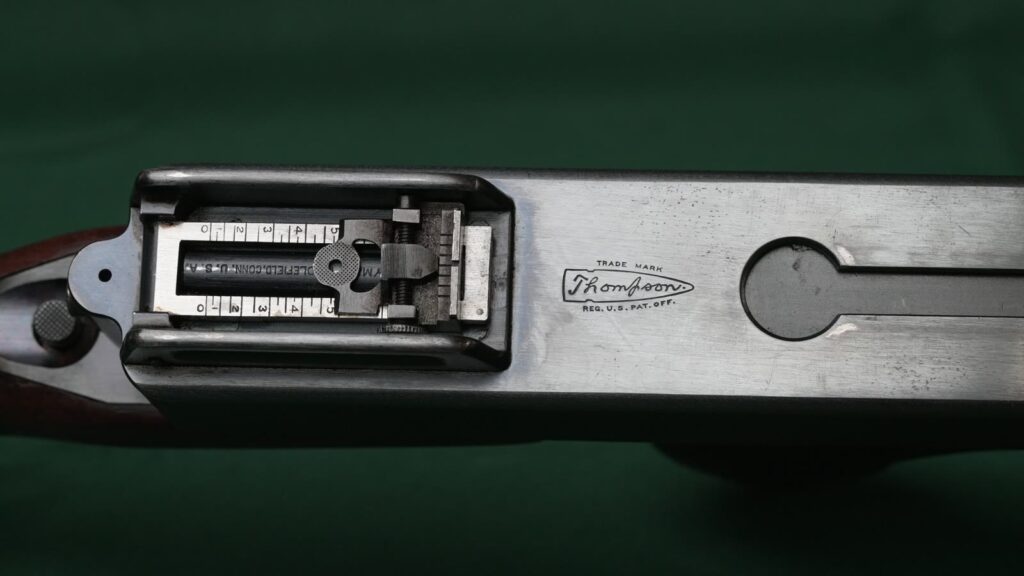
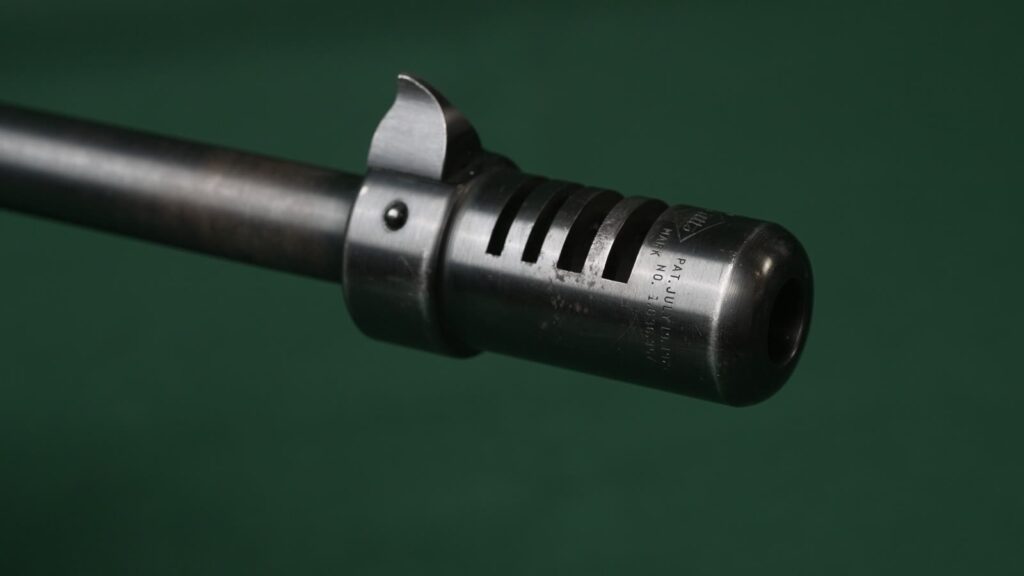
Other features are visible on this pair. The rear sight is an adjustable ladder sight, which Small Arms Review says Lyman made for Auto-Ordnance, with the Thompson trademark stamped beside it. The barrel has radial cooling fins. Both guns now wear a Cutts compensator at the muzzle. Small Arms Review notes that no Colt left the factory with one; it was offered from 1926 as an add-on, and a Model of 1921 fitted with it was called the 1921AC. The compensators and the walnut stocks on both guns are original period parts, not reproductions, though we haven’t established exactly when the compensators were fitted.
What the 1928 conversion changed
The conversion was not just a new number. The Navy asked for a lower rate of fire, for better control and less ammunition use. Small Arms Review gives the figures as from about 800 rounds per minute down to about 600; Forgotten Weapons puts the earlier rate nearer 900. Auto-Ordnance did it by adding a block of steel to the actuator, making it four ounces heavier, and by changing the recoil spring and pilot rod. The firing pin spring changed too.
Forgotten Weapons notes that most of the original 15,000 were still in inventory, so Auto-Ordnance simply converted existing guns, and the slower rate became the Thompson’s new standard.
The British proof marks on 9997
9997 has one more clue, on the barrel ring just ahead of the receiver: British proof marks. They include a crown over NP, a 45, a crown over BM, and the words NITRO PROOF.
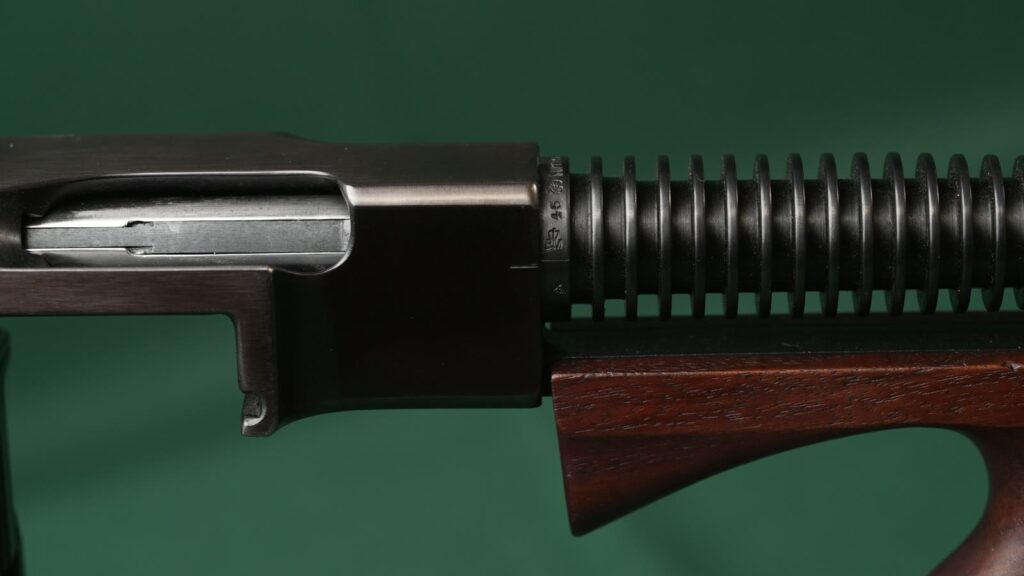
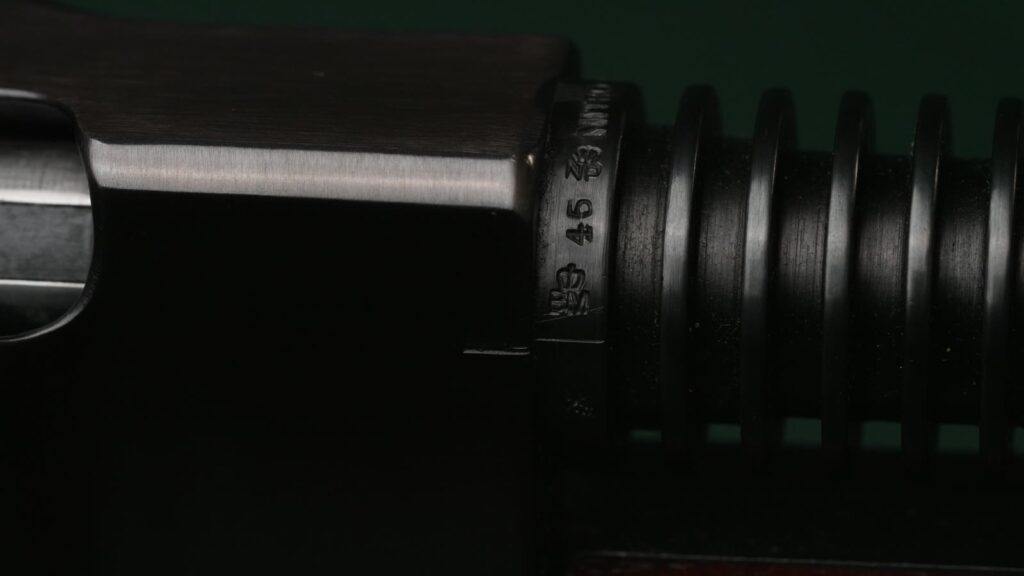
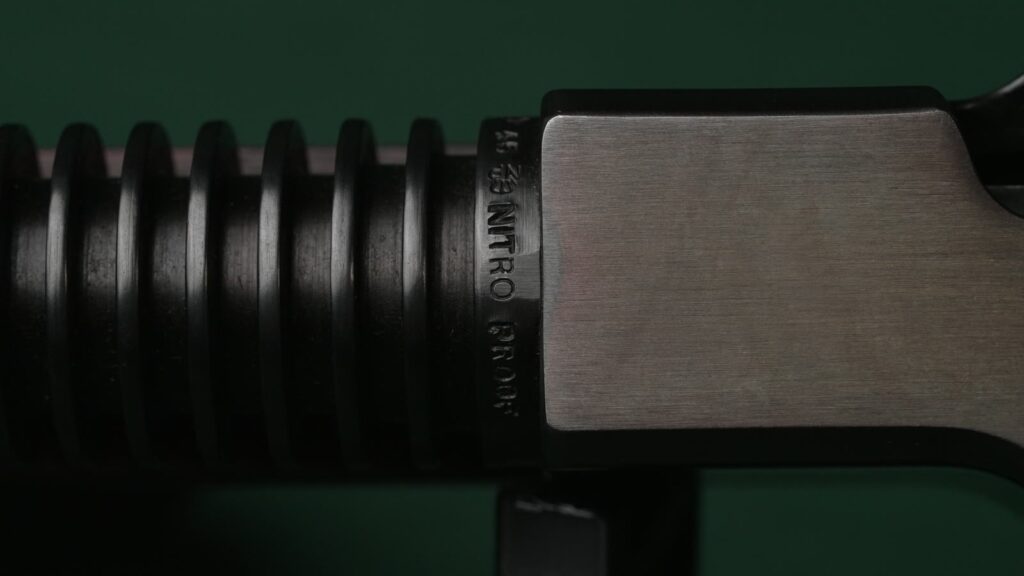
A crown over BM is a Birmingham mark. A published chart of British proof marks lists the crown over NP as Birmingham’s definitive nitro proof, used from 1904 to 1954. On the Thompson collectors’ board, one researcher identifies the crown over BM on Colt Thompsons as the Birmingham nitro proof for military firearms. A proof mark records that a barrel passed a British proof test. On its own it is not evidence of British service or combat.
What the marks can’t tell us is when, or why, this barrel went through Birmingham. Britain ordered Thompsons in quantity once war came; American Rifleman dates the first wartime order to February 1940, though Thompson researchers on the collectors’ board dispute some of the details. British inspectors also stamped export guns in the United States, but an inspection stamp is not the same thing as a proof-house mark on a barrel.
The same collectors’ thread shows the marks don’t have to mean wartime. One owner describes two 28 Navies listed to the Atlanta police department in 1934, both with British proofs, and asks how, where and when the marks got there. Another member reports a Birmingham date stamp on a British-proofed Colt pointing to 1922–23. A Thompson author in the thread, who has written on British Thompsons, believes the proofing on these Colts was most likely done in Great Britain, and notes that some Colts were used by British forces in World War II. Nobody in the thread could close the case.
Proof marks sit on the barrel, and a barrel can be changed in a hundred years. 9997 itself has been reblued at some point, and its barrel may not be the one it left Colt with. So did 9997 reach Britain during World War II, or was it proofed long before? The proof mark alone can’t tell us. We’re still looking for records.
Side by side again
As our owner put it in the video: “Honestly, it feels like a dream. If old guns have souls, I bet these two know they’re back together.”
If you’d like to see another Thompson pair we keep together, read our piece on the Shanxi Thompsons from Taiyuan Arsenal.
Specifications
| Item | Colt Thompson 9997 | Colt Thompson 9998 |
|---|---|---|
| Maker | Colt’s Patent Fire Arms Mfg. Co., for Auto-Ordnance | Colt’s Patent Fire Arms Mfg. Co., for Auto-Ordnance |
| Receiver marking | MODEL OF 1921, NO 9997 | U.S. NAVY, MODEL OF 1928, NO 9998 (8 over 1) |
| Configuration (by marking) | Model of 1921; now Cutts-equipped (1921AC pattern) | 1928 Navy conversion |
| Cartridge | .45 ACP | .45 ACP |
| Listed recipient | Illinois Division of Highways | Chief of police, Waterloo (state not given) |
| Listed date | February 14, 1931 | June 18, 1934 |
| Muzzle | Cutts compensator | Cutts compensator |
| Notable marks | British proofs: crown over BM, crown over NP, 45, NITRO PROOF | None seen in our footage |
| Finish | Refinished | Blued (originality not assessed) |
On the floor at OSA
Colt Thompsons 9997 and 9998 are part of our own collection and stay with us. If their story pulls you toward the guns around it, these pieces in our case are related:
- 1917 Webley Mark VI revolver converted to .45 ACP: a British service revolver converted to the Thompson’s cartridge.
- 1942 Kongsberg M/1914 in .45 ACP with a signed factory archive letter: another .45 ACP gun whose history is backed by paper. Read more in our Kongsberg M/1914 guide.
- DWM Police Luger P08, unit marked, with a 1933 holster: a police-issued sidearm from the same interwar years.
- 1943 Standard Products M1 Carbine: an American long gun of the Second World War, the war that revived Thompson production.
The grid below updates by itself as pieces come and go.
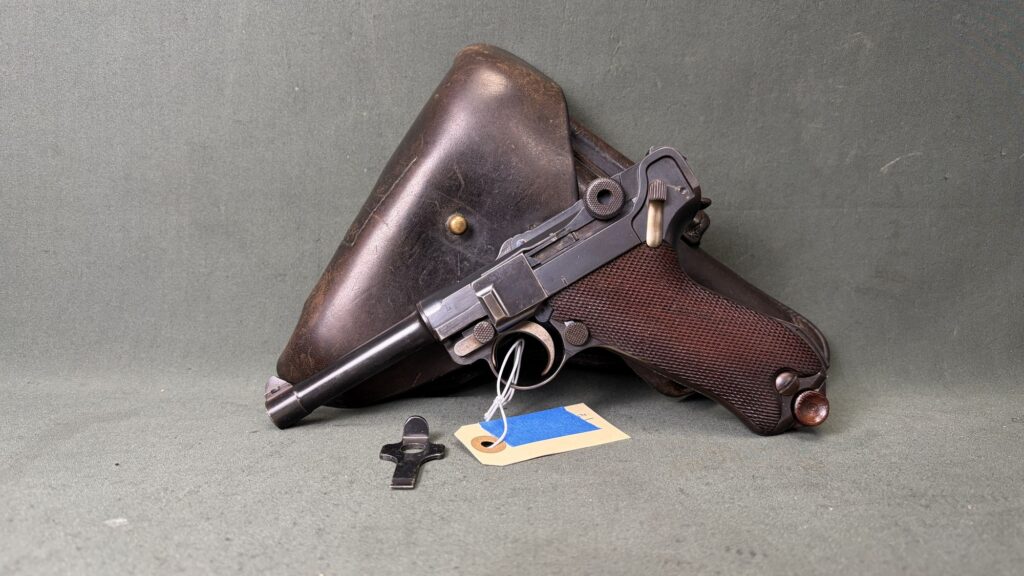 DWM Police Luger P08 9mm Unit Marked with 1933 Robert Larsen Berlin Holster$2,650.00
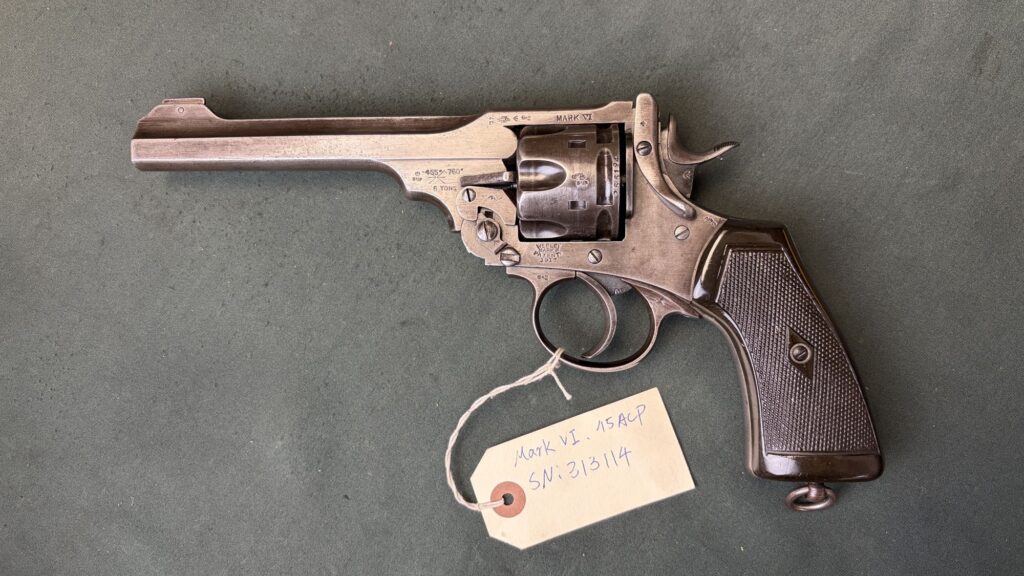 1917 Webley Mark VI Revolver .45 ACP Conversion British WWI Service Revolver$849.00
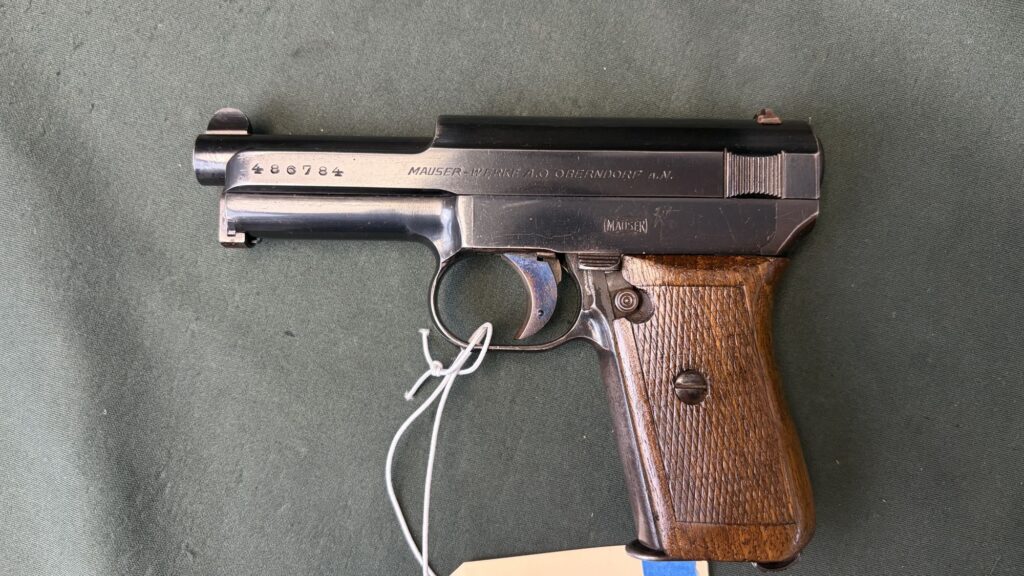 Mauser Model 1914 Pistol .32 ACP 7.65mm Excellent with Leather Holster$745.00
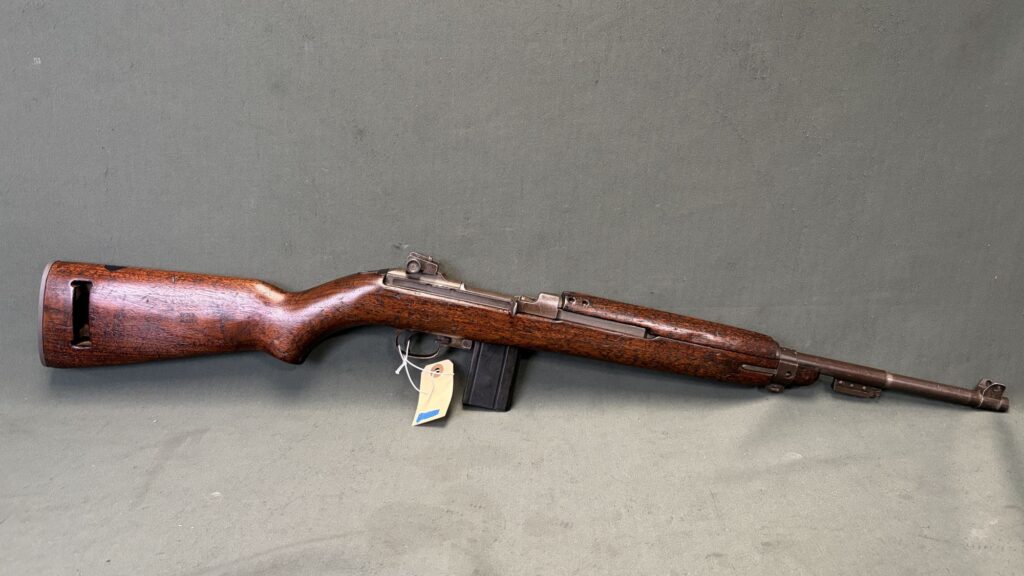 1943 Standard Products M1 Carbine .30 Carbine Underwood Barrel GHD Stock Original price was: $1,875.00.$1,650.00Current price is: $1,650.00.
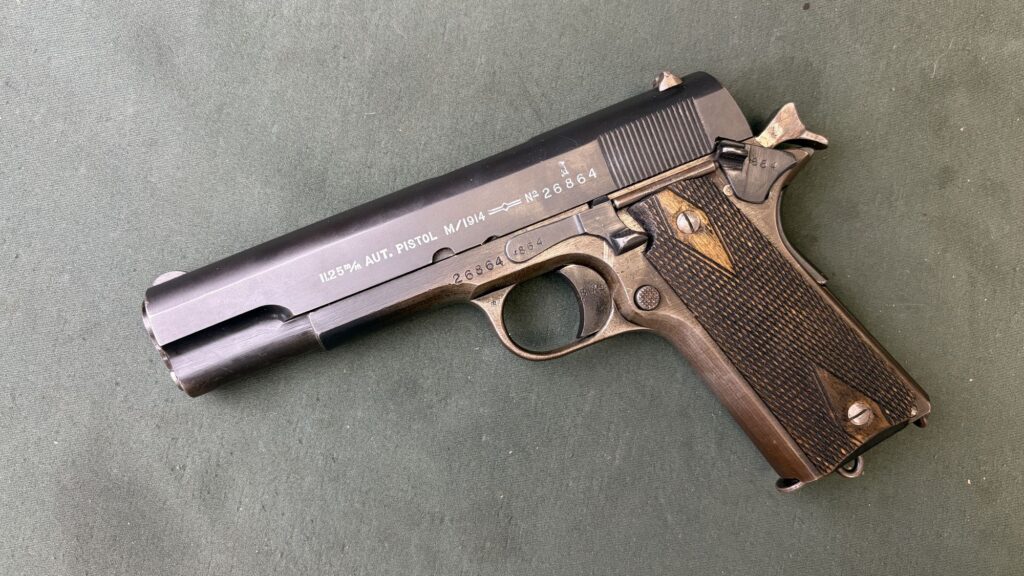 1942 Kongsberg M/1914 .45 ACP Matching with Signed Factory Archive Letter$4,950.00
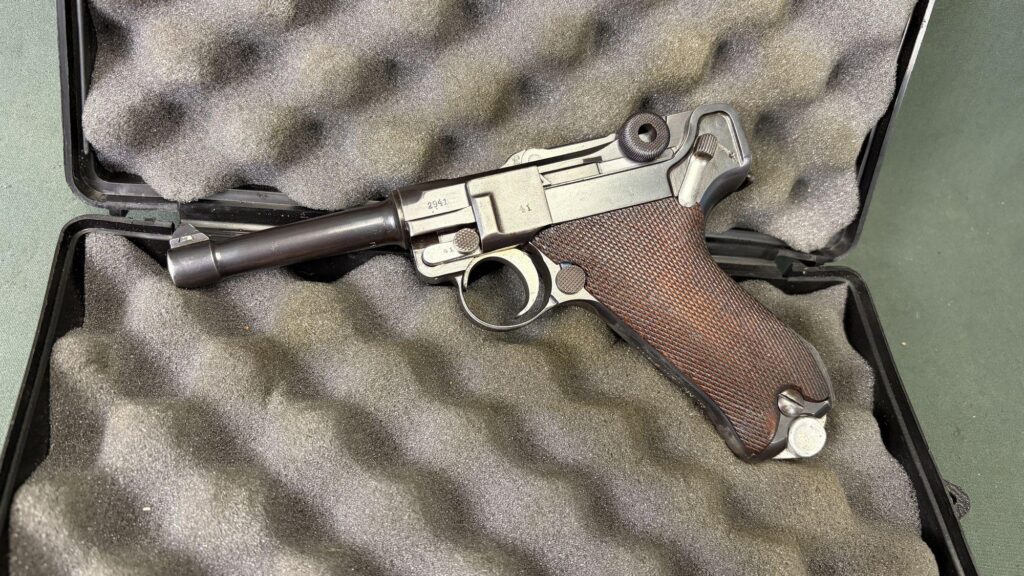 DWM P.08 Luger 9mm — 1918, Weimar Police, Matching$2,365.00
The short version is on our Instagram. Watch it on Instagram.
General information for collectors, not legal advice. The recipients and dates for 9997 and 9998 come from the published serial-number history; the entries do not explain the British proof marks on 9997, and the Waterloo entry does not name a state.
Common Questions
How many Thompson submachine guns did Colt make?
Colt made 15,000 Thompsons under contract to Auto-Ordnance, starting in 1921. All of them left the factory as the Model of 1921, and some were later converted to other models.What is a 1921/28 Navy overstamp Thompson?
It is a Colt Model of 1921 converted to the slower-firing U.S. Navy Model of 1928. The 1 in 1921 on the receiver was overstamped with an 8, U.S. Navy was usually added, and the actuator was made heavier along with a new recoil spring and pilot rod.How can I find the history of a Colt Thompson serial number?
The standard reference is Gordon Herigstad’s two-volume Colt Thompson Submachine Gun: Serial Numbers & Histories, which works through each of the 15,000 Colt serial numbers.Does a British proof mark mean a Colt Thompson served with British forces?
Not necessarily. Collectors have reported British proof marks on several Colt Thompsons, including guns listed to U.S. police departments in the 1930s. Where and when those marks were applied is still debated, and barrels can be replaced.What is the difference between a Model of 1921 and a Model of 1928 Colt Thompson?
The Model of 1928 Navy was a converted Model of 1921 with a heavier actuator, new recoil spring and pilot rod, which lowered the rate of fire. On the receiver, the 1 in 1921 was overstamped with an 8, and U.S. Navy was usually added.Sources
- Frank Iannamico, “The Thompson Submachine Gun ID Guide, Part III: The Colt Thompson Submachine Gun,” Small Arms Review — https://smallarmsreview.com/the-thompson-submachine-gun-id-guide-part-iii-the-colt-thompson-submachine-gun/ (Auto-Ordnance 1916, Blish principle, .45 ACP, Colt contract 1921, 15,000 all built as Model of 1921, first gun March 1921, almost twenty years to clear the first run, Lyman sight, finned barrel, no Cutts originally fitted, Cutts compensator from 1926 and 1921AC, Navy conversion 800 to about 600 rpm, actuator four ounces heavier, 8 over 1 and U.S. Navy markings, few went to the Navy)
- Forgotten Weapons, “The Marines’ First SMG: 1921/28 Thompson Gun” — https://www.forgottenweapons.com/the-marines-first-smg-1921-28-thompson-gun/ (Navy requested lower rate, earlier rate about 900, most of the 15,000 still in inventory, overstamp and heavier parts, slower rate became the standard, limited use by bandits and police, FBI 115 from 1935)
- American Rifleman, “The G.I. Thompson in World War II” — https://www.americanrifleman.org/content/the-g-i-thompson-in-world-war-ii/ (some 4,700 Colt-made Thompsons still on hand in late 1938, Savage production)
- American Rifleman, “The Tommy’s Thompson” — https://www.americanrifleman.org/content/the-tommy-s-thompson/ (first wartime British order February 1940, British inspectors stamping export guns)
- Gordon Herigstad, Colt Thompson Submachine Gun: Serial Numbers & Histories, Vol. 1, entries for 9997 and 9998, as quoted in a transcription we hold, not checked against the printed page (Illinois Division of Highways, February 14, 1931; City of Waterloo chief of police, June 18, 1934, state not given)
- American Rifleman, “Colt Thompson Submachine Gun: Serial Numbers & Histories” — https://www.americanrifleman.org/content/colt-thompson-submachine-gun-serial-numbers-histories (Herigstad’s serial-number reference covers all 15,000 Colts)
- Wikipedia, “Saint Valentine’s Day Massacre” — https://en.wikipedia.org/wiki/Saint_Valentine%27s_Day_Massacre (February 14, 1929, North Clark Street, seven killed, two Thompsons)
- Wikipedia, “Tommy Carroll (criminal)” — https://en.wikipedia.org/wiki/Tommy_Carroll_%28criminal%29 (killed by police in Waterloo, Iowa, June 7, 1934; car parked across from the police garage; died that evening)
- National Firearms Act, 48 Stat. 1236 — https://www.govinfo.gov/content/pkg/STATUTE-48/pdf/STATUTE-48-Pg1236.pdf (machine gun definition and federal tax, approved June 26, 1934)
- Illinois State Police, “Illinois State Police History” — https://isp.illinois.gov/Home/About (founded 1922 as Illinois Highway Maintenance Police; around 1931 machine guns stored as an emergency arsenal in Springfield)
- Shotguns.se, “British Proof” — https://shotguns.se/html/uk.html (crown over NP as Birmingham definitive nitro proof, 1904–1954)
- MachineGunBoards.com, Thompson Submachine Gun Message Board thread on British-proofed Colts (November 2015) — machinegunboards.com, topic 18586 (crown over BM as Birmingham nitro proof for military firearms; Atlanta police 28 Navies of 1934 with British proofs; Birmingham date stamp 1922–23; disputed details of the 1940 order; most likely proofed in Great Britain; Colts used by British forces in WWII)