
Journal · Collector’s Guide
Transferable Machine Guns: What the Term Means
Transferable machine guns are the registered machine guns that, under current federal law, can still pass to qualified private owners in the United States, and no new ones can be added. At Old Steel Arsenal we keep more than 200 machine guns, transferables and post-86 samples, every one federally registered, along with more than 1,000 vintage firearms. Four of them stand out: a Stoner 63A, an FG42, an StG 44, and an M240, one of only 11 transferable M240s in America as we understand it.
What are transferable machine guns?
Since 1986, federal law has closed the pool of machine guns that ordinary private owners can hold. During the final House debate on the Firearm Owners Protection Act, Representative William J. Hughes of New Jersey offered the amendment collectors still call the Hughes Amendment. Signed into law on May 19, 1986, it added 18 U.S.C. 922(o), which makes it unlawful for any person to transfer or possess a machine gun, with two exceptions. One covers the government and those acting under its authority. The other covers “any lawful transfer or lawful possession of a machinegun that was lawfully possessed before the date this subsection takes effect.”
A machine gun lawfully possessed and registered before the provision took effect can still pass between qualified private owners, subject to federal approval and state law. Under current federal law, no machine gun made after the cutoff can join them.
Our collection also includes post-86 samples, a category the law keeps out of ordinary private collections; they fall under the government-authority side of the statute.
The M240: one of a handful
The M240 is the American designation for the FN MAG, a general-purpose machine gun designed in Belgium by Ernest Vervier of FN in the 1950s. The U.S. Army adopted it in 1977, first as a coaxial gun on tanks, and slowly extended it to other roles through the 1980s and 1990s. It has served in American hands from Grenada and Panama to the Gulf War, Afghanistan and Iraq. Current guns come from FN America, the American subsidiary of FN Herstal, and from U.S. Ordnance.
As we understand it, there are only 11 transferable M240s in the entire United States, and we have one. Ours has a gray, riveted receiver.

The Stoner 63A: one receiver, many guns
Eugene Stoner had already designed the ArmaLite AR-10 and AR-15 when he left ArmaLite and began a modular weapon system in the early 1960s. The idea was a common receiver and a set of interchangeable components that could be assembled into a rifle, a carbine, or several machine gun configurations, all in 5.56mm, the cartridge Stoner had already used for the AR-15. The first models were produced in February 1963, and in March 1963 the Department of Defense’s Advanced Research Projects Agency ordered 25 in various configurations for trials.
Production moved in September 1964 to the Cadillac Gage plant in Warren, Michigan. The improved Stoner 63A went into production in 1966, and Wikipedia puts production of both versions at about 4,000. Its best-known users were the U.S. Navy SEALs in Vietnam, who often used a drum-shaped container that holds the ammunition belt on the left side. Ours wears a belt drum of that kind.
The FG42: a rifle for paratroopers
The FG 42, the Fallschirmjägergewehr 42 or “paratrooper rifle 42,” was built for Germany’s airborne troops. In 1941 the German Air Force, which controlled the paratroopers, asked for a selective-fire weapon they could carry and fight with from the moment they landed. The design that underwent military trials in mid-1942 was by Louis Stange of Rheinmetall-Borsig, who had worked on the MG 34. Production went largely to Heinrich Krieghoff Waffenfabrik, which also produced the later, revised version.
Paratroopers of the Fallschirmjäger instructional battalion carried it on the raid to free Benito Mussolini in September 1943, to try out new equipment. It stayed in service only from 1943 to 1945, and roughly 7,000 were made. Telescopic sights for it were the ZFG42 or the ZF4; ours carries a ZFG42.

The StG 44: the first assault rifle in mass production
The StG 44, Sturmgewehr 44 or “assault rifle 44,” was designed by Hugo Schmeisser and chambered for the 7.92×33mm Kurz, an intermediate cartridge shorter than the full-power rifle round of the day. The idea went back to 1918, when a German officer argued for an intermediate round; the ammunition maker Polte of Magdeburg was commissioned to develop one in April 1938.
It grew out of Haenel’s MKb 42(H), one of two competing trial designs, was issued as the MP 43 and MP 44, “machine pistols,” for political reasons, and was renamed Sturmgewehr 44 after its success on the Eastern Front. It was the first assault rifle accepted into widespread service and mass production, and Wikipedia puts production across all variants at 425,977 rifles by the end of the war.

All Alpha Armory, our private range
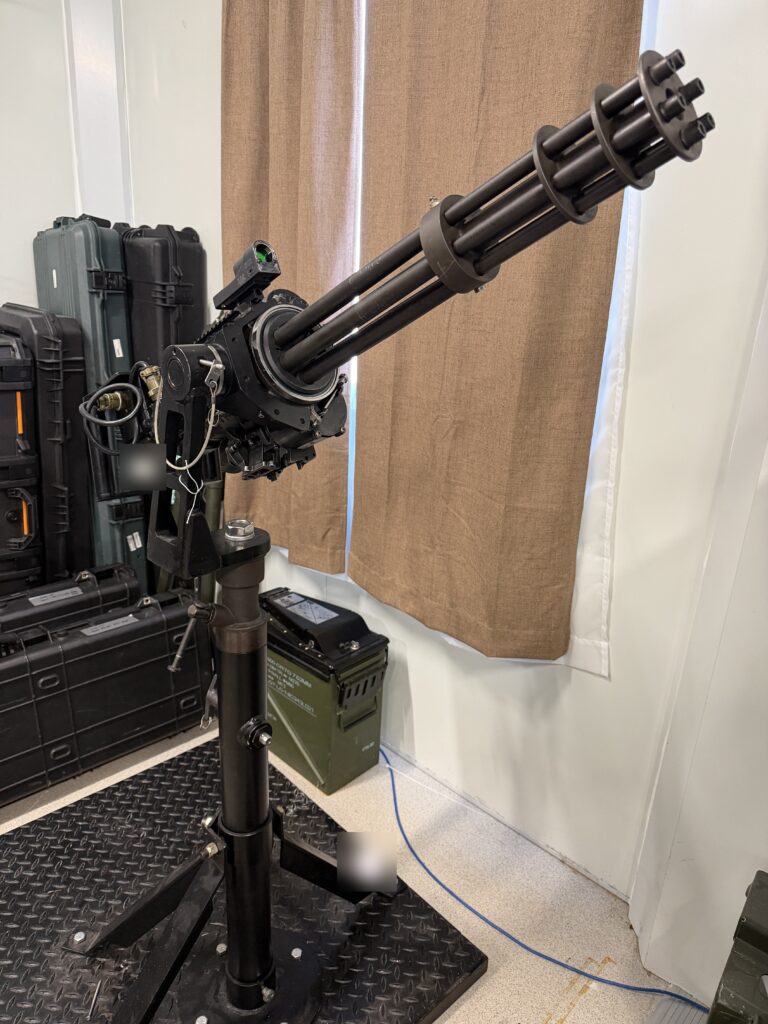
Our machine guns have a home range: our own private range, All Alpha Armory. The collection goes well past the four above, and past machine guns: there are more than 1,000 vintage firearms in it. Among the other machine guns are a .50-caliber gun on its tripod and a six-barrel rotary gun on a pedestal mount.
The four at a glance
| Gun | Origin | Designer | Key date | Cartridge |
|---|---|---|---|---|
| M240 (FN MAG) | Belgium | Ernest Vervier, FN | U.S. adoption, 1977 | 7.62×51mm NATO |
| Stoner 63A | United States | Eugene Stoner, with L. James Sullivan and Robert Fremont | 63A production, 1966 | 5.56×45mm |
| FG 42 | Germany | Louis Stange | In service, 1943 | 7.92×57mm |
| StG 44 | Germany | Hugo Schmeisser | In service as MP 43, 1943 | 7.92×33mm Kurz |
On the floor at OSA
Every gun in this video is part of the Old Steel Arsenal collection. If the history of these four interests you, these pieces on the floor at Old Steel Arsenal are connected to them:
- FN Hi Power, 9mm and a 1979 FN Browning Hi Power in two-tone: made by FN, the Belgian company behind the MAG that became the M240.
- Colt Sporter Competition HBAR: an AR-15, the rifle Eugene Stoner designed before the Stoner 63.
- 1941 Mauser Borsigwalde ar 41 Karabiner 98k: the German service rifle of the same war as the FG42 and StG 44, in the full-power 8mm Mauser round. Our guide to K98k maker codes explains how to read one.
The grid below updates by itself as pieces come and go.
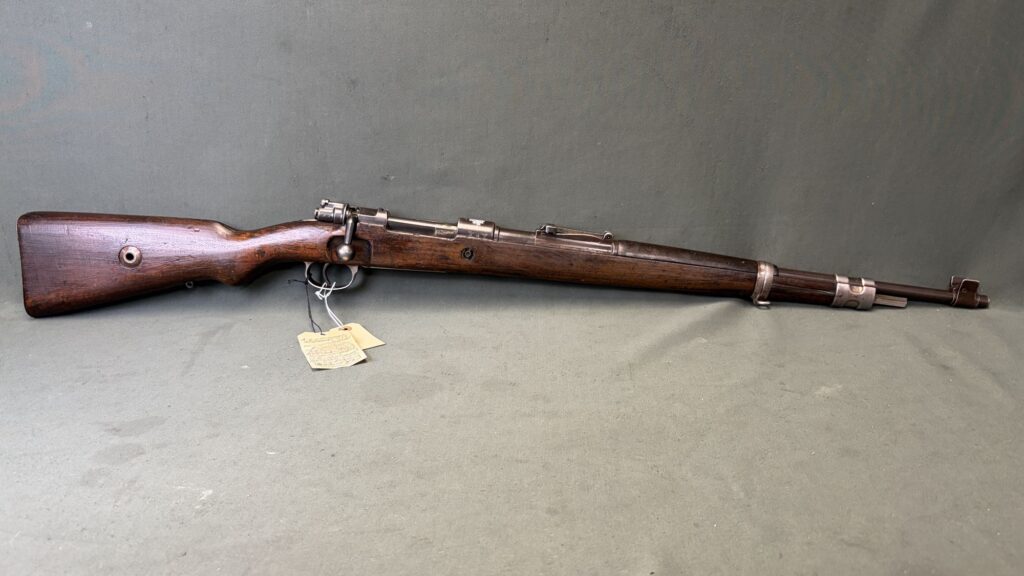 1937 Portuguese Contract Mauser Kar98k 8mm All Matching Portuguese Crest Waffenamt Marked$1,300.00
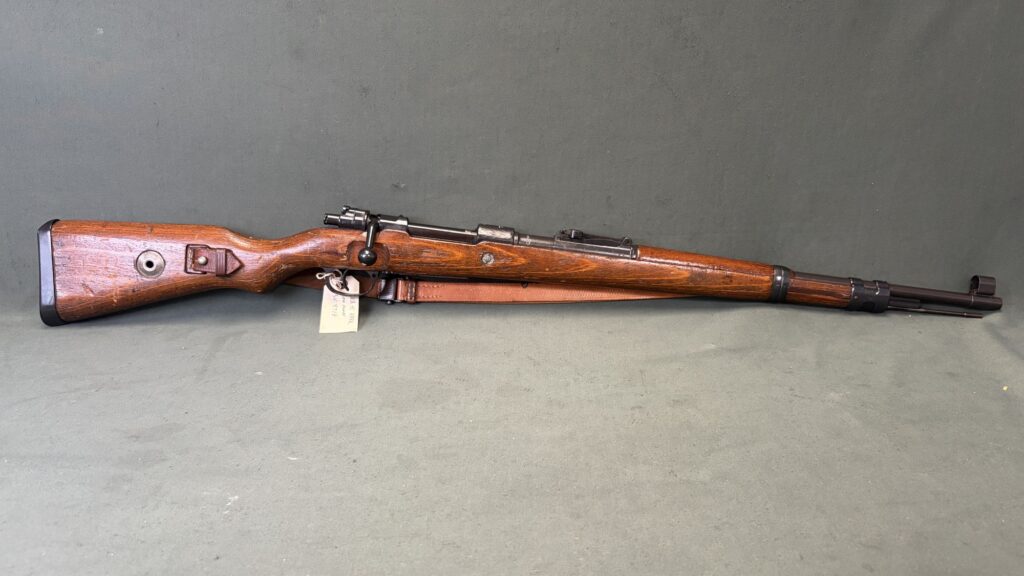 1941 bnz Steyr K98k 8mm Mauser Complete with Sight Hood Cleaning Kit and Sling$1,265.00
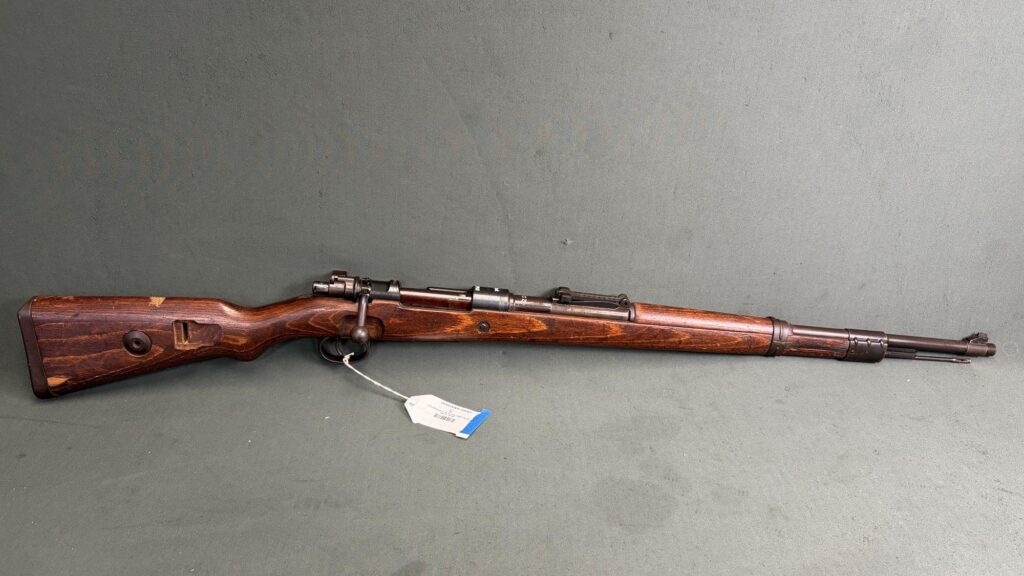 German K98k 8mm — ‘dot’ 1943 Brünn, Non-Import$1,345.00
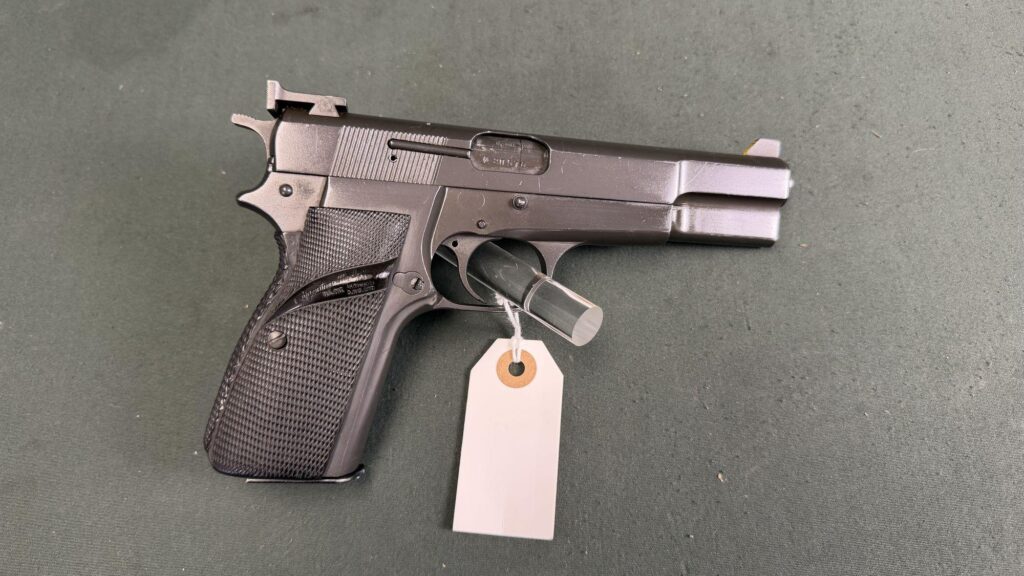 Hi Power 9MM PARA$979.00
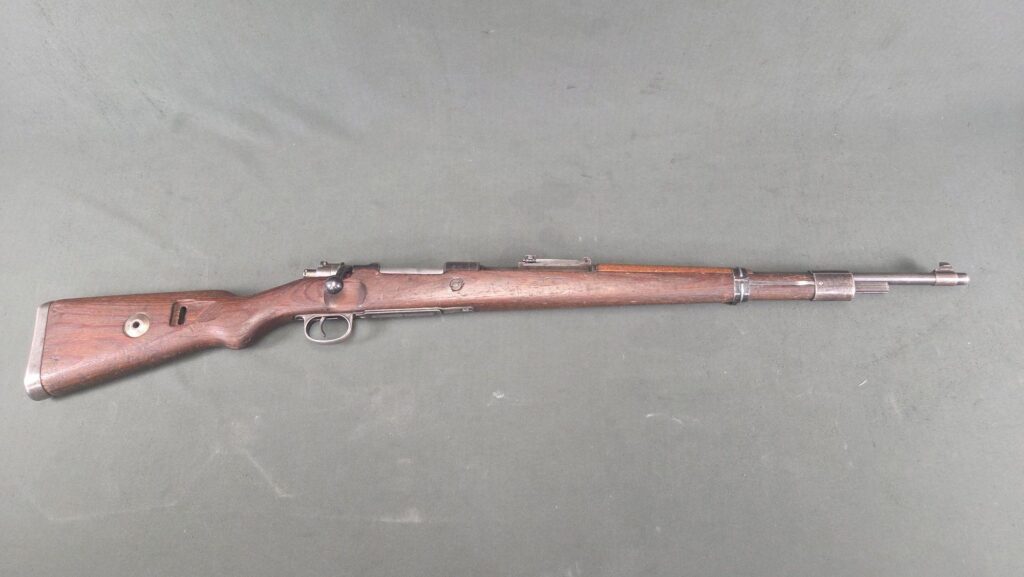 DOT 44 K98k rifle 8mm Mauser$1,285.00
 Colt Sporter Competition HBAR$1,475.00
General information for collectors, not legal advice. Machine gun ownership is regulated under federal and state law; talk to a qualified attorney before acting on anything here.
Common Questions
What is a transferable machine gun?
A transferable machine gun is one that was lawfully possessed and registered before 18 U.S.C. 922(o), the machine gun provision of the Firearm Owners Protection Act, took effect on May 19, 1986. Those can still pass to qualified private owners, subject to federal approval and state law.What is the Hughes Amendment?
The Hughes Amendment, offered by Representative William J. Hughes, added 18 U.S.C. 922(o) to the Firearm Owners Protection Act of 1986. It makes it unlawful to transfer or possess a machine gun except under government authority or if it was lawfully possessed before the provision took effect.What is a post-86 sample?
A post-86 sample is a machine gun in a category the 1986 law keeps out of ordinary private collections. It falls under the government-authority side of the statute rather than the exception for machine guns lawfully possessed before the cutoff.How many transferable M240s are there?
As we understand it, there are only 11 transferable M240s in the United States, and one is in the Old Steel Arsenal collection.What was the FG42 designed for?
The FG 42 was designed for German paratroopers, who needed a selective-fire weapon they could carry and fight with on landing. About 7,000 were made, and it served from 1943 to 1945.Why is the StG 44 called the first assault rifle?
The StG 44 was the first assault rifle accepted into widespread service and mass production. It fired the 7.92×33mm Kurz, an intermediate cartridge shorter than the full-power rifle rounds of its day.Sources
- Old Steel Arsenal: collection size, the M240’s transferable status and the count of 11 transferable M240s are the shop’s own statements, not independently verified
- 18 U.S.C. 922(o), via Cornell Legal Information Institute — https://www.law.cornell.edu/uscode/text/18/922 (unlawful to transfer or possess a machine gun, exceptions for government authority and for machine guns lawfully possessed before the effective date; 922(o) effective May 19, 1986)
- Wikipedia, “Firearm Owners Protection Act” — https://en.wikipedia.org/wiki/Firearm_Owners_Protection_Act (signed May 19, 1986; Rep. William J. Hughes and House Amendment 777 adding 922(o))
- Wikipedia, “M240 machine gun” — https://en.wikipedia.org/wiki/M240_machine_gun (FN MAG, designer Ernest Vervier, 1950s, U.S. adoption 1977 as a coaxial tank gun, wider adoption in the 1980s and 1990s, wars, FN America and U.S. Ordnance)
- Wikipedia, “Stoner 63” — https://en.wikipedia.org/wiki/Stoner_63 (Stoner’s AR-10 and AR-15, modular concept, 5.56×45mm, first models February 1963, ARPA order of 25 in March 1963, Cadillac Gage from September 1964, 63A from 1966, about 4,000 of both versions, drum-shaped belt containers used by SEALs, designers Stoner, Sullivan and Fremont)
- Wikipedia, “FG 42” — https://en.wikipedia.org/wiki/FG_42 (paratrooper rifle, Luftwaffe request 1941, Louis Stange of Rheinmetall-Borsig, MG 34, production largely by Krieghoff, Krieghoff revision, Mussolini raid September 1943, service 1943–1945, about 7,000 built, ZFG42 or ZF4 sights)
- Wikipedia, “StG 44” — https://en.wikipedia.org/wiki/StG_44 (Hugo Schmeisser, 7.92×33mm Kurz, Piderit’s 1918 paper, Polte commission April 1938, MKb 42(H) and MKb 42(W), MP 43 and MP 44 names and renaming, first assault rifle in widespread service and mass production, 425,977 produced)