
Journal · Collector’s Guide
Mauser C96 vs Astra 900: The Spanish Broomhandle
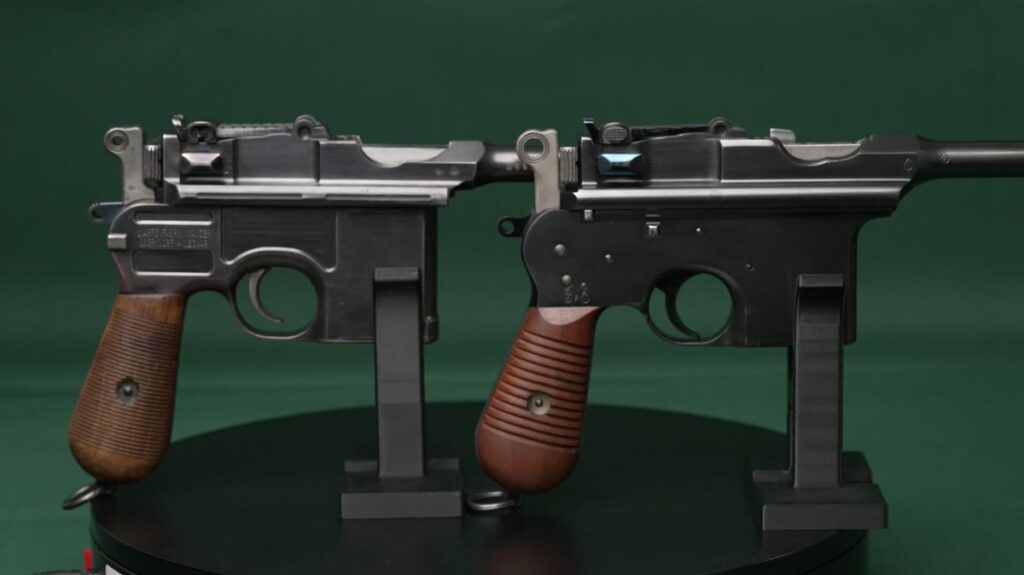
Spain built its own copy of the Mauser Broomhandle, and the Astra 900 is one of them. Our Astra 900 and our Mauser C96 share the same outline, the same 7.63 Mauser round, the same 10-round stripper clip and even the same safety beside the hammer. The quickest way to tell them apart is the right side of the frame: the German gun shows no pins there, the Astra shows its pins. In China, the Astra was known as the seven-pin box cannon.
Why Spain copied the Broomhandle
Mauser introduced the C96 in 1896. It could be fired as an ordinary pistol, carried in its wooden holster, or clipped to that holster as a shoulder stock and used as a short carbine. In China, that box-like wooden stock helped give the gun its local name, “box cannon.”
After World War I, China was split between rival warlords, and every one of them needed arms. In 1919, several foreign powers, Spain among them, signed an arms embargo meant to keep weapons of war out of China. According to American Rifleman, handguns were left out of the agreement. Forgotten Weapons adds that stocked pistols, even fully automatic ones, were not counted as military arms. A pistol with a stock was the loophole, and the C96 was the pistol China wanted.
Chinese arsenals such as Hanyang and Shanghai made their own copies, and Spanish makers in the Basque country saw the opening too. Beístegui Hermanos of Eibar had its Model H, marked with the “Royal” name, in production by 1926. Unceta y Compañía of Guernica, the maker of Astra pistols, followed. American Rifleman reports that Astra finished its first 900-series pistols in December 1927.
According to American Rifleman, Spanish patent law would have allowed an exact copy of the C96, but Beístegui chose an outwardly similar pistol with different mechanics, quicker to produce. Astra did the same. Its 900 shared the C96’s small ring hammer, 7.63 Mauser chambering, fixed 10-round magazine loaded by stripper clip, tangent rear sight and matched wooden stock, with distinctive mechanical differences inside.
What the Astra 900 and Mauser C96 share
Put the two side by side and the shared features line up one after another.
Same round, same clip. Both guns are chambered for 7.63 Mauser and load through the top of the open action from a 10-round stripper clip. Neither has a detachable magazine.
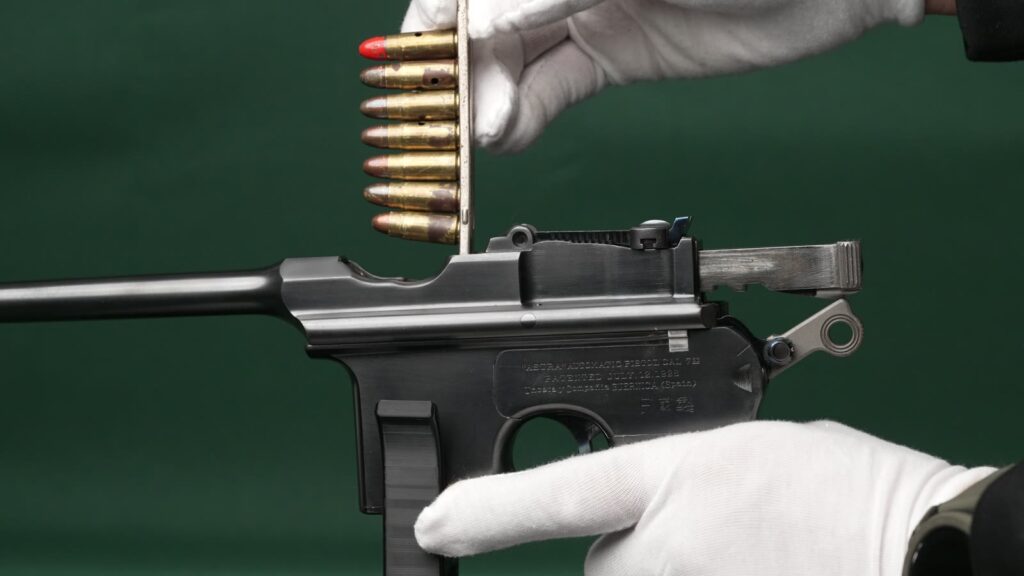
Same safety. On both of our guns the safety lever sits beside the hammer at the rear of the frame, and it works the same way.
How to read the markings on the Mauser C96 and the Astra 900
The markings tell you which gun you are holding before you ever look inside.
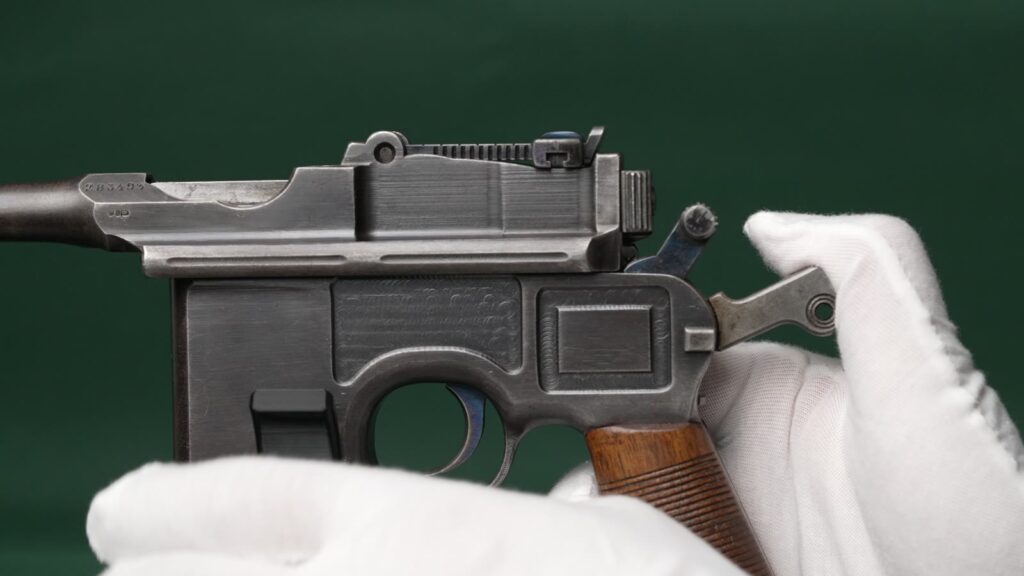
The Mauser. Our C96 is marked on the right side of the frame: WAFFENFABRIK MAUSER, OBERNDORF A NECKAR. That is the Mauser name and its hometown, Oberndorf on the Neckar river in Germany.
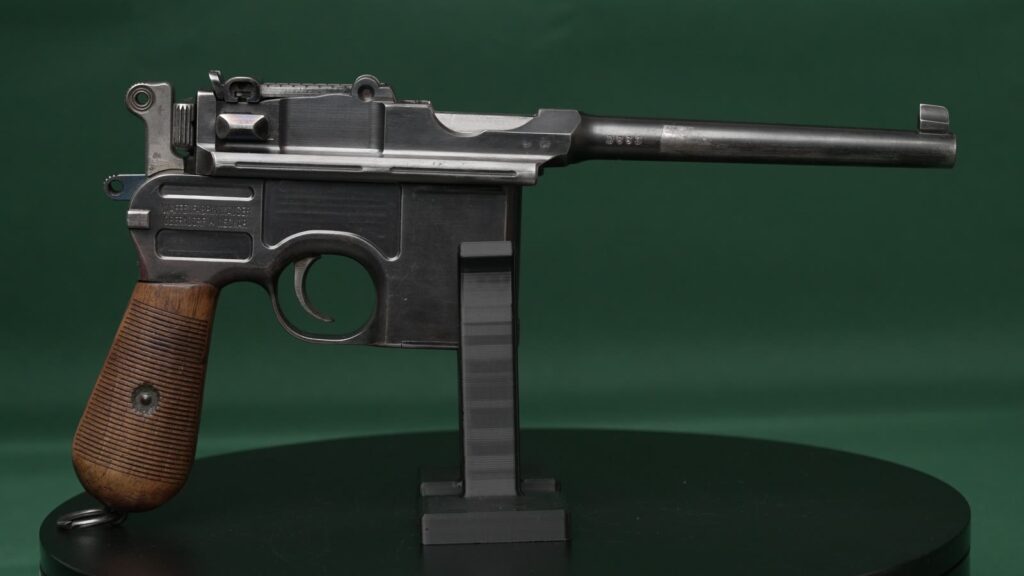
The Astra. Our Astra 900 carries its marking on the left side plate, in three lines:
- “ASTRA” AUTOMATIC PISTOL CAL 7.63
- PATENTED JULY 12 1928
- Unceta y Compañía GUERNICA (Spain)
Below that are three Chinese characters. According to American Rifleman, Astra set up its own company in Shanghai in 1929 to deal directly with Chinese customers, and a few years later began marking the side plate of a number of its 900s with Chinese characters meaning “Made in Spain.” Our gun was made around 1933. The July 12, 1928 date is the patent date, not the date of manufacture.
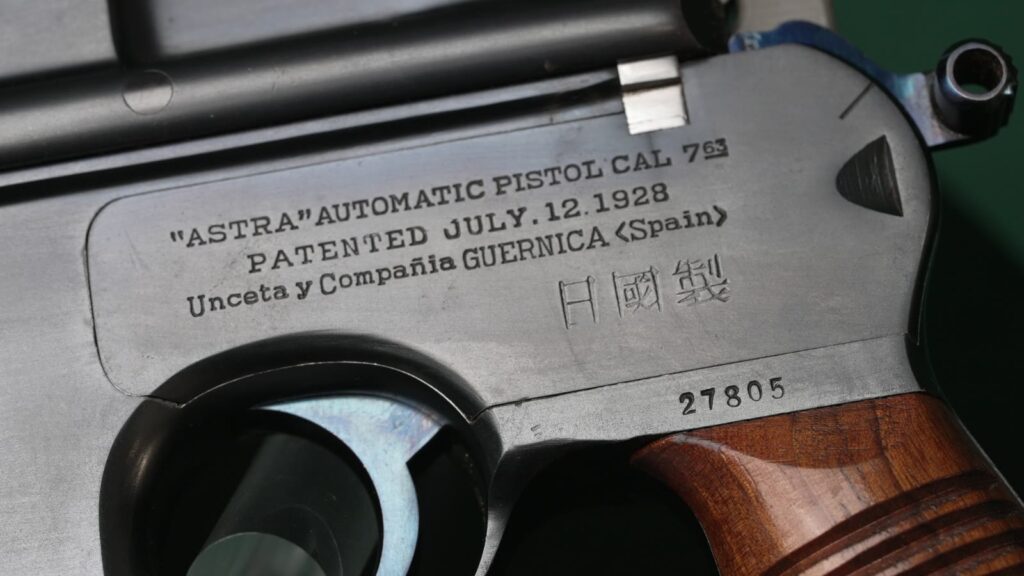
If you find an Astra with that Chinese marking, it was built with China in mind, and China is where Astra aimed the 900.
How to tell a Mauser C96 from an Astra 900
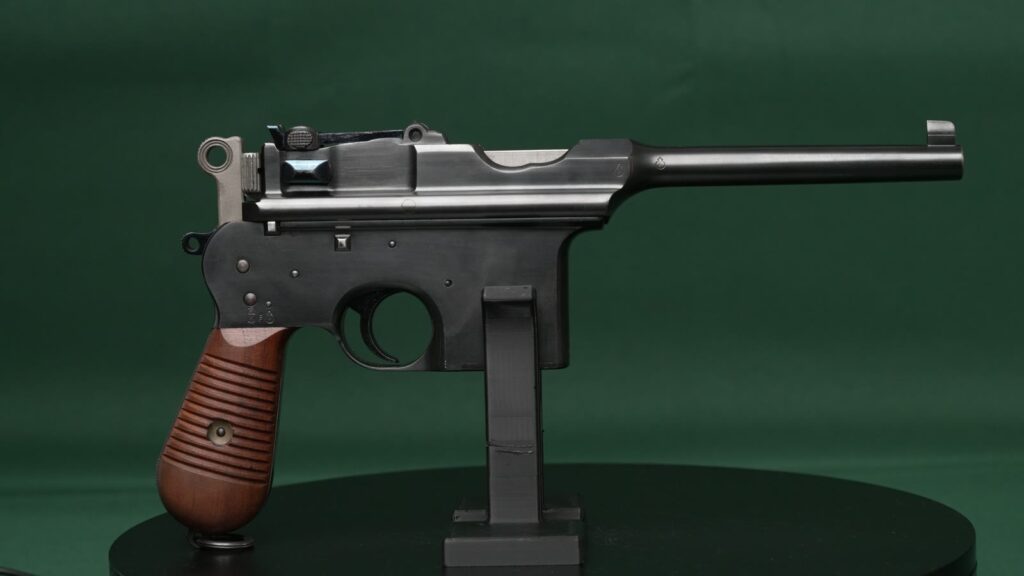
The fastest way to tell a C96 from an Astra 900 is to look at the right side of the frame.
On our Mauser, there are no pins through the frame. The frame is not plain. It has milled panels and grooves, but nothing holds the lockwork in from the outside. On the Astra, you can see pin heads in the frame. In China, people called the Astra the seven-pin box cannon, after the pins that show on its frame. Box cannon comes from the wooden holster that doubles as its stock.
This check works for the Astra 900. Not every Spanish copy shows it: according to American Rifleman, Beístegui’s later Royal MM31 even took apart like a Mauser.
How the C96 lockwork works without pins
Inside the Mauser, the lockwork is one block of parts that hold each other together. According to Sportsman’s Vintage Press, the C96 uses no holding pins, and the only screw in the gun is the one that holds the grips. The hammer, sear, mainspring and their linkage sit in a separate lock frame that slides into the main frame as a unit. Push the barrel and lock frame out, and in good condition the parts stay together on their own, as 1896mauser.com shows in its disassembly guide.
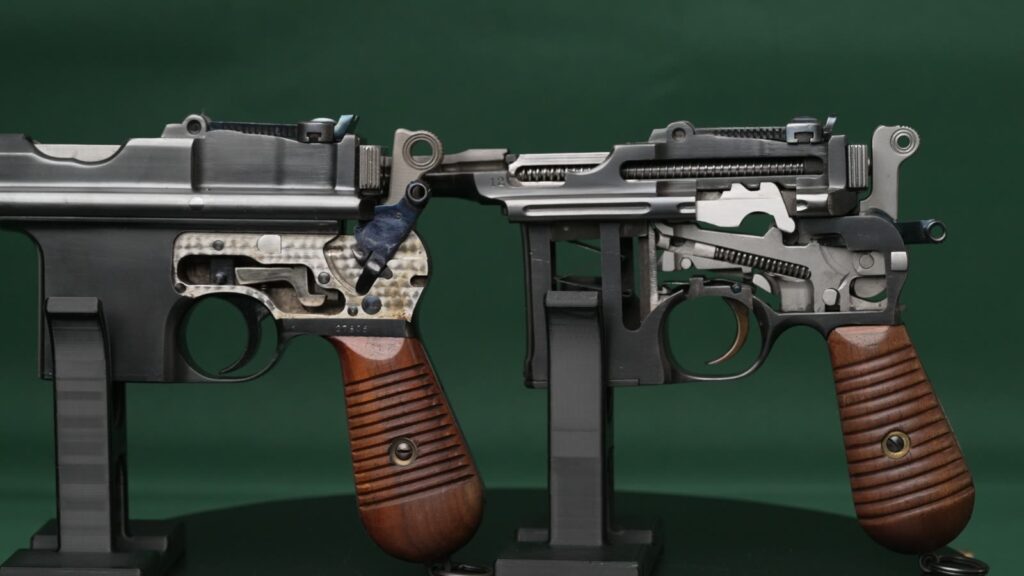
To show those Mauser parts in place, someone had to cut windows in a C96. We covered that pistol in our Mauser C96 cutaway guide.
How the Astra 900 side plate comes off
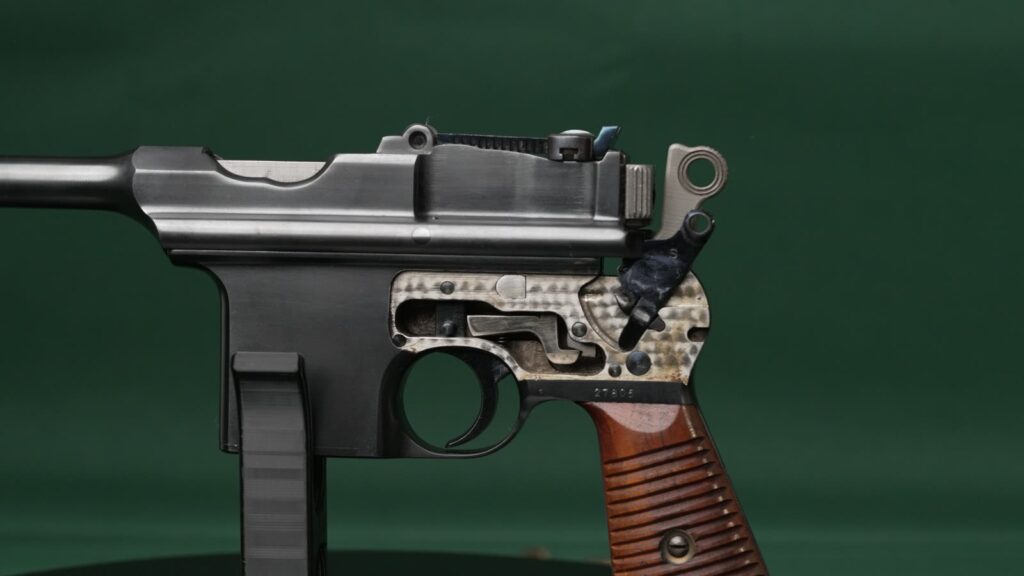
The Astra went another way. Its left side plate comes off, like a door. According to American Rifleman, pushing out a single pin lets the side plate slide off the frame and exposes the lockwork. Inside, you can see the pins the parts pivot on. American Rifleman also lists other mechanical changes from the Mauser: a pinned locking block, a screwed-in barrel and a separate barrel return spring.
From the semi-auto 900 to the Mauser 712
Our Astra 900 is semi-automatic. The full-auto broomhandles came from Spain first.
According to American Rifleman, Beístegui introduced a selective-fire version of its Model H in late 1927, and Astra answered with its Model 901 in 1928. Its 902 added a fixed 20-round magazine, and the 903 took detachable magazines.
In 1932, Mauser answered with its own machine pistol, the Model 712 Schnellfeuer. Forgotten Weapons calls the 712 “Mauser’s answer” to the Spanish select-fire lookalikes. We cover that pistol in our Mauser M712 Schnellfeuer guide.
Which one our owner prefers
We keep plenty of broomhandles, and this Astra rounds out the collection. Our owner, who put both guns in front of the camera, still leans German:
“Nobody builds guns quite like the Germans.”
The Mauser design reached further than China, too. Han Solo’s blaster in Star Wars was built on a Mauser C96, with a shortened barrel, a flash hider and a scope added.
Specifications
| Item | Mauser C96 | Astra 900 |
|---|---|---|
| Maker | Waffenfabrik Mauser, Oberndorf am Neckar, Germany | Unceta y Compañía (Astra), Guernica, Spain |
| Introduced | 1896 | December 1927 |
| Our example | Commercial C96, maker’s mark on right side | Made around 1933, Chinese “Made in Spain” mark |
| Cartridge | 7.63 Mauser | 7.63 Mauser |
| Action | Semi-automatic | Semi-automatic |
| Magazine | 10 rounds, fixed, loaded by stripper clip | 10 rounds, fixed, loaded by stripper clip |
| Safety | Lever beside the hammer | Lever beside the hammer |
| Lockwork | Separate lock frame, no holding pins | Pinned to the frame, under a removable left side plate |
| Stock | Wooden holster that doubles as a shoulder stock | Wooden holster that doubles as a shoulder stock |
| Chinese nickname | Box cannon | Seven-pin box cannon |
On the floor at OSA
Both guns in this video, the Mauser C96 and the Astra 900, are part of our own collection and stay with us. A few pieces in our case are related:
- WWI Imperial German Mauser C96 Broomhandle, a separate World War I era C96 with an NS-marked hammer, all matching. It is not the C96 in our photos, but the same German design.
- Mauser Model 1914 pistol, .32 ACP, a much smaller pocket pistol from the same Oberndorf company that made the C96.
- Spanish M43 Mauser short rifle, 8mm, another Mauser design built in Spain, this time a bolt-action rifle.
The grid below updates by itself as pieces come and go.
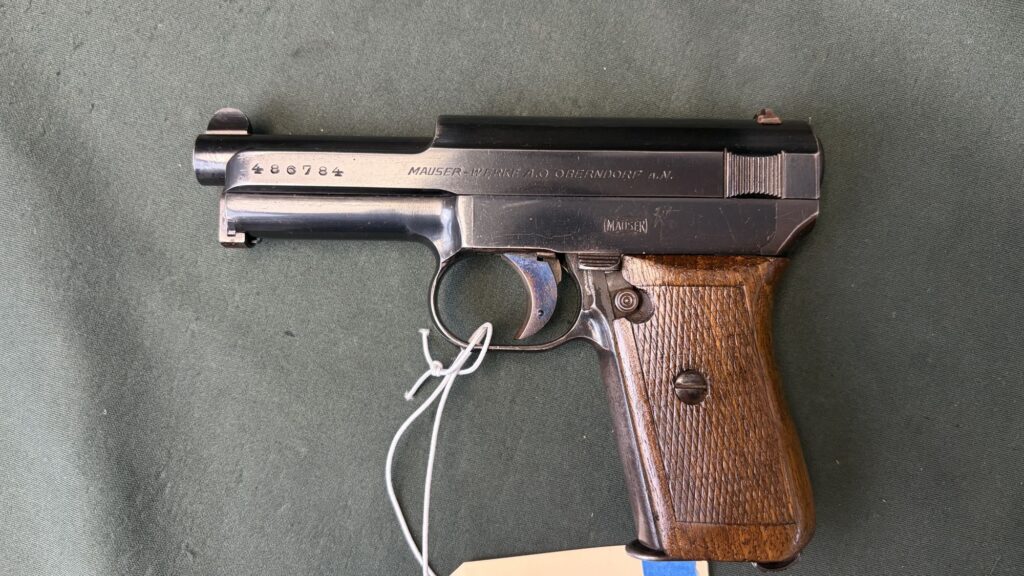 Mauser Model 1914 Pistol .32 ACP 7.65mm Excellent with Leather Holster$745.00
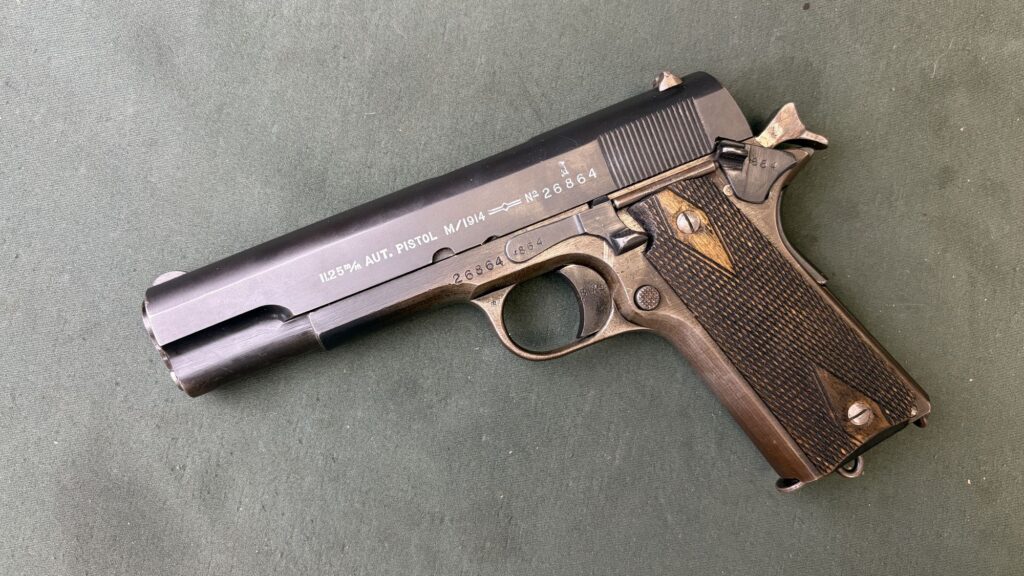 1942 Kongsberg M/1914 .45 ACP Matching with Signed Factory Archive Letter$4,950.00
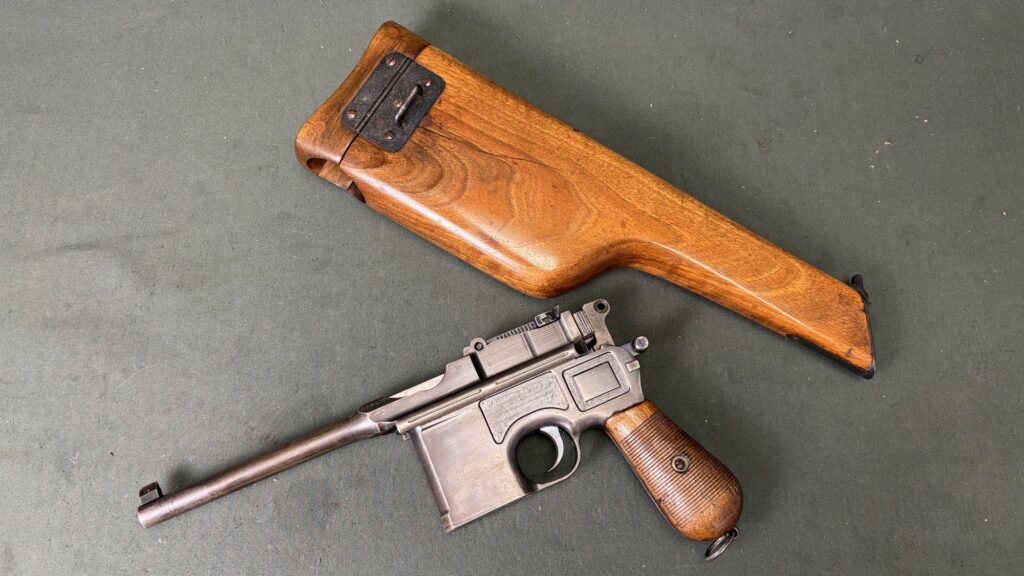 WWI Imperial German Mauser C96 Broomhandle All Matching NS Hammer$3,589.00
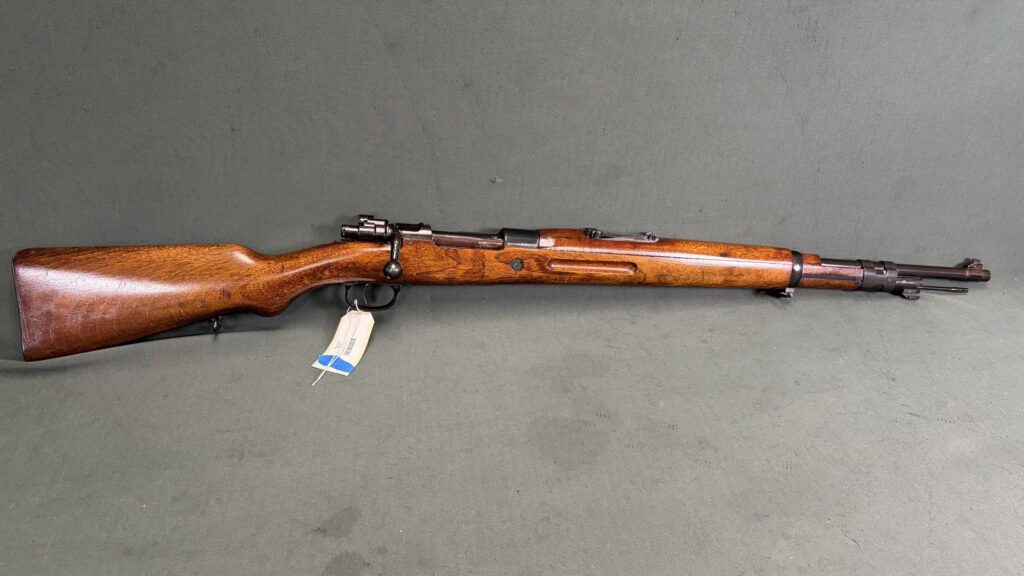 Spanish M43 Mauser Short Rifle 8mm — Late Uncrested, Like-New$679.00
The short version is on our Instagram. Watch it on Instagram.
General information for collectors, not legal advice. Dates for early Spanish broomhandles vary slightly between references.
Common Questions
What is the Astra 900?
The Astra 900 is a Spanish pistol made by Unceta y Compañía (Astra) in Guernica from late 1927. It looks like the Mauser C96 Broomhandle, fires the same 7.63 Mauser round from a 10-round fixed magazine, and was built mainly for China.How can you tell an Astra 900 from a Mauser C96?
Look at the right side of the frame. A Mauser C96 has no pins through the frame there, while an Astra 900 shows pin heads. The Astra also has a removable left side plate marked with the Astra name and Guernica.What do the Chinese characters on an Astra 900 mean?
Astra marked some of its 900-series pistols with three Chinese characters meaning “Made in Spain.” The marking was meant for Chinese customers, the main destination for the 900.Did Mauser make a full-auto C96?
Yes. In 1932 Mauser introduced the Model 712 Schnellfeuer, a select-fire Broomhandle with detachable magazines. Forgotten Weapons describes it as Mauser’s answer to the Spanish select-fire copies.Does the Mauser C96 use pins or screws?
The C96 lockwork is a separate block of interlocking parts held together without holding pins. According to Sportsman’s Vintage Press, the only screw in the gun is the one that holds the grips.Is the Astra 900 fully automatic?
No. The Astra 900 is semi-automatic. Astra’s select-fire versions included the 901, 902, 903 and 904, and Mauser answered them with the Model 712 Schnellfeuer in 1932.Sources
- American Rifleman, “Spanish Broomhandles” — https://www.americanrifleman.org/content/spanish-broomhandles/ (1919 embargo exempted handguns; Beístegui first; first Astra 900s December 1927; side plate slides off after pushing one pin; pinned locking block, screwed-in barrel, separate return spring; Chinese characters meaning Made in Spain; Shanghai company; Beístegui select-fire late 1927, Astra 901 in 1928, 902 20 rounds, 903 detachable; 712 in 1932; tangent sight, stock, fixed 10-shot magazine loaded by stripper clip)
- Forgotten Weapons, “Astra Model 900” — https://www.forgottenweapons.com/astra-model-900/ (stocked pistols not counted as military arms; 900 semi-auto in 7.63 Mauser; 901/902/903/904 select-fire)
- Wikipedia, “Astra 900” — https://en.wikipedia.org/wiki/Astra_900 (Spanish copy of the C96 intended mainly for export to China)
- Wikipedia, “Mauser C96” — https://en.wikipedia.org/wiki/Mauser_C96 (box cannon nickname from the wooden box-like stock; Chinese arsenals Hanyang and Shanghai made copies; Han Solo’s blaster built from a C96 with shortened barrel, flash hider and scope; Royal Model H 1926)
- Forgotten Weapons, “Mauser Schnellfeuer or Model 712 Machine Pistol” — https://www.forgottenweapons.com/mauser-schnellfeuer-or-model-712-machine-pistol/ (712 as Mauser’s answer to Spanish select-fire lookalikes)
- Sportsman’s Vintage Press, “The Mauser C96 & Other Mauser Pistols” — https://sportsmansvintagepress.com/read-free/mauser-rifles-pistols-table-of-contents/the-mauser-c96-other-mauser-pistols/ (no holding pins; only screw is the grip screw)
- 1896mauser.com, “Disassembly” — https://www.1896mauser.com/disassembly.htm (barrel and lock frame slide out together and hold together by themselves)