
Journal · Collector’s Guide
Mauser C96 Cutaway: Inside a Broomhandle in Motion
Someone milled windows into the side of this Mauser C96 Broomhandle, a pistol more than a hundred years old, and it still moves. This Mauser C96 cutaway was not made that way at the factory. The windows came later, we don’t know who cut them, and it is a very clean job. Through them you can watch the pistol take dummy rounds from a clip, chamber one, cock its hammer and drop it again. It is the first of the dozens of cutaway guns in our collection that we are going to show, one at a time.
A C96 with its side cut open
A cutaway is a real gun with windows cut through it to expose the mechanism. On this pistol the windows run along both sides: over the chamber at the rear of the barrel, along the bolt, through the walls of the magazine in front of the trigger guard, and across the lockwork behind it. The cartridges in the magazine, the exposed springs along the top of the action, and the hammer with its spring are all in plain view.
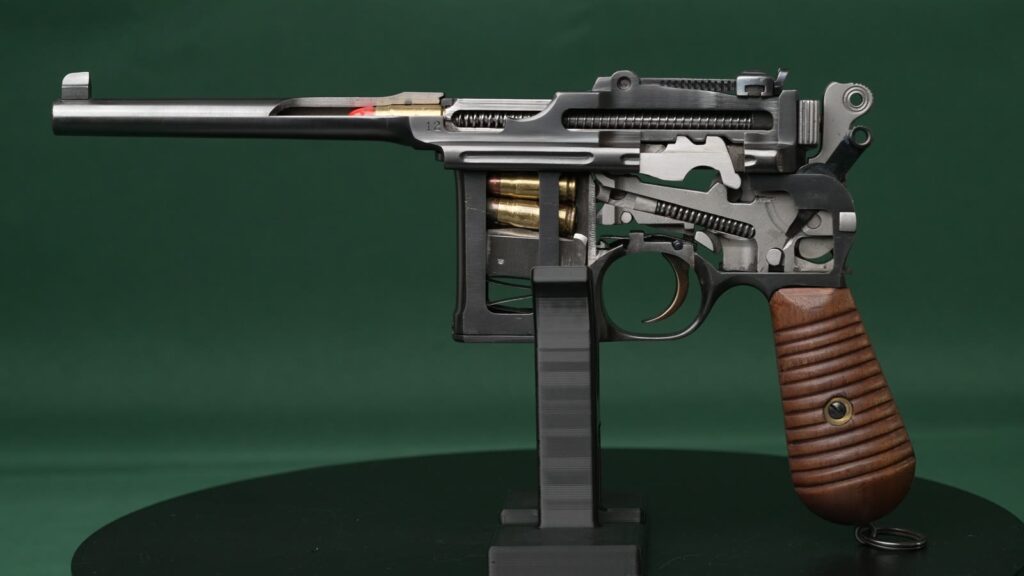
A Broomhandle is a famous pistol that most people have only seen from the outside. In the video you can see the bolt, the hammer and the magazine move through the cuts.
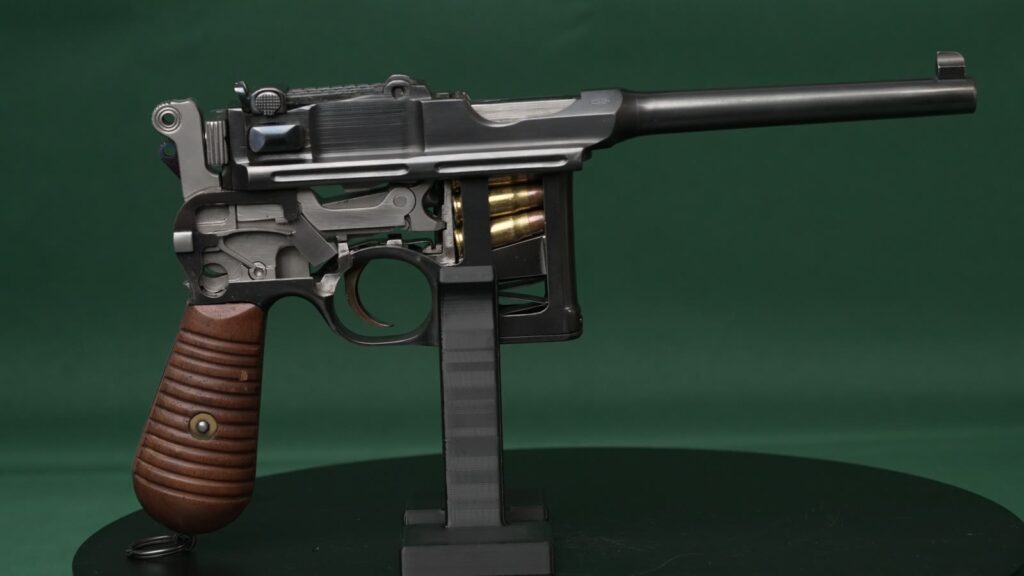
The Broomhandle in brief
Mauser’s C96 was designed by three brothers working in Paul Mauser’s research division, Fidel, Friedrich and Josef Feederle. Mauser built it from 1896 to 1937 and made about a million of them, and unlicensed copies were made in Spain and China in large but unrecorded numbers.
Its standard cartridge, the 7.63×25mm Mauser, was the highest-velocity commercially manufactured pistol cartridge until the .357 Magnum arrived in 1935. Within a year of its introduction the C96 was going to governments, civilians and military officers. Winston Churchill used one at the Battle of Omdurman in 1898. In World War I the German army contracted for 150,000 C96 pistols in 9mm Parabellum to make up for the slow production of its standard pistol, the P.08.
The English nickname comes from the grip, which is shaped like the handle of a broom. Its other trademarks are the magazine in front of the trigger, the long barrel and a wooden holster that doubles as a shoulder stock.
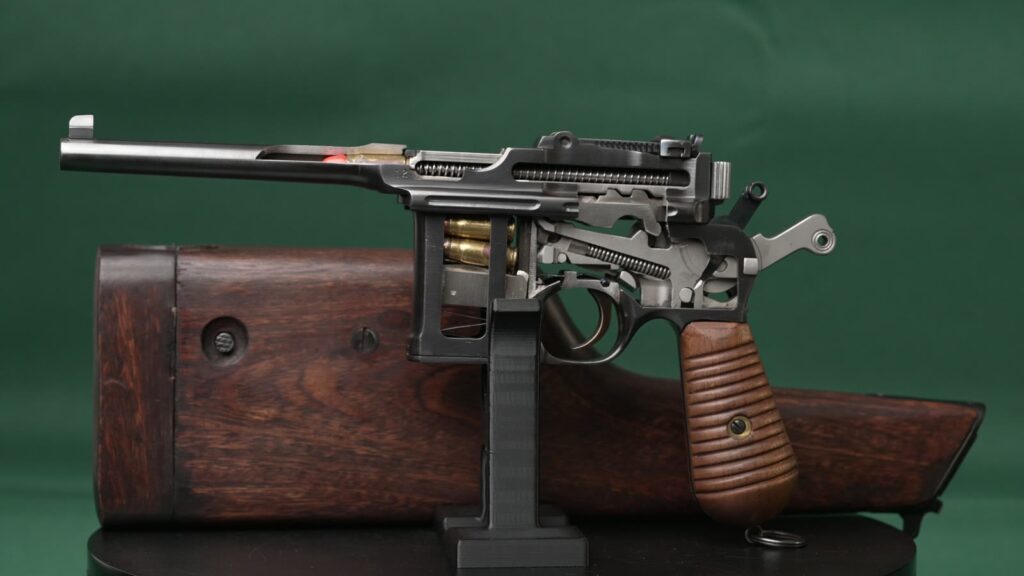
How to identify a Mauser C96
Here is what to look for on a C96, and what we see on this cutaway:
- The magazine sits in front of the trigger guard and is part of the frame. On a standard C96 it holds ten rounds and is filled from the top.
- The grip is a round-backed wooden handle, the broom handle, set at the rear of the frame.
- The rear sight is a tangent sight, adjustable for range. On a standard C96 it is graduated up to 1,000 meters.
- The hammer has no spur. Early C96s have a cone hammer, with ribbed cone-like projections on the sides of its head. Later ones, including our cutaway, have a ring hammer with a hole through its head.
- The maker’s name is on top of the barrel extension, over the chamber. On this cutaway it reads WAFFENFABRIK MAUSER in two lines.
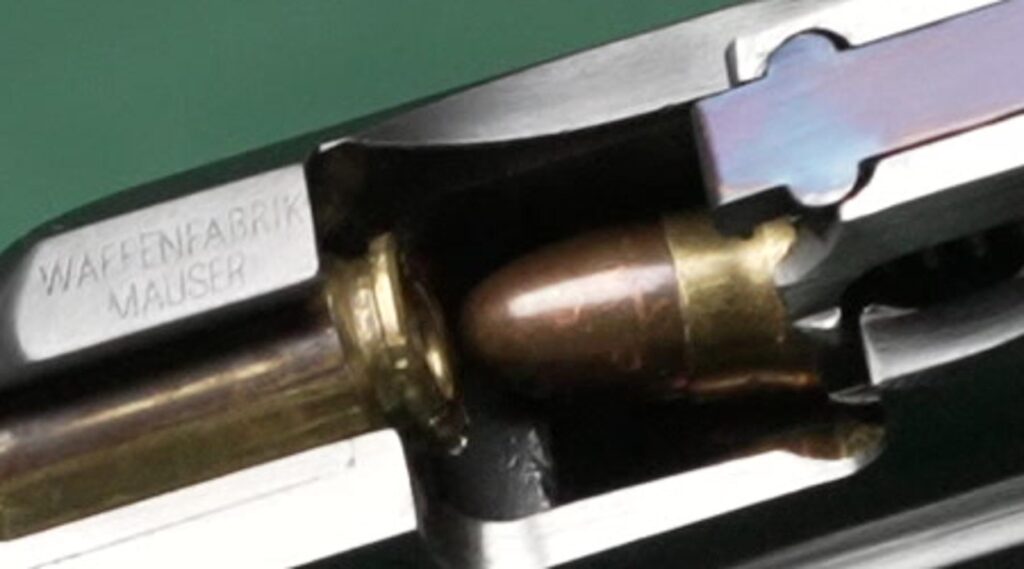
We have not read a full serial number on the cutaway. The only number we can read clearly is a 12 on the left side of the barrel extension, next to the front window.
How the Mauser C96 works, through the cutaway
This is the part the video is about. The pistol is loaded with dummy rounds, and the steps below are the ones we show in the video.
Loading. The C96 has a fixed magazine, so you don’t change a magazine to reload it. With the bolt held back, a clip of cartridges goes into the guides at the top of the action. A thumb pushes the cartridges down off the clip and into the magazine, and through the magazine windows you can see them stack up. A full clip holds ten. Ours carried six or seven dummy rounds.
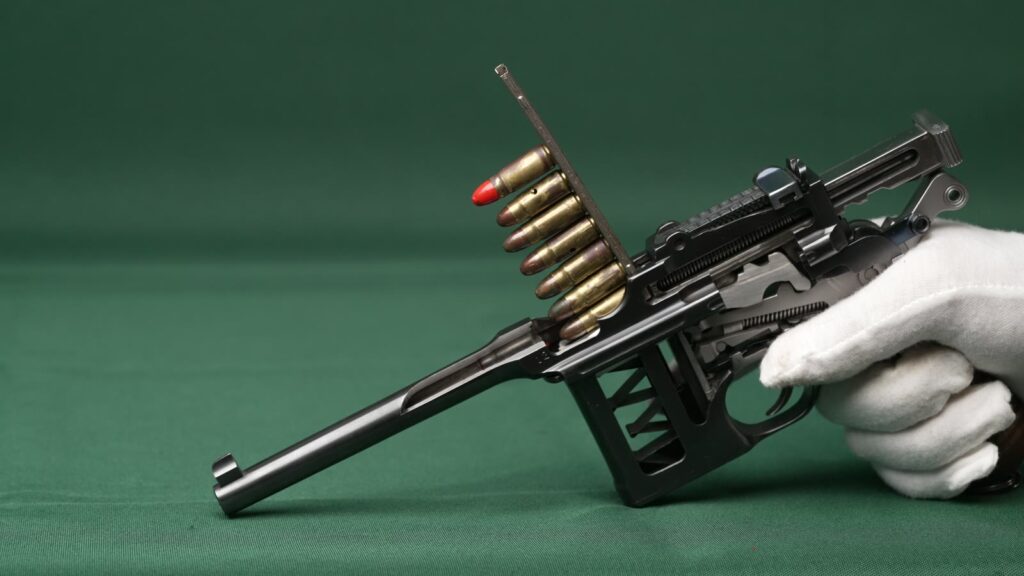
Chambering. When the empty clip is pulled out, the bolt snaps forward by itself, strips the top round from the magazine and pushes it into the chamber. The red-tipped dummy round shows in the window over the chamber.
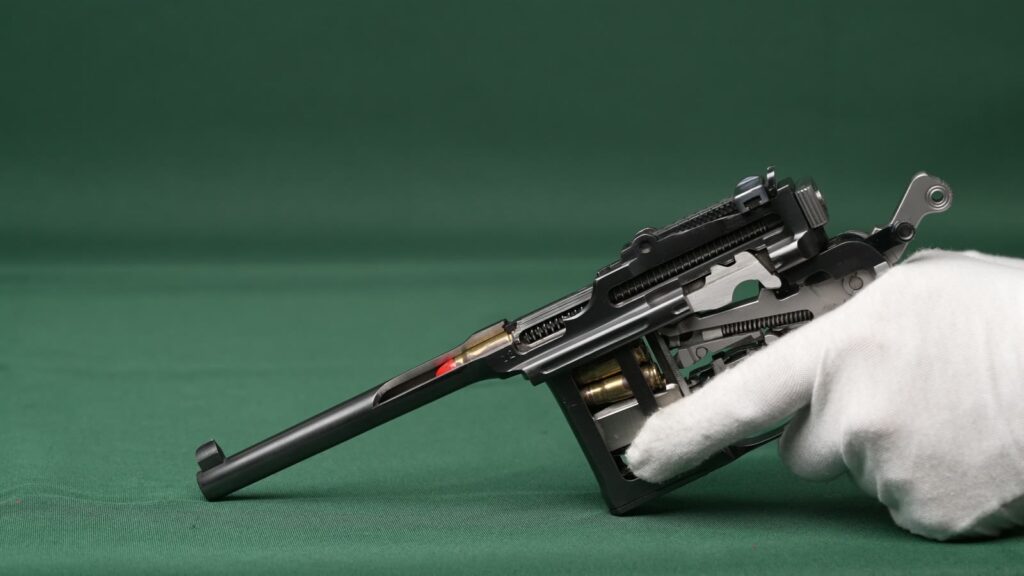
Cocking. On a C96, the hammer’s position tells you whether it is cocked. Upright, against the back of the bolt, it is down. Laid back, it is cocked. Through the side window you can see what cocking does: as the hammer comes back, the hammer spring running diagonally through the lockwork is compressed.
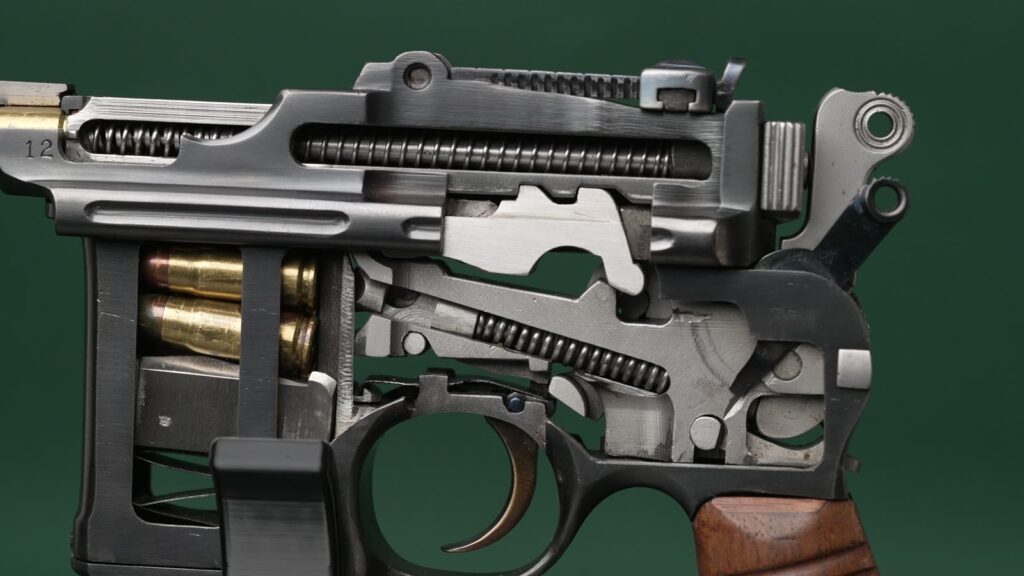
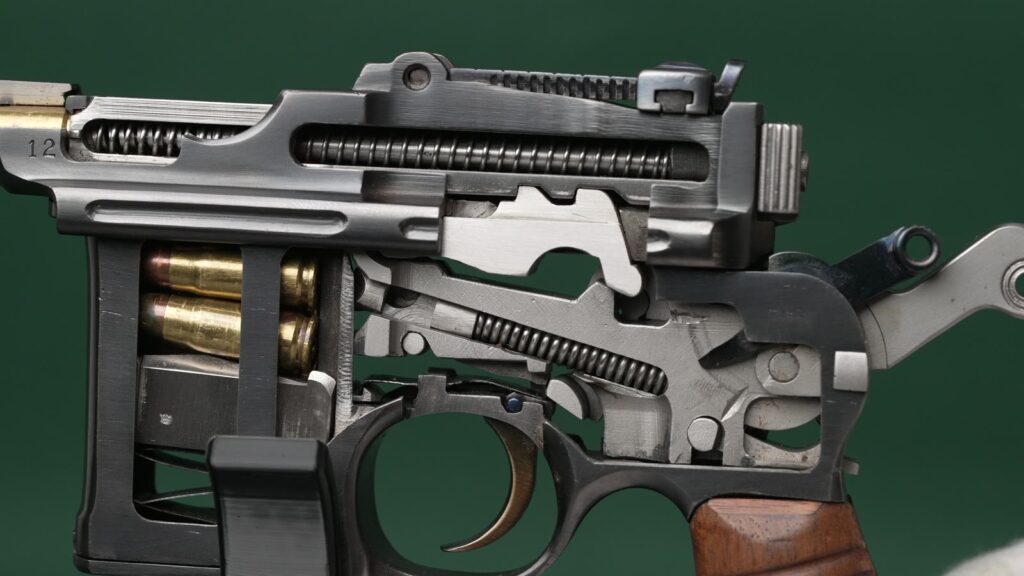
Safety. On this cutaway the safety is a lever at the left rear of the frame, below the hammer. In our demonstration, with the hammer cocked and the lever pushed up, a pull on the trigger leaves the hammer where it is.
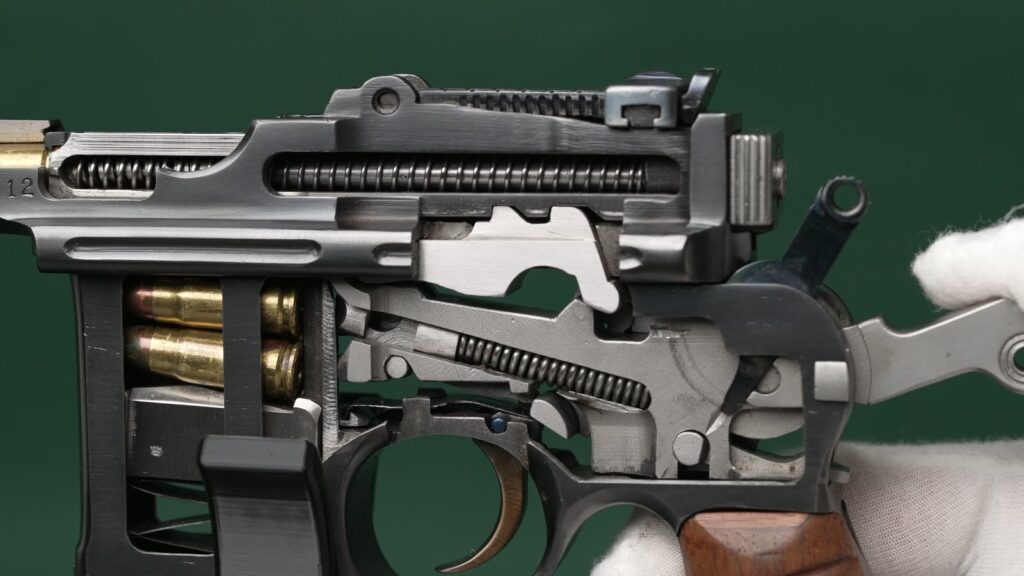
Dropping the hammer. With the lever pushed back down, a pull on the trigger releases the hammer, and it swings forward to stand upright against the bolt.
### What the windows don’t show
Our video shows the hammer, the bolt and the magazine at work. It does not show how the C96 locks and unlocks when it fires, and we didn’t film the part that does it. According to The Firearm Blog’s companion article to C&Rsenal’s Primer on the C96, the pistol is short recoil operated: on firing, the barrel and the bolt are locked together by a floating locking piece and travel back together a short way, then the locking block is cammed down by surfaces in the frame, which frees the bolt to keep going back and cock the hammer. Sportsman’s Vintage Press describes the same thing in older words, a toothed locking block holding the barrel and the breechblock together as the barrel recoils a short distance.
No pins, one screw
Many pistols are held together by pins and screws through the frame. According to Sportsman’s Vintage Press, the C96 “employs no holding pins”, and “the only screw employed is the stock screw”, the screw that holds the grips. Its lockwork is built as a separate unit, the lock frame, that sits inside the main frame.
A Spanish copy shows what Mauser avoided. The ETAI / Royal Model H, which appeared in 1926, was laid out much like a C96 but without the removable lock frame: its trigger, hammer and safety lever pivoted on pins and screws through the frame, and the screws held the frame together.
Next to an intact C96
At the end of the video the cutaway stands next to a complete C96, serial number 9080, made in the 1890s: one shows the inside, the other the outside. They are not twins. Serial 9080 has a very early hammer, and the sides of the frames differ too: the details changed between C96s made years apart. Made before 1899, serial 9080 counts as an antique firearm under U.S. federal law, which covers guns manufactured in or before 1898. But the intact gun gives you no view of the hammer spring, the lockwork or the rounds in the magazine. Without the windows, you’d never know what is going on in there.
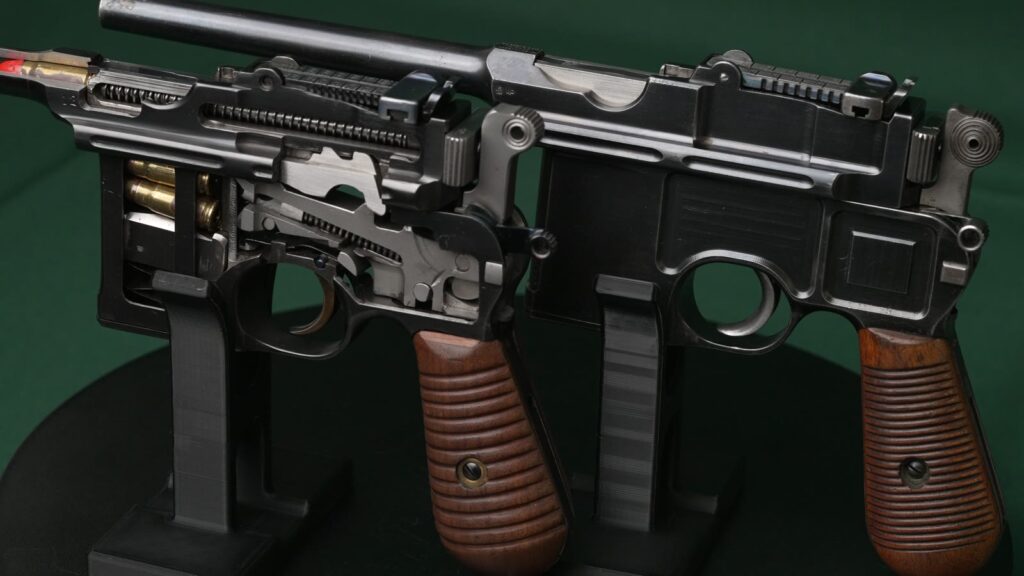
Watching it move
Whoever cut the windows did a really clean job. The first time we watched this one move, it was just fun, mostly because you can see how the mechanism inside actually runs.
Specifications
| Item | Mauser C96 cutaway |
|---|---|
| Maker | Waffenfabrik Mauser, Germany |
| Model | C96 “Broomhandle” |
| Made | Early 20th century |
| Cartridge | 7.63×25mm Mauser |
| Magazine | Fixed, loaded from the top with a clip (10 rounds on a standard C96) |
| Operation | Short recoil |
| Hammer | Spurless ring hammer (this pistol) |
| Safety | Lever at the left rear of the frame (this pistol) |
| Markings | WAFFENFABRIK MAUSER over the chamber; 12 on the left of the barrel extension |
| Cutaway | Windows milled into both sides after manufacture, maker unknown |
| Shown with | An intact C96, serial 9080, made in the 1890s (an antique under U.S. federal law) |
On the floor at OSA
The cutaway C96 and the intact C96, serial 9080, are part of our own collection, and so are the other cutaway guns we’ll be showing in this series. A few pieces in our case connect to them:
- WWI Imperial German Mauser C96 Broomhandle, a separate, World War I era C96, all matching, with an NS-marked hammer: the same model as our cutaway, seen whole.
- Mauser Model 1914 pistol, .32 ACP, a later and much smaller Mauser pistol, from the same Mauser company.
- 1911 DWM Luger P08, 9mm, the German army’s standard pistol, whose slow production in World War I led the army to contract for 150,000 C96 pistols in 9mm.
For the select-fire descendant of the C96, see our guide to the Mauser M712 Schnellfeuer. To read the stamps on the C96’s old rival, see Luger P08 markings explained.
The grid below updates by itself as pieces come and go.
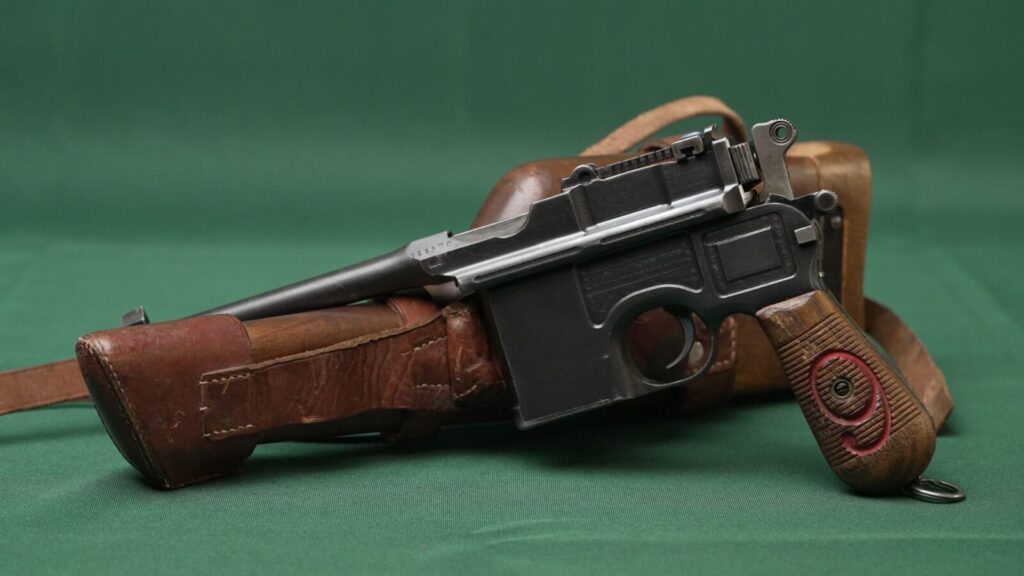 1917 Mauser C96 Red 9 Broomhandle 9mm All Matching with Stock and Rig$6,350.00
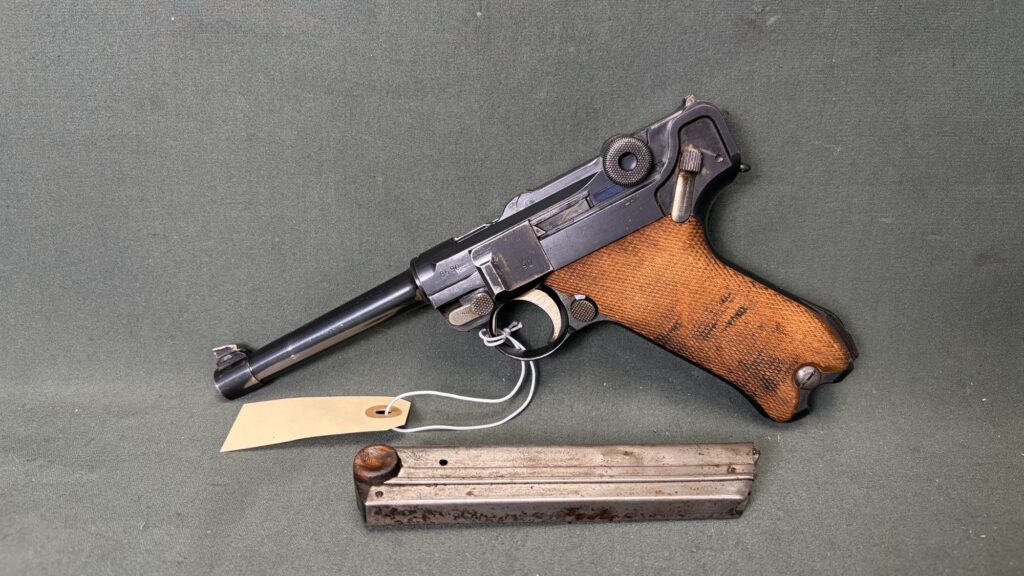 1918 DWM Artillery Luger Converted .30 Luger Finnish Service Tikka Barrel$1,475.00
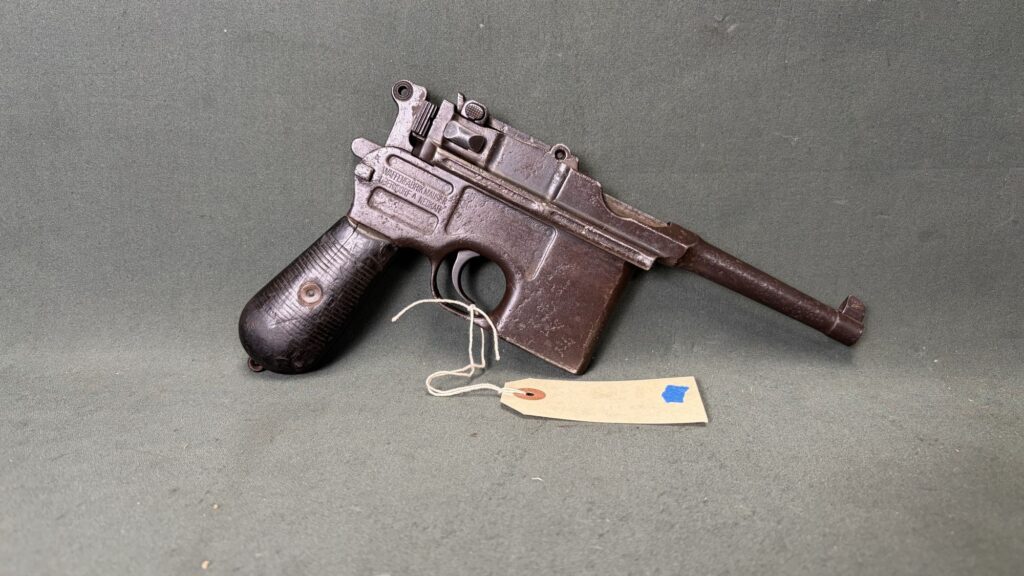 Mauser C96 Bolo Broomhandle Pistol$895.00
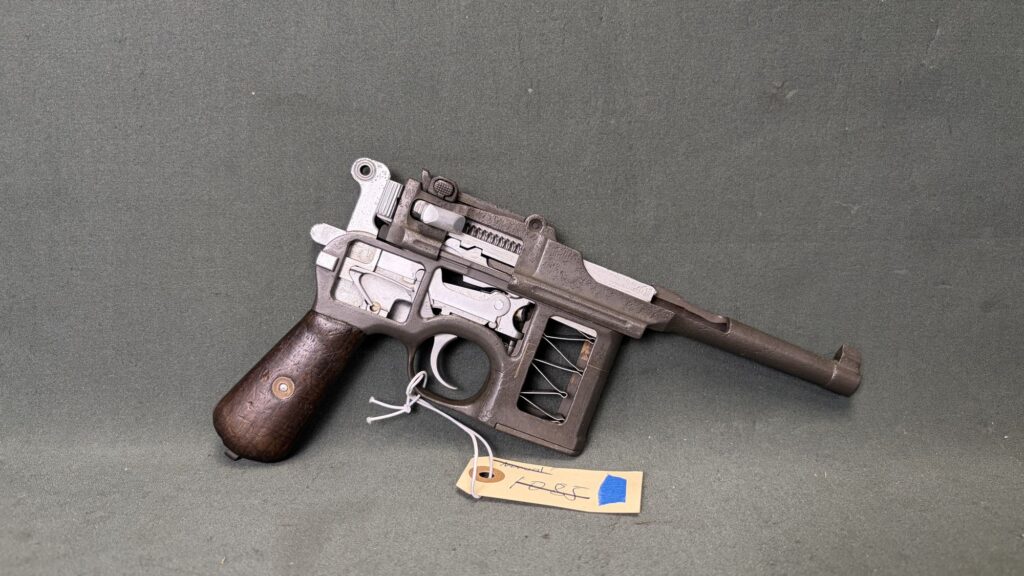 Mauser C96 Bolo Cutaway Display Piece Exposed Mechanism$1,050.00
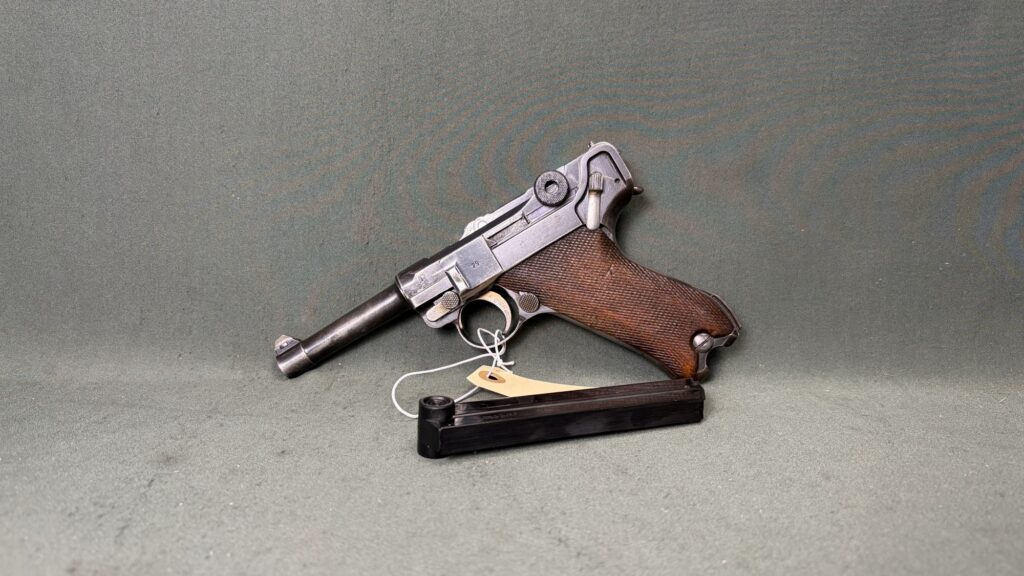 1929 Era Commercial Luger .30 Luger Finnish Service Mauser Banner Toggle$1,200.00
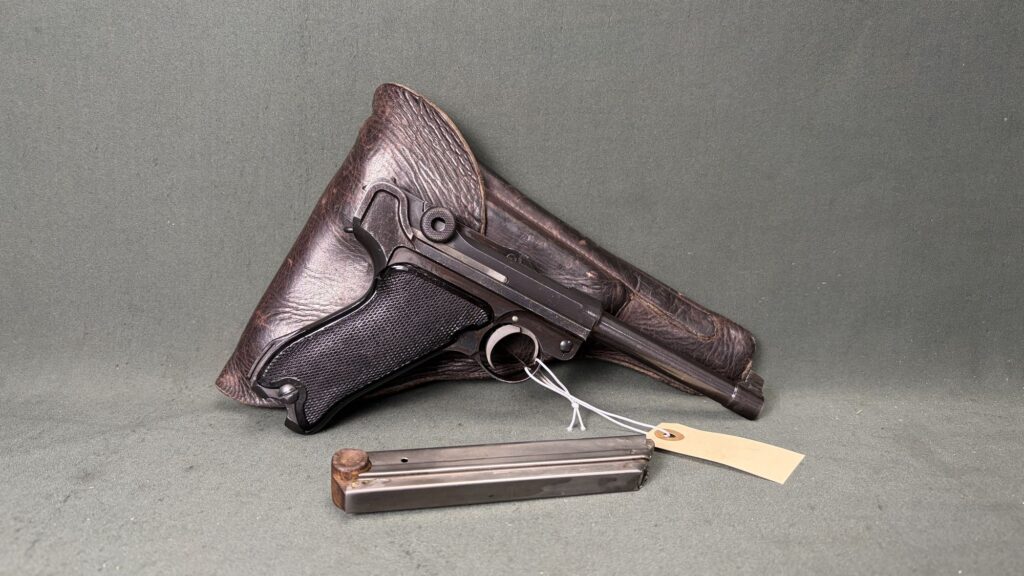 Finnish SA Marked Luger P08 9mm Tikka 4.75 in Barrel Bakelite Grips with Holster$1,725.00
General information for collectors, not legal advice. Production figures are approximate and vary between references.
Common Questions
Why is the Mauser C96 called the Broomhandle?
Because of its grip. The C96’s round wooden grip is shaped like the handle of a broom, and English speakers nicknamed the pistol after it.How do you load a Mauser C96?
The standard C96 has a fixed ten-round magazine in front of the trigger guard. With the bolt held back, you put a loaded clip in the guides at the top of the action and push the cartridges down into the magazine. When the clip is pulled out, the bolt goes forward and chambers the top round.How does the Mauser C96 work?
It is short recoil operated. On firing, the barrel and bolt are locked together and recoil a short way, then a locking block is cammed down by surfaces in the frame, which frees the bolt to keep moving back and cock the hammer.Does the Mauser C96 have pins or screws?
The C96 is assembled without holding pins. According to Sportsman’s Vintage Press, the only screw is the one that holds the grips. The lockwork is a separate unit, the lock frame, that fits inside the main frame.How can you tell if a C96 hammer is cocked?
Look at the hammer. When it is laid back toward the grip, it is cocked. When it stands upright against the back of the bolt, it is down.Did Mauser make cutaway C96 pistols like this one?
Not this one. The windows in our C96 were cut after it left the factory, by someone we can’t identify. It is a factory Mauser pistol that was later turned into a cutaway.What cartridge does the Mauser C96 use?
The standard chambering is 7.63×25mm Mauser, which was the highest-velocity commercially made pistol cartridge until the .357 Magnum arrived in 1935.Sources
- Wikipedia, “Mauser C96” — https://en.wikipedia.org/wiki/Mauser_C96 (Feederle brothers, production 1896–1937, about one million made by Mauser, Spanish and Chinese copies, Broomhandle nickname, integral magazine ahead of the trigger, holster stock, 10-round stripper-clip-fed magazine, tangent sight to 1,000 m, ring hammer, Churchill at Omdurman 1898, 150,000 9mm pistols for the German army in WWI to offset slow P.08 production, ETAI / Royal Model H of 1926 without the removable lock frame, M712 Schnellfeuer variant)
- Wikipedia, “7.63×25mm Mauser” — https://en.wikipedia.org/wiki/7.63%C3%9725mm_Mauser (the C96 cartridge)
- Sportsman’s Vintage Press, “The Mauser C96 & Other Mauser Pistols” — https://sportsmansvintagepress.com/read-free/mauser-rifles-pistols-table-of-contents/the-mauser-c96-other-mauser-pistols/ (no holding pins, only screw is the stock screw, magazine stripped in from a clip through the top of the action, toothed locking block, barrel recoils a short distance)
- The Firearm Blog, “C&Rsenal: Primer 009, The Mauser C96” — https://www.thefirearmblog.com/blog/2015/10/07/candrsenal-primer-009-the-mauser-c96 (short recoil operation, floating locking piece cammed down by the frame, Feederle brothers in Mauser’s research division, stripper clip feeding)
- Cornell Law School LII, “18 U.S. Code § 921 – Definitions” — https://www.law.cornell.edu/uscode/text/18/921 (antique firearm: manufactured in or before 1898)
- Wikipedia, “Stripper clip” — https://en.wikipedia.org/wiki/Stripper_clip (the C96 among early pistols loaded with stripper clips)