Journal · Collector’s Guide
Iraqi Hi Power: A 1982 FN With the Eagle of Saladin
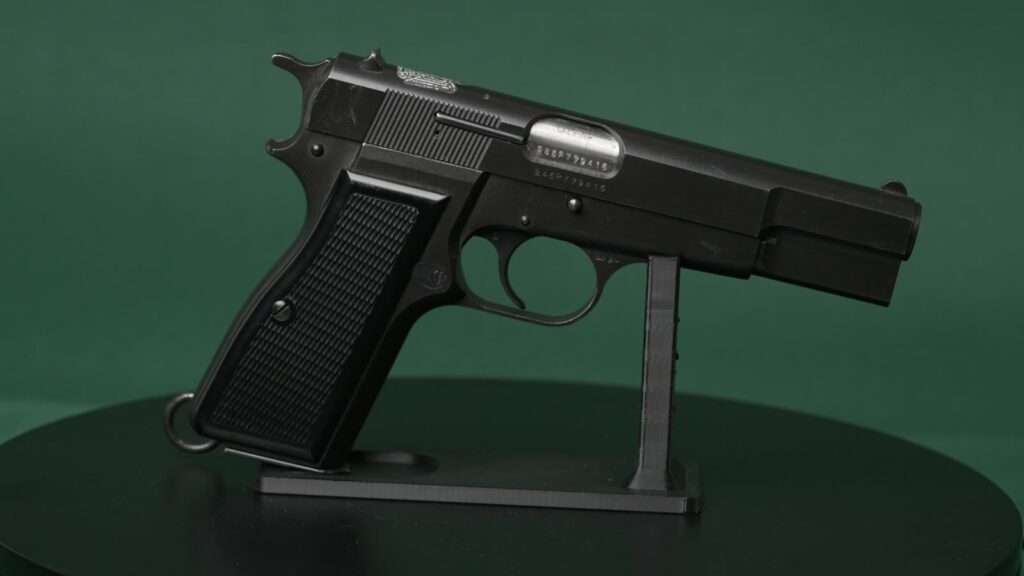
This Iraqi Hi Power was made by FN in Belgium in 1982, two years into Iraq’s war with Iran, and nine years before the United States went to war with Iraq in Desert Storm. Three marks on it can be read today: a date code in the serial number, Iraq’s Eagle of Saladin on top of the slide in the version used before January 1991, and a tiny stamp on the magazine that looks like the Greek letter pi. Where this pistol served, and how it reached the United States, we don’t know. It is part of our own collection.
The pistol Browning didn’t live to finish
The High Power began as an answer to a French military requirement: a compact service pistol with a magazine of at least ten rounds, an external hammer, a safety catch and a magazine disconnect. FN asked John Browning to design it. Browning had already licensed his M1911 to Colt, so he had to work around his own patents. He filed the U.S. patent for the new pistol in June 1923 and died in 1926, before the design was finished.
Dieudonné Saive at FN Herstal completed it. His staggered, double-stack magazine is what gave the pistol its name: thirteen rounds of 9mm, nearly twice the seven of a Colt M1911. France never adopted it, but Belgium did, in 1935, and the Grande Puissance, the High Power, went on to serve with the armed forces of more than fifty countries. Wikipedia’s list of users includes Iraq.

Built for Iraq during the Iran–Iraq War
The Iran–Iraq War began with Iraq’s invasion of Iran in September 1980 and ran until a ceasefire in August 1988. This pistol’s serial number dates it to 1982, in the war’s third year.
That is as far as the pistol’s own marks go. A crest and a date code tell you who a gun is marked for and when it was made. They say nothing about which unit it went to or whether it saw combat.
What came next for Iraq is well documented. Iraq invaded Kuwait in August 1990, and Operation Desert Storm, the coalition’s air and ground campaign, began on 17 January 1991. We have written about that war from the coalition side, through the Beretta M9 General Norman Schwarzkopf carried, and about another of his pistols, his Desert Eagle.
How to read Iraqi Hi Power markings
### FN’s name on the slide: High Power, not Hi-Power
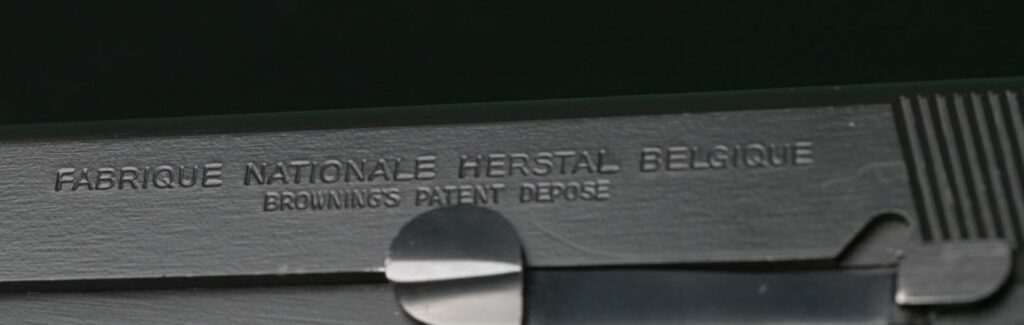
The left side of the slide reads FABRIQUE NATIONALE HERSTAL BELGIQUE, and below it BROWNING’S PATENT DEPOSE. According to American Rifleman, that tells you which name the gun carries. Pistols marked Fabrique Nationale are High Powers; Hi-Power is the name Browning Arms Company introduced in the 1950s for the guns marked with its own name, to avoid confusion with its High-Power rifle. Collectors use both names for the same pistol; on the steel, this one is an FN High Power.
### The serial number is a date code
The serial is 245PY79416, and it appears twice on the right side: on the barrel where it shows through the ejection port, next to CAL 9mmP, and on the slide just below the port. The two numbers match.
Browning publishes a dating chart for Hi Powers made from 1976 to 1997, and this pistol’s serial follows the same pattern. The first three digits give the type: 245 is a 9mm Hi Power. The next two letters are the year, one letter per digit: Z=1, Y=2, X=3, W=4, V=5, T=6, R=7, P=8, N=9, M=0. Read with that chart, PY is 8-2, or 1982. The last five digits are a sequence number, which the chart says starts again at 01001 each year.

### The Eagle of Saladin, before January 1991
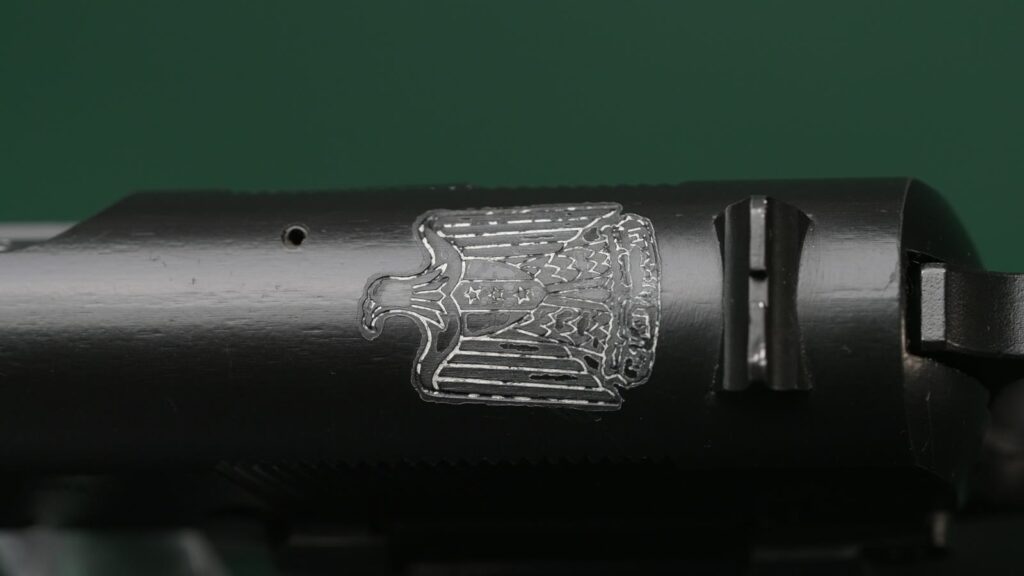
On top of the slide, ahead of the rear sight, is Iraq’s national emblem: the Eagle of Saladin, holding a shield in the colors of the Iraqi flag. Iraq adopted this eagle in 1965. The version on this slide has three stars on the shield, the three green stars of the flag Iraq had used since 1963.
In January 1991, days before the Desert Storm air campaign, Iraq changed the flag by writing the takbir, “Allahu Akbar”, between the stars, and redrew the emblem to match. To fit the words on one line, the bands on the eagle’s shield were turned from vertical to horizontal. The crest on this pistol has the vertical bands and the three stars alone, so it is the older version, the one in use when the pistol was made.
### The pi mark on the magazine
The last mark is the smallest. On the front of the magazine, just above the floorplate, is a stamp shaped like the Greek letter pi.
The usual explanation comes from collectors. The High Power Collectors forum’s magazine FAQ describes a fancy H, standing for Herstal, on FN military contract magazines, and says it resembles an inverted pi sign; it also reports the mark on some Belgium-marked magazines. The same FAQ adds a caution: early Mec-Gar magazines, made in Italy, carry a small pi sign too, so the stamp alone does not prove which factory made a magazine. We have not seen an FN document that explains it.

How it works
The High Power is a single-action, short-recoil pistol with a tilting barrel. The barrel and slide lock together with lugs on top of the barrel that sit in recesses inside the slide. When the gun fires, they recoil together for a short distance; then a cam under the rear of the barrel pulls the barrel down, out of the slide’s recesses, and the slide carries on alone. There is no swinging link of the kind the M1911 uses. The Czech CZ 75 uses a similar linkless cam system.
In the video, the magazine drops free into a gloved hand and the slide is pulled back once. Saive’s staggered magazine was meant to raise capacity without making the grip or the magazine much bigger. The original French requirement also asked for a magazine disconnect, a safety meant to keep the pistol from firing with the magazine out, and the High Power was designed with one. FN dropped it from the redesigned High Power it introduced in 2022.
### The black finish
The black on this pistol is paint, and it is the original FN finish, never refinished. According to American Rifleman, FN developed the finish around 1929 to 1930 at a French request for the FN Model 1922: black enamel paint over a phosphate base, for corrosion resistance. It stayed an FN standard for decades on military arms, including post-war High Powers and the FAL and FNC rifles.

Forty-four years on
We filmed this one in the shop, not on the range, so we won’t tell you how it shoots. What struck us was its condition. It is a forty-four-year-old military pistol, and we didn’t expect it to look this good. The finish is original, and there is no U.S. import mark anywhere on it.
Specifications
| Item | Iraqi FN High Power |
|---|---|
| Maker | FN Herstal, Belgium |
| Year made | 1982 (PY in the serial) |
| Serial | 245PY79416, barrel and slide matching |
| Markings | Iraqi Eagle of Saladin, pre-1991 version, on top of the slide |
| Cartridge | 9×19mm |
| Magazine | 13 rounds, double stack |
| Action | Single action, short recoil, tilting barrel, no link |
| Finish | Black paint over phosphate, original |
| Import mark | None |
| Other | Lanyard ring; pi-shaped stamp on the magazine |
On the floor at OSA
The Iraqi High Power in these photos is part of our own collection. If FN’s 9mm is your kind of pistol, these pieces in our case are related to it:
- 1979 FN Hi Power, two-tone: made at the same Belgian factory three years earlier, in the two-tone finish instead of military black paint.
- FN Hi Power 9mm, South African police contract: another Belgian FN, described as a South African police contract gun, with target-style sights.
- CZ 75 Pre-B, Czech police surplus: it locks with a linkless cam system similar to the High Power’s.
- 1942 Kongsberg M/1914 in .45 ACP: Browning’s M1911 made under license in Norway, a license Norway arranged through FN in 1914.
- 1995 SIG P228 with the Swiss Ticino police crest: another 9mm service pistol with a police crest on it.
The grid below updates by itself as pieces come and go.
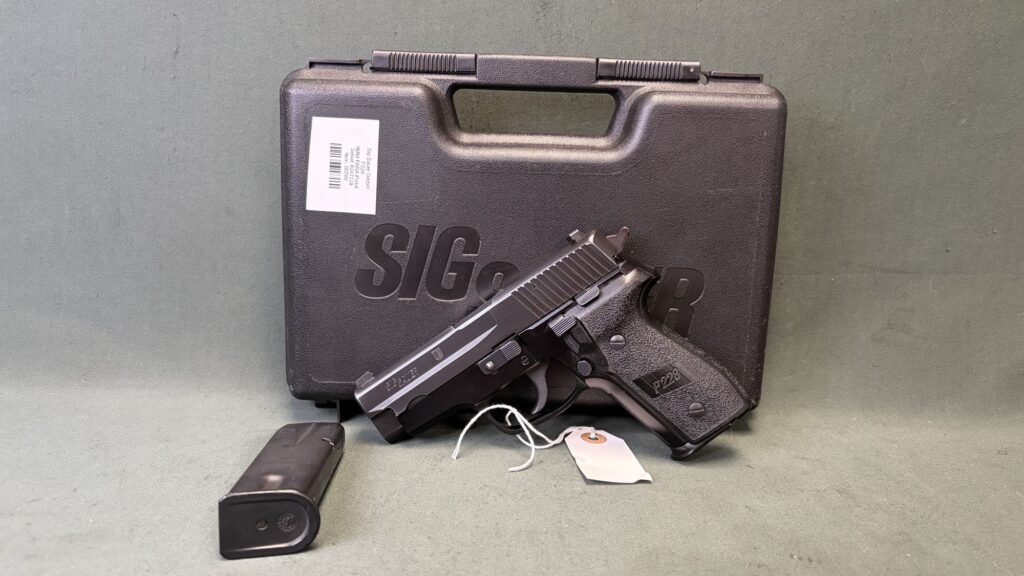 SIG Sauer P228 9mm 1995 German Ticino Police Crest No Import Mark Box$1,249.00
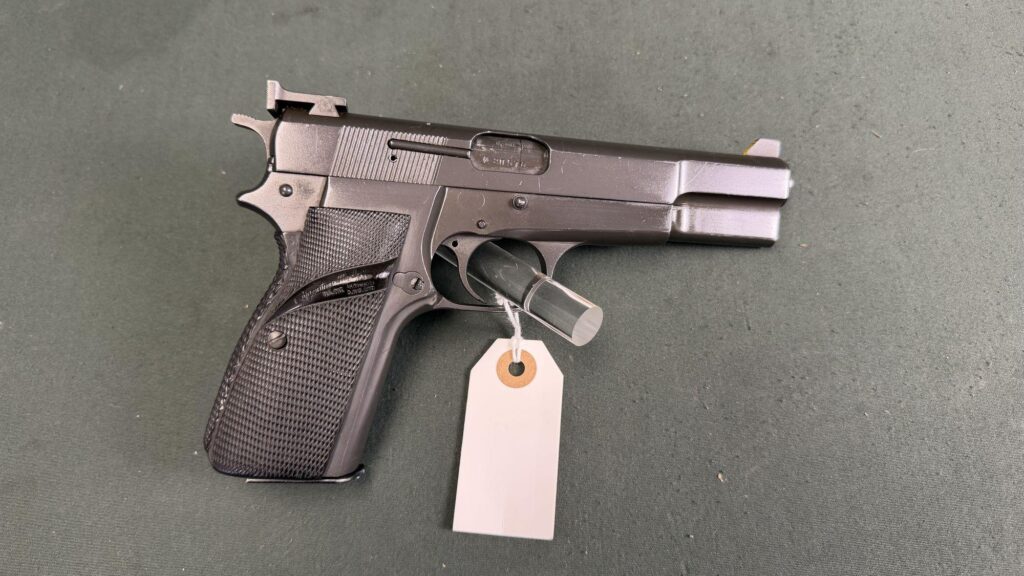 Hi Power 9MM PARA$979.00
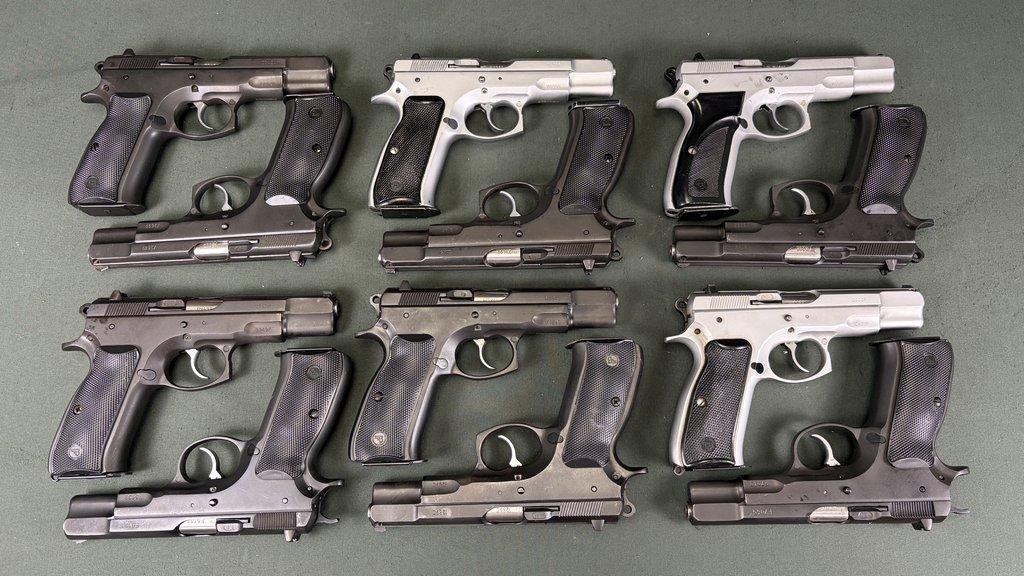 Free ShippingCZ 75 Pre-B 9×19 Czech Police Surplus Grade A Matching Numbers Mirror Bore$569.00
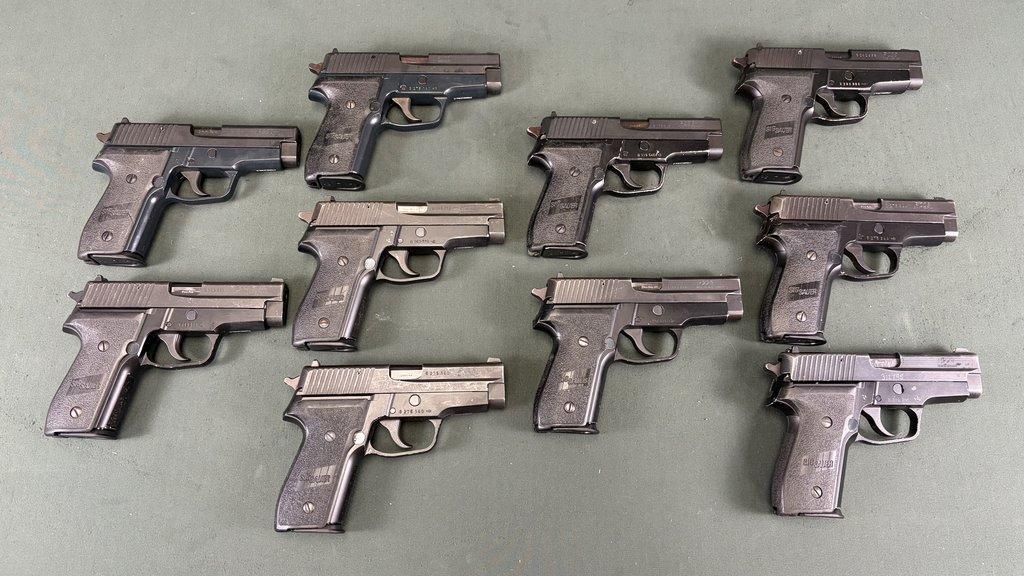 Free ShippingSIG Sauer P228 9mm German Police Israeli IDF Surplus Grade B Mirror Bore Original price was: $629.00.$569.00Current price is: $569.00.
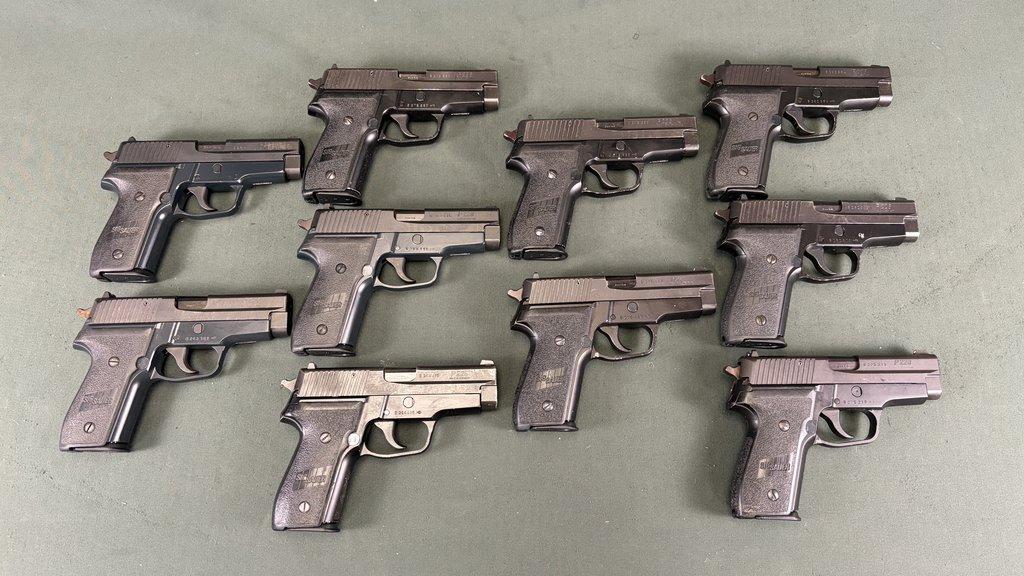 Free ShippingSIG Sauer P228 9mm German Police Israeli IDF Surplus Grade A Mirror Bore Original price was: $679.00.$629.00Current price is: $629.00.
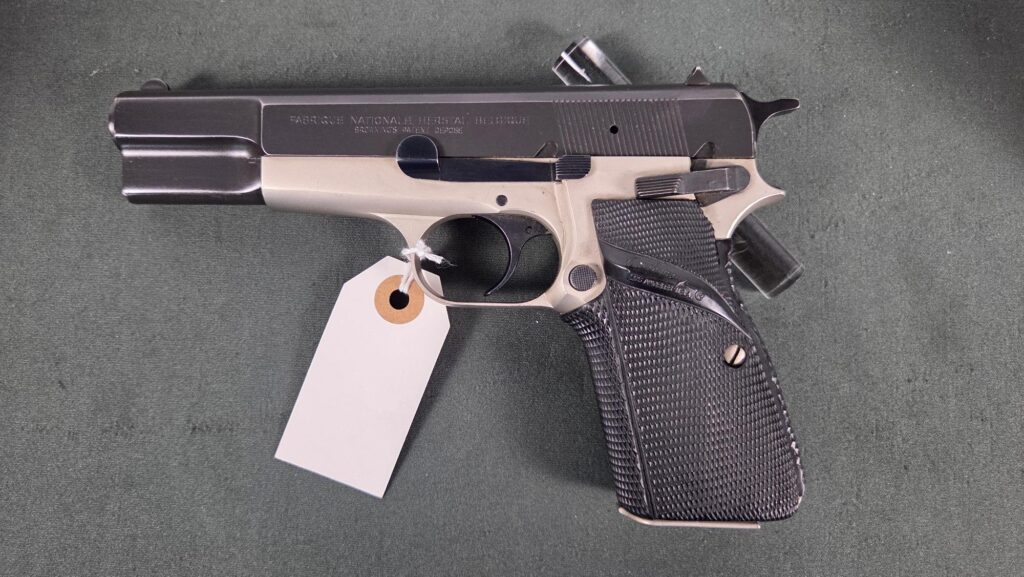 Hi Power 9MM PARA$1,029.00
The short version is on our Instagram. Watch it on Instagram.
General information for collectors, not legal advice. Check markings on the individual pistol.
Common Questions
How can you tell an Iraqi Hi Power?
Look at the top of the slide for Iraq’s national emblem, the Eagle of Saladin holding a shield. On the version used before January 1991, the shield shows three stars with no writing between them. The crest is a clue to who the pistol was marked for, not proof on its own of a contract or of original configuration.How do I date an FN Hi Power from the serial number?
For pistols made from 1976 to 1997, the two letters after the three-digit type code are the year, one letter per digit: Z=1, Y=2, X=3, W=4, V=5, T=6, R=7, P=8, N=9, M=0. A serial starting 245PY is a 9mm made in 1982.What does the pi symbol on a Hi Power magazine mean?
Collectors on the High Power Collectors forum read it as a stylized H for Herstal, FN’s hometown, and report it on FN military contract magazines. Early Mec-Gar magazines also carry a small pi sign, so the stamp alone does not prove FN made the magazine.Is it High Power or Hi-Power?
According to American Rifleman, guns marked Fabrique Nationale are High Powers, and Hi-Power is the name Browning Arms Company used from the 1950s on guns marked with its own name. Most people use the two names for the same pistol.Why do some FN Hi Powers have a black painted finish?
FN developed a corrosion-resistant finish of black enamel paint over a phosphate base around 1929 to 1930, and used it for decades on military arms, including post-war High Powers and FAL rifles.When did Iraq change the Eagle of Saladin emblem?
In January 1991, when Iraq added the words “Allahu Akbar” between the three stars of its flag. The emblem’s shield was redrawn with horizontal bands to fit the words, so a crest with vertical bands and stars alone is the earlier version.Sources
- Wikipedia, “Browning Hi-Power” — https://en.wikipedia.org/wiki/Browning_Hi-Power (French requirement, Browning’s patent and death in 1926, Saive, 13-round magazine vs the M1911’s seven, 1935 Belgian adoption, more than 50 user countries, Iraq in the users list, single action short recoil tilting barrel, magazine disconnect removed in the 2022 model)
- American Rifleman, “5 Little-Known Facts About the FN/Browning High Power” — https://www.americanrifleman.org/content/5-little-known-facts-about-the-fn-browning-high-power/ (High Power vs Hi-Power naming; black enamel over phosphate finish, 1929–1930, FN Model 1922, FAL and FNC)
- Browning, “Hi Power Pistol” date-your-firearm chart — https://www.browning.com/support/date-your-firearm/hi-power-pistol.html (1976–1997 serial format, 245 = 9mm, letter-to-digit year code, numbers restart at 01001 each year)
- Wikipedia, “Coat of arms of Iraq” — https://en.wikipedia.org/wiki/Coat_of_arms_of_Iraq (Eagle of Saladin adopted 1965, three green stars, modified January 1991, shield bands turned horizontal)
- Wikipedia, “Flag of Iraq” — https://en.wikipedia.org/wiki/Flag_of_Iraq (three stars since 1963, takbir added in January 1991)
- Wikipedia, “Iran–Iraq War” — https://en.wikipedia.org/wiki/Iran%E2%80%93Iraq_War (began with Iraq’s invasion in September 1980, ceasefire August 1988)
- Wikipedia, “Gulf War” — https://en.wikipedia.org/wiki/Gulf_War (invasion of Kuwait August 1990; Operation Desert Storm from 17 January 1991)
- High Power Collectors forum, “Hi Power Magazine FAQs” — https://highpowercollectors.proboards.com/thread/1245/hi-power-magazine-faqs-updates (pi-shaped mark read as a fancy H for Herstal; early Mec-Gar magazines also carry a pi sign)
- Wikipedia, “CZ 75” — https://en.wikipedia.org/wiki/CZ_75 (Browning linkless cam locking system, lugs and enclosed cam track)
- Wikipedia, “Kongsberg Colt” — https://en.wikipedia.org/wiki/Kongsberg_Colt (Norway’s M1911 license arranged through Fabrique Nationale in September 1914)