
Journal · Collector’s Guide
HK P9S .45 ACP: Roller-Delayed Pistol Guide
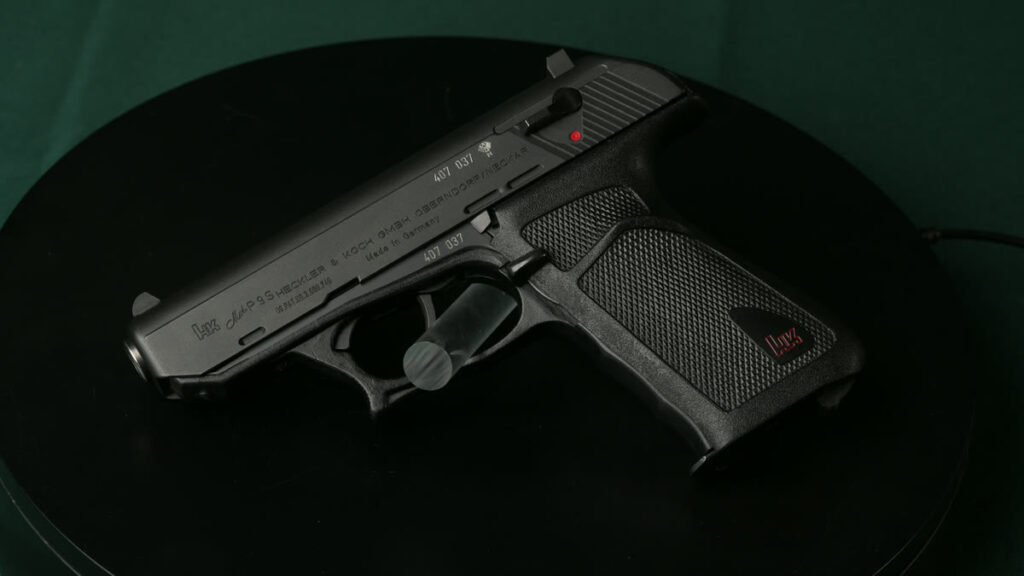
The HK P9S is Heckler & Koch’s roller-delayed pistol: the same delayed-blowback principle as the MP5 submachine gun, packed into a slide, with a barrel that stays put when it fires. It was the first service pistol of Germany’s GSG 9, and the U.S. Navy adopted it in 9mm for use with a suppressor. The one in our photos is a P9S in .45 ACP, the version H&K built for the American market, and it is part of the Old Steel Arsenal collection.
From the P9 to the P9S
H&K began designing the original single-action HK P9 in 1965, bringing the roller-delayed system of its G3 rifle down to pistol size. The first P9 was single action only. In 1970 H&K added a double-action trigger, the Spannabzug, and the pistol became the P9S. The German site all4shooters reads the name as Pistole, 9-Schuss, Spannabzug: pistol, nine shots (in 9mm), double-action trigger. all4shooters also calls it the first service pistol of GSG 9.
The .45 ACP model came later. According to Luxus Capital’s history of the pistol, H&K developed it for American demand and introduced it in 1976; Wikipedia gives 1977. It holds seven rounds in a single-column magazine, against nine in the 9mm.
Why the U.S. Navy used the P9S
Navy SEALs already had the 1911, so why did some of them carry a P9S? The answer is the suppressor, and the Navy guns were 9mm, not .45 like ours. Wikipedia, citing Kevin Dockery’s Weapons of the Navy SEALs, records that the U.S. Navy adopted the P9S for use with a sound suppressor. Al Paulson’s account in Small Arms Review is more specific: the Teams adopted the 9x19mm P9S with a suppressor designed by Qual-A-Tec and made under license by H&K in Virginia, each pistol came with an extra-length threaded barrel, and the Navy did not use the .45 ACP variant. According to Paulson, the Navy pistols also had the higher target sights so the shooter could see over the suppressor.
The fixed barrel suits that job. A typical recoil-operated pistol has to move its barrel to unlock, and a suppressor’s extra mass on the muzzle usually calls for a recoil booster to keep it cycling. The P9S barrel does not move, so, as Wikipedia puts it, the pistol can work with the suppressor attached without a booster.
How the HK P9S roller-delayed action works
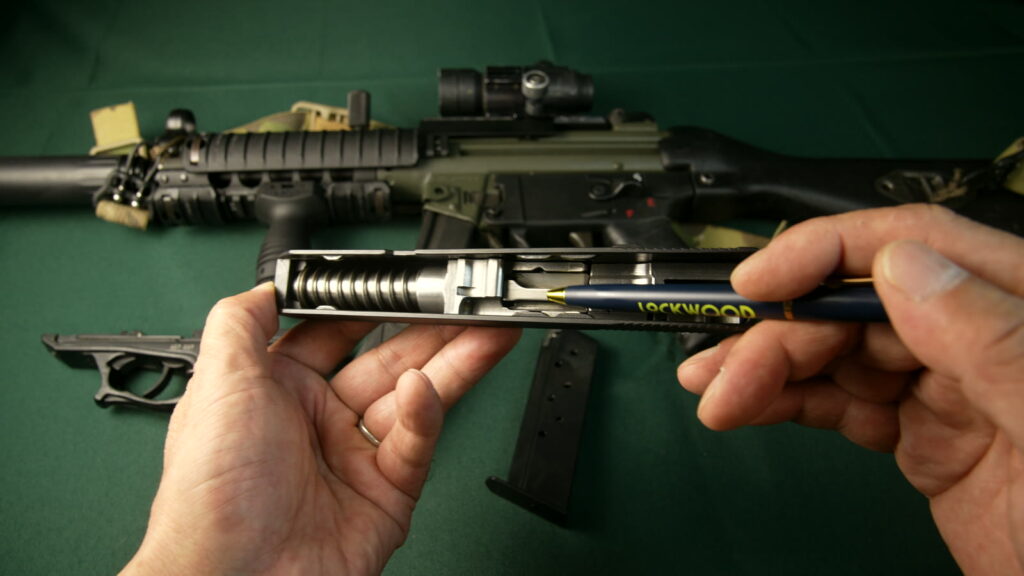
The P9S is a delayed blowback. A light bolt head carries two rollers, one on each side, which bear against angled faces on a fixed barrel mount that holds the barrel and is clamped to the frame. When the cartridge fires, the case starts pushing the bolt head back at once, and the angled faces drive the rollers inward against a control piece in the much heavier carrier. The geometry drives the carrier back faster than the bolt head, which slows the bolt head’s early movement while pressure drops. Then the carrier pulls the head along and the breech opens.
all4shooters explains how H&K rearranged the MP5 layout for a pistol. Unlike the G3 and MP5, the P9S has no rifle-style receiver for the bolt to run in: a reciprocating slide acts as the bolt carrier. A solid block set into the slide forms the control piece, and the bolt head rides on that block. The recoil spring, which sits above the barrel in the G3 and MP5, goes around the barrel, and the barrel does not move when the pistol fires.
What it is like to shoot
In our video we put it this way: it’s a .45 that shoots like a 9. The rollers swallow the kick, and the sights settle right back on target. all4shooters also describes the P9S as soft-shooting and credits a buffer element in the front of the grip frame for part of that.
One lever, three jobs
The lever on the left of the grip, behind the trigger, does three things, and in our experience many people don’t know about all of them:
1. Cock. Press it down and it cocks the concealed hammer. A pin at the rear of the slide shows when the hammer is cocked. 2. Decock. Used together with the trigger, the lever lets the hammer down under control instead of letting it fall. 3. Slide release. With the slide locked open, the same lever sends it home.
Wikipedia notes that this cocking and decocking lever was first seen on the Sauer 38H. Thanks to the double-action trigger, the P9S can be carried with the hammer down and fired with a long first pull, or cocked with the lever for a single-action first shot. There is also a manual firing-pin safety at the left rear of the slide.
How to read HK P9S markings
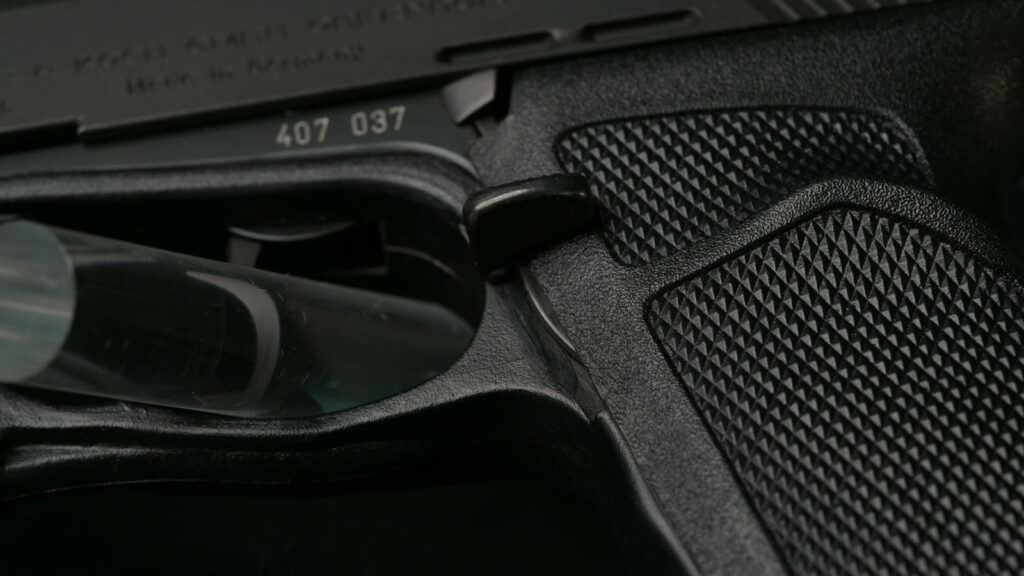
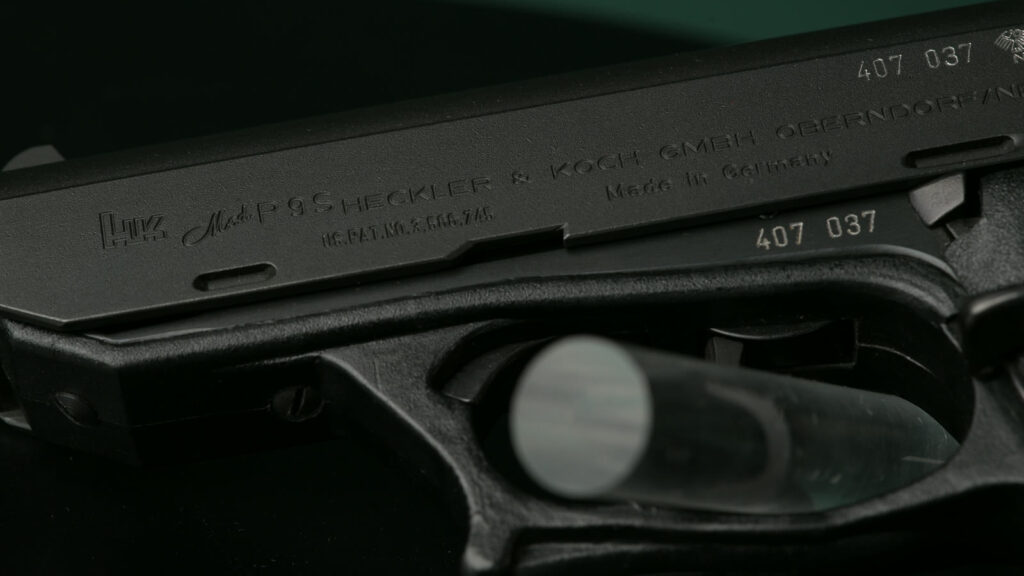
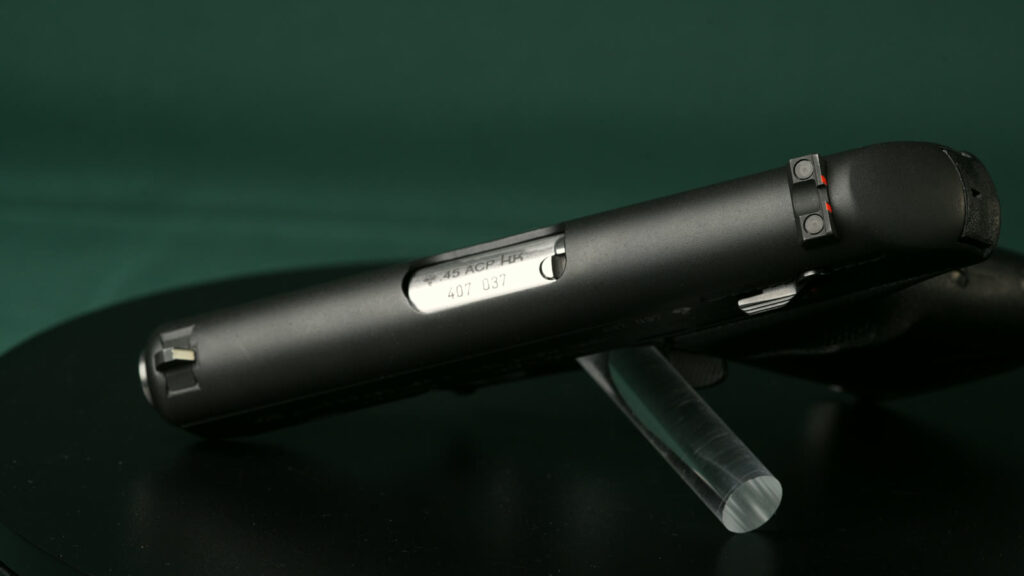
The left side of the slide carries the HK logo and Mod. P9S, then HECKLER & KOCH GMBH OBERNDORF/NECKAR, a U.S. patent number and Made in Germany. Our serial, 407 037, is on the slide with the eagle over N beside it, and again on the frame. The barrel, seen through the ejection port, is marked .45 ACP and carries the same serial and an eagle proof.
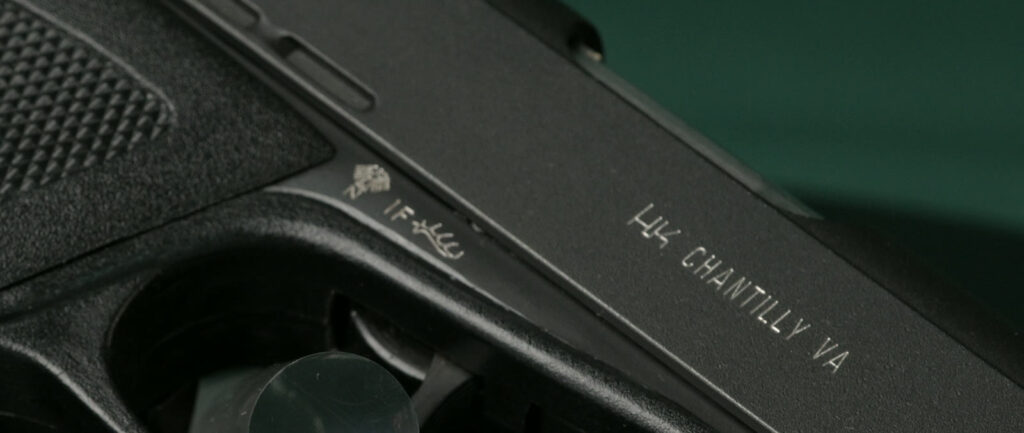
The right side of the slide reads HK CHANTILLY VA: H&K’s U.S. import mark, with the importer’s city and state as U.S. import-marking rules generally call for. Our single-action P9, an earlier gun, carries excl. for SACO Arl. Va. instead.
Near the trigger guard are the German proof marks: the eagle over N for the smokeless-powder proof, the antlers of the Ulm proof house, and a two-letter date code. Walther explains the German two-letter proof-year code, in use since 1968, as A for 0 through K for 9 with no J, and International Sportsman notes that H&K uses the same letters. So IF on ours reads 8 and 5, a proof year of 1985. SIG uses a different letter set, with J and no I; our guide to SIG P228 vs P226 and West German date codes covers that one.
When was the HK P9S made?
The P9S appeared in 1970. Published end dates disagree: Luxus Capital says production ceased in the late 1970s, Wikipedia’s summary box gives 1995 while its text says 1978, and Al Paulson writes that H&K assembled the last P9S in 1989, with Hellenic Arms Industry (EBO) in Greece building it under license as the EP9S as late as 1996. The IF code dates our pistol’s proof to 1985, which fits Paulson’s account but does not settle the question by itself. According to all4shooters, the P9S soon lost out in the important police market to H&K’s own P7, only a few years younger, and P9S numbers stayed low.
Specifications
| Item | HK P9S .45 ACP |
|---|---|
| Maker | Heckler & Koch GmbH, Oberndorf am Neckar |
| Cartridge | .45 ACP (also made in 9x19mm and 7.65mm Parabellum) |
| Magazine | 7 rounds, single column (9 in 9mm) |
| Operation | Roller-delayed blowback, fixed barrel |
| Trigger | Double action / single action, internal hammer |
| Controls | Cocking/decocking lever (also slide release), firing-pin safety, heel magazine release |
| Barrel | Polygonal rifling |
| Ours | Serial 407 037, proofed 1985, HK Chantilly VA import mark |
On the floor at OSA
The P9S in this article is part of the Old Steel Arsenal collection and is not one of the pieces linked below. These are related pistols in our case:
- An Auto-Ordnance 1911 in .45 ACP, a stainless take on the 1911 pattern the SEALs already had.
- A Kimber 45th Anniversary 1911 in .45 ACP and a Kimber Rapide Scorpius 1911 in .45 ACP, two modern takes on the same cartridge and platform.
- An HK VP9L 9mm long slide, a modern pistol from the same maker.
The grid below updates by itself as pieces come and go.
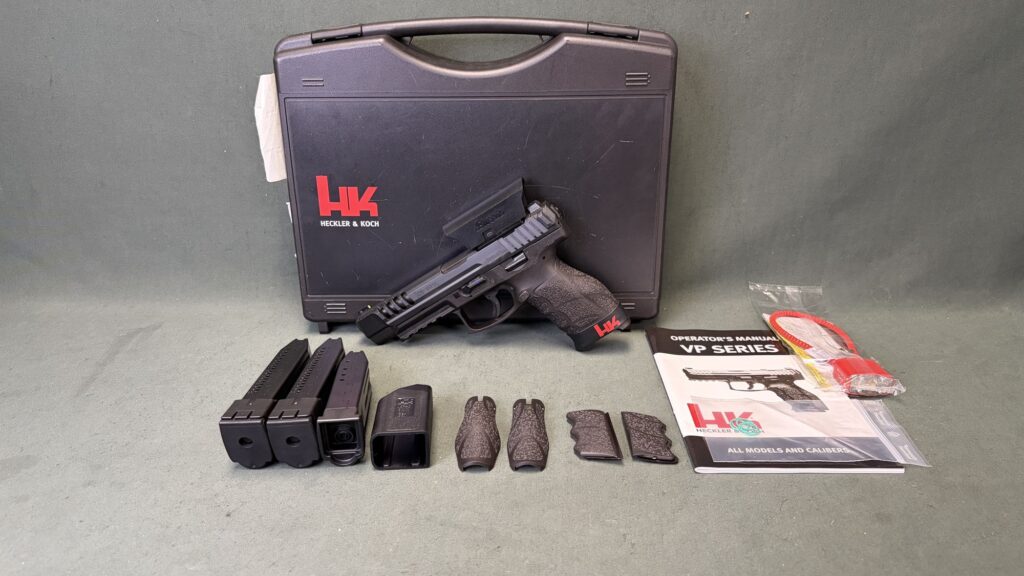 Black FridayHK VP9L 9mm Long Slide with Burris FastFire 3 and Three Magazines Original price was: $849.00.$799.00Current price is: $799.00.
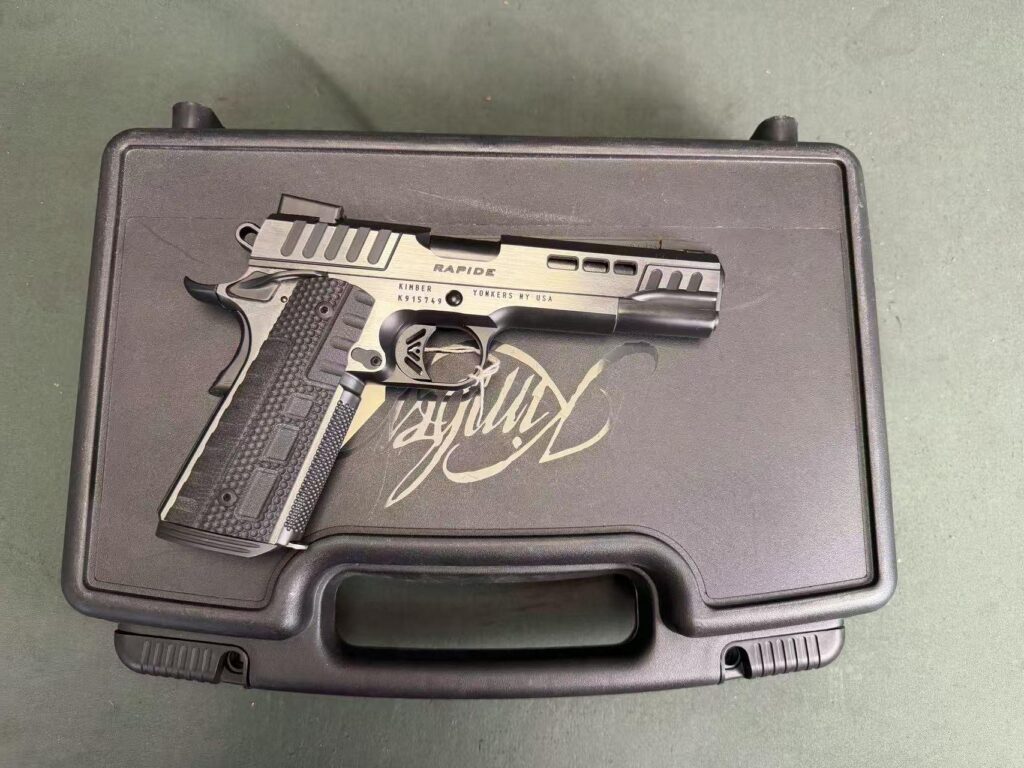 Black FridayKimber Rapide Scorpius 1911 .45 ACP TruGlo TFX Pro Sights Open Box Original price was: $1,499.00.$1,029.00Current price is: $1,029.00.
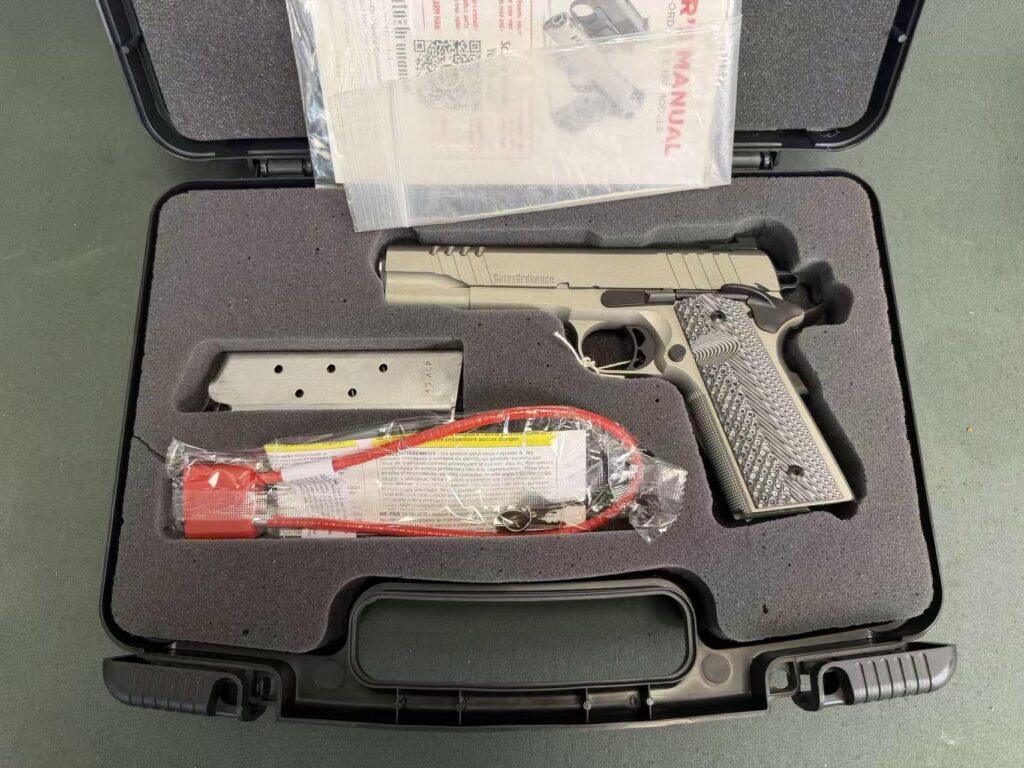 Black FridayAuto-Ordnance 1911TCAC6 .45 ACP Stainless Cerakote TruGlo Night Sights Original price was: $649.00.$639.00Current price is: $639.00.
The short version is on our Instagram. Watch it on Instagram.
General information for collectors, not legal advice. Production dates for the P9 family vary between sources; check details on the individual pistol.
Common Questions
What does the S in HK P9S stand for?
Spannabzug, German for a double-action trigger. The P9S is the double-action version of H&K’s original single-action P9.Is the HK P9S the same action as the MP5?
The same principle: a roller-delayed blowback with two rollers in the bolt head. In the pistol a reciprocating slide takes the place of the bolt carrier, the recoil spring goes around the barrel, and the barrel does not move.Did Navy SEALs use the HK P9S?
Yes, in the suppressed role, in 9mm. The U.S. Navy adopted the 9mm P9S with a suppressor, according to Kevin Dockery’s Weapons of the Navy SEALs as cited by Wikipedia and Al Paulson in Small Arms Review; Paulson writes that the Navy did not use the .45 ACP version. Its fixed barrel suits suppressed use.What does the lever on an HK P9S do?
Three things: it cocks the hammer, it works with the trigger to lower the hammer under control, and with the slide locked open it releases the slide.How many rounds does a P9S .45 hold?
Seven in its single-column magazine. The 9mm P9S holds nine.How do I read the date code on an HK P9S?
Find the two letters next to the German proof marks. In the German proof-year code H&K uses, each letter stands for a digit, A for 0 through K for 9 with no J, giving the last two digits of the proof year. IF is 1985.Sources
- Wikipedia, “Heckler & Koch P9” — https://en.wikipedia.org/wiki/Heckler_%26_Koch_P9 (U.S. Navy adoption with a suppressor citing Dockery, fixed barrel and suppressor reliability without a recoil booster, .45 ACP in 1977, lever as decocker, re-cock and slide release first seen on the Sauer 38H, concealed hammer and cocking indicator, firing-pin safety, recoil spring around the barrel, magazine capacities, P9S production to 1995 in the infobox and 1978 in the text)
- Luxus Capital, “The Heckler & Koch P9 and P9 S” — https://luxuscap.com/resources-on-guns/heckler-koch/the-heckler-koch-p9-and-p9-s/ (design work from July 1965, P9 S introduced 1970 with DA/SA trigger, P9 S production ceased in the late 1970s, .45 ACP version for American demand introduced 1976)
- Klaus Schaub, all4shooters, “Pistole mit Rollenverschluss: Die Heckler & Koch P9S” — https://www.all4shooters.com/de/shooting/historische-waffen/heckler-koch-p-9s-geschichte-entwicklung-funktion-mp5-g3-rollenverschluss/ (first service pistol of GSG 9, P9S as Pistole 9-Schuss Spannabzug, buffer element in the grip, lost the police market to the P7 and low numbers, Spannabzug added 1970, how the roller delay works and how it is arranged in the pistol, recoil spring over the barrel, barrel does not move)
- Al Paulson, Small Arms Review, “H&K’s Navy Silencers: Part I” (January 1999) — https://smallarmsreview.com/testing-evaluation-january-1999/ (Navy adopted the 9x19mm P9S with Qual-A-Tec suppressor made under license by H&K in Virginia, extra-length threaded barrel, Navy did not use the .45 ACP variant, higher target sights on Navy pistols, H&K assembled the last P9S in 1989, EBO EP9S under license as late as 1996)
- Carl Walther, defense service FAQ — https://carl-walther.com/company/contact/defenseservice (German proof year letter code since 1968, A=0 through K=9, no J)
- International Sportsman, “Proof Marks, Date Codes, and German Firearms” — https://internationalsportsman.com/proof-marks-date-codes-and-german-firearms (eagle over N nitro proof, Ulm antlers on Heckler & Koch guns, H&K uses the same code, SIG uses J instead of I)
- 27 CFR 478.92, identification of firearms by licensed importers — https://www.ecfr.gov/current/title-27/chapter-II/subchapter-B/part-478/subpart-F/section-478.92 (importer name and city and state on imported firearms)