
Journal · Collector’s Guide
HK P9: The Single-Action Original of the P9S
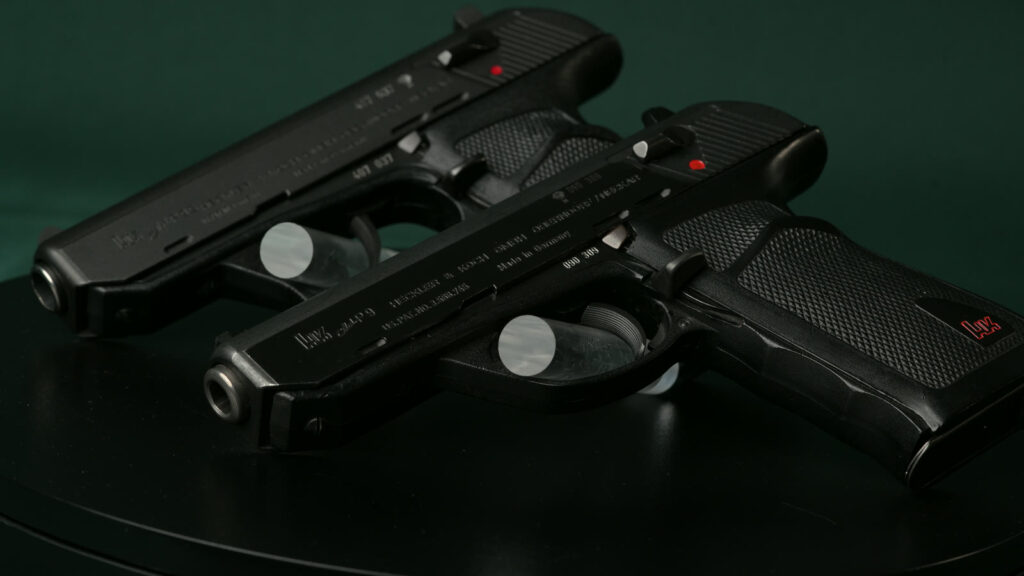
The HK P9 is the pistol the better-known P9S grew out of: the same roller-delayed action and polygonal bore, but a single-action-only trigger. The S that Heckler & Koch added in 1970 stands for Spannabzug, the German term for a double-action pull, and the plain P9 was made only in the hundreds. The one in this article is serial 090 309, with a 1972 proof date, and it is part of the Old Steel Arsenal collection.
Where the P9 came from
H&K’s P9 began in the mid-1960s as an attempt to bring the roller-delayed system of the company’s G3 rifle down to pistol size. Luxus Capital’s history of the pistol dates the start to July 1965, under H&K chief Theodor Koch, with a first complete prototype assembled in 1966. According to the German shooting site all4shooters, the project was first planned as a fully automatic weapon for tank crews and paratroops; the P9 that took shape in 1968 was a semi-automatic pistol instead.
The P9 went into series production at the end of the 1960s. Luxus Capital gives August 1969 and serial numbers starting at 90 001; ours, serial 090 309, fits that sequence. In 1970 H&K introduced the double-action P9S. From then on the single-action P9 continued only in small numbers beside it.
How many HK P9 pistols were made?
Very few, and the figures do not agree. Our video uses 465, a number we have not found in a published reference we can cite. The text of Wikipedia’s article gives 485 single-action P9s, built between 1969 and 1973, although the same page’s summary box runs P9 production to about 1978. Luxus Capital puts the total at about 510, with production ending in January 1978. It is not clear that these figures count exactly the same guns; what they share is a run in the hundreds, tiny next to the P9S.
P9 vs P9S: the one-letter difference
Both pistols have a hammer hidden inside the slide and a cocking lever on the left side of the grip. The lever cocks the hammer, and used together with the trigger it lowers the hammer again, so the pistol can be carried with the hammer down. On the P9 the trigger only releases a hammer that is already cocked. It cannot cock a lowered hammer itself, so there is no long first pull: the hammer has to be cocked first, by cycling the slide or with the lever. That is single action only. A pin at the rear of the slide shows when the hammer is cocked, and Wikipedia describes a manual firing-pin safety at the left rear of the slide.
The P9S added the Spannabzug, the double-action pull, so the first shot can be fired from a decocked hammer with a long trigger stroke. The cocking lever stayed, so a P9S can still be cocked for a single-action first shot. The German site all4shooters reads the model name as Pistole, 9-Schuss, Spannabzug: pistol, nine shots, double-action trigger. According to Luxus Capital, the P9S quickly became the preferred version, which helped keep the P9’s run short.
How the roller-delayed action works
The P9 is a delayed blowback, on the same principle as the G3 and the MP5. A light bolt head carries two rollers, one on each side. In the pistol, the rollers bear against angled faces on a fixed barrel mount that holds the barrel and is clamped to the frame. The slide carries a solid block that forms the control piece, and the bolt head sits on it.
When the cartridge fires, the case starts pushing the bolt head back at once. The angled faces drive the rollers inward against the control piece, and the geometry makes the slide move back faster than the bolt head. That slows the bolt head’s early movement while chamber pressure drops, until the slide takes the head with it and the breech opens. The recoil spring goes over the barrel, and the barrel does not move when the pistol fires.
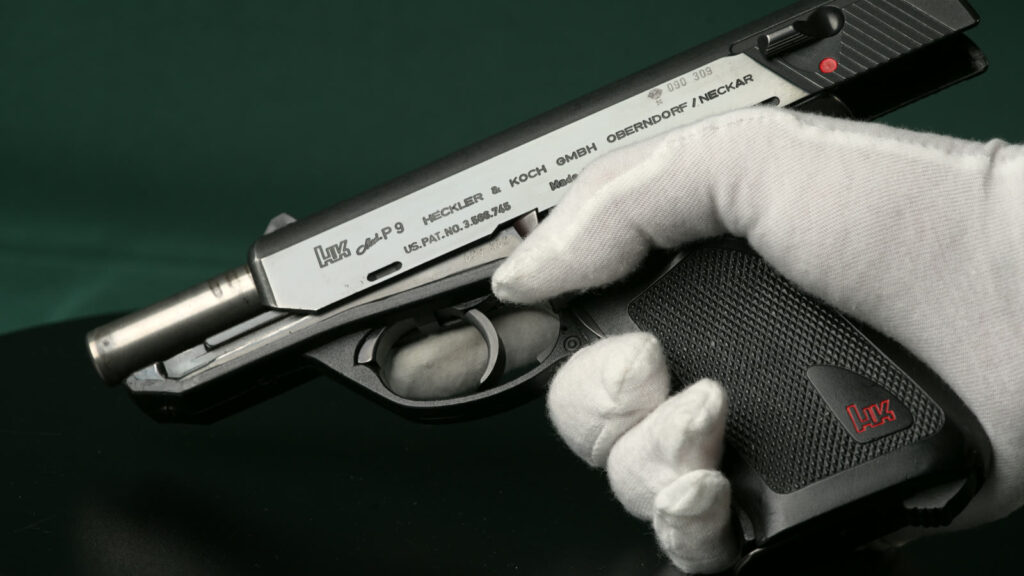
The barrel is polygonal. According to Luxus Capital, H&K first used a six-sided polygonal profile on the P9 and later changed to four sides for manufacturing reasons; we have not checked which profile ours has. The grip frame is stamped steel with a polymer covering, a production method carried over from H&K’s rifle work.
How to read HK P9 markings
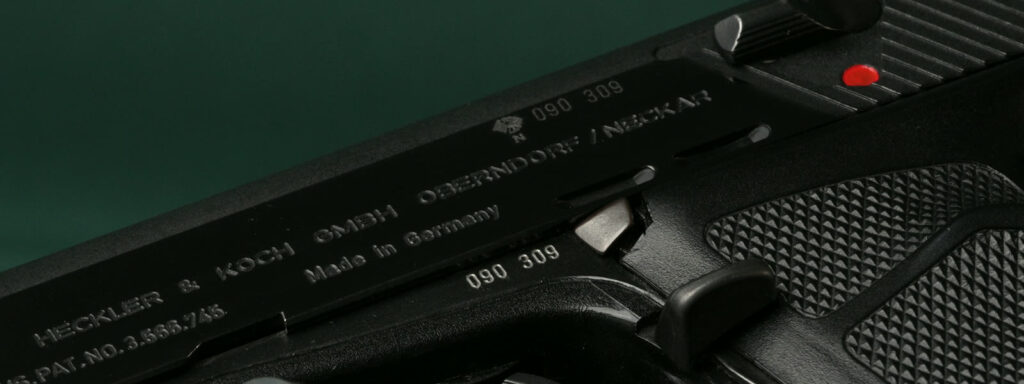
The left side of the slide carries the HK logo and Mod. P9, then HECKLER & KOCH GMBH OBERNDORF / NECKAR, US.PAT.NO.3.566.745 and Made in Germany. The serial, 090 309 on ours, appears on the slide with the eagle over N beside it, and again on the frame. On ours the frame, slide and barrel all carry the same number, with a mirror-bright bore and a polished barrel.
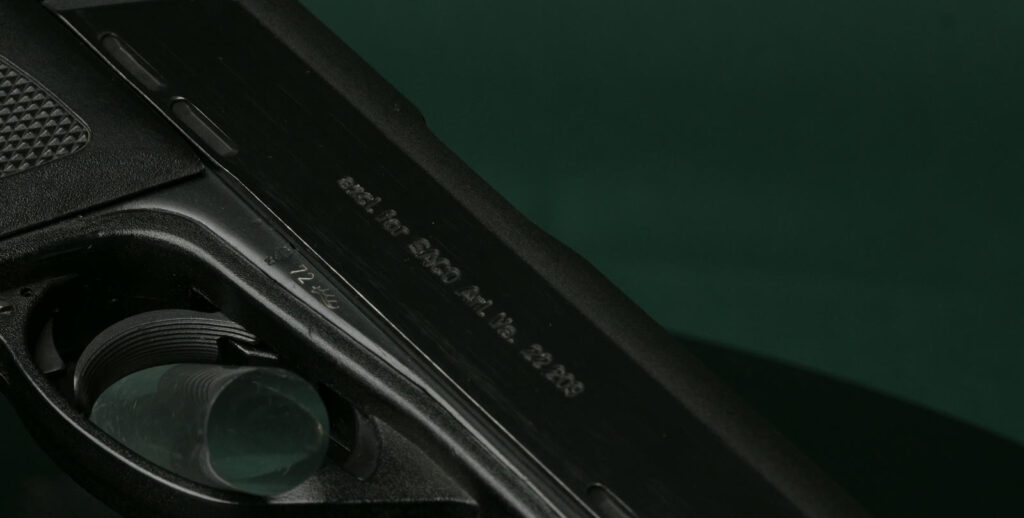
On the right side, ours is stamped excl. for SACO Arl. Va. with the ZIP code 22209. excl. for reads exclusively for: SACO, in Arlington, Virginia, was H&K’s U.S. importer at the time. Lower down, beside the trigger guard, are the proof-date stamp 72 and the proof marks. The 72 is the year of proof, which is not necessarily the exact year of assembly. The eagle over N is the German proof for smokeless (nitro) powder, and the antlers identify the Ulm proof house.
The windowed magazine
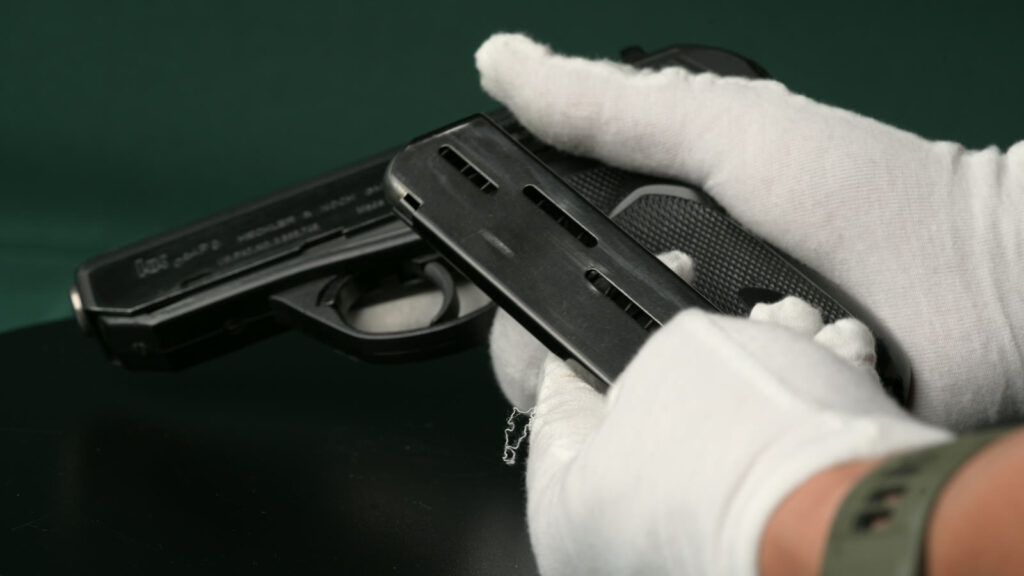
The P9 uses a single-column magazine released by a catch at the heel of the grip. The body of ours has windows cut right through it at several heights, so with the magazine out of the gun you can see the cartridges and tell roughly how many are left at a glance.
Specifications
| Item | HK P9 |
|---|---|
| Maker | Heckler & Koch GmbH, Oberndorf am Neckar |
| Cartridge | 9x19mm (ours) |
| Operation | Roller-delayed blowback, fixed barrel |
| Trigger | Single action only, internal hammer |
| Controls | Cocking lever on the left of the grip, firing-pin safety on the slide, heel magazine release |
| Magazine | Single column, windowed |
| Barrel | Polygonal rifling |
| Production | Late 1960s to 1970s, a few hundred made |
| Ours | Serial 090 309, 72 proof date, matching frame, slide and barrel |
On the floor at OSA
The P9 in this article is part of the Old Steel Arsenal collection and is not one of the pieces linked below. These are related pistols in our case:
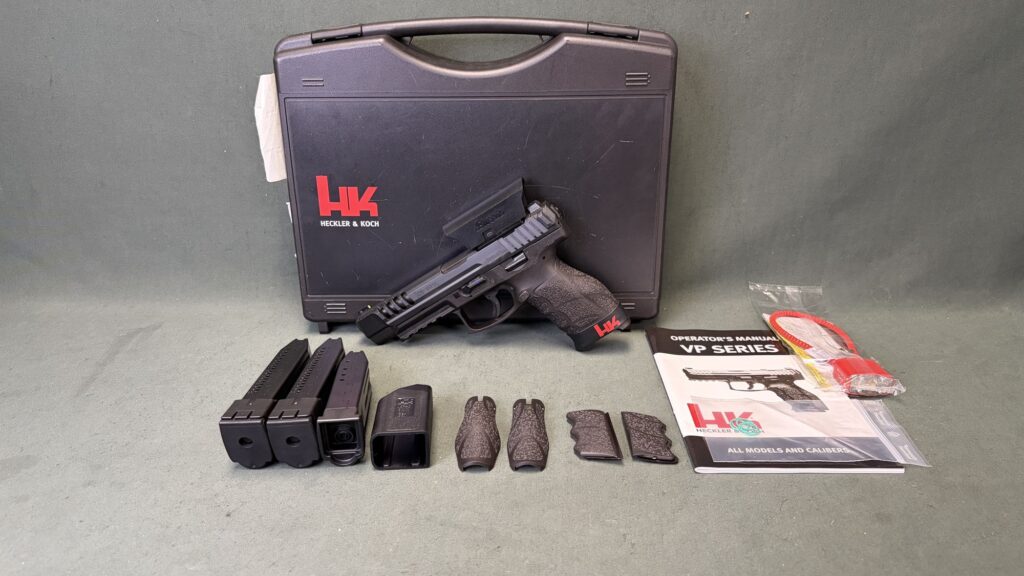
- An HK VP9L 9mm long slide, a modern 9mm from the same maker.
- A Mauser Model 1914 in .32 ACP, made in Oberndorf by the company whose former engineers founded Heckler & Koch in 1949.
- A German-made SIG Sauer P226, a West German service pistol from the same era of 9mm designs.
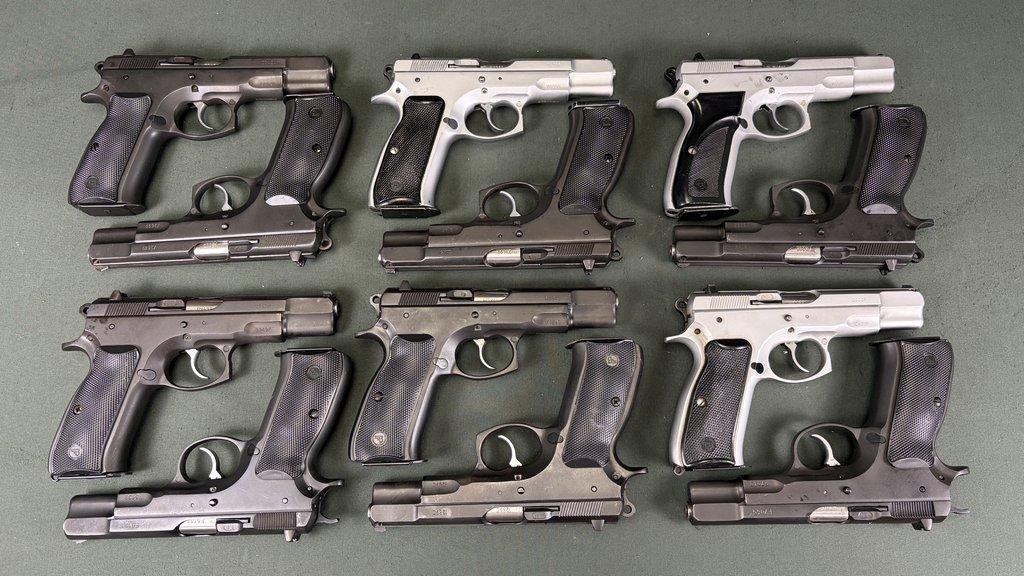
- CZ 75 Pre-B and transitional pistols from Czech police and military service, European service 9mms with the double-action first shot the P9 lacked. Our guide on how to identify a CZ 75 Pre-B explains the early guns.
The grid below updates by itself as pieces come and go.
 Black FridayHK VP9L 9mm Long Slide with Burris FastFire 3 and Three Magazines Original price was: $849.00.$799.00Current price is: $799.00.
 Free ShippingBlack FridayCZ 75 Pre-B 9×19 Czech Police Surplus Grade A Matching Numbers Mirror Bore Original price was: $569.00.$540.00Current price is: $540.00.
The short version is on our Instagram. Watch it on Instagram.
General information for collectors, not legal advice. Production figures for the P9 vary between sources; check details on the individual pistol. For collector status, see our guide to curio and relic firearms.
Common Questions
What is the difference between the HK P9 and the P9S?
The trigger. The P9 is single action only: its trigger releases an already-cocked hammer and cannot cock a lowered one; the hammer is cocked by cycling the slide or with the lever on the left of the grip. The P9S adds a double-action pull, so the first shot can be fired from a decocked hammer.What does the S in P9S stand for?
Spannabzug, the German term for a double-action trigger. The German site all4shooters reads the full name as Pistole, 9-Schuss, Spannabzug.How many original HK P9 pistols were made?
Only a few hundred. Published figures disagree: Wikipedia gives 485 and Luxus Capital about 510.When was the HK P9 made?
Series production began in 1969 and the double-action P9S followed in 1970. Sources differ on when the single-action P9 ended: Wikipedia’s text says 1973, Luxus Capital January 1978.Does the HK P9 use the same action as the G3 and MP5?
The same principle, roller-delayed blowback, adapted to a pistol with a fixed barrel and a slide in place of the rifle’s bolt carrier.What does "excl. for SACO Arl. Va." mean on an HK pistol?
It reads exclusively for SACO, Arlington, Virginia. SACO was Heckler & Koch’s U.S. importer at the time.Sources
- Wikipedia, “Heckler & Koch P9” — https://en.wikipedia.org/wiki/Heckler_%26_Koch_P9 (485 single-action P9s, pre-73 P9 1969–1973 in the text and c.1969–1978 in the infobox, P9S named for Spannabzug, internal hammer and cocking lever, manual firing-pin safety, cocking indicator pin, recoil spring around the barrel, heel magazine release, single-column magazine)
- Luxus Capital, “The Heckler & Koch P9 and P9 S” — https://luxuscap.com/resources-on-guns/heckler-koch/the-heckler-koch-p9-and-p9-s/ (July 1965 start under Theodor Koch, 1966 prototype, series production from August 1969 with serials from 90 001, about 510 made, end in January 1978, P9 S became the preferred variant, P9 S introduced in 1970, stamped sheet-metal frame with polymer, six- then four-sided polygonal profile)
- Klaus Schaub, all4shooters, “Pistole mit Rollenverschluss: Die Heckler & Koch P9S” — https://www.all4shooters.com/de/shooting/historische-waffen/heckler-koch-p-9s-geschichte-entwicklung-funktion-mp5-g3-rollenverschluss/ (project first planned as fully automatic for tank crews and paratroops, P9 in 1968, Spannabzug added in 1970, P9S as Pistole 9-Schuss Spannabzug, internal hammer and left-side cocking lever, how the roller delay works and how it is arranged in the pistol: fixed barrel mount clamped to the frame, block in the slide forming the control piece, recoil spring over the barrel, barrel does not move)
- Forgotten Weapons, “HK P9S” — https://www.forgottenweapons.com/hk-p9s-video/ (original short run was the single-action-only P9, quickly replaced by the double-action P9S)
- International Sportsman, “Proof Marks, Date Codes, and German Firearms” — https://internationalsportsman.com/proof-marks-date-codes-and-german-firearms (eagle over N nitro proof, Ulm antlers)
- Wikipedia, “Heckler & Koch” — https://en.wikipedia.org/wiki/Heckler_%26_Koch (founded 1949 in Oberndorf am Neckar by former Mauser engineers)