
Journal · Collector’s Guide
SIG P210 Danish m/49: History and Markings
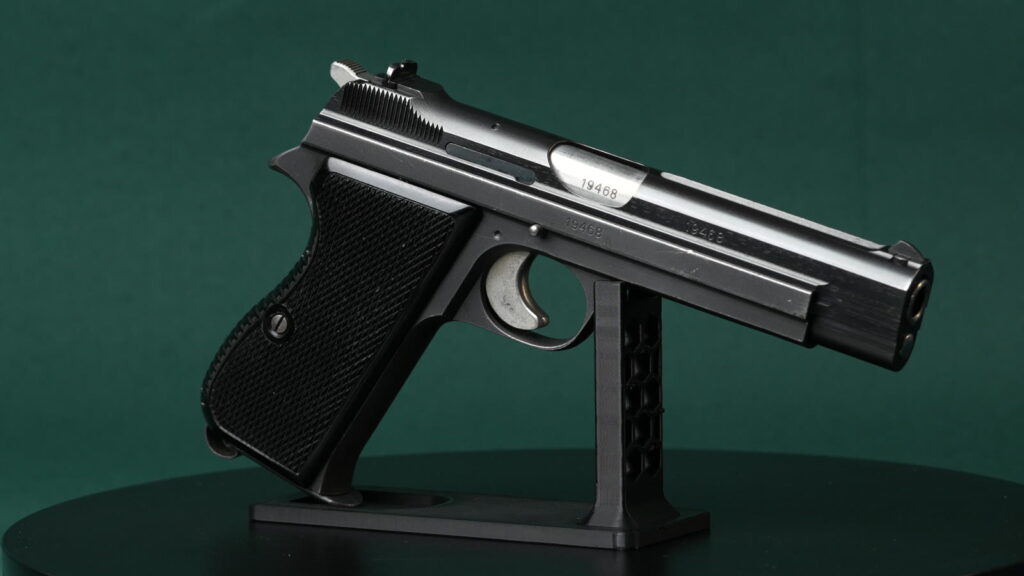
The SIG P210 Danish m/49 is the Swiss-made P210 marked for the Danish armed forces, and Denmark had it before Switzerland did. The Danes chose SIG’s pistol in August 1948 and took their first 14,000 that same month, two months before the Swiss formally adopted it, then carried it for about seventy years. You can tell a Danish gun by its frame: the m/49 designation, a Danish crown, and the initials of the Danish organization that received it, HTK or FKF. The one in our photos is part of our own collection.
From a French patent to a Swiss pistol
The P210 started as a license. In 1937 SIG, then Schweizerische Industrie-Gesellschaft in Neuhausen, acquired the rights to Charles Petter’s design, the one France adopted as the Modèle 1935A, for everywhere except France. SIG’s engineers reworked it through the war years under prototype names such as P 44/8, P 44/15 and P 44/16, and the single-stack, eight-round version went into production as the SP 47/8.
Switzerland’s National Defence Commission approved it on 14 October 1948 as the 9 mm Pistole Modell 1949, usually shortened to P49. Switzerland adopted the P75 (the SIG P220) as its replacement in 1975, though P49s stayed with reservists long after. SIG named the commercial version the P210, and the name stuck to the whole family.
Denmark’s m/49: ahead of the Swiss
Denmark needed a new service pistol after the war. According to SIG designer Emil Busenhart’s account of the company’s pistols, Danish army officers from Hærens Tekniske Korps visited SIG in February 1947, and after trials against pistols from Colt, Smith & Wesson, FN and Lahti, the Danes chose the SIG in August 1948. The first 14,000 pistols, designated 9 mm Pm/49 HTK, were delivered on 27 August 1948. The m/49 replaced the Bergmann-Bayard M1910/21.
Forgotten Weapons puts the Danish total at just under 27,000 pistols. Luxus Capital’s summary of Lorenz Vetter’s history of SIG pistols gives the deliveries year by year:
| Year | Pistols | Received by |
|---|---|---|
| 1948 | 14,000 | HTK |
| 1951 | 2,607 | HTK |
| 1953 | 3,600 | FKF |
| 1954 | 5,306 | FKF |
| 1962 | 1,417 | HTK |
Those add up to 26,930, about 18,000 HTK pistols and about 8,900 FKF pistols, which squares with the Forgotten Weapons figure. The FKF guns are the smaller group.
The m/49 stayed in service a long time. When Denmark opened trials for a successor, its defence procurement agency said the new pistol would replace the m/49, and in April 2018 Denmark selected the SIG P320 X-Carry, with the changeover planned to start in 2019.
How to read SIG P210 Danish m/49 markings
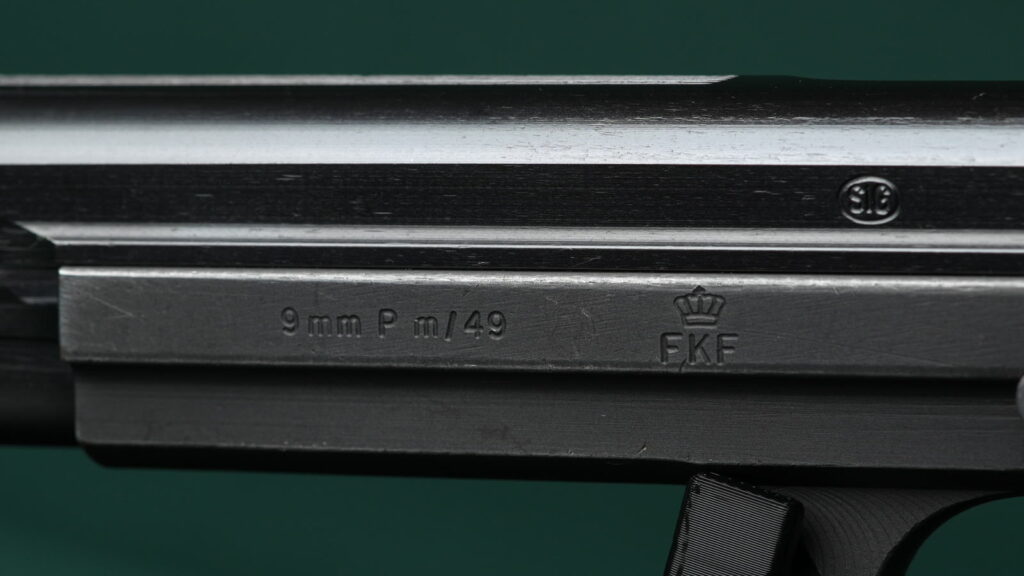
On the left side of our pistol the frame reads 9mm P m/49, with a crown over FKF stamped behind it, and the slide above carries the SIG logo. FKF is generally read as Forsvarets Krigsmateriel Forvaltning, the Danish defence materiel administration; HTK is Hærens Tekniske Korps, the Army Technical Corps. The crown is the Danish royal crown.
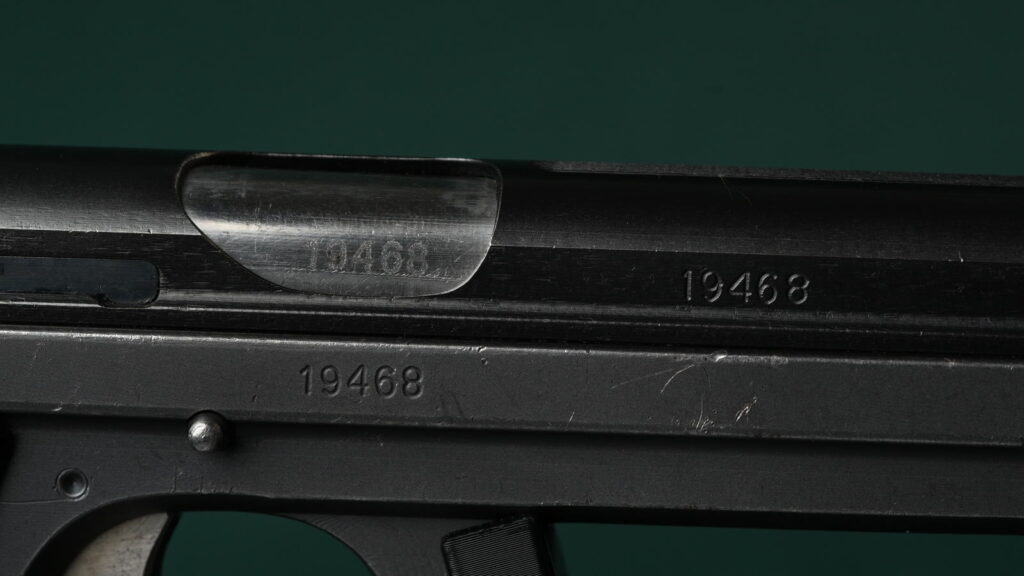
The weapon number is stamped on the frame, the slide and the barrel, among other parts. We checked those three on ours, and each reads 19468. The barrel number shows through the ejection port, so you can check it without taking anything apart.
Dating a Danish m/49
The marking tells you which Danish organization received the pistol, and the delivery years narrow it down. FKF deliveries are recorded only for 1953 and 1954, so ours, an FKF gun, was delivered around 1953. HTK guns could come from 1948, 1951 or 1962. A specific year for a single pistol needs more than the marking.
Why the slide rides inside the frame
On nearly every semi-automatic pistol, the frame rails run up and out, and the slide wraps around them. On the P210 it is reversed. As American Rifleman describes it, the frame rails come up and turn inward, and the slide’s rails reach out into them, so the slide rides inside the frame. Forgotten Weapons notes the rails run the full length of the frame.
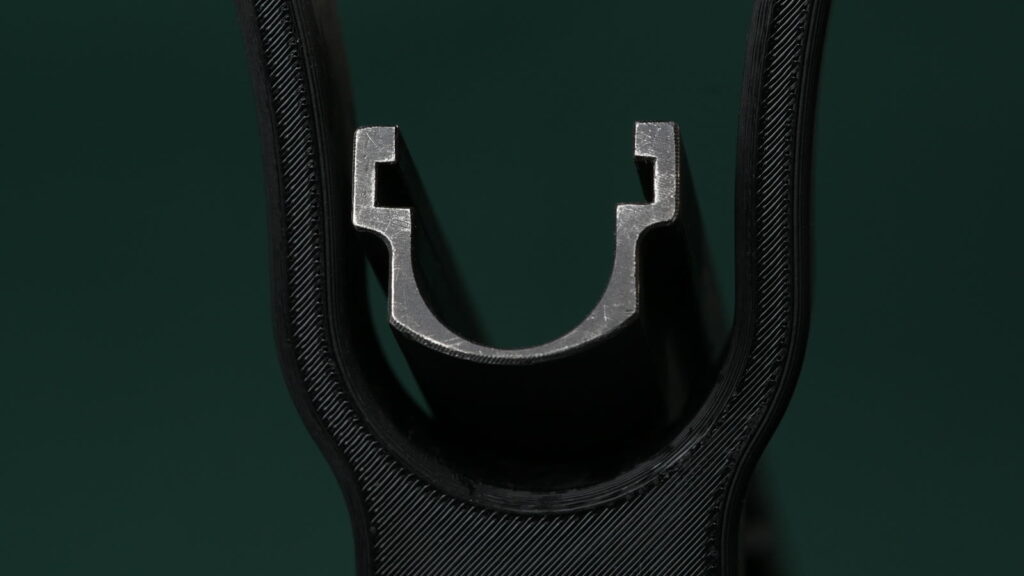
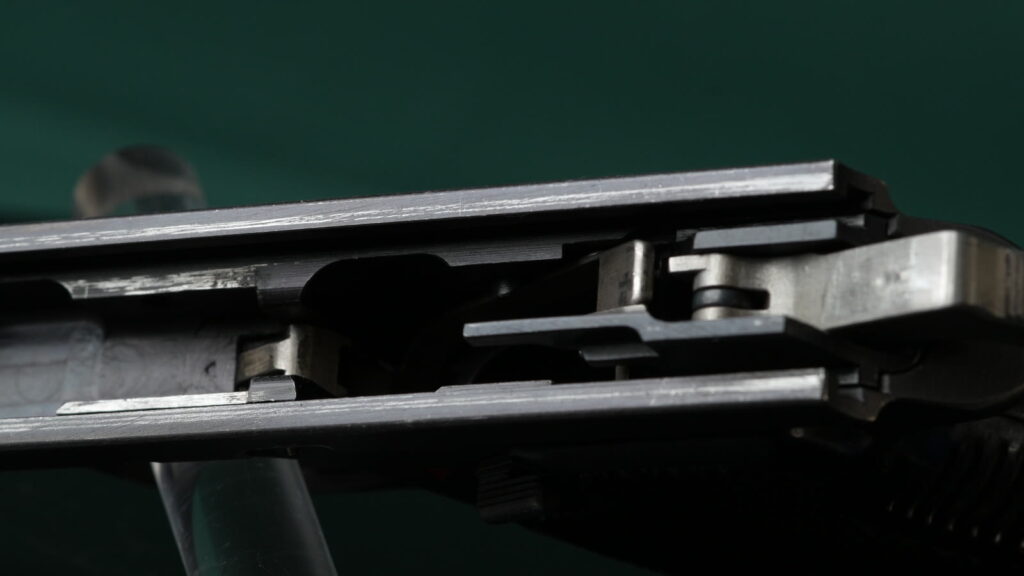
American Rifleman calls the result “a better degree of mechanical control,” and Forgotten Weapons singles out the P210’s “exceptional fitting and tolerances.” On our m/49, racking the slide feels like a hot knife through butter.
The rest of the mechanism is a short-recoil, tilting-barrel design in the Browning family, but a cam cut milled into the barrel replaces the swinging link, and the lockwork comes out as a self-contained module, a feature carried over from Petter’s French pistol.
The 50-meter standard
Published accounts of the accuracy requirement agree on the distance and the group size but not on the shot count. Tactical Life writes that service P49s had to group 10 shots into 5 centimeters, just under 2 inches, at 50 meters. Outdoor Life gives five shots in two inches or less at 50 meters, with match-grade ammunition. We have not found the original acceptance specification itself.
In our video, with our Swiss military P210 and one hand, the first shot at a steel plate 130 yards out was a hit. One shot, from a different P210 than the one in these photos.
The trigger
The P210 is our favorite handgun, and we have collected nearly every variant. The trigger is a large part of why. It is a single-action trigger with an exposed hammer, and we’d call it almost perfect: light, with a clearly defined wall and a crisp break, short travel and a positive reset. That holds for every P210 we have handled, the Danish m/49 included.
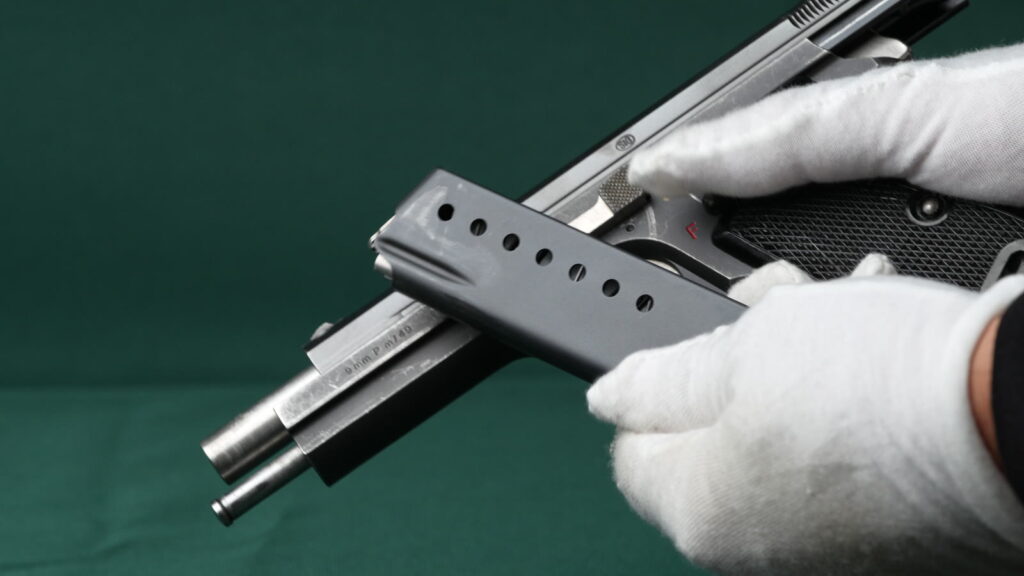
The magazine is a single-stack eight-rounder, released by a catch at the heel of the grip rather than a button behind the trigger guard, the layout of an old service pistol.
Specifications
| Item | Danish m/49 |
|---|---|
| Maker | SIG, Neuhausen, Switzerland |
| Danish choice and first delivery | August 1948 |
| Danish designation | 9 mm Pistol m/49 |
| Cartridge | 9×19mm |
| Magazine | 8 rounds, single stack, heel catch |
| Action | Single action, short recoil, tilting barrel with a cam cut, no link |
| Swiss equivalent | Pistole 49 (P49) |
| Replaced in Danish service by | SIG P320 X-Carry, selected 2018 |
The P210 family
SIG built the P210 in a long run of variants. Selected ones, as Forgotten Weapons lists them:
| Model | What it is |
|---|---|
| P210-1 | Fixed sights, blued finish, wood grips |
| P210-2 | As the -1, with plastic grips |
| P210-3 | As the -1 or -2, with an early loaded-chamber indicator |
| P210-4 | West German Border Guard pistols, no lanyard loop, serials beginning with D |
| P210-5 | Target model, 6-inch barrel |
| P210-6 | Target model, standard-length barrel |
| P210 Target | Made in the United States by SIG Sauer, shown at SHOT Show 2017 |
The later versions are not the same pistol made somewhere else. American Rifleman notes that the U.S.-made P210 Target keeps the inverted rails but locks up at its barrel hood.
Switzerland replaced the P49 with the P220. For the later SIG service pistols, see how to tell a P228 from a P226 and read West German date codes.
Collecting a Danish m/49
An original m/49 is now more than 50 years old, which puts it in the federal curio and relic category by age; our curio and relic guide explains what that means for collectors. When you look one over, check the frame for the m/49 designation, the crown and HTK or FKF, compare the numbers on frame, slide and barrel, note any importer marking, and rack the slide.
On the floor at OSA
The m/49 in these photos stays in our collection. If the P210 is your kind of pistol, these pieces in our case share something with it:
- Waffenfabrik Bern Swiss Luger 06/29 in .30 Luger: the Luger was the Swiss service pistol the P49 followed.
- CZ 75 Pre-B, Czech police surplus: one of the few other pistols American Rifleman names with reversed rails, the slide riding inside the frame.
- 1995 SIG P228 with the Swiss Ticino police crest: a later SIG carried by Swiss police.
- German-made SIG P228, German police and Israeli service and a German SIG P226 in stainless two-tone: the SIG service pistols that followed the P220.
The grid below updates by itself as pieces come and go.
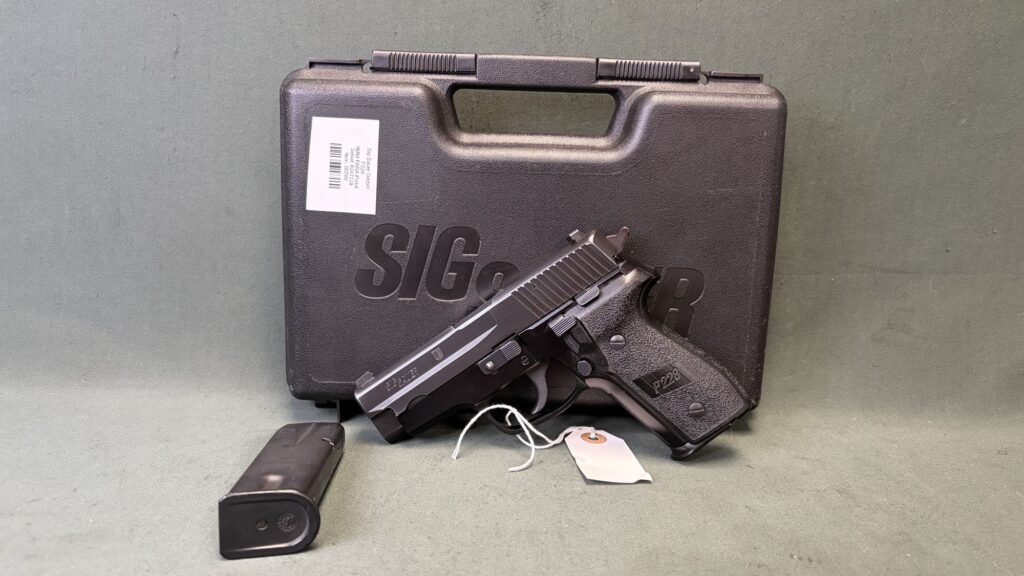 SIG Sauer P228 9mm 1995 German Ticino Police Crest No Import Mark Box$1,249.00
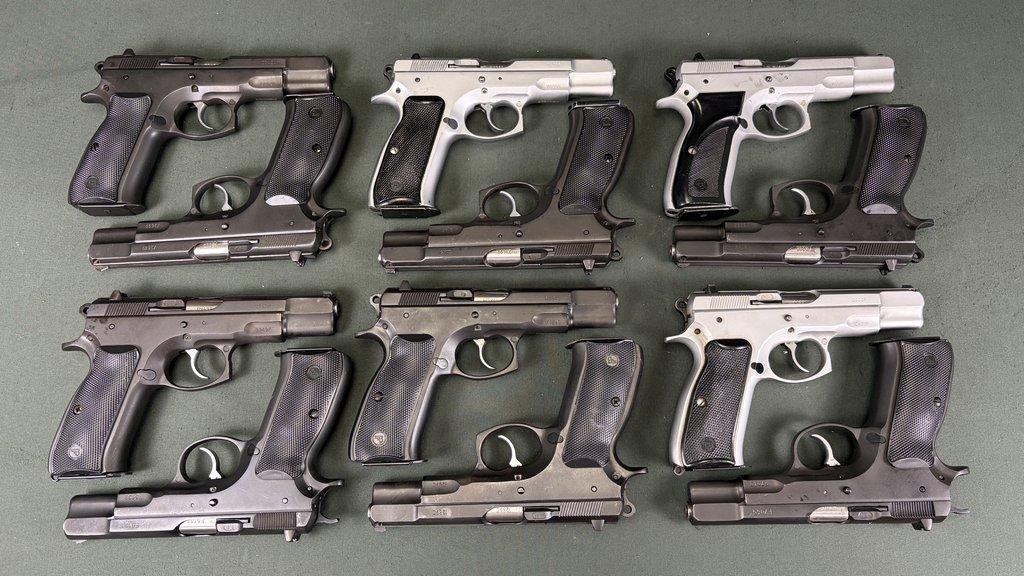 Free ShippingCZ 75 Pre-B 9×19 Czech Police Surplus Grade A Matching Numbers Mirror Bore$569.00
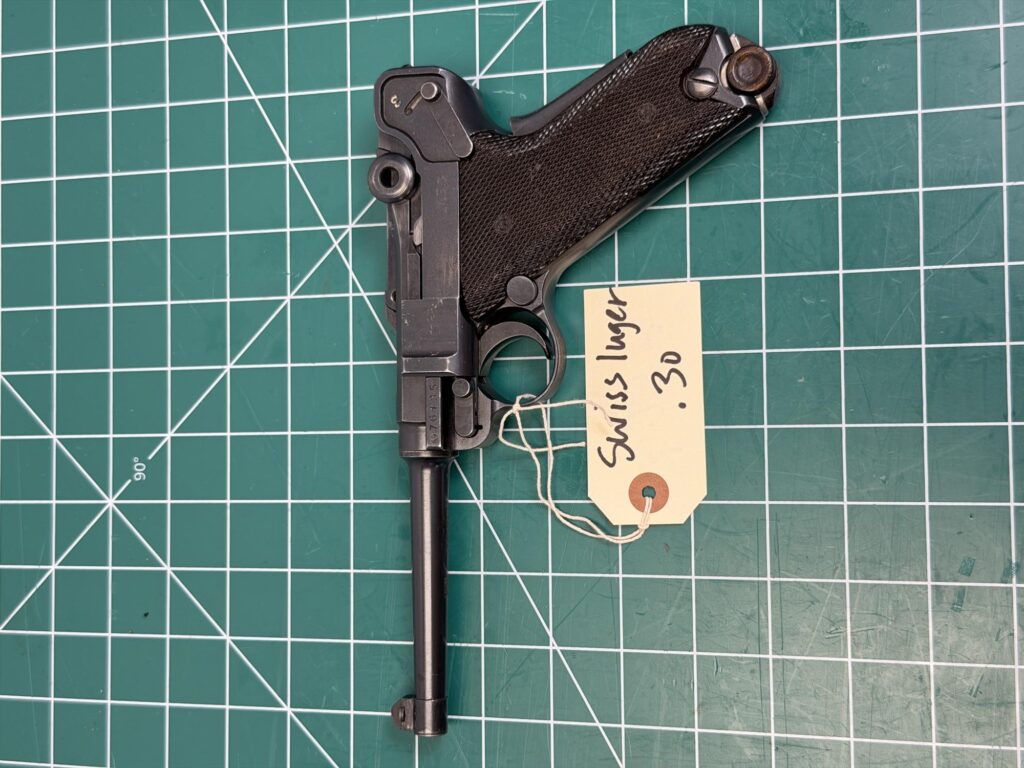 Waffenfabrik Bern Swiss Luger 06/29 pistol chambered in .30 Luger$2,379.00
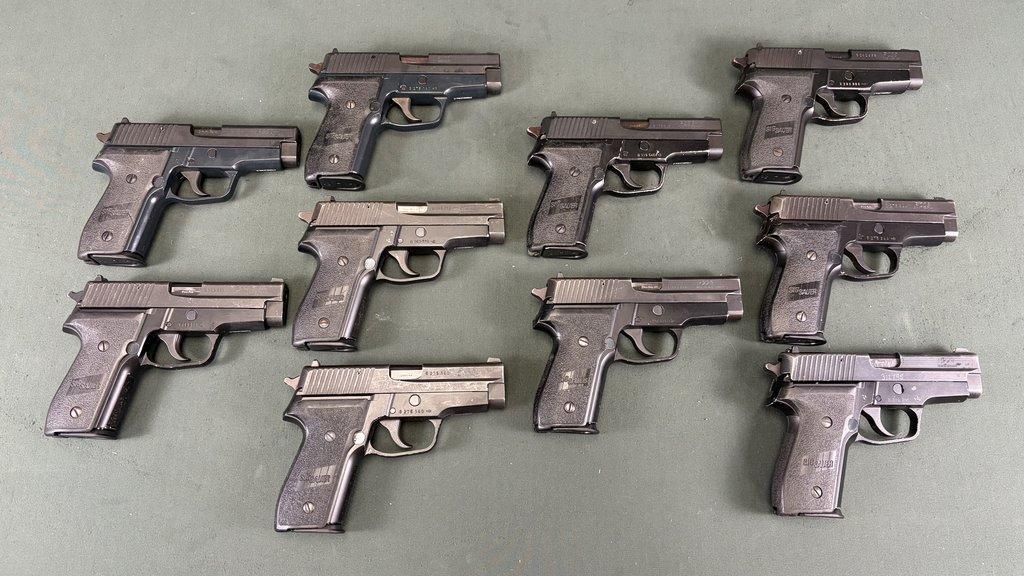 Free ShippingSIG Sauer P228 9mm German Police Israeli IDF Surplus Grade B Mirror Bore Original price was: $629.00.$569.00Current price is: $569.00.
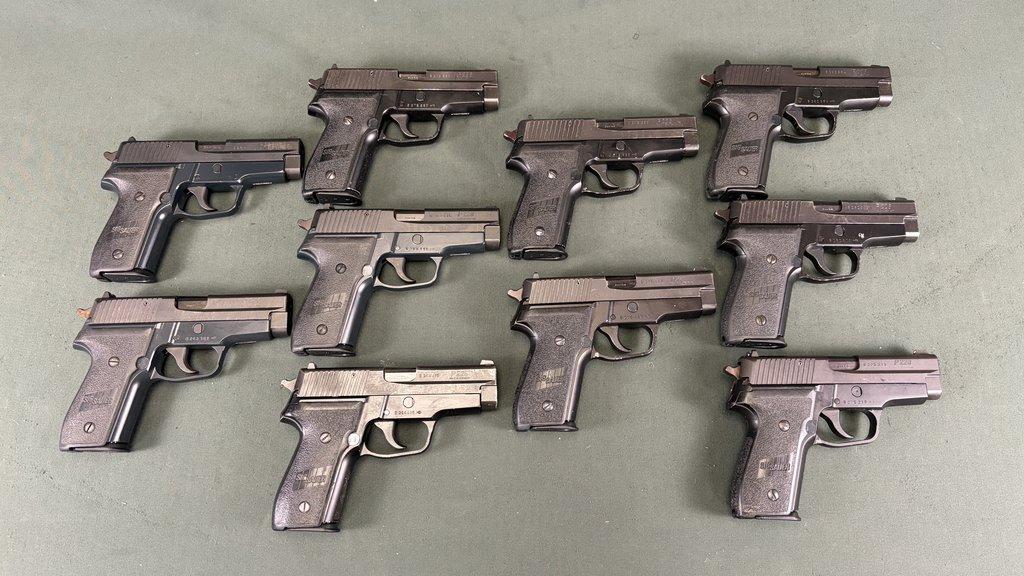 Free ShippingSIG Sauer P228 9mm German Police Israeli IDF Surplus Grade A Mirror Bore Original price was: $679.00.$629.00Current price is: $629.00.
The short version is on our Instagram. Watch it on Instagram.
General information for collectors, not legal advice. Delivery records and markings come from secondary sources; verify details on the individual pistol.
Common Questions
What is a Danish m/49 pistol?
It is a SIG P210, the Swiss-made 9mm pistol the Swiss Army carried as the Pistole 49, in Danish service as the 9 mm Pistol m/49. Danish pistols carry the m/49 designation and a Danish crown over HTK or FKF on the frame.What do HTK and FKF mean on a Danish m/49?
They are the Danish organizations that received the pistols. HTK is Hærens Tekniske Korps, the Army Technical Corps; FKF is generally read as Forsvarets Krigsmateriel Forvaltning, the defence materiel administration. By Luxus Capital’s summary of Lorenz Vetter’s history of SIG pistols, HTK received about 18,000 and FKF about 8,900.How many Danish m/49 pistols were made?
Just under 27,000, according to Forgotten Weapons. The delivery figures in Luxus Capital’s summary of Lorenz Vetter’s history of SIG pistols add up to 26,930, delivered in 1948, 1951, 1953, 1954 and 1962.How do I date a Danish m/49?
Start with the marking. FKF deliveries are recorded only for 1953 and 1954; HTK deliveries for 1948, 1951 and 1962. That narrows a pistol to a delivery period, not to a single year.How long did Denmark use the P210?
About seventy years. Denmark chose it in 1948 and in April 2018 selected the SIG P320 X-Carry to replace it, with the changeover planned to begin in 2019.How accurate is the SIG P210?
Very accurate for a service pistol. Tactical Life reports a requirement of 10 shots inside 5 cm, just under 2 inches, at 50 meters; Outdoor Life gives five shots in two inches or less at 50 meters with match-grade ammunition. We have not found the original acceptance specification.Is a Danish m/49 a curio and relic firearm?
An original m/49 qualifies by age: the federal definition covers firearms manufactured at least 50 years ago, other than replicas. Check that the pistol is an original Danish service gun before relying on it.Sources
- Emil Busenhart, “The Technical Development of the SIG Semi-Automatic Pistols,” via Luxus Capital — https://luxuscap.com/resources-on-guns/sig-sauer/the-technical-development-of-thesig-sauer-semi-automatic-pistols/ (1937 license, P 44 prototypes, HTK visit in February 1947, Danish trials and August 1948 decision, first 14,000 delivered 27 August 1948, Swiss approval on 14 October 1948)
- Luxus Capital, “Danish Army Pistol SIG 9 mm P m/49,” summarizing Lorenz Vetter, Das grosse Buch der SIG-Pistolen (1995) — https://luxuscap.com/resources-on-guns/sig-sauer/danish-army-pistol-sig-9-mm-p-m-49/ (deliveries by year and service, FKF and HTK names, where the markings appear)
- Forgotten Weapons, “Danish M49 Service Pistol by SIG” — https://www.forgottenweapons.com/danish-m49-service-pistol-by-sig/ (just under 27,000 pistols, replacing the Bergmann-Bayard, single action, full-length rails, self-contained lockwork)
- Forgotten Weapons, “SIG P210” — https://www.forgottenweapons.com/sig-p210/ (Petter license and development, SP 47/8, cam-cut locking, fitting and tolerances, variant list)
- Wiley Clapp, American Rifleman, “Tested: SIG Sauer’s Made-in-America P210 Pistol” — https://www.americanrifleman.org/articles/2018/12/21/tested-sig-sauer-s-made-in-america-p210-pistol (reversed rails and how they are arranged, Petter features, CZ 75 as another reversed-rail pistol, P210 Target lockup, SHOT Show 2017 P210 Target)
- Outdoor Life, “Sig P210 Carry Gun Review” — https://www.outdoorlife.com/guns/sig-sauer-p210-review/ (five shots in two inches or less at 50 m with match-grade ammunition)
- Tactical Life, “Sig Sauer P210 and the Swiss Army P49” — https://athlonoutdoors.com/article/sig-sauer-p210-and-the-swiss-army-p49/ (P75 adopted 1975, P49s kept by reservists, 10 shots in 5 cm at 50 m)
- The Firearm Blog, “Danish Army Begins Pistol Trials to Replace SIG P210” — https://www.thefirearmblog.com/blog/2017/11/15/danish-army-begins-pistol-trials-replace-sig-p210 (procurement agency statement, changeover planned from 2019)
- Shephard, “Denmark selects SIG Sauer P320 X-Carry as new pistol” — https://shephardmedia.com/news/landwarfareintl/denmark-selects-sig-sauer-p320-x-carry-new-pistol (April 2018 selection)
- 27 CFR 478.11, definition of curios or relics — https://www.ecfr.gov/current/title-27/chapter-II/subchapter-B/part-478/subpart-B/section-478.11 (firearms manufactured at least 50 years prior)