Journal · Collector’s Guide
Panama Hi Power: A 1987 FN Made for Noriega’s Army
This Panama Hi Power was made by FN in Belgium in 1987 for the Panama Defense Forces, the military Manuel Noriega commanded. Two years later, on 20 December 1989, the United States invaded Panama with about 27,000 troops, and within two months the Defense Forces no longer existed. You can read both of those facts off the steel: the crest and Spanish lettering on top of the slide, and a date code in the serial number. Who carried it, and where it was that December, the marks don’t say. It is part of our own collection.
Panama’s Defense Forces and Noriega
From 1953, Panama’s armed force was its National Guard. In 1983 it was reorganized into the Fuerzas de Defensa de Panamá, the Panama Defense Forces, under Law 20 of 29 September 1983. Manuel Noriega took command of the Guard in August 1983 and stayed at the head of the new force until the invasion.
The Defense Forces were not only an army. Under one command they took in Panama’s army, air force, navy and police, and their handguns included the Browning Hi-Power, made by FN in Belgium. Their commander was Panama’s de facto ruler for the rest of the decade. In 1989 Noriega annulled an election the opposition candidate, Guillermo Endara, appeared to have won.

December 1989: Operation Just Cause
The United States had kept a large garrison around the Panama Canal for decades. Operation Just Cause began on 20 December 1989, and the Army’s special operations historians count more than 27,000 U.S. military personnel who took part. They list the aims as removing Noriega, subduing the Defense Forces, protecting American lives and property, and safeguarding the canal. He was wanted in the United States on drug trafficking charges. Noriega took refuge in the Holy See’s diplomatic mission in Panama City and surrendered on 3 January 1990.
Panama did not rebuild its army. On 10 February 1990, the new government of Guillermo Endara abolished the Defense Forces and, by Executive Decree No. 38, organized the Fuerza Pública, the Public Force, in their place. A 1994 constitutional amendment made that permanent. Article 310 of Panama’s constitution now begins: the Republic of Panama will not have an army. The police services it allows are subordinate to civilian authority. The force named on this pistol’s slide carried that name for less than seven years.
How to read Panama Hi Power markings
### The crest: Fuerzas de Defensa
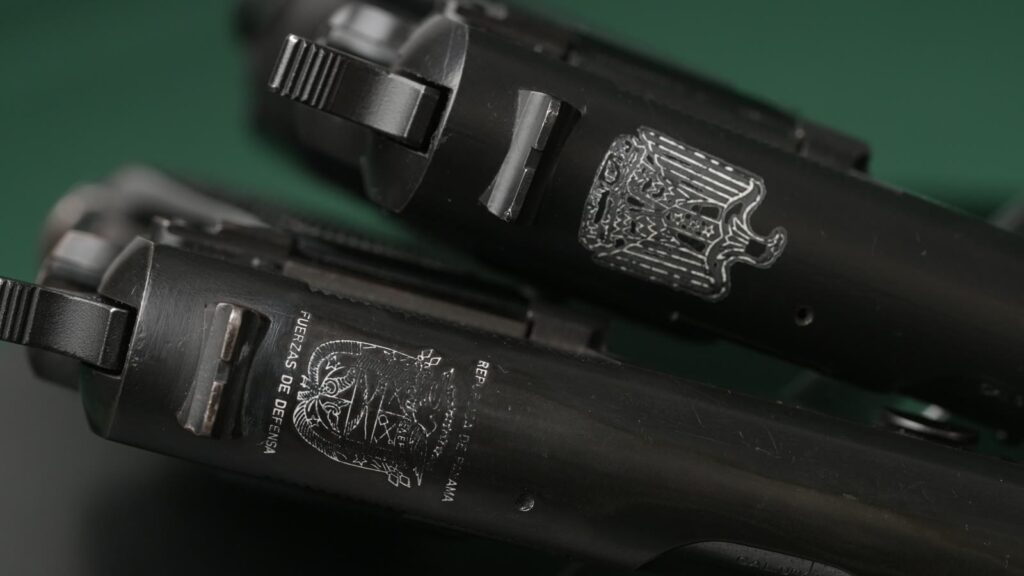
On top of the slide, just ahead of the rear sight, is Panama’s national coat of arms: an eagle with its wings spread above a shield, flanked by national flags. Around it, in Spanish, are two lines of text. REPUBLICA DE PANAMA runs along one side, FUERZAS DE DEFENSA along the other.
The crest was marked at the factory, not added later. That second line names the institution: the Panama Defense Forces, which used the name Fuerzas de Defensa from 1983 to early 1990. The crest doesn’t date the pistol by itself; the serial number does that.

### The serial number: PR means 1987
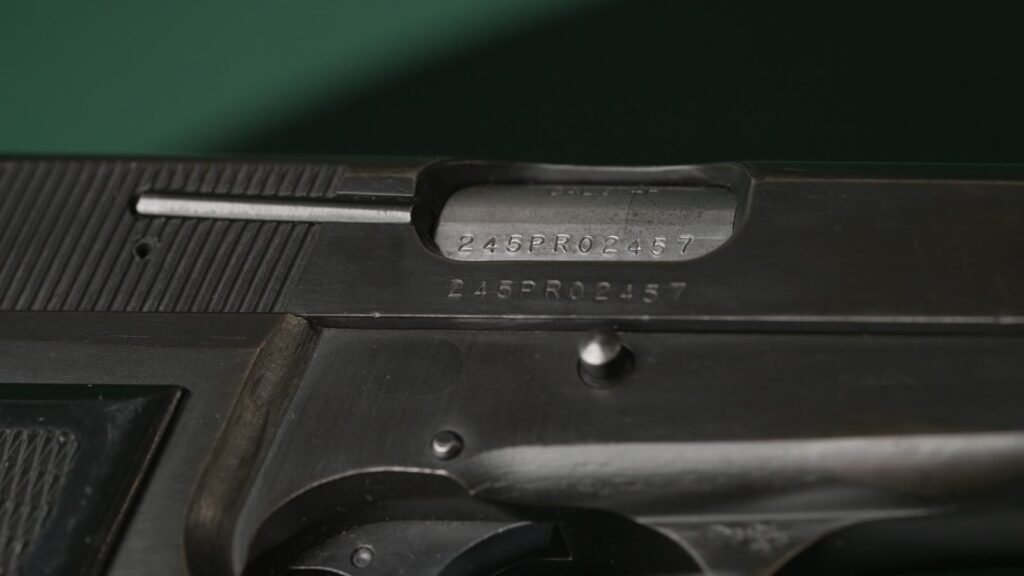
The serial is 245PR02457. On the right side it appears on the barrel, where it shows through the ejection port, and again on the slide just below the port. The frame carries it a third time, on the front of the grip below the trigger guard. All three match.
Browning’s dating chart for Hi Powers made from 1976 to 1997 explains the format. The first three digits, 245, mark a 9mm Hi Power. The two letters after them are the year, one letter for each digit, using a code that counts down the alphabet from Z and skips four letters along the way:
| Z | Y | X | W | V | T | R | P | N | M |
|---|---|---|---|---|---|---|---|---|---|
| 1 | 2 | 3 | 4 | 5 | 6 | 7 | 8 | 9 | 0 |
There is no U, S, Q or O. Count back from Z without skipping them and you get the wrong year. On this pistol, P is 8 and R is 7: 1987. The last five digits are the sequence number for that year.
### FN’s factory line
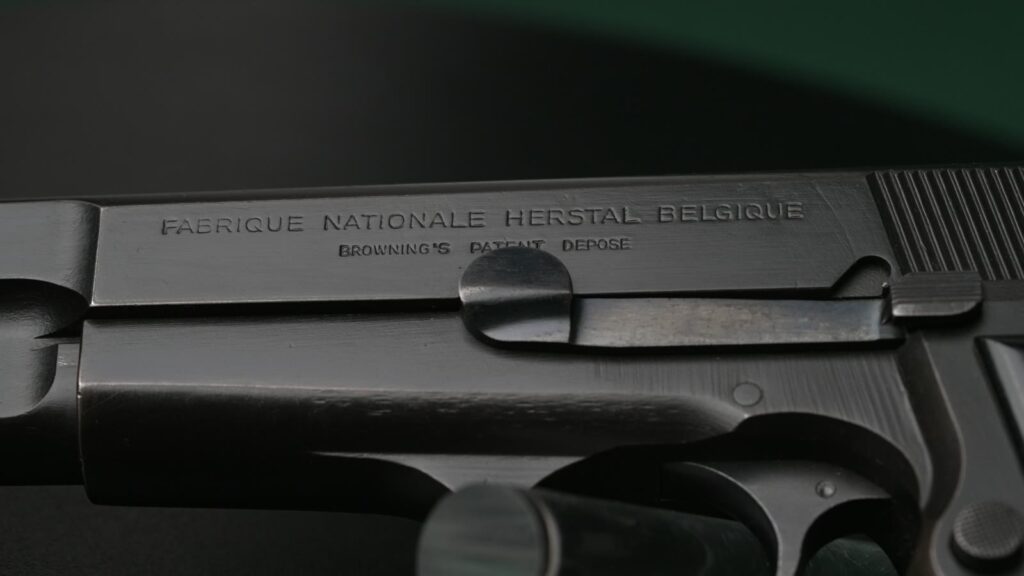
The left side of this pistol’s slide reads FABRIQUE NATIONALE HERSTAL BELGIQUE, and under it BROWNING’S PATENT DEPOSE. The pistol was designed by John Browning and finished after his death by Dieudonné Saive at FN in Herstal, Belgium, where this one was made more than fifty years later.
Five years apart: Panama and Iraq
We filmed this pistol next to the Iraqi Hi Power from our previous video. Its serial is 245PY79416: P is 8, Y is 2, so 1982. Both came out of Herstal with serials in the same format, five years apart, and each carries a different government’s crest on top.

How the High Power works
The High Power is a single-action, short-recoil pistol: the hammer has to be cocked before the trigger will drop it, and working the slide does that. In the video, the slide runs home, is pulled back and released once more, the magazine goes up into the grip, and the trigger is pulled. The hammer falls.
For how the barrel and slide lock together, see our Iraqi Hi Power article, which covers the mechanism in more detail.
Wear and use
The Iraqi pistol surprised us by how good it looked for its age. This one has seen far more use than the Iraqi one, above all on the grip, and the lanyard ring shows long use too.
The grip panels are chipped and scuffed, and the finish on the frame around the grip has worn thin. On the back of the grip there are scratches through the finish. Wear like this comes from heavy handling. It doesn’t say by whom, or where.


Specifications
| Item | Panama FN High Power |
|---|---|
| Maker | FN Herstal, Belgium |
| Year made | 1987 (PR in the serial) |
| Serial | 245PR02457, barrel, slide and frame matching |
| Markings | Panama coat of arms, REPUBLICA DE PANAMA, FUERZAS DE DEFENSA on top of the slide |
| Cartridge | 9×19mm |
| Action | Single action, short recoil |
| Magazine | 13 rounds, original |
| Other | Original grip panels and lanyard ring; heavy wear on the grip |
| Collection | Old Steel Arsenal’s own collection |
On the floor at OSA
The Panama High Power in these photos is part of our own collection. If the FN High Power is your kind of pistol, these pieces in our case are related to it:
- 1979 FN Hi Power, two-tone: made at the same Belgian factory eight years earlier; its serial uses the same letter code.
- FN Hi Power 9mm, South African police contract: another Belgian FN made for a government contract, this one described as a South African police gun.
- CZ 75 Pre-B, Czech police surplus: a 9mm service pistol from the same decades that locks with a linkless cam like the High Power’s. Our guide covers how to identify a CZ 75 Pre-B.
- 1995 SIG P228 with the Swiss Ticino police crest: another 9mm service pistol carrying a government crest on the slide. We also explain how to read SIG’s West German date codes.
The grid below updates by itself as pieces come and go.
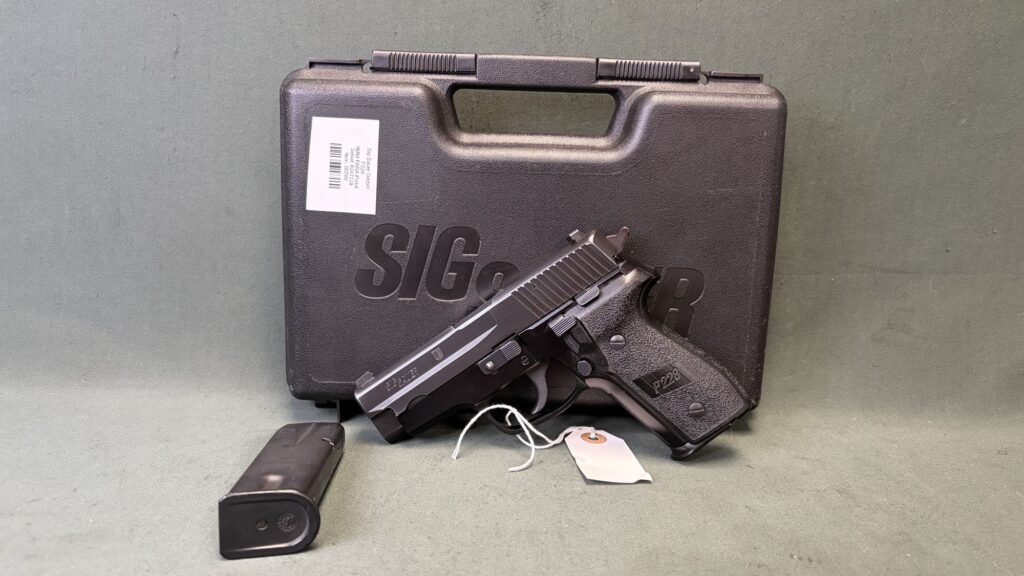 SIG Sauer P228 9mm 1995 German Ticino Police Crest No Import Mark Box$1,249.00
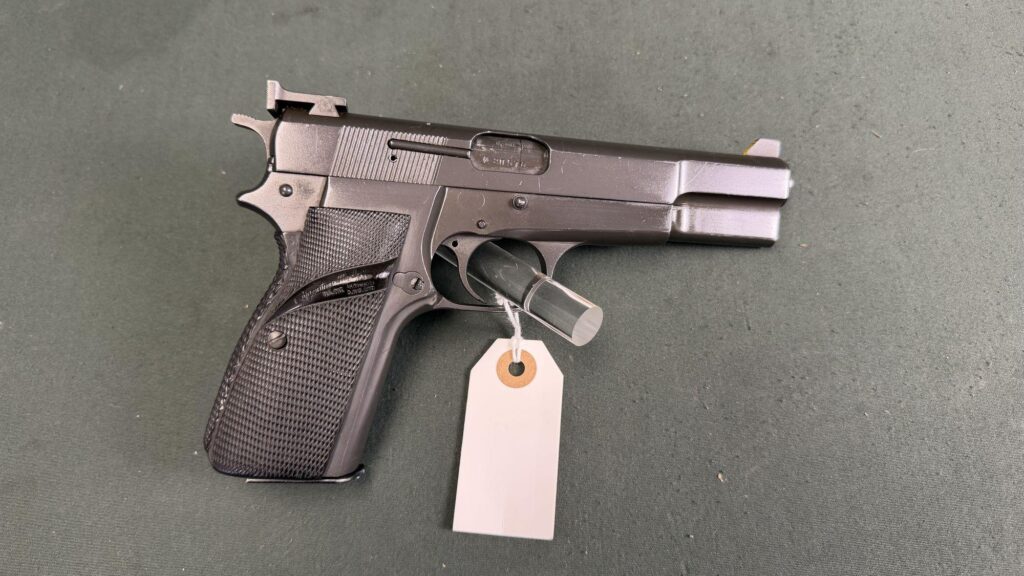 Hi Power 9MM PARA$979.00
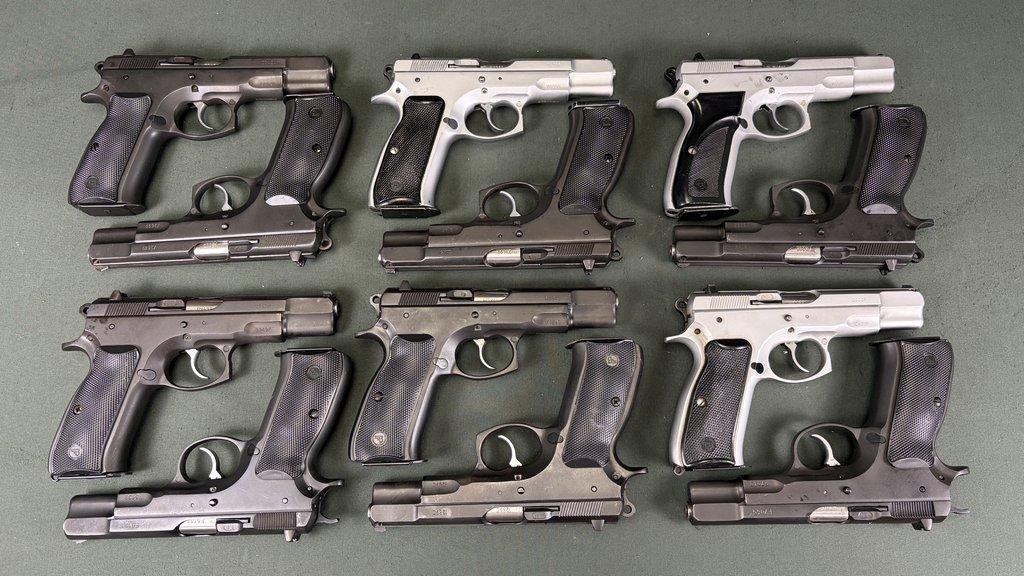 Free ShippingCZ 75 Pre-B 9×19 Czech Police Surplus Grade A Matching Numbers Mirror Bore$569.00
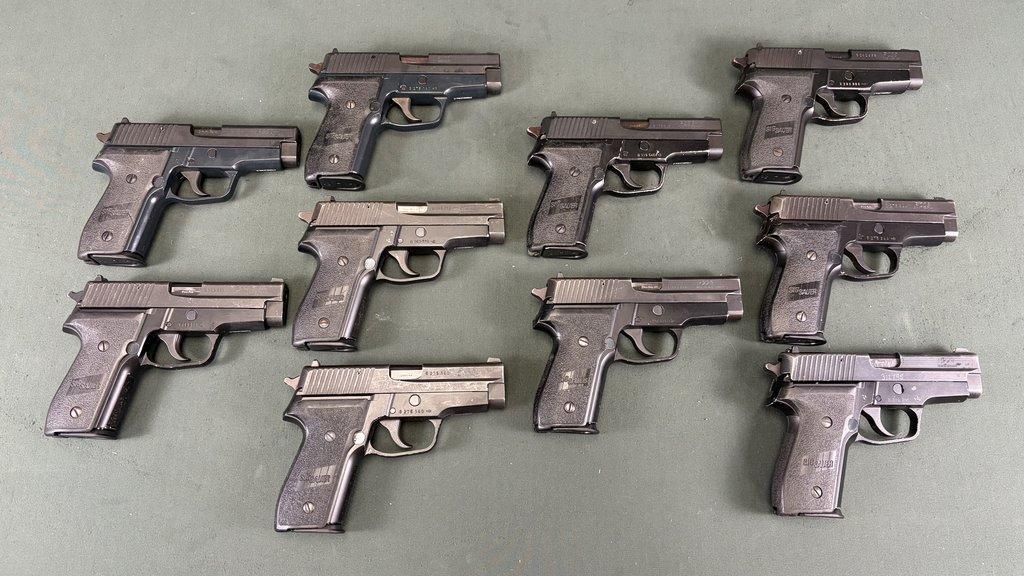 Free ShippingSIG Sauer P228 9mm German Police Israeli IDF Surplus Grade B Mirror Bore Original price was: $629.00.$569.00Current price is: $569.00.
 Free ShippingSIG Sauer P228 9mm German Police Israeli IDF Surplus Grade A Mirror Bore Original price was: $679.00.$629.00Current price is: $629.00.
 Hi Power 9MM PARA$1,029.00
General information for collectors, not legal advice. Check markings on the individual pistol.
Common Questions
How do I date an FN Hi Power from the serial number?
For pistols made from 1976 to 1997, the two letters after the three-digit type code are the year, one letter per digit: Z=1, Y=2, X=3, W=4, V=5, T=6, R=7, P=8, N=9, M=0. U, S, Q and O are skipped. A serial starting 245PR is a 9mm made in 1987.What does Fuerzas de Defensa mean on a Hi Power?
It is Spanish for Defense Forces. With REPUBLICA DE PANAMA and Panama’s coat of arms, it marks a pistol for the Panama Defense Forces, the military that existed from 1983 until early 1990.What were the Panama Defense Forces?
The Fuerzas de Defensa de Panamá were formed from Panama’s National Guard under Law 20 of 1983 and commanded by Manuel Noriega. They were abolished in February 1990, after the U.S. invasion, and replaced by the Fuerza Pública, the Public Force.Does Panama have an army today?
No. Article 310 of Panama’s constitution says the Republic will not have an army. Its public security forces, the Fuerza Pública, are subordinate to civilian authority.Was this Panama Hi Power used in the 1989 invasion?
We don’t know. The crest shows it was marked for the Defense Forces, and the serial dates it to 1987, but no record we have says who carried it or where it was in December 1989.Sources
- Browning, “Hi Power Pistol” date-your-firearm chart — https://www.browning.com/support/date-your-firearm/hi-power-pistol.html (1976–1997 serial format, 245 = 9mm, the ten-letter year code, in which U, S, Q and O do not appear)
- Policía Nacional de Panamá, “Historia” — https://www.policia.gob.pa/historia.html (Law 20 of 29 September 1983 creating the Defense Forces from the National Guard)
- U.S. Army Special Operations History, “ARSOF in Panama” — https://arsof-history.org/arsof_in_panama/index.html (more than 27,000 U.S. military personnel; aims: remove Noriega, subdue the PDF, protect American lives and property, safeguard the canal)
- Wikipedia, “United States invasion of Panama” — https://en.wikipedia.org/wiki/United_States_invasion_of_Panama (Noriega as de facto ruler; U.S. Canal Zone garrison; Noriega annulled the 1989 election; wanted for drug trafficking; start on 20 December 1989; Holy See mission; surrender 3 January 1990; Endara government abolished the PDF on 10 February 1990; 1994 constitutional amendment abolished the military)
- Wikipedia, “Panamanian Defense Forces” — https://en.wikipedia.org/wiki/Panamanian_Defense_Forces (National Guard founded 1953; formed 1983 from the National Guard; Browning Hi-Power listed among PDF handguns; army, air force, navy and police branches; Noriega in command from August 1983; Executive Decree No. 38 of 10 February 1990 organizing the Public Force, subordinated to the executive)
- Tribunal Electoral de Panamá, “Constitución Política de la República de Panamá” — https://constitucion.te.gob.pa/constitucion-vigente/ (Article 310: the Republic will not have an army; police services subordinate to civilian power)
- Wikipedia, “Coat of arms of Panama” — https://en.wikipedia.org/wiki/Coat_of_arms_of_Panama (eagle above the shield, national flags on either side)
- Wikipedia, “Browning Hi-Power” — https://en.wikipedia.org/wiki/Browning_Hi-Power (Browning and Saive, single action, short recoil)