
Journal · Collector’s Guide
East German Makarov: A Garage Tactical Upgrade
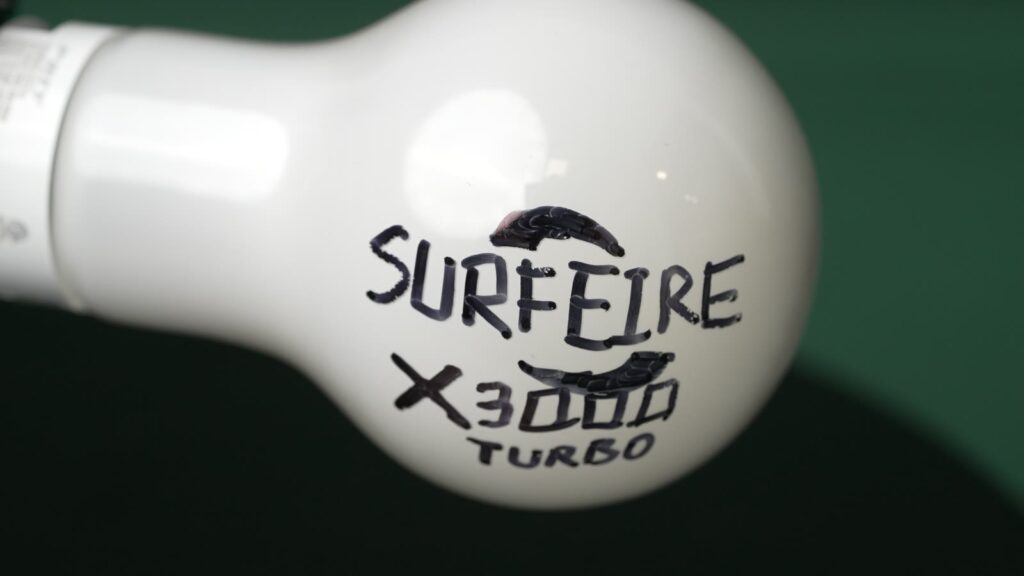
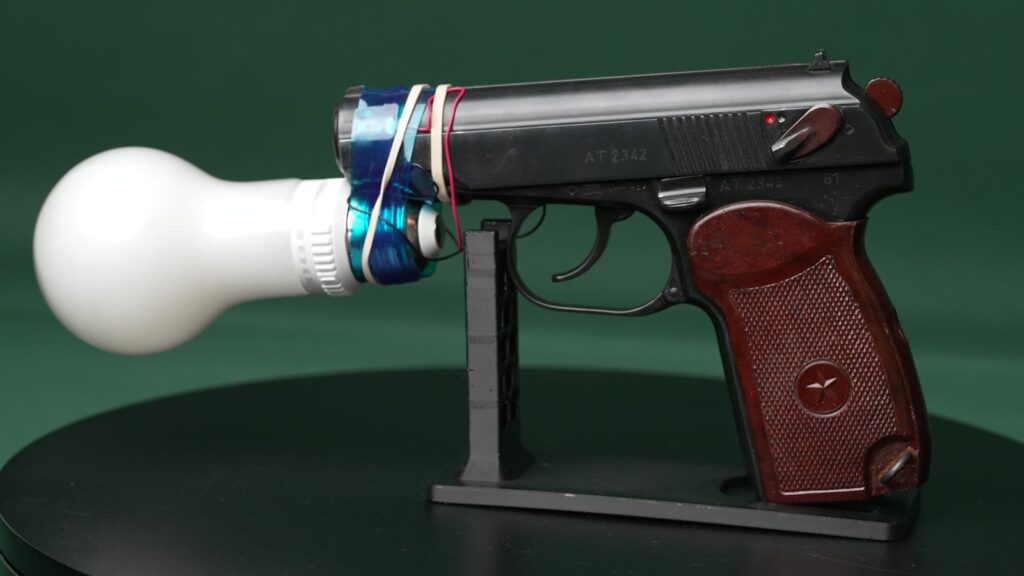
This East German Makarov has received state-of-the-art tactical upgrades. The pistol underneath was made in the DDR, East Germany, and the date code on its frame reads 61. The upgrades were made recently, in a garage, by Jack, one of our crew. The weapon light is designated the SurfEire X3000 Turbo, secured with rubber bands and powered by a single AA battery. It has never turned on. Jack wrote the whole job up as a formal procurement report. Below are the report’s main findings, followed by how to read the East German markings under the upgrade.
The procurement report
Jack’s report opens with the basis for the weapon system: an original Makarov pistol, manufactured in the DDR in the 1960s and retained. Magazine capacity and lighting, it says, were addressed recently, in a garage. The capacity side of the program has its own write-up: the converted PPSh drum Jack built is covered in our Makarov drum magazine article.
The light gets the most space. Its designation is the SurfEire X3000 Turbo, which the report lists as a state-of-the-art LED weapon light with adjustable color temperature. The bulb is a FEIT LED, and its base is printed with color temperature settings from 2700K to 6500K. The report notes that the adjustable color temperature was carried over from the domestic lighting requirement.
The light is secured to the weapon system with high-strength polymer bands, two of them, wrapped around the front of the slide over a layer of blue tape.

Power supply
Power is supplied by a single 1.5-volt AA battery, selected, in the report’s words, on the basis of availability. It is a Duracell, held under the muzzle end by the same bands, with its copper-colored positive end wrapped in clear tape and a red wire looped around it.

The program manager’s procurement justification reads, in its entirety: “lmao.”
The report then concedes one point. Electrical compatibility was not established before assembly. In our footage, one gloved hand holds the pistol while the other works the battery and wires, and the bulb stays dark.
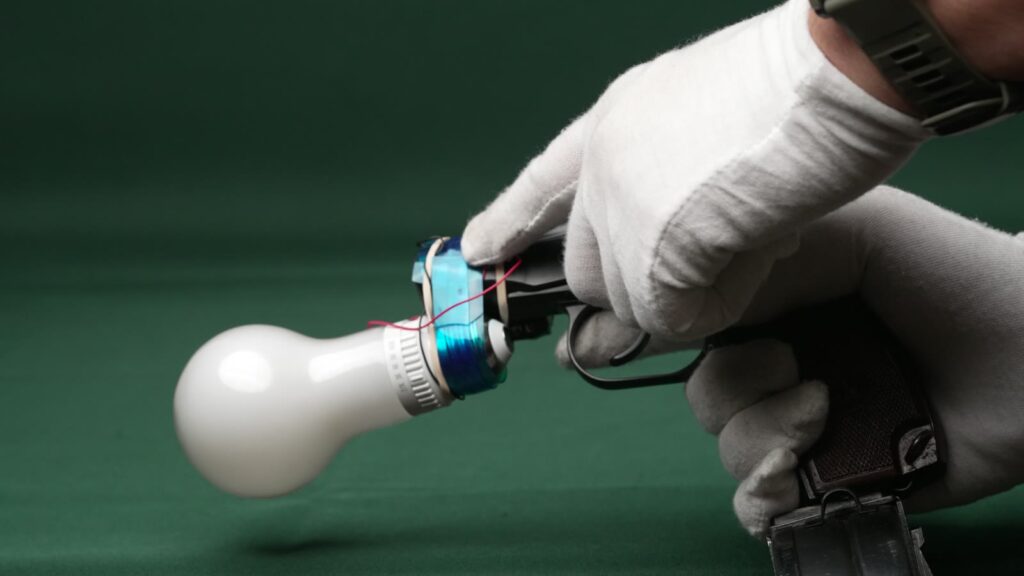
No firing evaluation was conducted, as our insurance provider strongly opposed the proposition.
The holster and the white Monster
The original leather holster was retained as part of the procurement package. It no longer accommodates the complete assembly: with the bulb and battery hanging off the muzzle, the pistol does not go in.
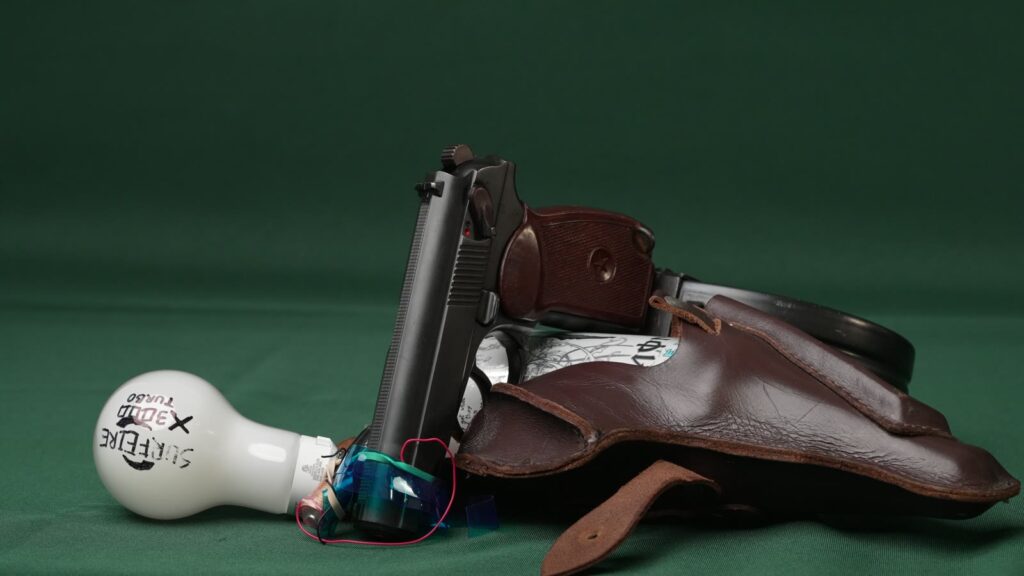
The report finds a second use for it. The holster can still be worn as a fashion accessory, and it will hold exactly one white Monster.
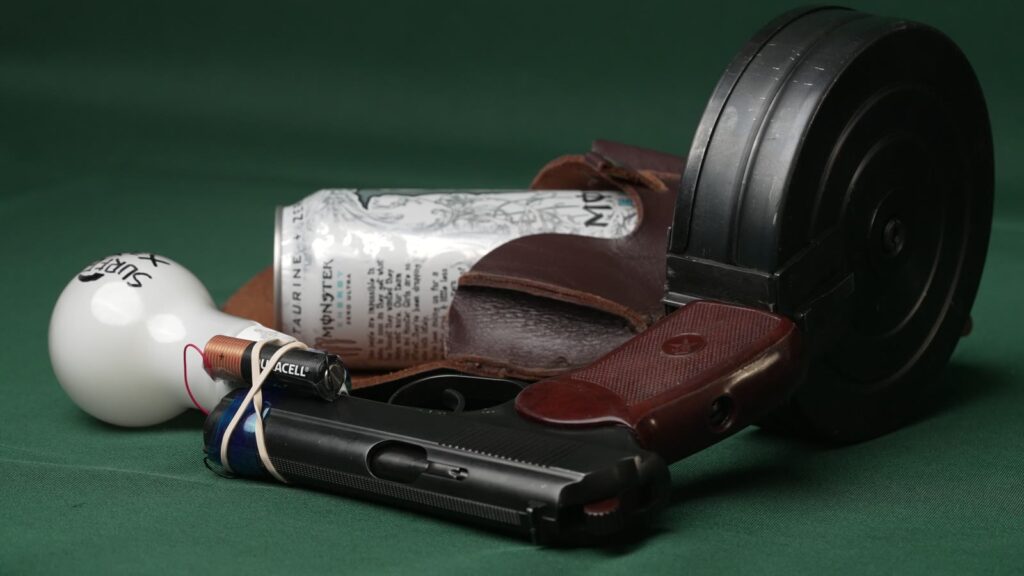
No further examples are currently scheduled. That makes this a rare surviving example of an unsupervised Saturday evening.
The East German Makarov, or Pistole M
The Soviet armed forces adopted Nikolay Makarov’s pistol in December 1951 as the Pistolet Makarova, or PM, to replace the Tokarev TT. According to American Rifleman, it stayed the Soviet service pistol until about 1991. It fires the 9×18mm Makarov cartridge. Wikipedia describes it as a straight blowback pistol with the barrel fixed to the frame, and American Rifleman notes the East German version is double-action/single-action with an eight-round magazine.
East Germany built its own, and Wikipedia gives the GDR-era name as Pistole-M. American Rifleman dates East German production from the late 1950s to 1965 and cites one source placing it at the Ernst Thälmann plant in Suhl. Some imported pistols repeat that on the slide: the article quotes an importer’s marking that names the Ernst Thälmann works in Suhl. That is the importer’s wording, added for the American market, not an original East German factory stamp.
How to read East German Makarov markings
Serial and date code. East German Makarovs carry one or two letters ahead of a four-digit serial number, and each letter code seems to have covered a block of 9,999 pistols, American Rifleman explains. A two-digit date code right after the serial gives the year of manufacture. On ours the frame reads AT 2342, and after it, 61. The slide carries the same AT 2342. The article’s table of observed letter codes also lists AT under 1961, so the two agree: this pistol is a 1961.
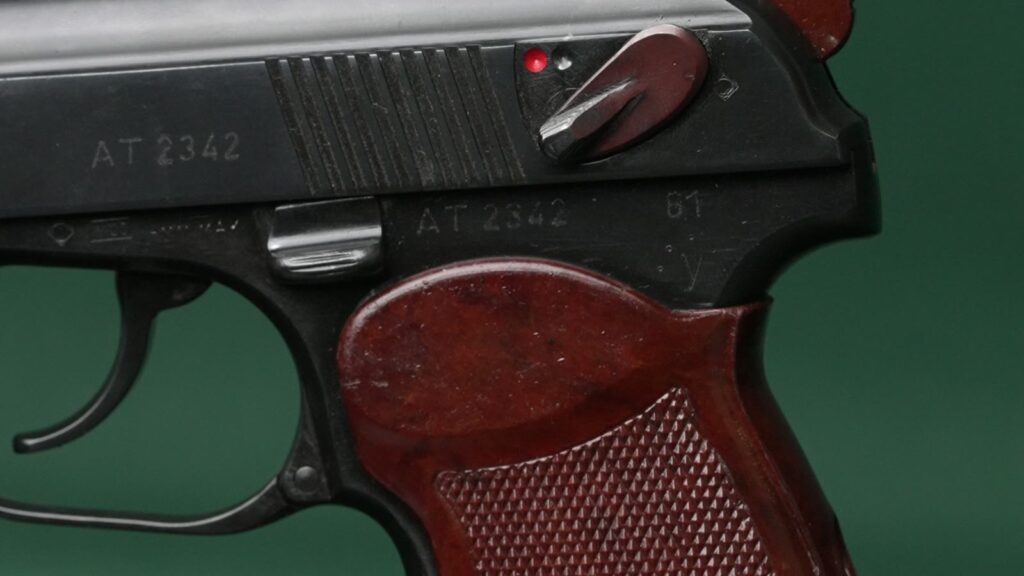
K100 in a rectangle. The K100 mark appears on all East German Makarovs and is an inspection acceptance mark, in a rectangle on the left side of the frame ahead of the slide stop. Next to it on ours is a small diamond with a circle inside, which the same article identifies as a proof mark.
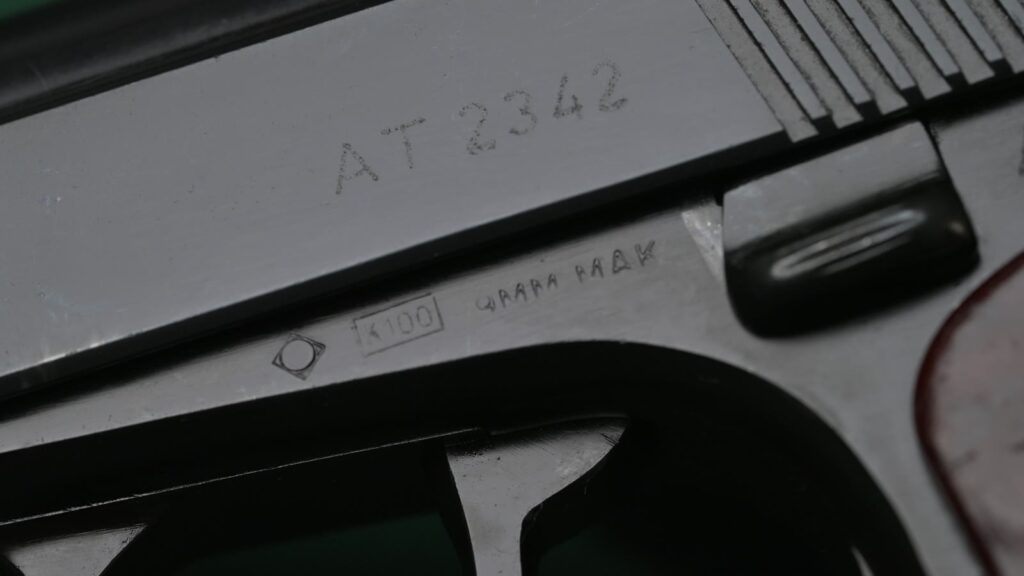
GERMANY and CAI. The right side of the frame carries GERMANY and a mark beginning CAI ST. Federal rules require an imported firearm to be marked with the country of manufacture and with the importer’s identification, which can be its name with its city and state, abbreviations allowed. CAI ST ALB VT stands for Century Arms International of St. Albans, Vermont. Of the East German pistols the American Rifleman author observed, the majority came in through Century Arms, with the typical marking Germany CAI ST ALB VT 9mm Mak.

Grips. Wikipedia describes the Pistole-M with plain dark grip shells, and American Rifleman says most have black checkered plastic grips, with a few reddish-brown flecked ones noted. Ours wears smooth reddish-brown grips with a star in the center. We have not established whether they are the grips this pistol left the factory with.
Specifications
| Item | Our East German Makarov, as upgraded |
|---|---|
| Pistol | Makarov pattern (Pistole-M), made in the DDR |
| Date code | 61 (1961) |
| Serial | AT 2342 on frame and slide |
| Marks | K100 inspection mark, diamond proof mark, GERMANY and CAI importer marking |
| Cartridge | 9×18mm Makarov |
| Action | Double-action/single-action, straight blowback, fixed barrel |
| Standard magazine | 8 rounds |
| Weapon light | SurfEire X3000 Turbo (FEIT LED bulb, 2700K–6500K, hand-lettered) |
| Mounting | Bands over blue tape |
| Power | One 1.5-volt AA battery |
| Illumination | Not demonstrated |
| Firing evaluation | Not conducted |
| Holster | Leather; holds one white Monster |
On the floor at OSA
The East German Makarov in this article stays in our collection, upgrade included. No Makarov is listed on our site right now, but a few pieces in our case come from the same corner of history:
- CZ 75 Pre-B, Czech police surplus: another service pistol from the Eastern Bloc side of the Cold War.
- 1927 Czechoslovak CZ vz. 24 with holster: a unit-marked Central European service pistol that still has its holster, and still fits in it.
- Mauser Model 1914 in .32 ACP with leather holster: a German pocket pistol with its leather holster, no bands involved.
The grid below updates by itself as pieces come and go.
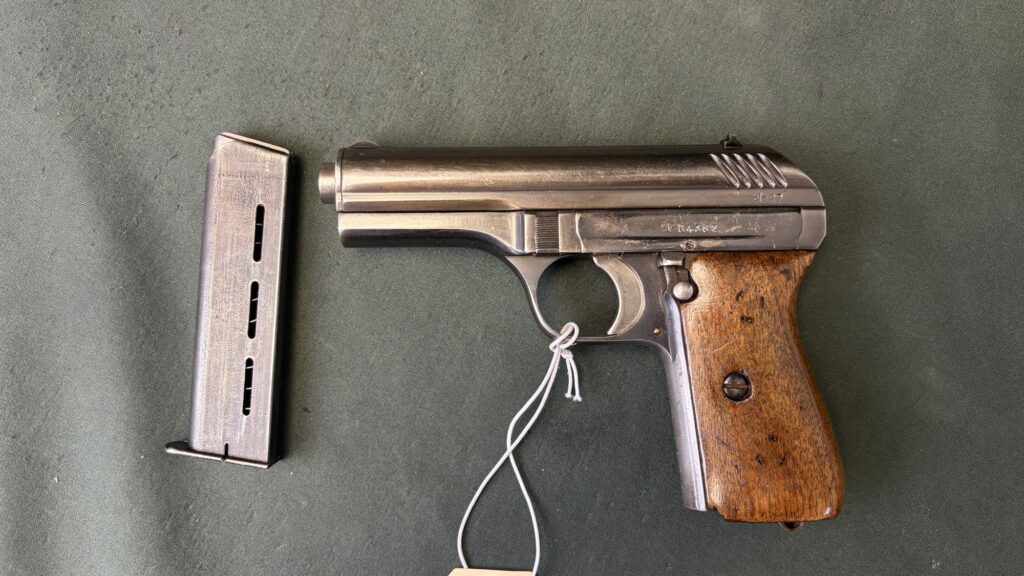 1927 Czechoslovak CZ vz. 24 Pistol .380 ACP All Matching Unit Marked with Holster$745.00
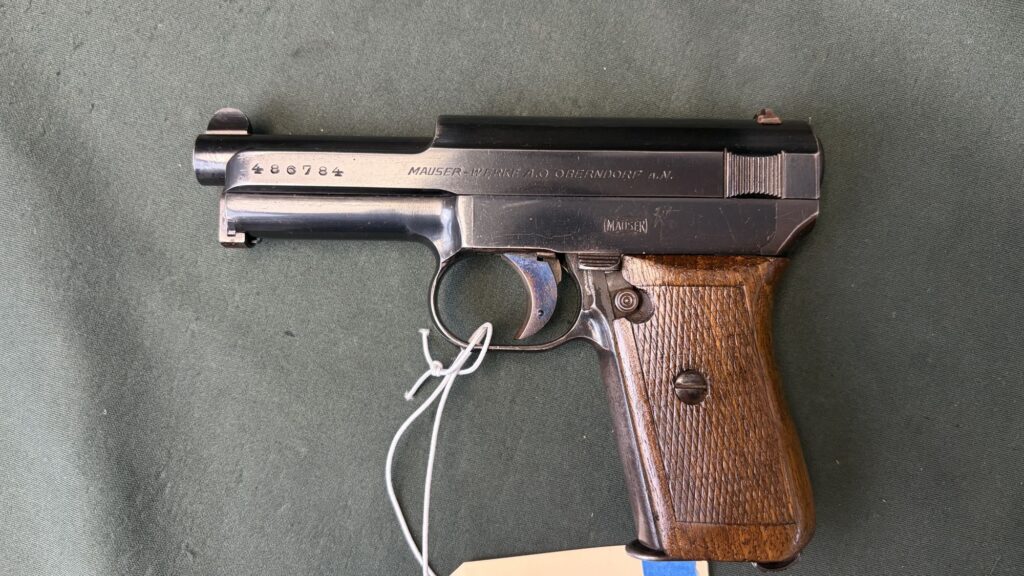 Mauser Model 1914 Pistol .32 ACP 7.65mm Excellent with Leather Holster$745.00
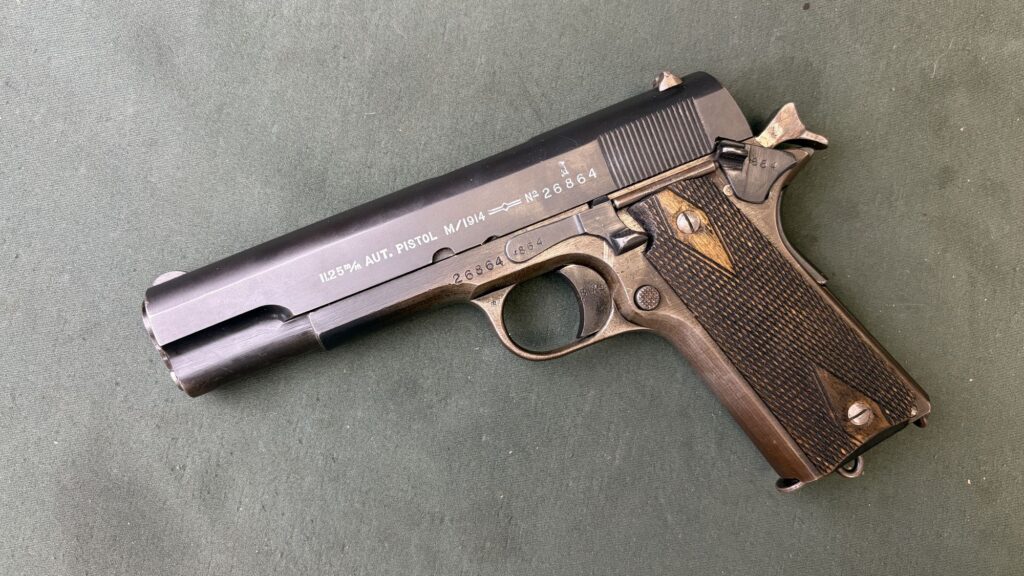 1942 Kongsberg M/1914 .45 ACP Matching with Signed Factory Archive Letter$4,950.00
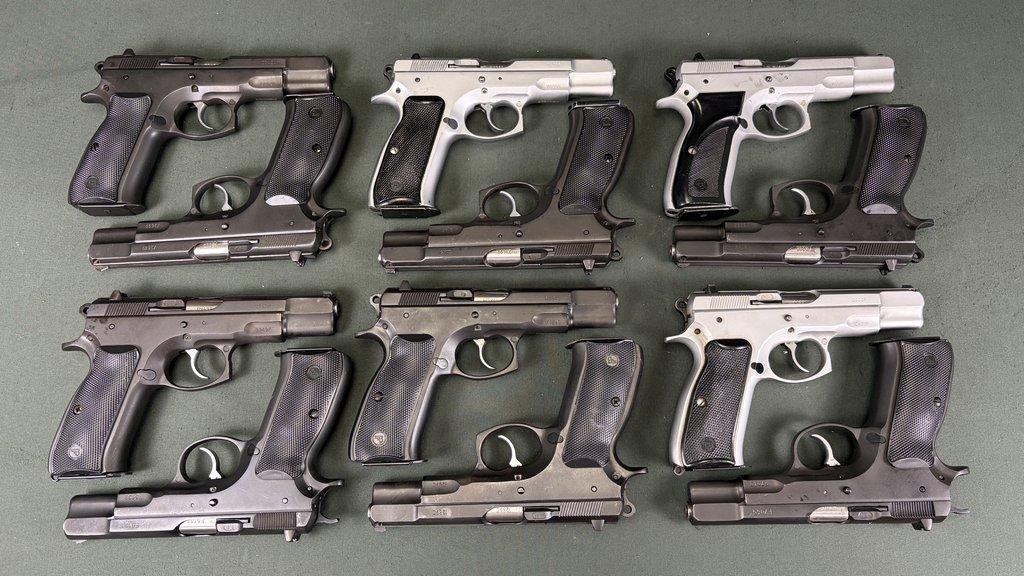 Free ShippingCZ 75 Pre-B 9×19 Czech Police Surplus Grade A Matching Numbers Mirror Bore$569.00
The short version is on our Instagram. Watch it on Instagram.
General information for collectors, not legal advice. Please do not strap household electrical parts to a firearm.
Common Questions
How can you tell an East German Makarov?
East German Makarovs, known in the GDR as the Pistole-M, carry a one- or two-letter code ahead of a four-digit serial, a two-digit date code after it, and a K100 mark in a rectangle on the left side of the frame. Imported examples are usually also marked GERMANY with the importer’s name.What does K100 mean on a Makarov?
According to American Rifleman, K100 is an inspection acceptance mark found on all East German Makarovs. It is stamped inside a rectangle on the left side of the frame, ahead of the slide stop.How do I date an East German Makarov?
Read the two digits stamped right after the serial number: they give the year of manufacture. Ours reads AT 2342 61, a 1961 pistol. American Rifleman puts East German production between the late 1950s and 1965.How is an East German Makarov different from a Soviet one?
Wikipedia lists plain dark grip shells, higher-polish bluing and early features such as an undrilled safety lever and round safety detent holes as the signs of a Pistole-M. The K100 mark and the letter-code serial are East German markings as well.What caliber is an East German Makarov?
Like the Soviet PM, the East German Makarov fires the 9×18mm Makarov cartridge from an eight-round magazine. It is a double-action/single-action, straight blowback pistol with a fixed barrel.What does CAI ST ALB VT mean on a Makarov?
It is an importer’s mark. CAI is Century Arms International, and ST ALB VT is its home, St. Albans, Vermont. Federal rules require imported firearms to show the importer and the country of manufacture, which is why GERMANY appears next to it.Does the SurfEire X3000 Turbo work?
Not so far. Electrical compatibility was not established before assembly.Sources
- American Rifleman, “The East German Makarov: A Cold-War Collectible” — https://www.americanrifleman.org/content/the-east-german-makarov-a-cold-war-collectible/ (PM in Soviet service from 1951 to about 1991; East German production late 1950s to 1965; Ernst Thalmann plant in Suhl per one source; importer marking naming Ernst Thalmann, Suhl; DA/SA blowback, eight rounds; K100 inspection acceptance mark on the left frame ahead of the slide stop; diamond-with-circle proof mark; letter code plus four-digit serial, blocks of 9,999; two-digit date code after the serial; AT listed under 1961; mostly black checkered grips, a few reddish-brown flecked; majority of observed pistols imported by Century Arms Int’l of St. Albans, Vt., marking Germany CAI ST ALB VT 9mm Mak)
- Wikipedia, “Makarov pistol” — https://en.wikipedia.org/wiki/Makarov_pistol (adoption December 1951, replacement of the TT, 9×18mm Makarov, straight blowback with fixed barrel; GDR-era name Pistole-M, plain dark grip shells, higher polish bluing, undrilled safety lever, round safety detent holes)
- Cornell LII, 27 CFR 478.92 — https://www.law.cornell.edu/cfr/text/27/478.92 (imported firearms marked with the importer’s identification, name with city and state or an alternative, recognized abbreviations allowed, and the country of manufacture)