
Journal · Collector’s Guide
“Mauser C96 Red 9: All Matching, Down to the Stock”
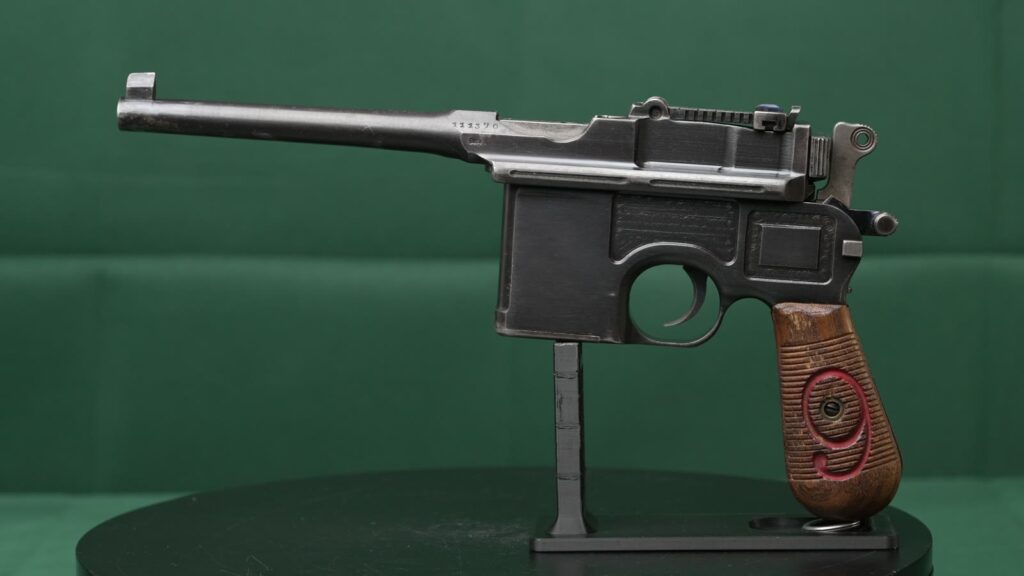
This Mauser C96 Red 9 is one of the 9mm Parabellum pistols the German army ordered from Mauser in World War One, when Luger production could not keep up. Serial 111370 is all matching, down to its original wooden holster stock, which carries the same number. We grade it about 99% overall and call it collector grade.
Why the German army ordered a 9mm Mauser C96
The German army’s standard pistol was the P08 Luger, and wartime Luger production could not meet demand. Mauser still had its C96 tooling set up, so the army turned to the broomhandle, but in 9mm Parabellum, the same cartridge as the P08, so the two pistols could share ammunition.
Sources disagree on the numbers. The Australian War Memorial’s collection record gives 150,000 pistols, and Wikipedia adds that about 137,000 were delivered before the war ended. Forgotten Weapons gives a different account: a contract placed in July 1917 for 200,000 pistols, first deliveries in January 1918, about 95,000 delivered by the end of the war, and production continuing after it. Collectors often call these the M1916 Prussian contract pistols.
The red 9 on the grip
Many 7.63mm Mauser C96 pistols were already in German service. To keep anyone from loading the wrong cartridge, the new 9mm pistols were given a large numeral 9 cut into each wooden grip panel and filled with red paint. The Australian War Memorial describes it as a warning against 7.63 ammunition. Collectors call these pistols the Red 9.
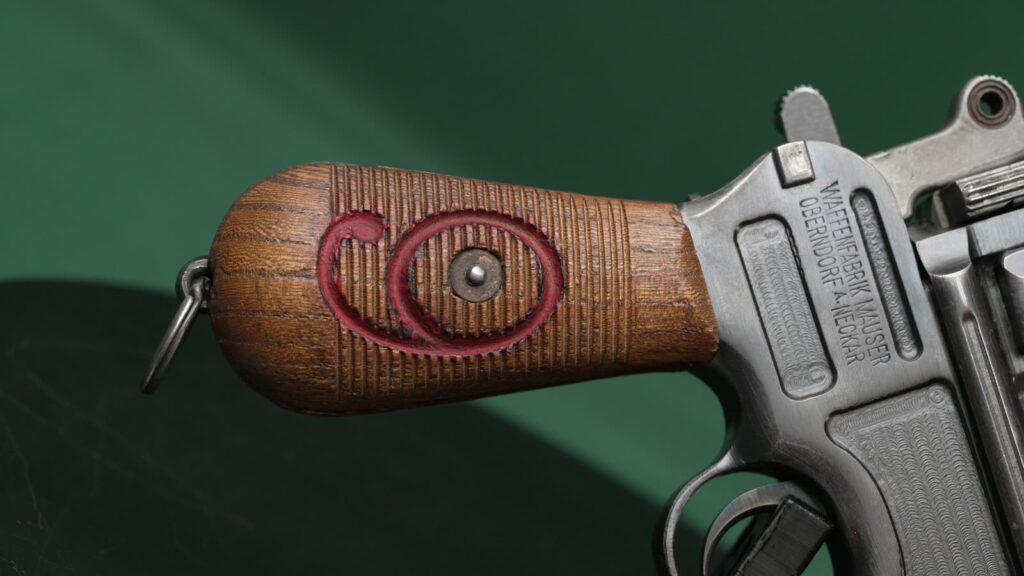
Not every 9mm C96 has the red 9. According to Wikipedia, the army left the branding to unit armourers, so some genuine contract pistols never got the numeral. Grips can also be swapped over a century. That is why the inside of the grip panels matters on a pistol like this, and we come back to it below.
How to read the numbers on a Mauser C96 Red 9
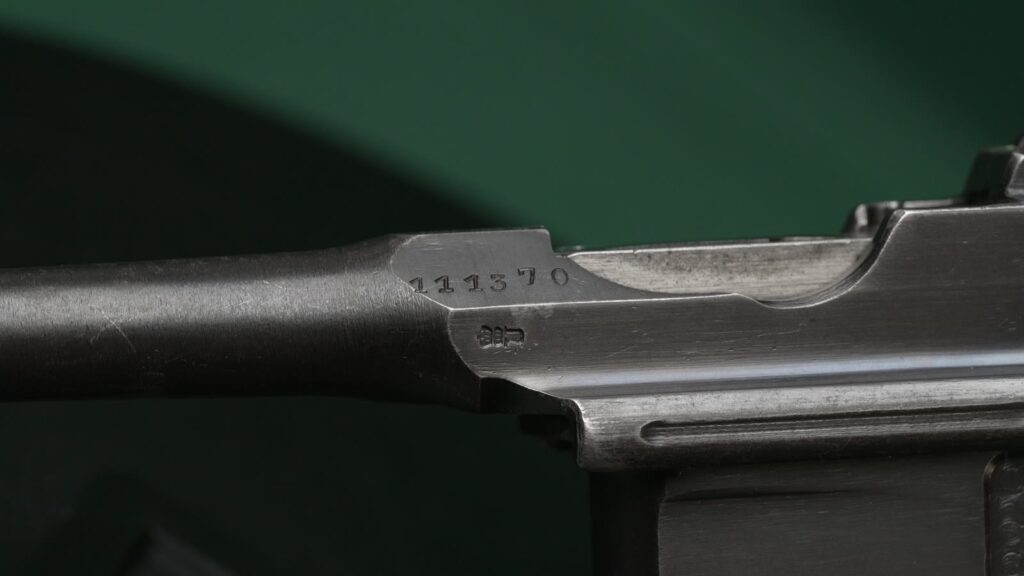
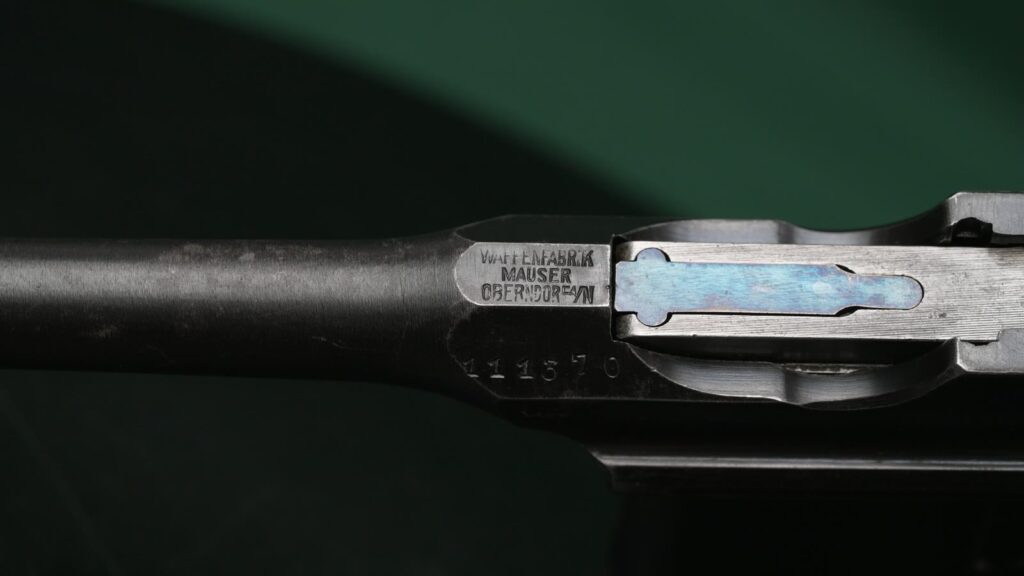
On this pistol, the full serial 111370 appears on the barrel extension and on the frame, and the smaller parts carry either the last three digits, 370, or the last four, 1370.
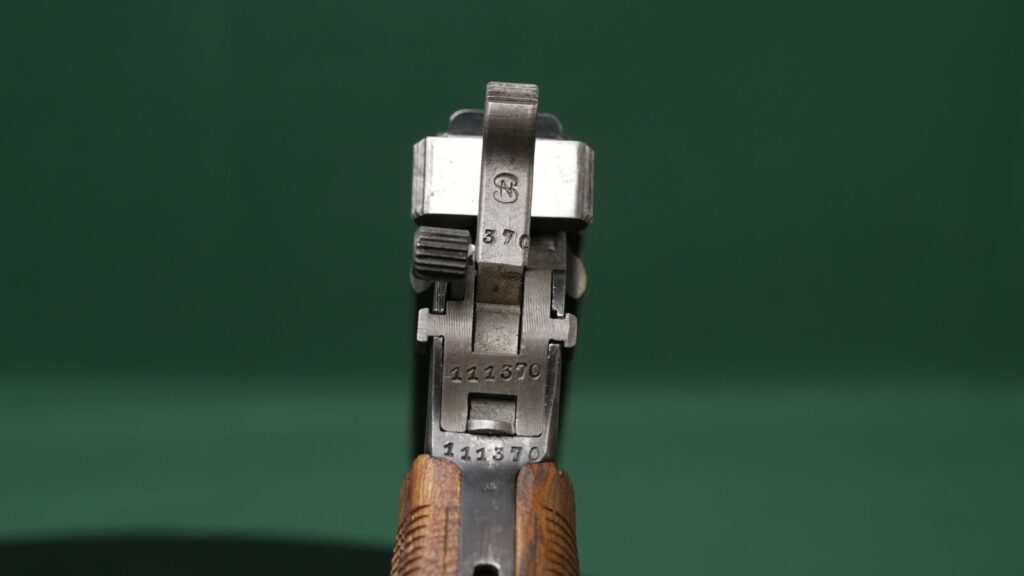
Seen from behind, the hammer carries 370. Above the number is the NS monogram. NS stands for Neue Sicherung, “new safety,” the improved safety Mauser introduced in late 1915; the letters identify the safety type, not a maker or an inspector. Below the hammer the full 111370 appears twice.
Behind the tangent rear sight, the back of the bolt reads 1370, with a small crown proof below it. The Australian War Memorial notes the same spot on its own Red 9: the serial is on the bolt behind the rear sight.
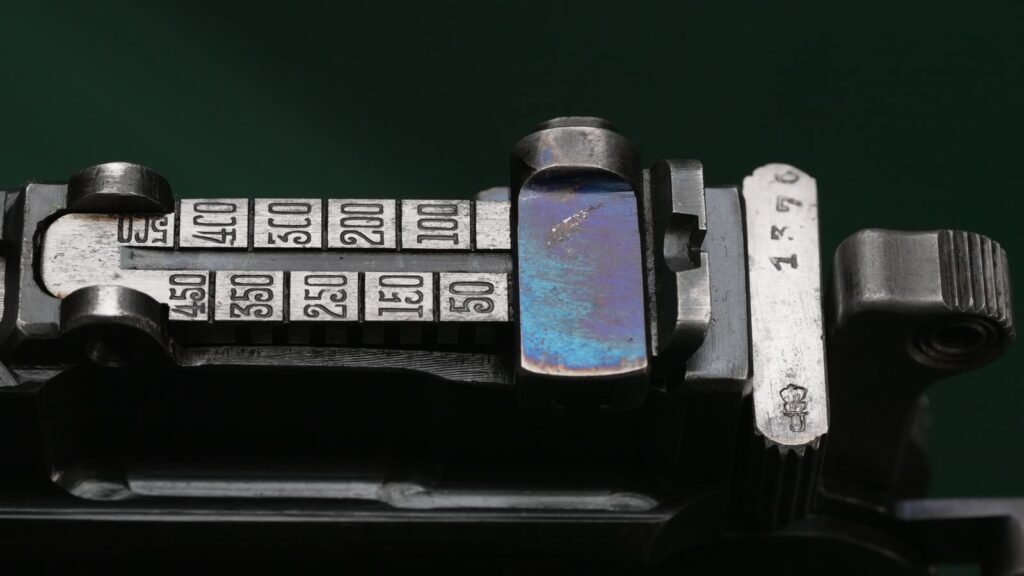
The sight tells you something on its own. Original 9mm contract pistols have 9mm-rated tangent sights marked 50 to 500 meters, and Wikipedia gives this as a way to tell them from 7.63 pistols converted to 9mm. The 7.63 guns used longer-range sights that varied over the years, many of them graduated to 1,000 meters. This one reads 50 to 500.
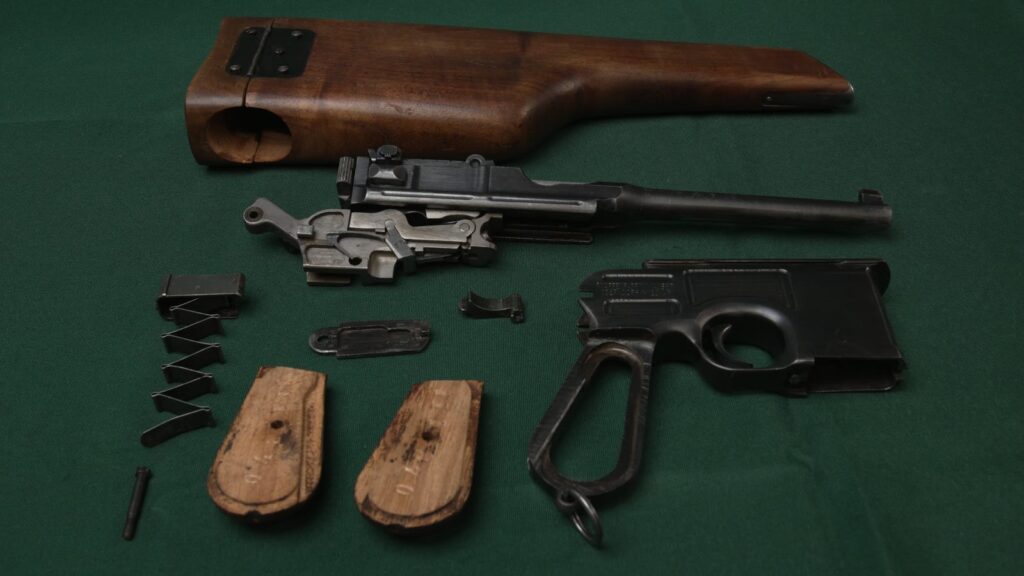
Inside, the numbers continue. With the pistol apart, one internal part reads 1370 and another reads 370. Both grip panels are stamped 111370 on the inside. Those grip stamps are shallow and hard to read in a photo, but we have checked them in hand, and they tie the red 9 grips to this frame.

A matching C96 is one where every numbered part agrees with the frame serial, whether that part carries three digits, four or all six. One part that disagrees does not make a pistol bad, but collectors will call it mismatched.
The holster stock
The C96 has a hollow wooden shoulder stock that doubles as a holster or carrying case. The pistol rides inside it, and the stock attaches to a slot cut in the back of the grip frame when you want to shoulder it. This one came with its leather harness.
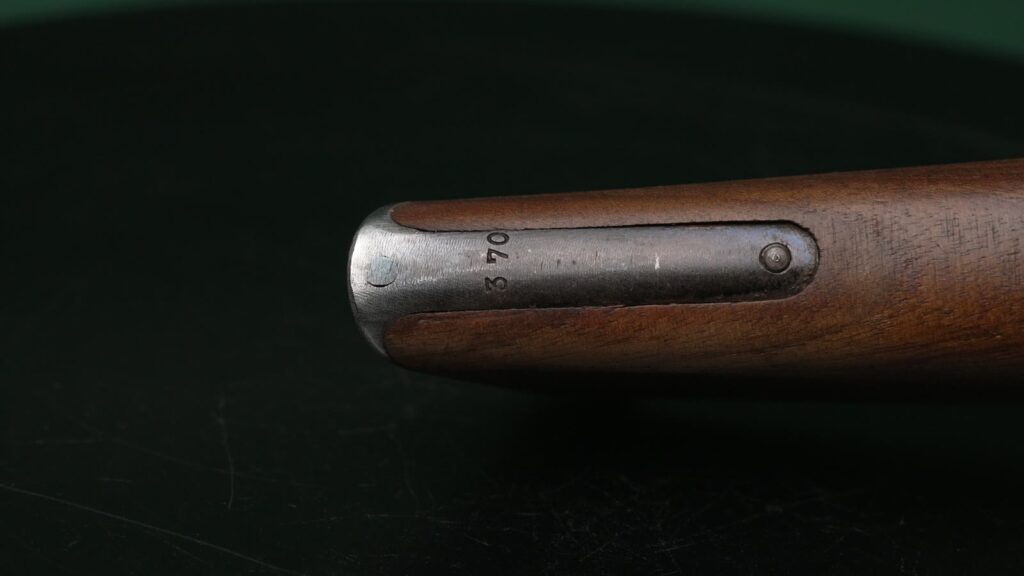
A stock numbered to its own pistol is the detail collectors look for. The metal fitting on this stock is stamped 370, the same as the gun, and having gone over it, we are confident it is the original stock for this pistol. When we checked it, that was the surprise of the whole pistol.
Condition: bore, finish and fire blue
The bore is bright, close to new. The original finish is still sharp, and so are the markings. The small parts still show their fire blue, the bright heat-blued color Mauser used on parts such as the extractor, the long blue piece you can see on top of the bolt.
Our grade for the pistol overall is about 99%. This is collector grade.
How the C96 works
The C96 is a short-recoil pistol. The barrel, the square barrel extension on top of the frame and the bolt inside it recoil together for a short distance before the bolt is unlocked and continues back on its own. The ten-round magazine is fixed in front of the trigger guard and is loaded from the top with a stripper clip, the same way on the 9mm pistols as on the 7.63s. If you want to see the parts move, our Mauser C96 cutaway shows the lock work with the side cut away. For a close cousin, see Mauser C96 vs Astra 900, and for the later select-fire version, the Mauser M712 Schnellfeuer. The Luger this pistol was ordered to back up is covered in Luger P08 Markings Explained.
Specifications
| Item | Mauser C96 Red 9, serial 111370 |
|---|---|
| Maker | Waffenfabrik Mauser, Oberndorf a. Neckar |
| Contract | German army, World War One (often called the M1916 Prussian contract) |
| Cartridge | 9mm Parabellum (9x19mm) |
| Action | Short recoil, locked breech |
| Magazine | Fixed 10-round box ahead of the trigger guard, stripper-clip fed |
| Hammer | NS (Neue Sicherung) |
| Rear sight | Tangent, 50–500 m (9mm-rated) |
| Grips | Wood, red 9, numbered 111370 inside |
| Holster stock | Original, metal fitting stamped 370, with leather harness |
| Matching | All matching, including internal parts, grips and stock |
| Bore | Bright, close to new |
| Condition | About 99% overall (our grade), collector grade |
On the floor at OSA
This Red 9 is a shop piece, and it is with us for now. It is not on the website yet.
A few related pieces that are on the floor:
- WWI Imperial German Mauser C96 Broomhandle, All Matching, NS Hammer: another First World War German army C96 with the NS hammer, all matching, with an early stock that does not match it. Put the two side by side and you see why a matching stock matters.
- 1915 to 1921 Mauser C96 Broomhandle 7.63×25, All Matching, Original Finish: a C96 in 7.63 Mauser, the cartridge the red 9 was there to warn against.
- Mauser C96 Bolo Cutaway Display Piece: the mechanism described above, cut open so you can see it.
- DWM 1915 LP.08 Artillery Luger, 9x19mm: a First World War long-barrel Luger variant in the same 9mm Parabellum cartridge.
The grid below updates by itself as pieces come and go.
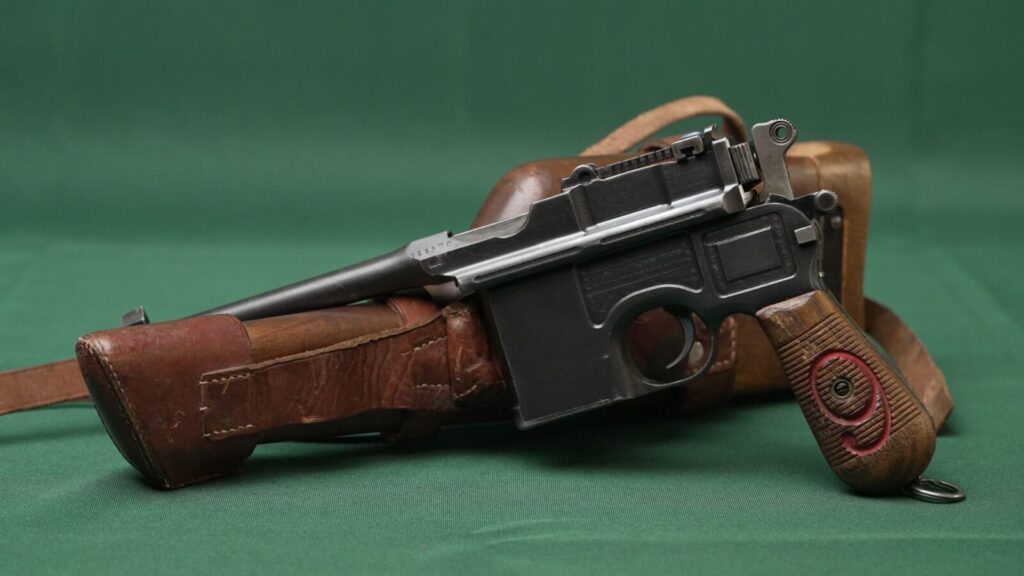 1917 Mauser C96 Red 9 Broomhandle 9mm All Matching with Stock and Rig$6,350.00
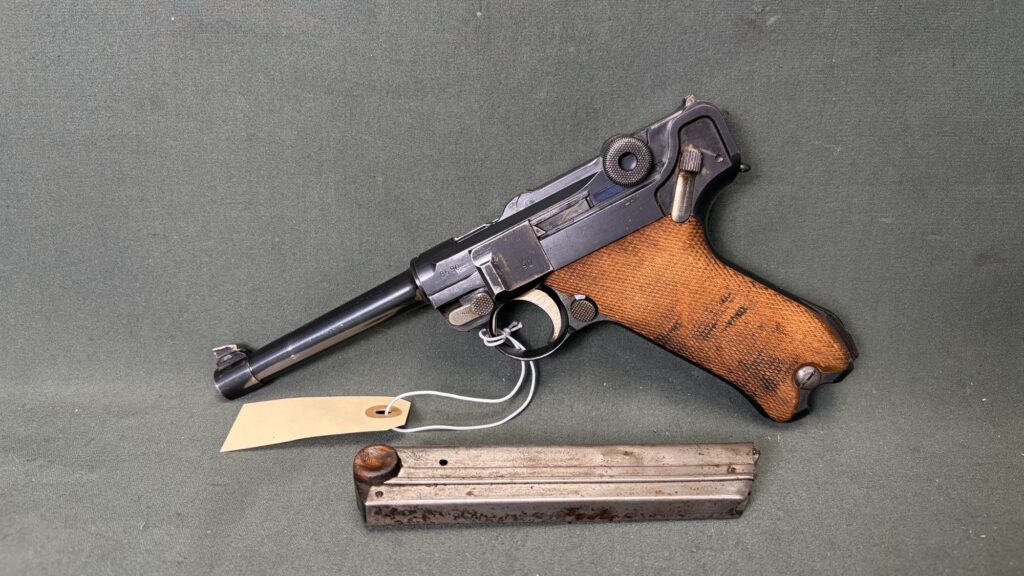 1918 DWM Artillery Luger Converted .30 Luger Finnish Service Tikka Barrel$1,475.00
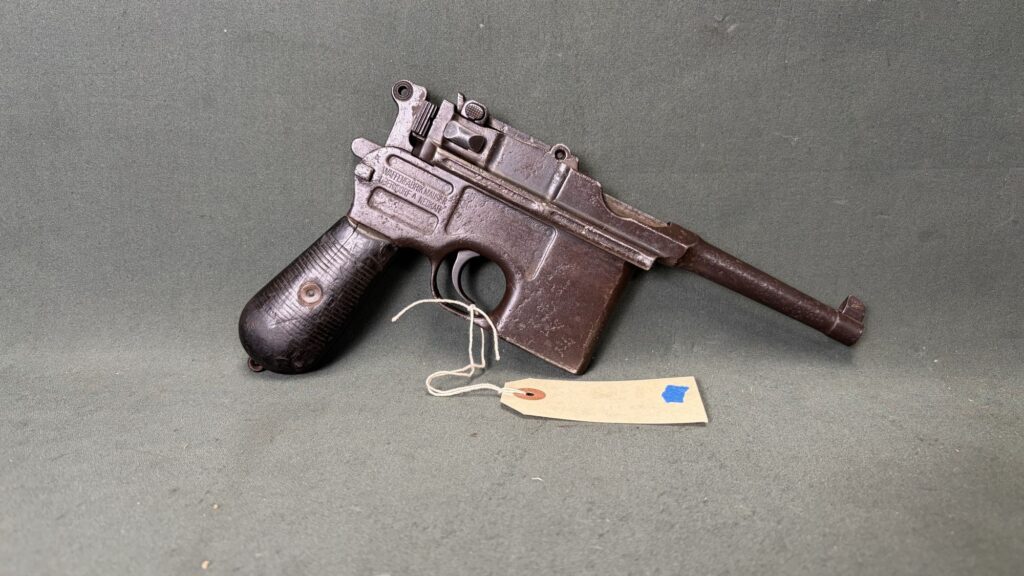 Mauser C96 Bolo Broomhandle Pistol$895.00
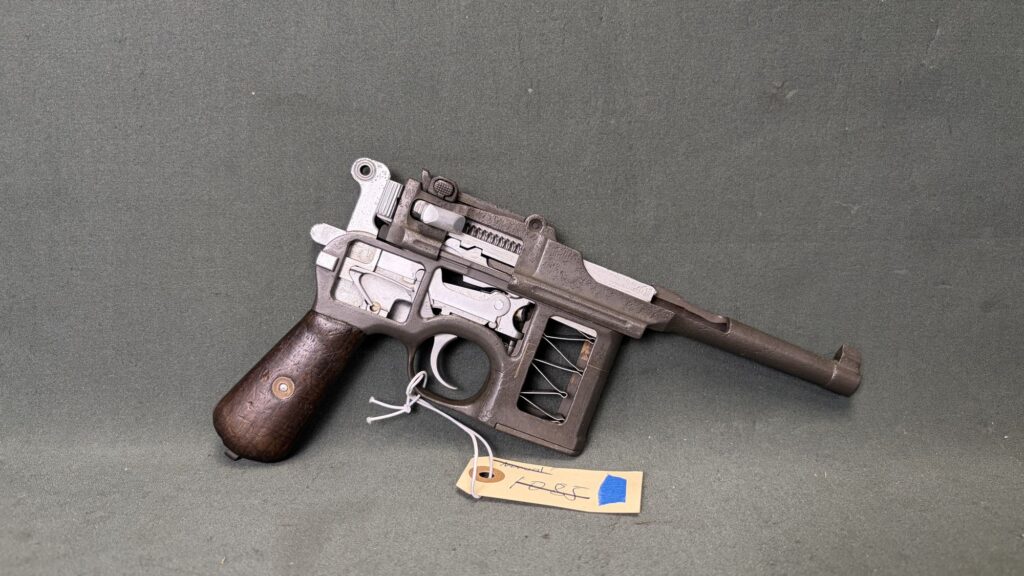 Mauser C96 Bolo Cutaway Display Piece Exposed Mechanism$1,050.00
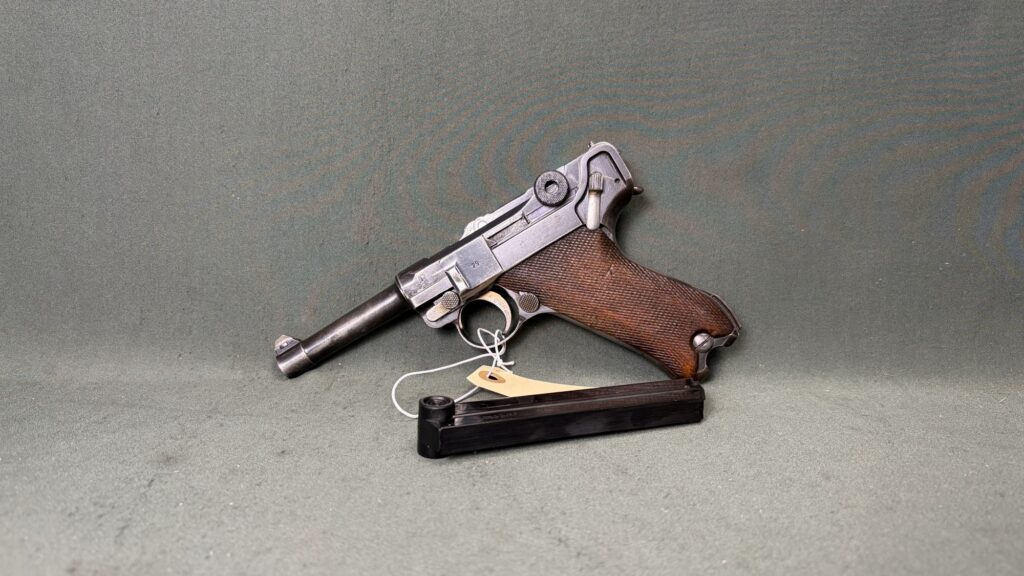 1929 Era Commercial Luger .30 Luger Finnish Service Mauser Banner Toggle$1,200.00
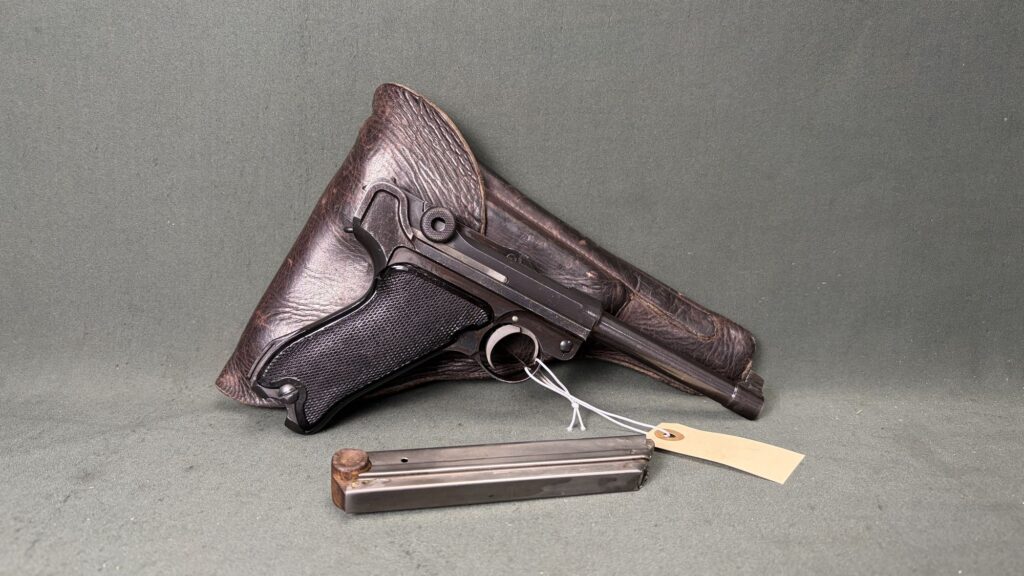 Finnish SA Marked Luger P08 9mm Tikka 4.75 in Barrel Bakelite Grips with Holster$1,725.00
The one-minute version is on our Instagram. Watch it on Instagram.
General information for collectors, not legal advice. Check your state and local rules before acquiring any antique or curio and relic firearm.
Common Questions
What is a Mauser C96 Red 9?
It is a C96 pistol that Mauser made for the German army during World War One in 9mm Parabellum, the same cartridge as the P08 Luger, usually with a large 9 cut into the grips and painted red to warn against loading 7.63 Mauser ammunition.How many 9mm C96 pistols did the German army order?
Sources differ. The commonly cited figures are a 150,000-pistol contract with about 137,000 delivered; Forgotten Weapons gives a July 1917 order for 200,000 with about 95,000 delivered before the war ended.Does every 9mm contract C96 have a red 9 on the grip?
No. The branding was left to unit armourers, so some genuine contract pistols never received it, and grips can be swapped over the years.How can you tell an original 9mm C96 from a 7.63 conversion?
One clue is the rear sight. Original 9mm contract pistols have 9mm-rated sights marked 50 to 500 meters, while 7.63 pistols used longer-range sights, many graduated to 1,000 meters.What does NS on a C96 hammer mean?
NS stands for Neue Sicherung, or new safety, the improved safety Mauser introduced in late 1915. It identifies the safety type, not a maker or inspector.What does all matching mean on a C96?
Every numbered part agrees with the frame serial. Mauser stamped some parts with the full number and others with only the last three or four digits.What is the wooden C96 stock for?
It is a hollow wooden shoulder stock that doubles as a holster or carrying case. The pistol rides inside it, and the stock attaches to a slot cut in the back of the grip frame.Sources
- Wikipedia, “Mauser C96” — https://en.wikipedia.org/wiki/Mauser_C96 (about 137,000 delivered, branding left to unit armourers, 50–500 m sights on original 9mm pistols, ten-round stripper-clip magazine, short recoil, stock doubling as a holster)
- Australian War Memorial, “Mauser C96 ‘Red 9’ Pistol” — https://www.awm.gov.au/collection/RELAWM15944 (150,000 pistols, slow Luger production, red 9 filled with red paint as a 7.63 warning, serial on the bolt behind the rear sight)
- Forgotten Weapons, “Broomhandle Mauser Red Nine: the C96 in World War One” — https://www.forgottenweapons.com/broomhandle-mauser-red-nine-the-c96-in-world-war-one/ (Mauser tooling still set up, July 1917 order for 200,000, first deliveries January 1918, about 95,000 delivered by war’s end, existing 7.63 pistols in service)
- 1896mauser.com, “C96 safeties” — https://1896mauser.com/safety.htm (NS hammer, Neue Sicherung, introduced in November 1915)
- 1896mauser.com, “C96 sights” — https://1896mauser.com/sights.htm (7.63 tangent sights graduated to 1,000 m)