
Journal · Collector’s Guide
Finnish Luger P08: SA, EK 59 and Black Widow-Style Grips
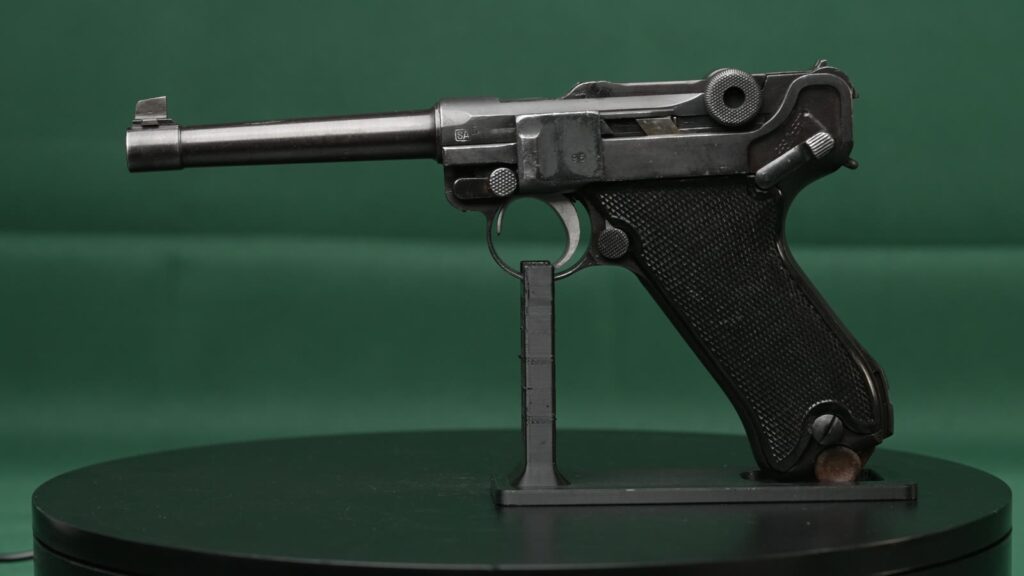
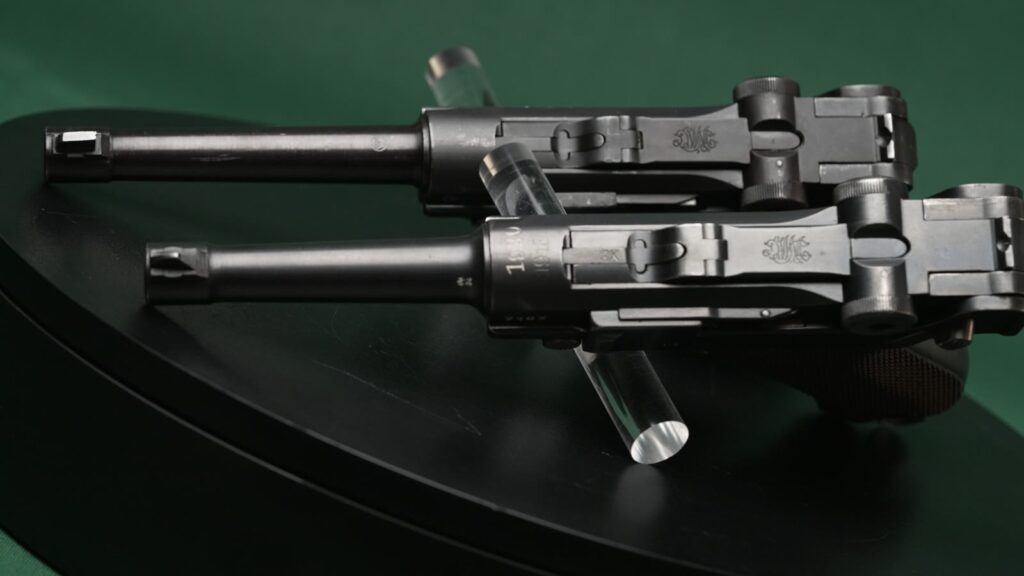
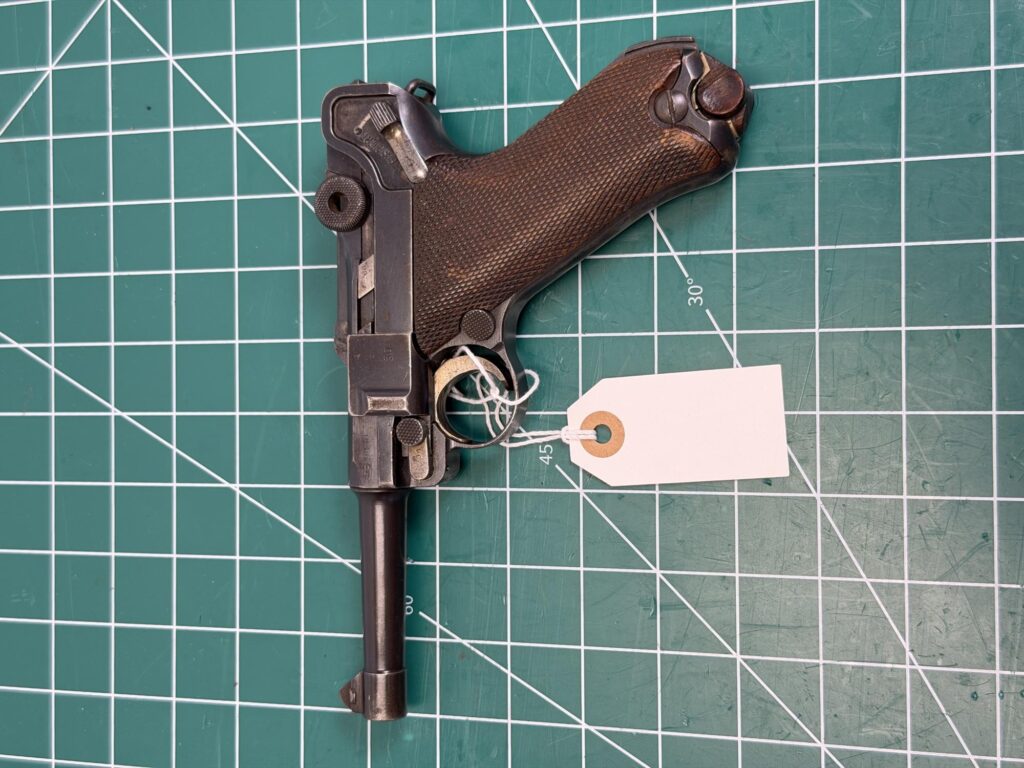
This Finnish Luger started life as a German DWM commercial pistol, serial 9996 with a script l under the number, and ended up as Finnish Army property: a boxed SA on the receiver, EK 59 marked by the lanyard loop, and a Finnish Tikkakoski barrel in 9mm. Then there are the grips. They are black, checkered, and look a great deal like the wartime German Bakelite grips collectors know from Black Widow Lugers. Are they wartime German grips, Finnish replacements, or later reproductions? We do not know yet, and that is the question our video puts to you. This piece is in our case at Old Steel Arsenal, and below we go through the main markings in our photos, what each one tells you, and the photos of the grip backs we’d like you to look at.
How Finland ended up with DWM Lugers
Finland’s army needed a service pistol in the early 1920s. According to Forgotten Weapons, after disappointment with the domestic Ahlberg pistol and surplus French Ruby pistols, the Finnish military turned to DWM in Germany in 1922. Many Finnish officers of the time were Jaegers who had served in the German army during the First World War, and Jaeger Platoon, a site on the Finnish Army of 1918 to 1945, notes that they had very favourable opinions of the P08.
Germany’s postwar restrictions shaped what Finland got. Forgotten Weapons writes that the pistols were chambered for 7.65mm Luger with barrels under 100mm, specifically 95mm and 98mm. The first 2,000 arrived in 1922, another 2,000 in 1923, and by 1929 the Army had about 8,000. The Finns designated the 7.65mm Luger the m/23 pistol. Jaeger Platoon adds that 9mm Lugers in Finnish service were listed as pistol m/08. Survivors stayed in service into the 1980s.
Not every Finnish Luger came through the army’s own contract. Forgotten Weapons notes that many private individuals, and the Civil Guard, acquired their own Lugers that went on to see military service. We can’t say which route this pistol took. The SA mark only tells us the army later counted it as its property.
How to read the markings on a Finnish Luger
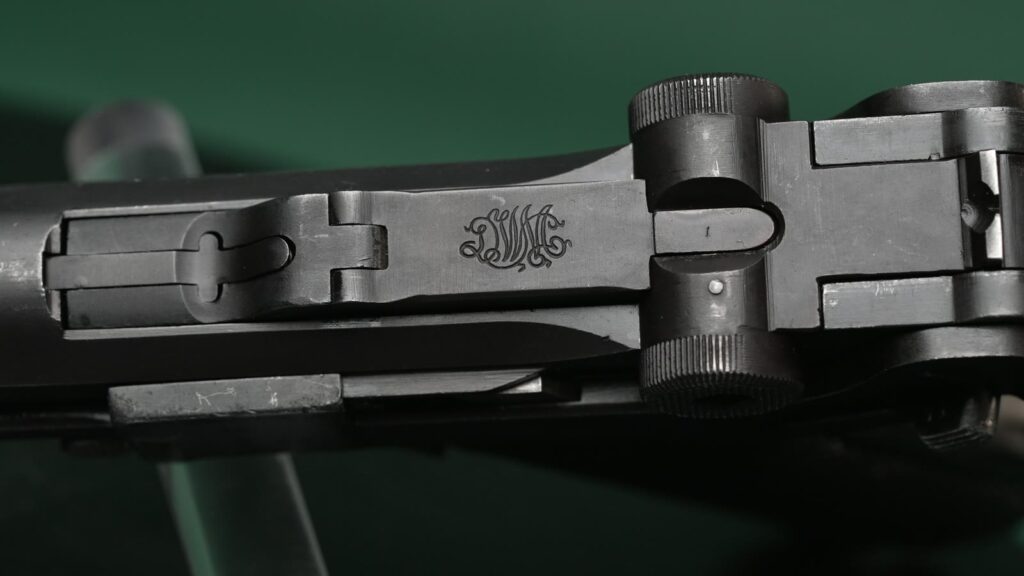
The DWM monogram
The front toggle link carries the script DWM monogram of Deutsche Waffen- und Munitionsfabriken. Forgotten Weapons notes that DWM put no crest or chamber marking on the Finnish contract guns. For the bigger picture on toggle marks and chamber dates, see our guide to Luger P08 markings.
The boxed SA and the crown N
On the left front of the receiver are two stamps. The crown over N is the German commercial proof. The SA in a rectangle stands for Suomen Armeija, Finnish Army. Land of Borchardt, a long-running Luger research site, describes this exact arrangement on Finnish m/23 pistols: an SA property mark in a rectangular cartouche on the left forward side of the receiver, next to the crown N commercial proof, and applied in the 1940s. So the SA tells you the Finnish Army counted this pistol as its property at some point after that. It does not tell you when the pistol arrived in Finland.

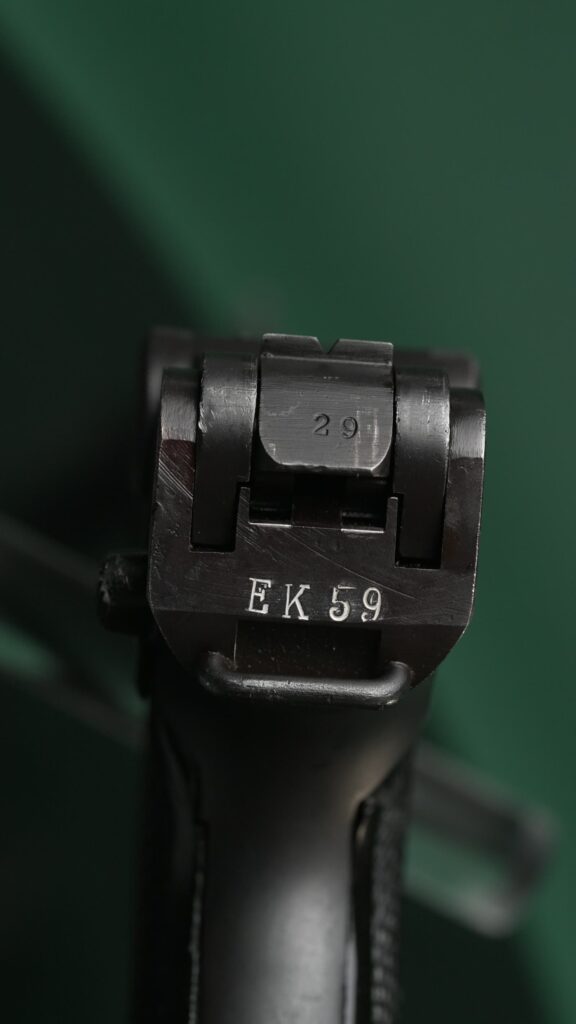
EK 59 at the lanyard loop
At the back of the frame, under the toggle and next to the lanyard loop, is EK 59. In a 1989 article in Auto Mag, Dr. Gene C. Stevenson surveyed unit markings on Finnish Lugers. He wrote that Finnish unit markings generally give the unit’s abbreviation and the weapon’s number, and that besides brass discs set into the grip, they were occasionally engraved on the pistol itself, including the frame lanyard housing. He also writes that the Finns stopped unit-marking weapons in 1940, so EK 59 most likely went on before the SA mark did. His table lists EK 44 and EK 45 in that same spot and reads EK as esikuntakomppania, which he translates as Staff Company: a headquarters company. Read that way, EK 59 would be weapon number 59 of a staff company. Which staff company, the mark does not say, and we are not going to guess.
Serial 9996, with a script l
The full serial is on the front of the frame, under the barrel: 9996, with a script l below it. This pistol belongs to DWM’s letter-suffix commercial series, the so-called alphabet commercials, where a number of up to four digits is followed by a letter, and the letter is part of the serial. Land of Borchardt notes that Finland’s contract pistols were numbered in this style. Collectors’ serial-range listings that we relied on for the video put the l block at around 1922 or 1923. Sources differ, though: Land of Borchardt, writing about another Finnish m/23 numbered 5245 l, places that pistol in the mid-1920s. Read the date as early to mid-1920s.

Numbers that don’t match
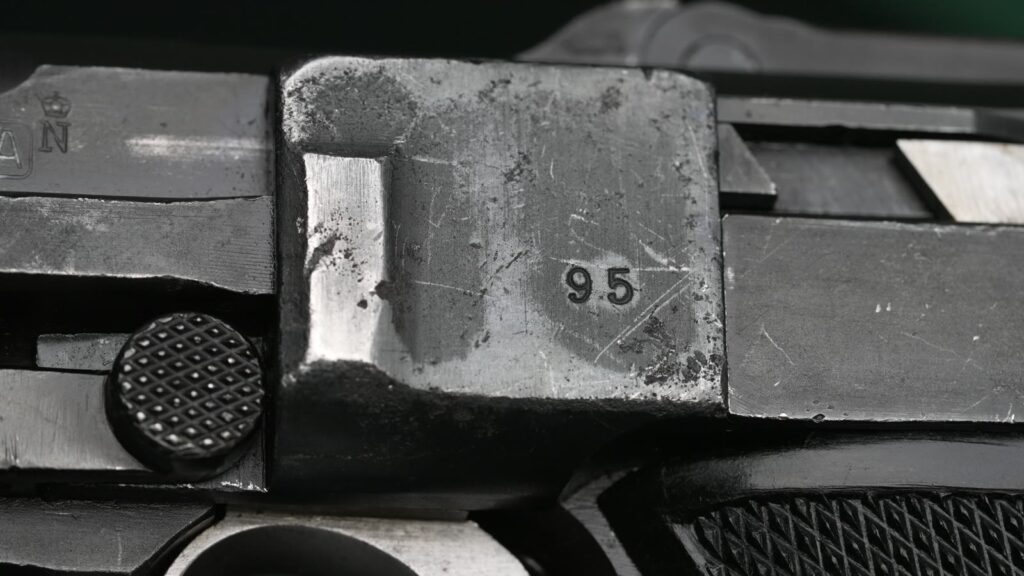
On 1920s commercial Lugers, according to Land of Borchardt, the last two digits of the serial are found on the trigger, the takedown lever, the side plate and the rear toggle link. On this pistol those digits should be 96. The side plate reads 95. The rear toggle link reads 29. We think the parts were most likely swapped when the Finns re-arsenaled the pistol, but nothing on the gun proves when it happened. Parts could also have changed later in its long life, before or after it left Finland.
The Tikkakoski 9mm barrel
The barrel is not the one DWM fitted. It carries a round maker’s mark from Tikkakoski, the Finnish firm that made replacement Luger barrels, and it is in 9mm. Forgotten Weapons explains that worn-out m/23 pistols were fitted with new 9x19mm barrels made by Sako and Tikkakoski, and that the hot Finnish submachine gun ammunition used in them caused heavy wear and eventually destroyed many of the guns. Jaeger Platoon adds two details. Changing a Luger from 7.65mm to 9mm mainly meant a new barrel and return spring. And so many barrels were swapped that the Ordnance Department sent out a circular letter forbidding the practice unless the original barrel was worn out or damaged.
Tikkakoski 9mm barrels came in more than one length: Jaeger Platoon lists 96mm and 120mm, against 102mm for a standard P08. Ours is 4.75 inches, longer than a standard 9mm Luger barrel.

The black grips: Black Widow, Finnish, or reproduction?
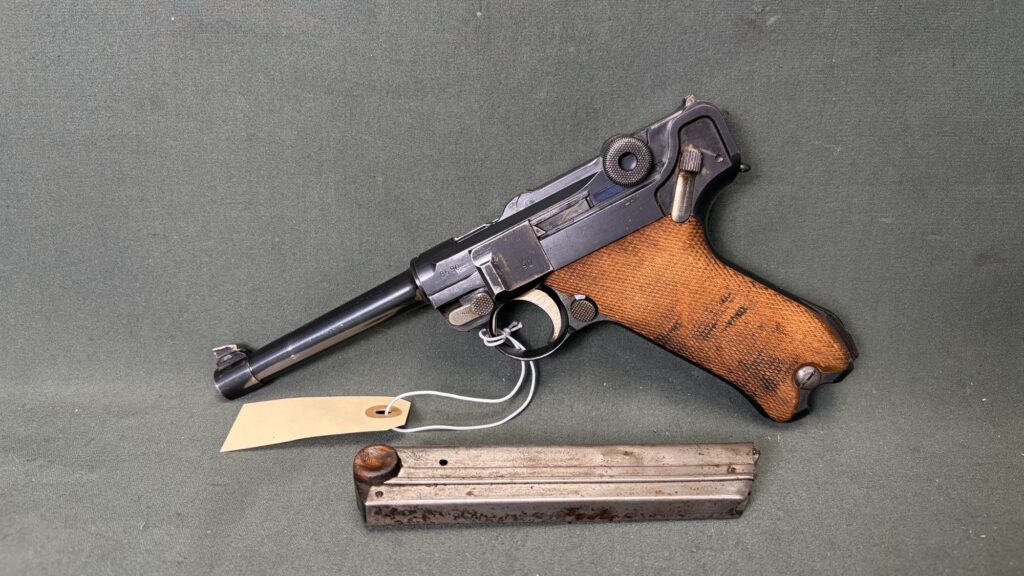
This Luger left DWM with wood grips, like the other P08 in our photos.
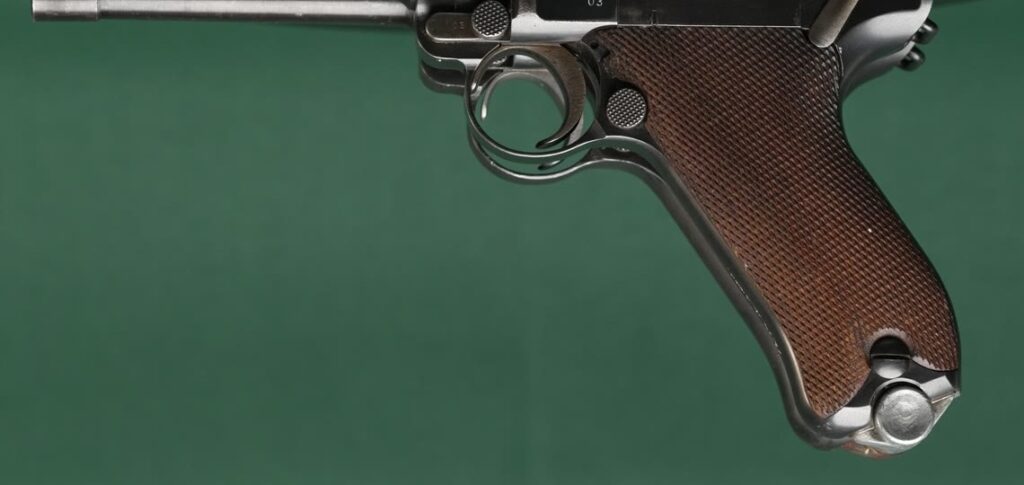
“Black Widow” is a postwar collector’s name. On LugerForum, longtime contributor Dwight Gruber explains that wood for pistol grips grew scarce in Germany late in 1940, that the army accepted plastic as a substitute, and that plastic Luger grips came into use in earnest in 1941. He credits the American Luger collector Ralph Shattuck with coining “Black Widow” for these plastic-gripped pistols. Strictly, the name belongs to the pistols, wartime Mauser P08s with black grips; collectors also use it loosely for the grips themselves. Wikipedia likewise records that some pistols were fitted with black Bakelite grips in 1941 and that the name came after the war. Our own article on a Black Widow byf 41 Mauser goes through the German side in detail.
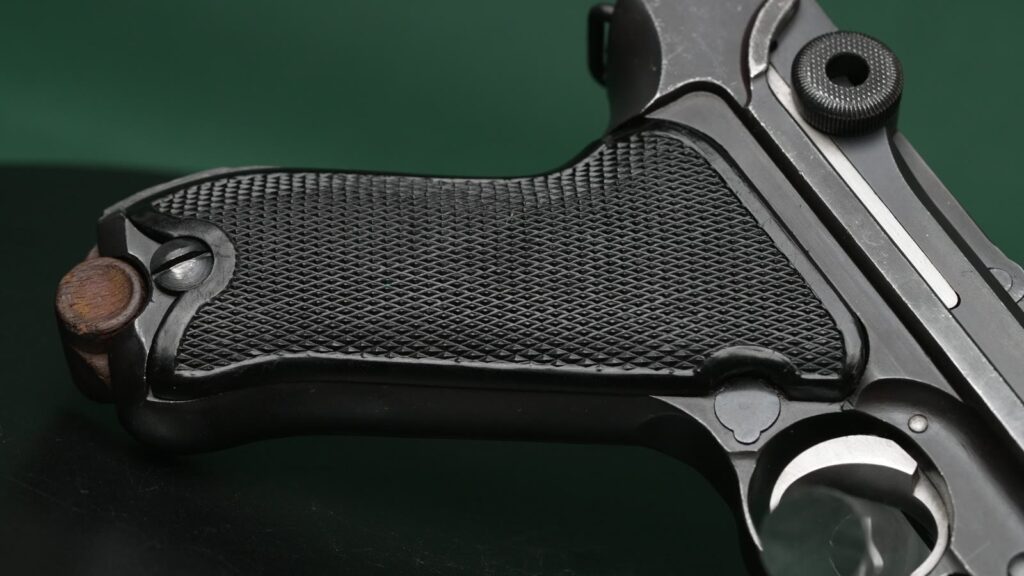
So this 1920s DWM can never be a Black Widow Luger, whatever its grips are. And the grips certainly did not leave the factory on it. The question is who made them, and the jackpot would be wartime German Bakelite. Their overall appearance matches the wartime originals, and from the way they are machined and finished, some details look consistent with genuine grips to us. That still leaves several possibilities:
- Wartime German Bakelite grips that found their way onto this pistol. Gruber notes that original grips can move from pistol to pistol.
- Reproductions. Gruber also writes about an active cottage industry forging these grips.
- Finnish replacement grips. Land of Borchardt writes that many original wood grips on Finnish m/23 pistols were changed out to black Bakelite grips made by the Finns.
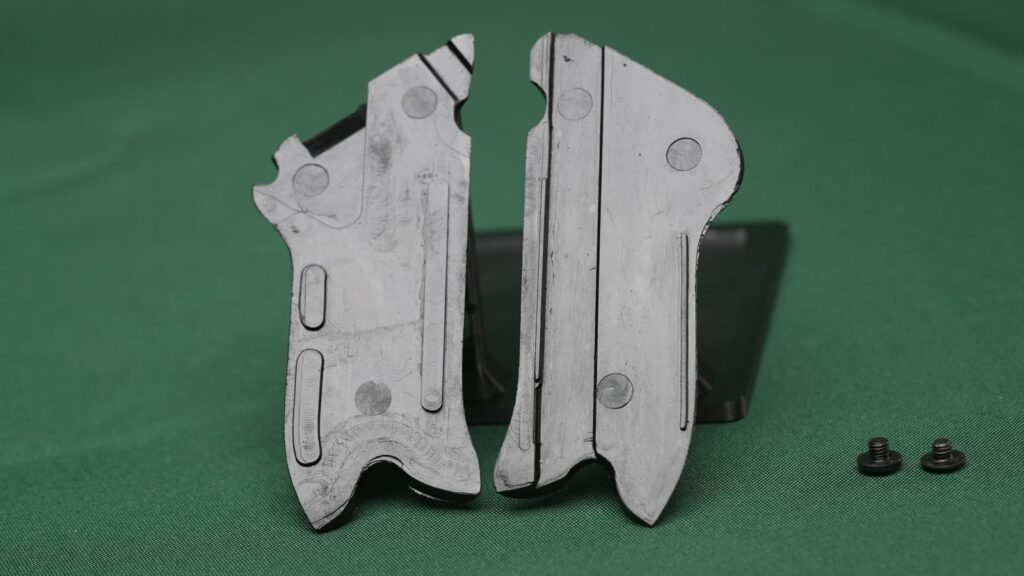
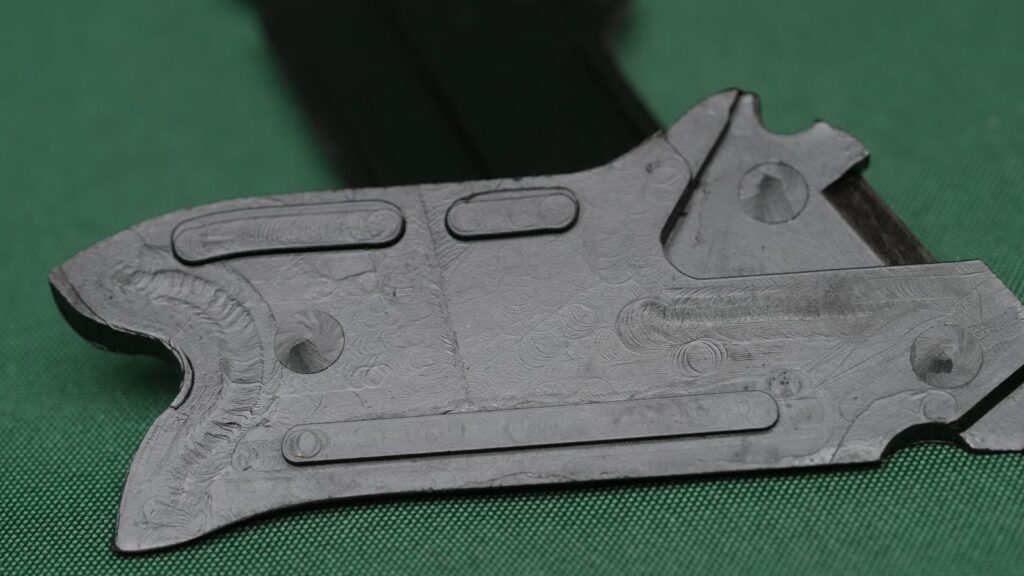
We are not ready to call it. In the same thread Gruber writes that black Bakelite Luger grips have identifiable characteristics, and when another collector asked about his grips, Gruber asked for sharp photos of the outside and detailed photos of the backs. So that is what we did: we took the grips off and photographed the backs. We found no markings on them. The right panel also has no recess for the brass unit disc that, according to Stevenson, Finnish m/23 grips generally carried, so these grips never held one. If you have handled wartime grips, look at these and tell us what you see.
Bore and condition
On the barrel: “The barrel seemed to be of very high quality, with a bright bore.” On the whole pistol: mixed numbers and all, it’s a solid shooter-grade P08. We have not fired it. Any century-old Luger should be checked by a qualified gunsmith before it is fired. The Finnish experience above, where hot submachine gun ammunition wore out and broke pistols, is also a good reason to stay with standard-pressure 9mm.
The holster
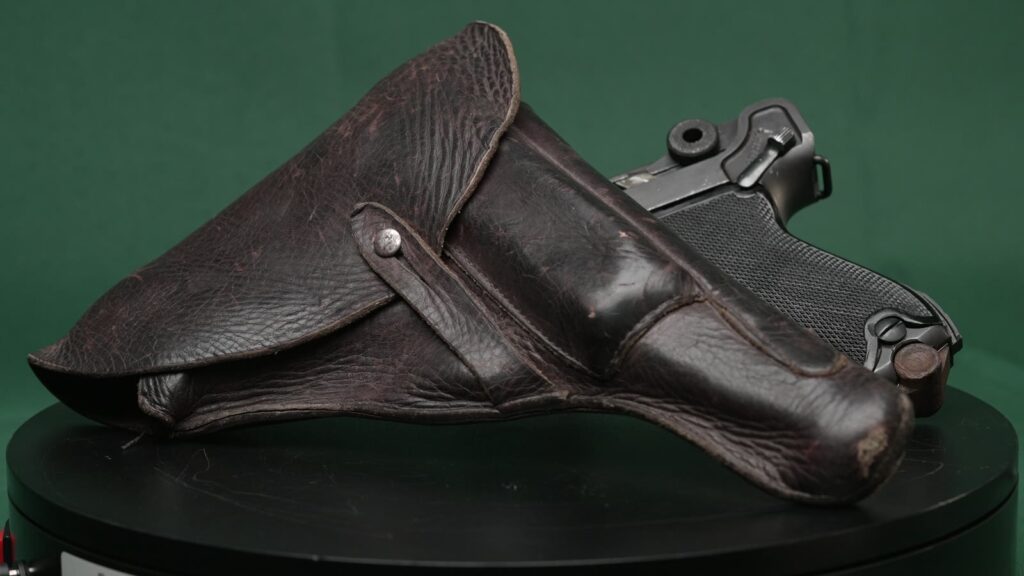
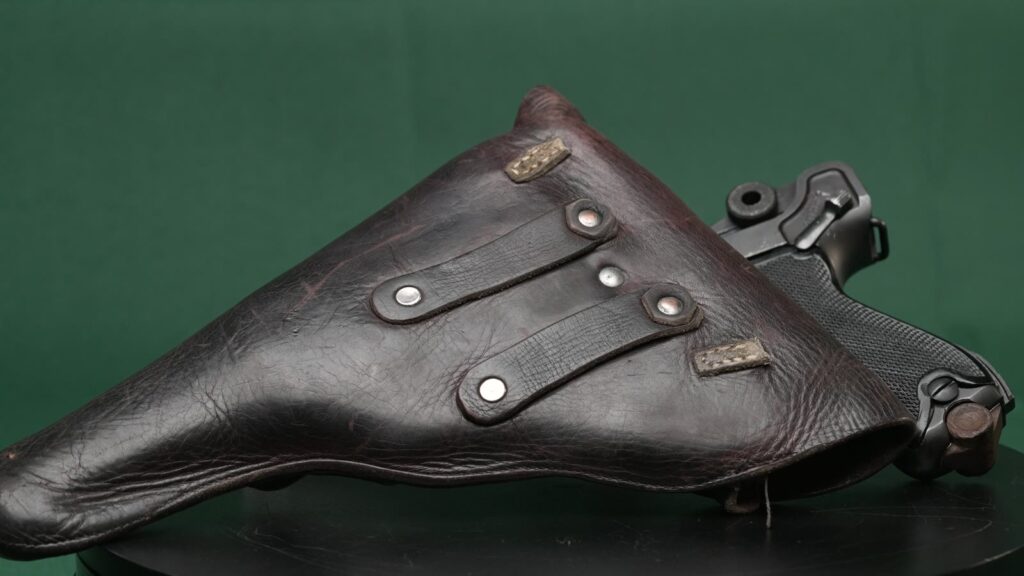
The pistol came with a leather holster in great shape. The importer described it as a period Finnish holster; it carries no visible markings, no SA, maker’s stamp or date, so we can’t confirm that ourselves, and we are not claiming it has been with this pistol since its service days. For background, Jaeger Platoon notes that Finland used more than one kind: the holsters first delivered with these pistols in the 1920s were surplus German World War One holsters, and similar leather holsters were also made in Finland.
Specifications
| Item | This Finnish Luger |
|---|---|
| Maker | DWM (Deutsche Waffen- und Munitionsfabriken), Germany |
| Type | Commercial P08 pattern, later Finnish Army service |
| Serial | 9996 with a script l suffix |
| Approximate date | Early to mid-1920s (l block; sources differ) |
| Finnish marks | Boxed SA on the left front of the receiver; EK 59 by the lanyard loop |
| Proof | Crown over N, German commercial proof |
| Numbered parts | Side plate 95, rear toggle link 29 (serial ends 96) |
| Barrel | Tikkakoski replacement, 9mm, 4.75 in |
| Cartridge | 9x19mm Parabellum |
| Action | Short recoil, toggle locked |
| Grips | Black checkered, fitted later; original grips were wood |
| Holster | Leather, described by the importer as period Finnish; no visible markings |
On the floor at OSA
The pistol in this article is a shop piece, not part of our own collection: you can see the full listing for the Finnish SA-marked Luger P08 with the Tikkakoski 9mm barrel and holster. Other Finnish Lugers are on the floor too:
- Late 1920s DWM Luger with a Finnish Tikka barrel and holster: a Tikkakoski barrel too, but in .30 Luger. Jaeger Platoon notes that Tikkakoski also made 7.65mm replacement barrels, so a new barrel did not always mean a new caliber.
- DWM Luger P08 in 7.65mm, Finnish service: a Finnish-service Luger still in the m/23’s original 7.65mm caliber, with its numbers matching.
- 1920s DWM Luger P08 in .30 Luger, Finnish service: another 1920s DWM in Finnish service, the same maker and decade as ours.
- 1929-era commercial Luger, Finnish service: a commercial Luger with a Mauser banner on the toggle rather than the DWM monogram, also in Finnish service.
The grid below updates by itself as pieces come and go.
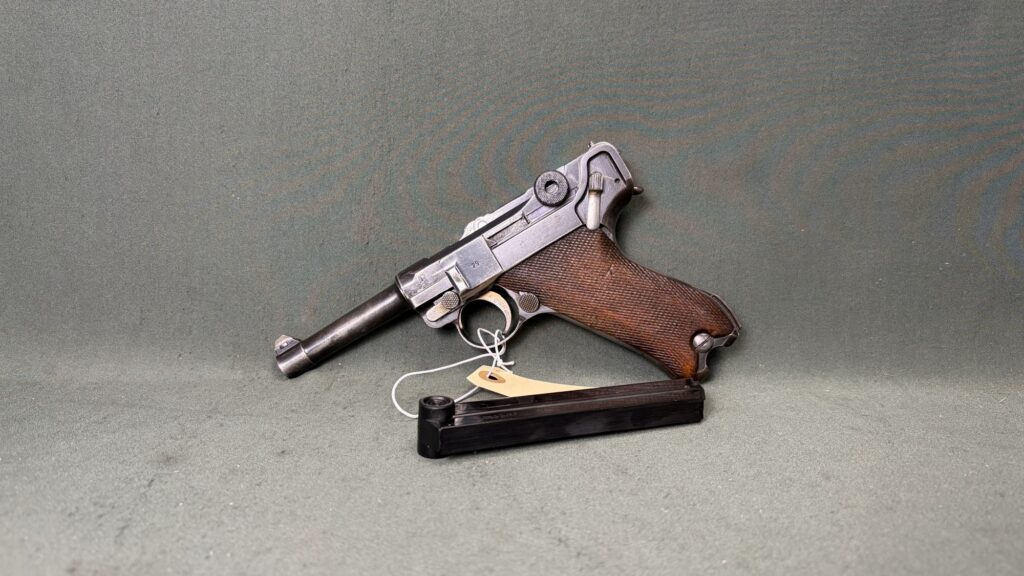
 1918 DWM Artillery Luger Converted .30 Luger Finnish Service Tikka Barrel$1,475.00
 1929 Era Commercial Luger .30 Luger Finnish Service Mauser Banner Toggle$1,200.00
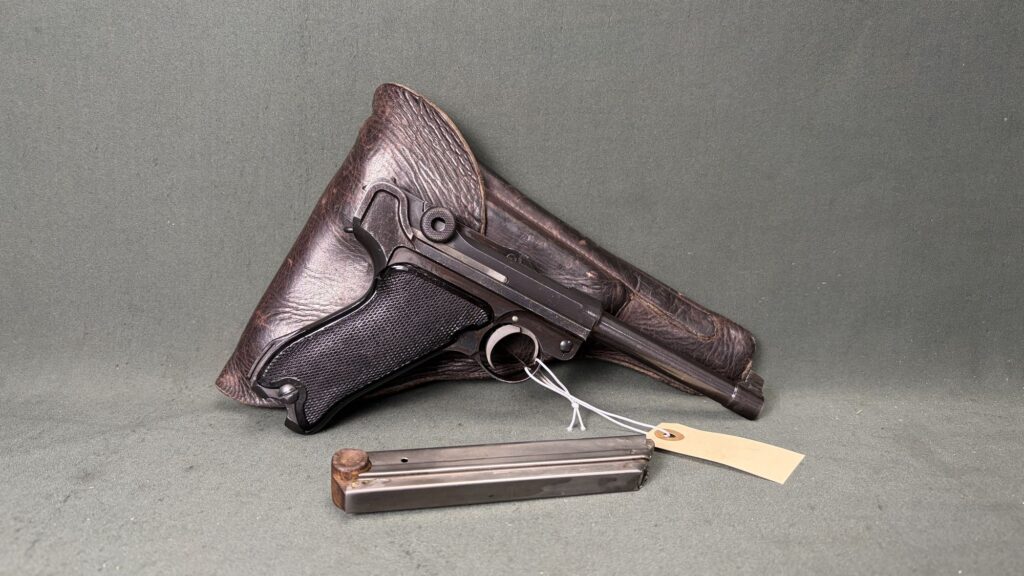 Finnish SA Marked Luger P08 9mm Tikka 4.75 in Barrel Bakelite Grips with Holster$1,725.00
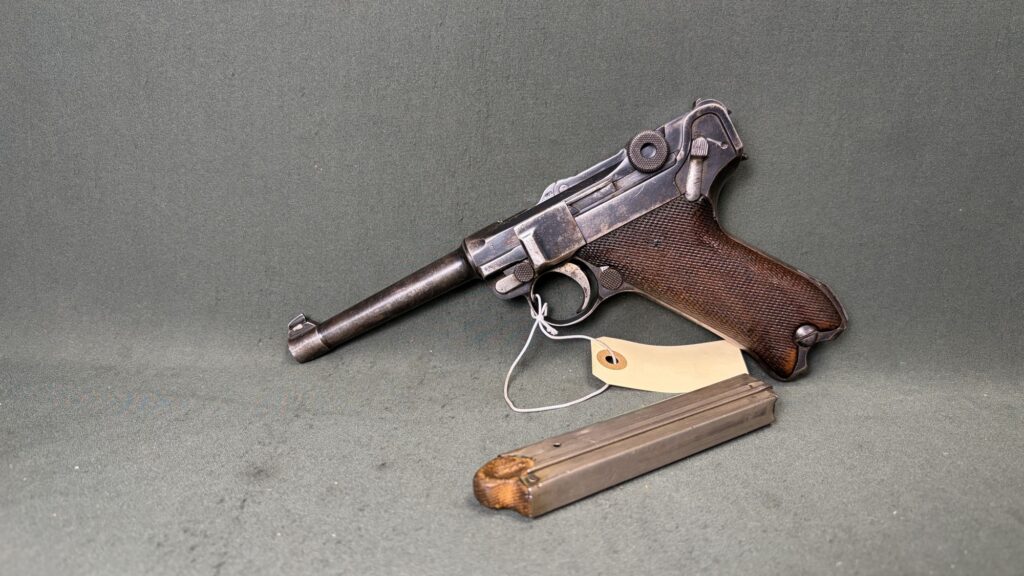 1920s DWM Commercial Luger .30 Luger 4.75 in Barrel Finnish Import Mirror Bore$1,175.00
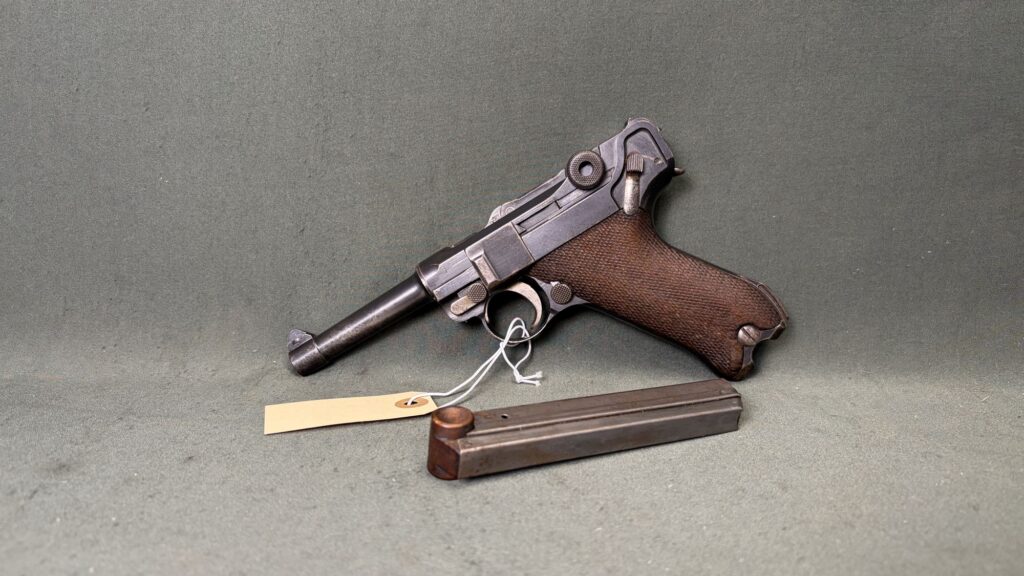 1920s DWM Luger P08 sn 67 .30 Luger Finnish Service All Matching Mirror Bore$1,467.00
 DWM commercial Luger P08 pistol$1,549.00
The short version is on our Instagram. Watch it on Instagram.
General information for collectors, not legal advice. History comes from the published sources listed below; markings, parts and grips vary from pistol to pistol.
Common Questions
Were Finnish Lugers 7.65mm or 9mm?
Both. The Finnish Army took in about 8,000 DWM Lugers in 7.65mm between 1922 and 1929 and called them the m/23. Lugers in 9mm, including m/23s later fitted with 9mm barrels, were listed as the m/08.What does the SA mark on a Finnish Luger mean?
SA stands for Suomen Armeija, Finnish Army. On m/23 Lugers it is a property mark in a rectangle on the left front of the receiver, next to the crown N proof, and according to Land of Borchardt it was applied in the 1940s.What does EK mean on a Finnish Luger?
In a 1989 survey of Finnish unit markings, Dr. Gene C. Stevenson read EK as esikuntakomppania, Staff Company. Finnish unit marks usually pair the unit abbreviation with the weapon’s number, so EK 59 would be weapon 59 of a staff company.Why do many Finnish Lugers have 9mm barrels?
Finland’s m/23 Lugers were 7.65mm pistols. Worn barrels were later replaced with 9mm barrels made by Sako and Tikkakoski, which only took a new barrel and return spring.What does the letter under a DWM commercial Luger serial number mean?
On DWM’s alphabet commercial Lugers, the serial is a number of up to four digits followed by a letter, and the letter is part of the serial. Collectors use the letter block to date a pistol approximately.What are Black Widow Luger grips?
Collectors’ shorthand for the black plastic grips fitted to some German P08 Lugers during the Second World War, mostly from 1941, when grip wood was scarce. Strictly, Black Widow is the postwar name for those pistols, coined by an American Luger collector.How can you tell if Black Widow grips are original?
There are two questions. Whether the grips themselves are wartime German Bakelite is judged from their own characteristics, which collectors study on the outside and the backs. Whether they are original to a given pistol is much harder, because grips can be moved between pistols; without documented history it usually can’t be proven.Sources
- Ian McCollum, Forgotten Weapons, “The Luger in Finland” — https://www.forgottenweapons.com/the-luger-in-finland/ (private individuals and the Civil Guard also acquired Lugers, Ahlberg and Ruby disappointment, DWM in 1922, Jaegers, 7.65mm with 95mm and 98mm barrels, 2,000 in 1922 and 2,000 in 1923, 8,000 by 1929, m/23 designation, Sako and Tikkakoski 9mm barrels on worn pistols, hot SMG ammunition, service into the 1980s, no crest or chamber marking on Finnish contract guns)
- Jaeger Platoon, “Finnish Army 1918–1945: Revolvers & Pistols Part 1” — https://www.jaegerplatoon.net/PISTOLS1.htm (Jaeger officers served in Prussian Jaeger Battalion 27 and favoured the P08, 9mm pistols listed as m/08, barrel and return spring swap, Ordnance Department circular letter, Tikkakoski 7.65mm replacement barrels, Tikkakoski 9mm barrels in 96mm and 120mm against 102mm standard, 1920s holsters surplus German WWI and made in Finland)
- Land of Borchardt, “1938, 1941, 1961, 1963 Finnish Soldier’s handbook. M23 Parabellum” — https://landofborchardt.com/finnishhandbook.html (SA in a rectangular cartouche on the left forward receiver beside the crown N commercial proof, applied in the 1940s; commercial four-digit letter-suffix serials; Tikkakoski 9mm replacement barrels in several lengths; wood grips changed to Finnish-made black Bakelite grips)
- Land of Borchardt, “Finnish military contract m/23 or Parabellum Pistooli 23” — https://landofborchardt.com/finnish4.html (serial 5245 l placed in the mid-1920s; last two digits on trigger, takedown lever, side plate and rear link of 1920s commercial Lugers)
- Dr. Gene C. Stevenson, “Military Unit Markings Noted on Finnish Lugers,” Auto Mag, June 1989, pp. 61–64 — https://img1.wsimg.com/blobby/go/2777b184-abfe-4859-a005-a1d5b84b19c0/downloads/AUTO%20MAG%201989%20JUNE.pdf (brass unit disc generally set into the right grip, unit abbreviation plus weapon number, markings occasionally engraved on the frame lanyard housing, unit marking stopped in 1940, EK 44 and EK 45 on the lanyard housing, EK = esikuntakomppania, Staff Company)
- LugerForums, “1920 DWM commercial” — https://www.lugerforums.com/threads/1920-dwm-commercial.53361/ (postwar DWM commercial letter-suffix blocks and their approximate years)
- LugerForums, “Commercial database v5 now here” — https://www.lugerforums.com/threads/commercial-database-v5-now-here.36778/ (commercial serial ranges by suffix)
- Dwight Gruber and others, LugerForum, “Black Widow Years/Codes” — https://forum.lugerforum.com/forum/showthread.php?p=81115 (wood scarce late in 1940, plastic in earnest from 1941, Ralph Shattuck coined Black Widow, grips moved between pistols, forged reproductions, identifiable characteristics, photos of the backs)
- Wikipedia, “Luger pistol” — https://en.wikipedia.org/wiki/Luger_pistol (black Bakelite grips fitted in 1941, Black Widow a postwar name)