
Journal · Collector’s Guide
M30 Luftwaffe Drilling: The Three-Barrel Survival Gun
The M30 Luftwaffe Drilling was a World War II survival gun for German aircrews, and it looks nothing like one. J.P. Sauer & Sohn of Suhl adapted one of its own sporting drillings for the job: two 12-gauge shotgun barrels over a 9.3x74R rifle barrel, with a case-hardened, engraved action and a checkered walnut stock. It came packed in a fitted metal transit case with ammunition, cleaning gear and a manual. According to American Rifleman, about 4,000 were ordered and apparently only 2,456 were delivered in 1941 and 1942. American Rifleman also reports no recorded instance of one being used in the survival role it was built for.
Where the M30 Luftwaffe Drilling came from
The word drilling comes from the German drei, three. A drilling is a break-open gun with three barrels. Layouts vary, but a common one, and the one the M30 uses, is two shotgun barrels and one rifle barrel, so a single gun can handle anything from game birds to deer. Combination guns like this have a long history in Europe as hunting arms and are popular with gamekeepers for that flexibility.
An aircrew that came down in the wilderness or behind enemy lines needed something to hunt with and something to defend itself with. American Rifleman describes the M30 as giving a downed crew both a self-defense gun and a hunting arm should they be stranded in inhospitable territory.
Hermann Göring ran the Luftwaffe. According to American Rifleman, he was also in charge of Germany’s forestry ministry, and he was an avid hunter and firearm enthusiast. Garry James wrote that this “may explain” why selected aircrews got a survival arm that would have been the envy of a sophisticated sportsman.
American Rifleman’s editors note that the gun was a commercial model in Sauer’s prewar lineup, known as the Model 30, and that it had reached the United States before the war began. The Luftwaffe version was, in Garry James’s words, basically a “militarized” version of one of the firm’s popular sporting arms, and he adds that the term is used loosely, because there was virtually no attempt to skimp on quality.
### How many were ordered and delivered
According to American Rifleman’s 2017 account, some 4,000 M30s were ordered from Sauer & Sohn, but apparently only 2,456 were actually delivered, in 1941 and 1942. We have not seen the delivery records behind that figure, so we keep the source’s hedge. The same account reports no recorded instance of an M30 being used in its intended survival mode.
Reading the case and its lid inventory
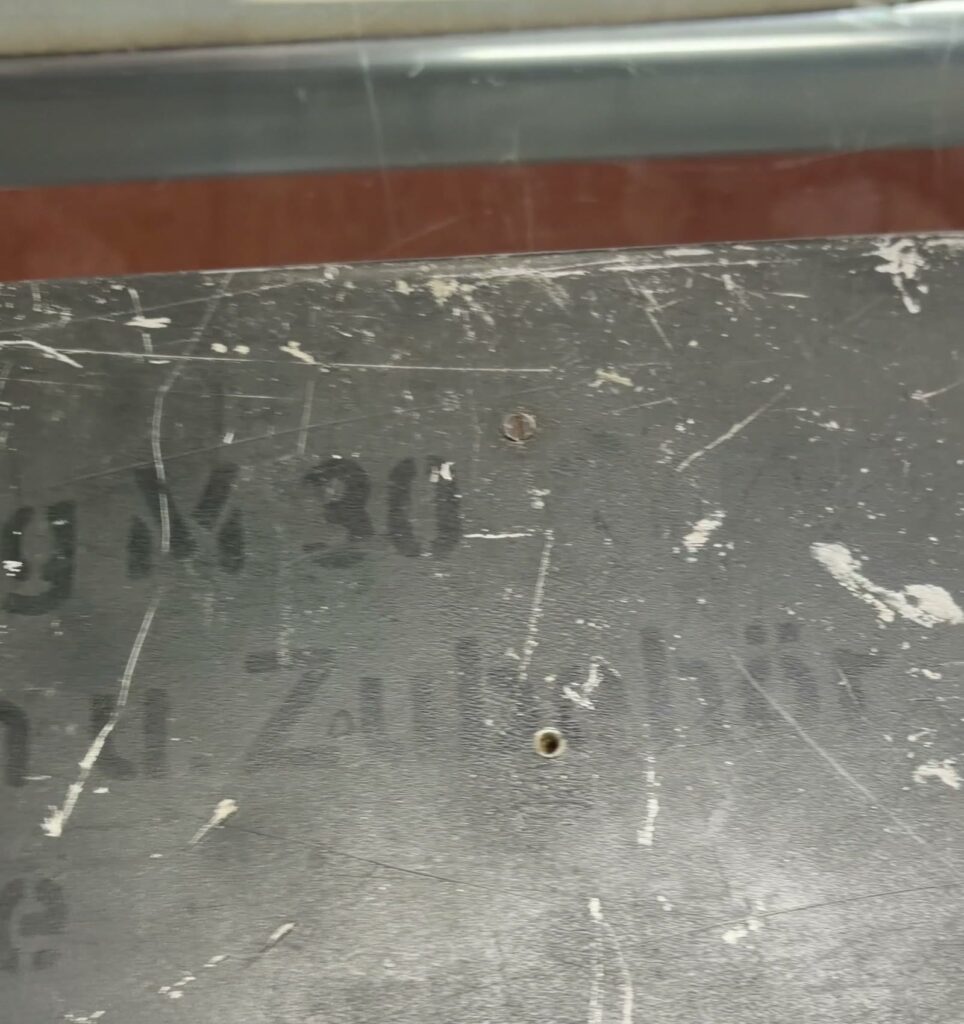
American Rifleman describes the type as a painted aluminum transit case stenciled on its lid “DRILLING M30 MIT MUNITION U ZUBEHÖR,” which translates to Drilling M30 with Ammunition and Accessories. On the case in our footage the paint is worn and scratched, and the stencil is only partly readable: “M 30” on one line and “u. Zubehör” on the next.
Inside the lid is a stenciled inventory headed Inhaltsverzeichnis, the table of contents. It lists everything the case was supposed to hold. Reading it top to bottom:
- 1 Beschreibung, Bedienungs- u. Wartungsvorschrift: the description, operating and maintenance manual
- 1 Kolben mit Verschlußstück: the stock with the action
- 1 Lauf mit Vorderschaft: the barrel set with the fore-end
- 1 Reinigungskasten: the cleaning kit, itemized a through h: a three-piece cleaning rod with a rotating handle, a small bottle of gun oil, cleaning tow, two brushes and one oil brush for the shot barrels, two brushes and one oil brush for the rifle barrel, and a tow holder for the rifle barrel
- 1 Gewehrriemen: a sling
- 25 Schrotpatronen, Cal. 12/65, Schrot 3½ mm: 25 shotshells with 3.5 mm shot
- 20 Brenneke-Patronen, Cal. 12/65: 20 Brenneke slugs
- 20 Kugelpatronen, Cal. 9,3×74 R: 20 rifle cartridges (the rest of this line runs off the edge of our frame)
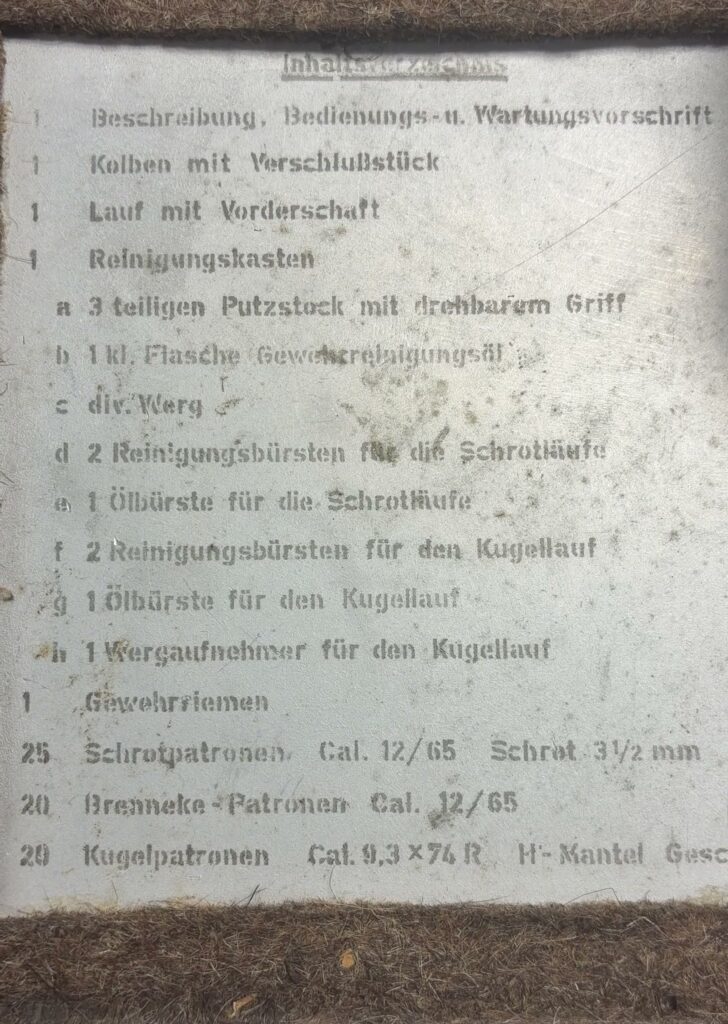
Those last three lines match the published kit. American Rifleman lists the ammunition as one 20-round box of 9.3x74R cartridges, 20 12-gauge Brenneke slugs and a 25-round carton of shotshells, along with a cleaning kit in a carton, a 32-page instruction manual and a sling. The lid also tells you how the gun traveled: stock with action in one piece, barrels with fore-end in another. In our footage the stock and action are visible lying in the case; the barrel group is not shown on its own.
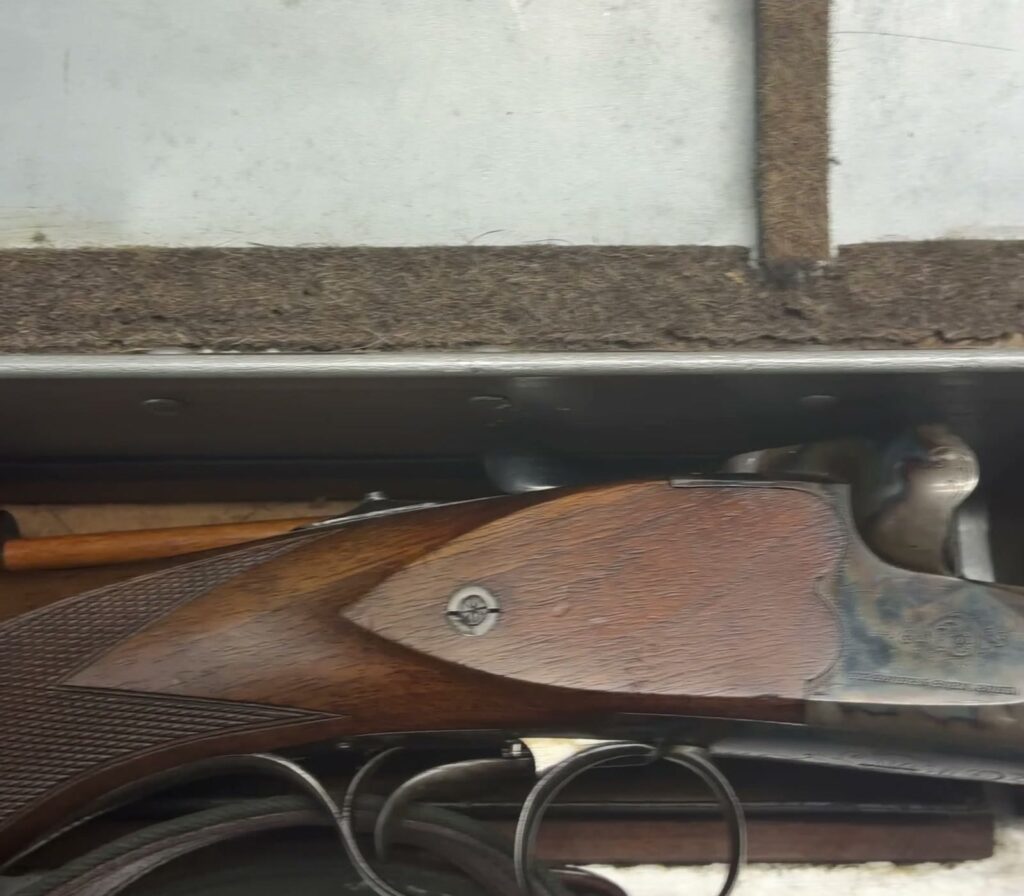
One caution for anyone looking at an M30 kit: the case, the manual and the ammunition are separate pieces, and separate pieces can be married together over 80 years. The shells in this case are a good example (see below). We have not confirmed that any item in it left Suhl with this gun.
### The Brenneke box
One of the boxes in the case carries a label from Wilh. Brenneke, Geschoßfabrik, Leipzig, the slug maker. The label opens with a hunter’s line, “handle waidgerecht,” roughly “act as a fair-chase hunter,” and goes on with advice about using the slug responsibly and minding the backstop. Brenneke was founded by Wilhelm Brenneke in 1895, and the Brenneke shotgun slug is still the company’s best-known product.
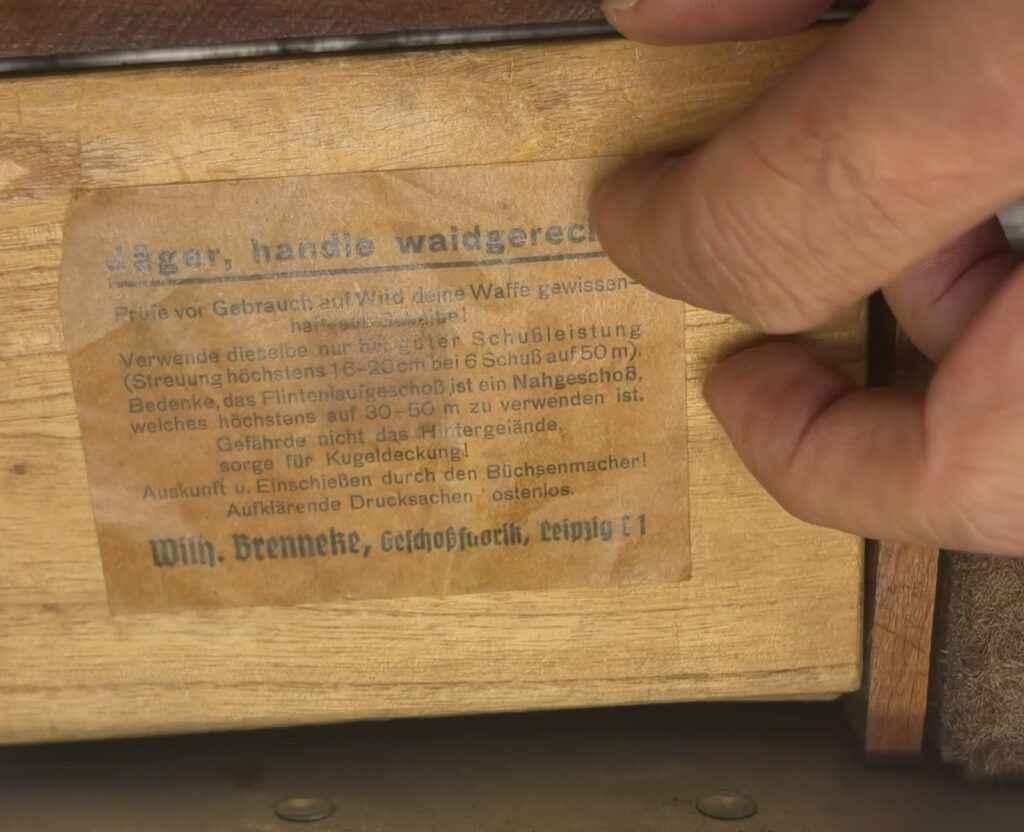
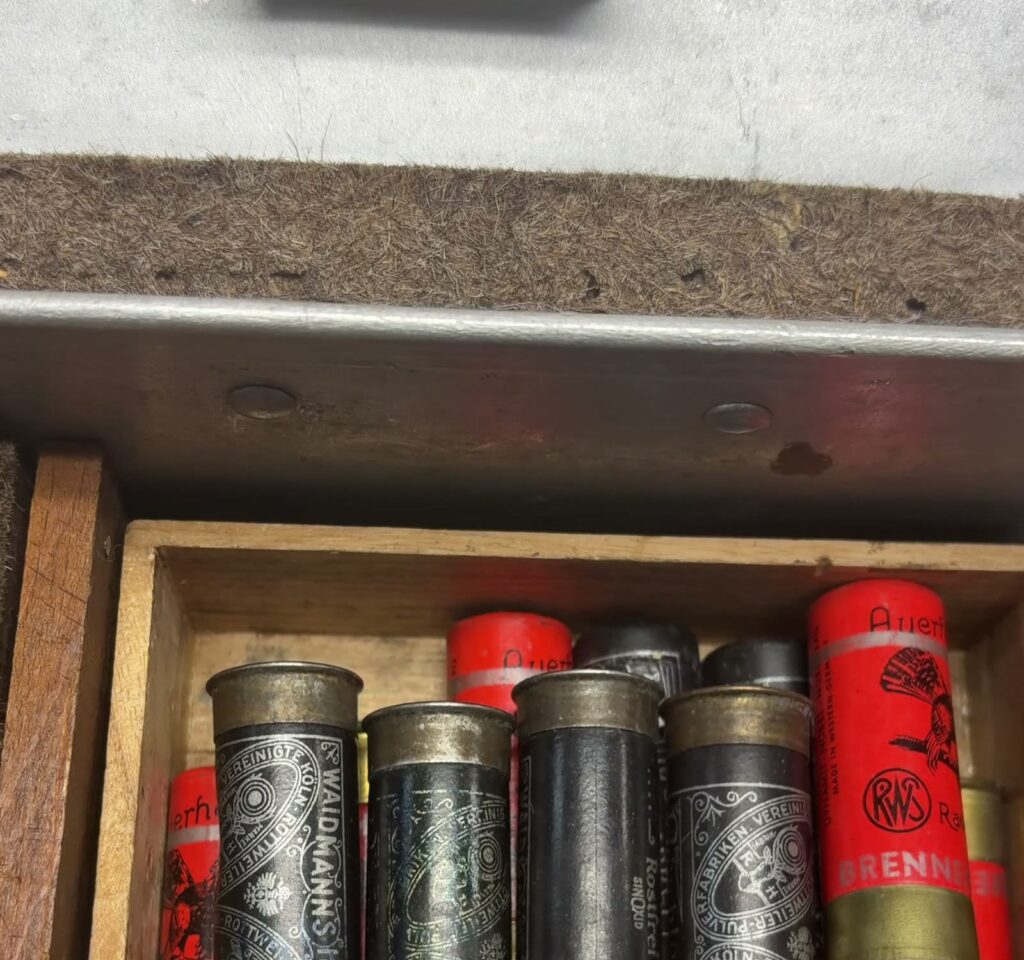
Note what is actually in the wooden box. It holds a mix of brands, black Waidmanns Heil paper shells alongside red RWS shells, and at least one of the red shells is printed MADE IN WESTERN GERMANY, a postwar marking. Whatever this case once held, the ammunition in it now is not the original issue as a complete set.
How to identify an M30 Luftwaffe Drilling
These are the features and markings to look for. Keep in mind that the Model 30 was also a commercial Sauer model, so barrel layout, maker and finish alone do not prove a gun is a Luftwaffe piece; the military marks and the documented kit are what set the M30 apart.
Three barrels, two calibers. Two 12-gauge barrels sit side by side on top, with a single 9.3x74R rifle barrel underneath. The 9.3x74R is a long, tapered, rimmed German sporting cartridge: a 9.3 mm bullet in a case about 74 mm long, the R for rimmed. It dates to around 1900, and American Rifleman compares its performance to the British .400/360 Nitro Express. Combination guns generally use rimmed cartridges, because rimless ones are harder to extract from a break-action.
The maker. The M30 was built by J.P. Sauer & Sohn of Suhl and carries Sauer & Sohn markings. Sauer is the same firm behind the 38H pistol; see our Himmler Sauer 38H article for a very different Sauer from the same years.
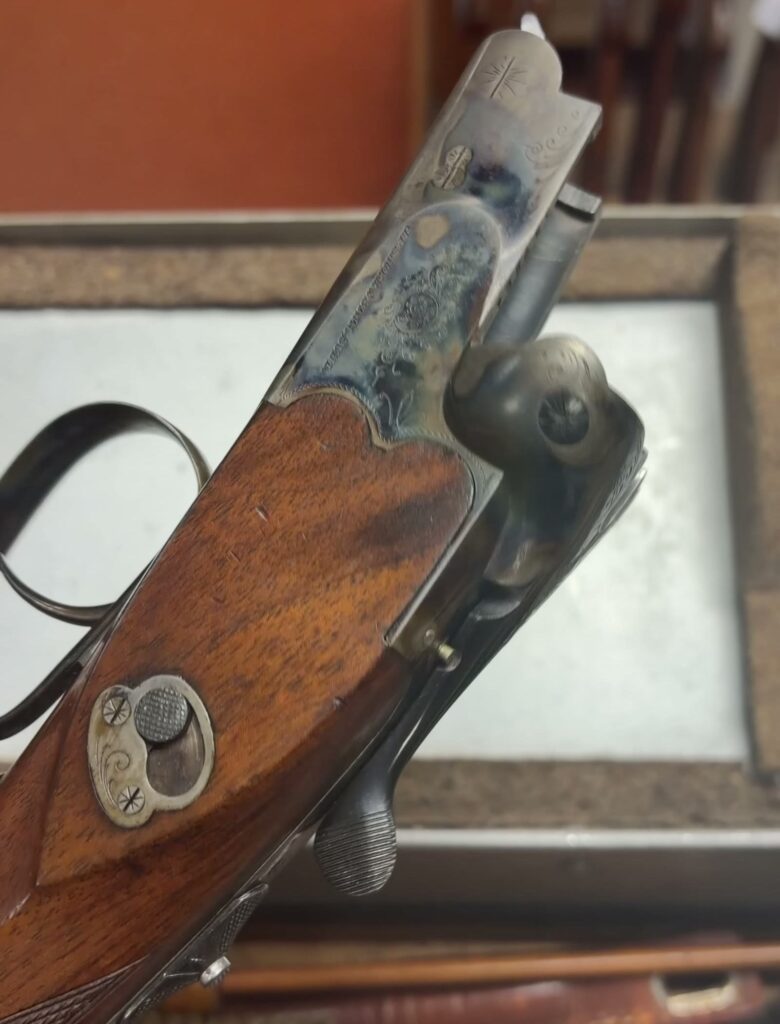
The finish. American Rifleman describes blued barrels of Krupp barrel steel, a tastefully case-hardened and engraved action, and a walnut stock checkered at the wrist, fore-end and cheekpiece. The case-hardening colors, blue and straw swirled into gray, are easy to see in our footage.
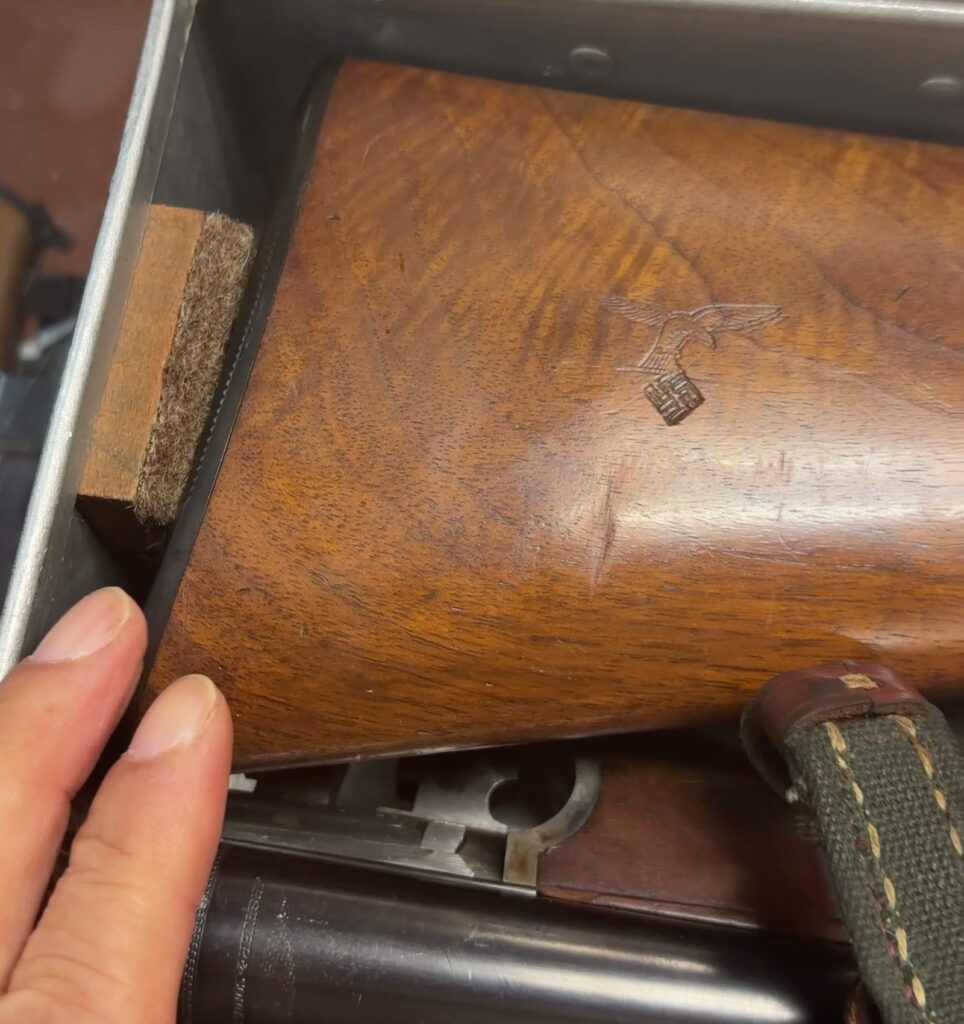
The Luftwaffe eagle. Along with the Sauer markings and proof marks, American Rifleman notes Luftwaffe eagle insignia stamped in the stock and on the barrels. On the gun in our footage the eagle is stamped into the side of the buttstock. For a different family of German markings, our Luger P08 markings guide covers chamber dates, toggle codes, proofs and acceptance stamps on the Luger.
How the M30 is built
American Rifleman describes the M30 as breaking open like a top-lever shotgun, locked with a Greener-style crossbolt, with two triggers. Our footage shows the two triggers, the checkered wrist and the engraved action closely; it does not show the gun being opened or fired, so we will stop at what can be seen.
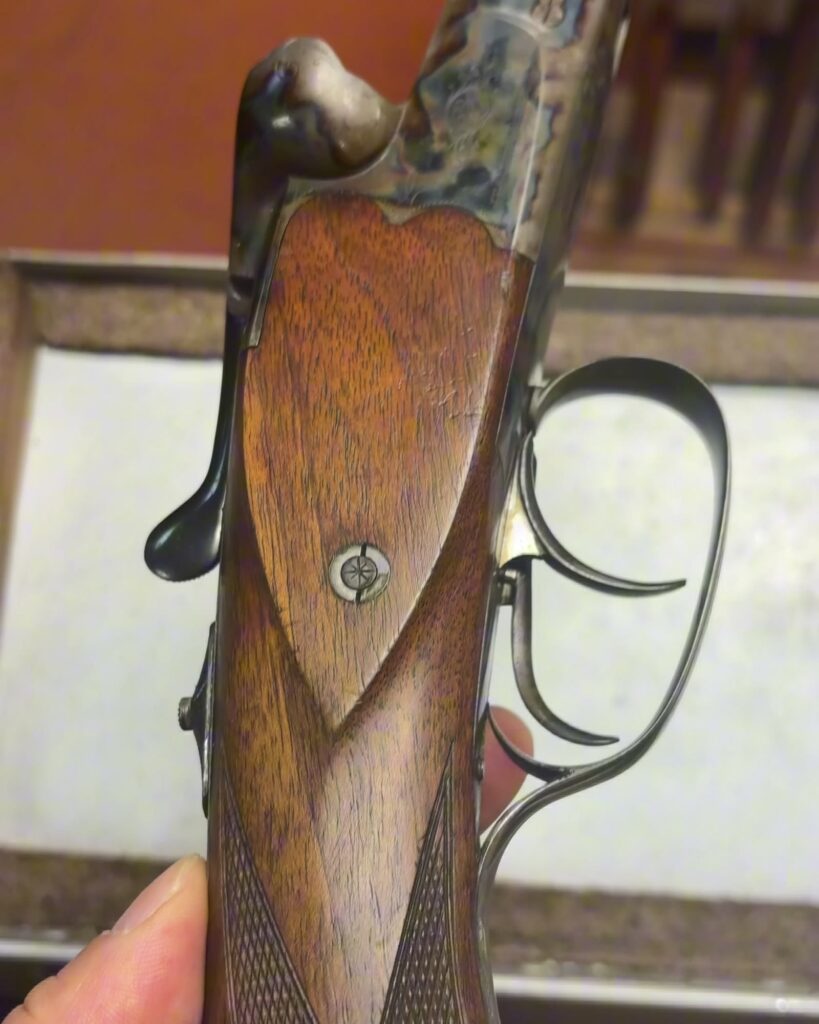
The M30 kept the engraving, case-hardening and checkering of a commercial sporting drilling and was sent out in a fitted case. American Rifleman lists the weight at 7 lbs., 8 ozs. and calls the 42-inch overall length well-balanced.
Specifications
| Item | M30 Luftwaffe Drilling (as listed by American Rifleman) |
|---|---|
| Maker | J.P. Sauer & Sohn, Suhl |
| Type | Drilling (three-barrel combination gun), break-open |
| Barrels | Two 12-gauge shotgun barrels over one 9.3x74R rifle barrel |
| Lock-up | Greener-style crossbolt, top lever |
| Triggers | Two |
| Weight | 7 lbs., 8 ozs. |
| Overall length | 42 inches |
| Ordered | About 4,000 |
| Delivered | Apparently 2,456, 1941–1942 |
| Issued kit | Case, manual, cleaning kit, sling, 25 shotshells, 20 Brenneke slugs, 20 rifle rounds |
On the floor at OSA
The M30 in these photos is not in our inventory, and we do not have an M30 on the floor. If German arms from the first half of the 20th century are what you are after, these are on the floor now:
- DWM Police Luger P08 with 1933 holster: a unit-marked German police Luger; our P08 markings guide helps you read the stamps on one.
- 1937 Portuguese Contract Mauser Kar98k: an Oberndorf-made Kar98k dated 1937, all matching and Waffenamt marked.
- Mauser C96 Broomhandle, 1915 to 1921: an earlier Mauser pistol in 7.63×25, all matching with original finish.
- Mauser Model 1914 pistol in .32 ACP: a pocket pistol from Mauser-Werke Oberndorf with its leather holster.
The grid below updates by itself as pieces come and go.
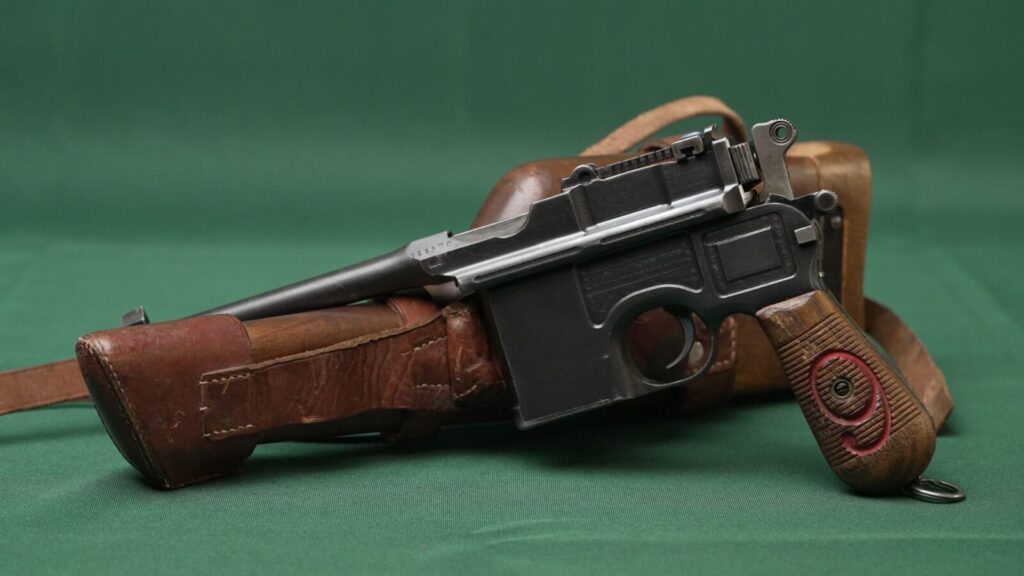 1917 Mauser C96 Red 9 Broomhandle 9mm All Matching with Stock and Rig$6,350.00
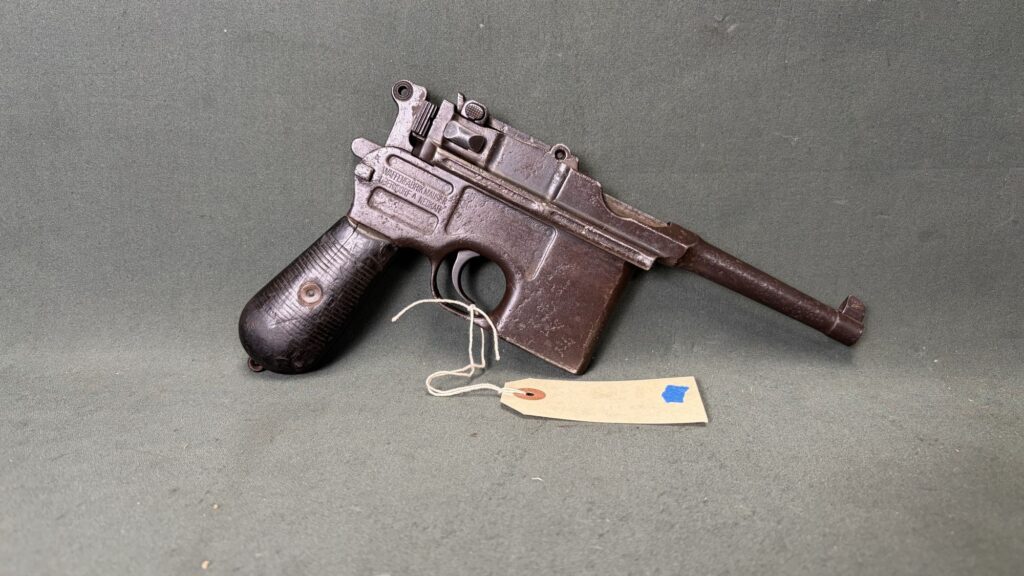 Mauser C96 Bolo Broomhandle Pistol$895.00
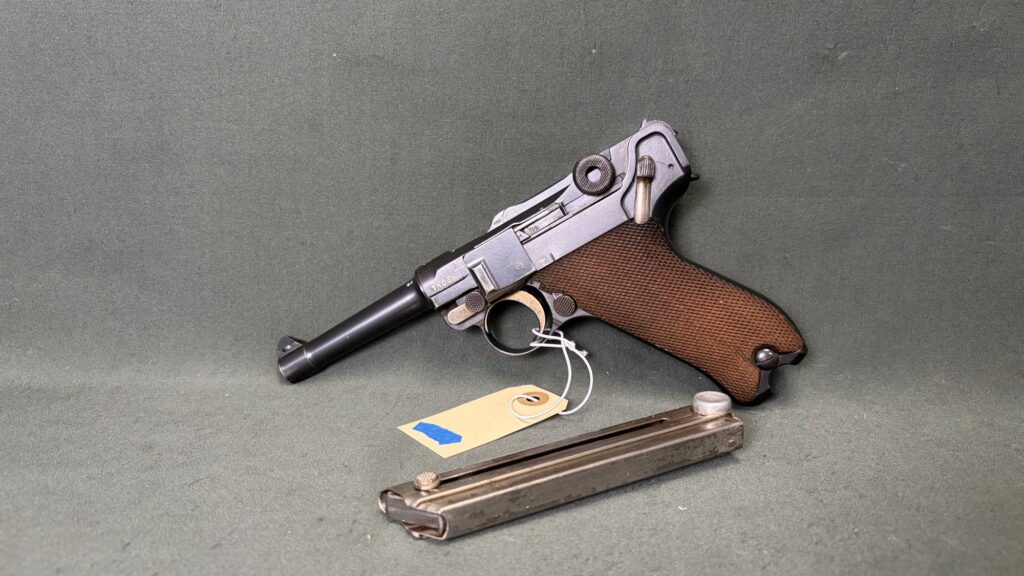 1918/1920 Double Date DWM Luger P08 9mm Weimar Police Rework All Matching$2,350.00
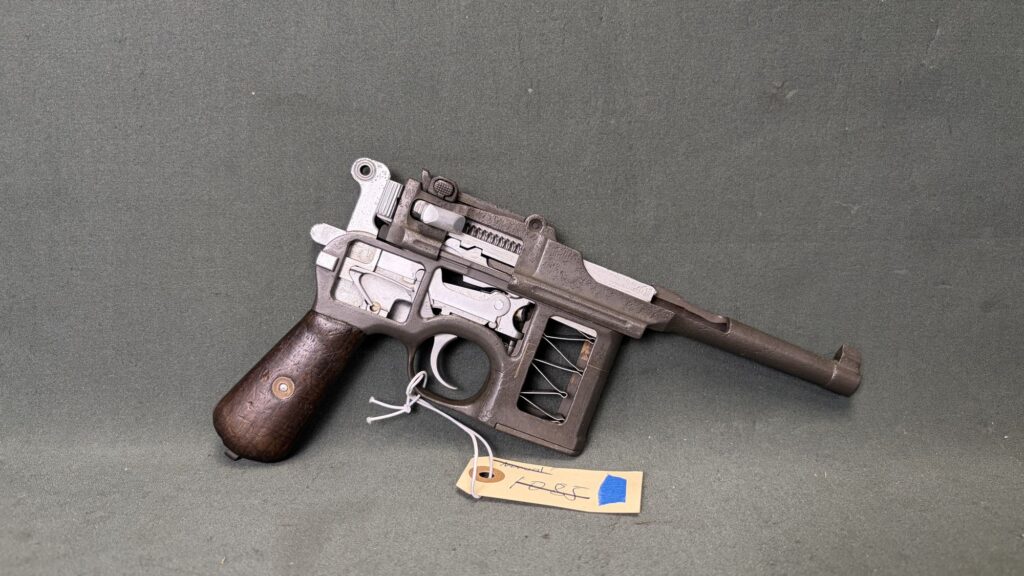 Mauser C96 Bolo Cutaway Display Piece Exposed Mechanism$1,050.00
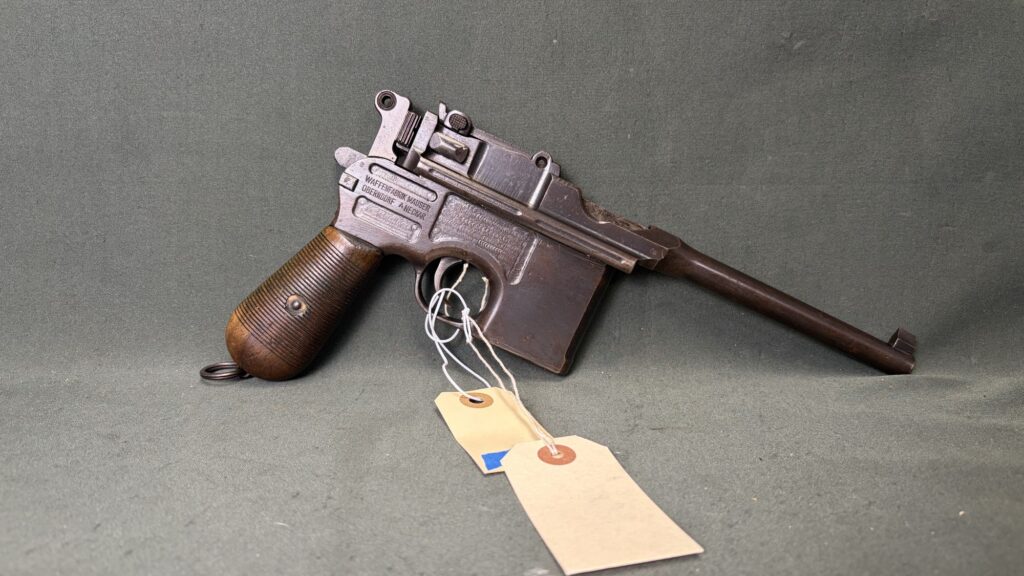 1915 to 1921 Mauser C96 Broomhandle 7.63×25 All Matching Original Finish$1,885.00
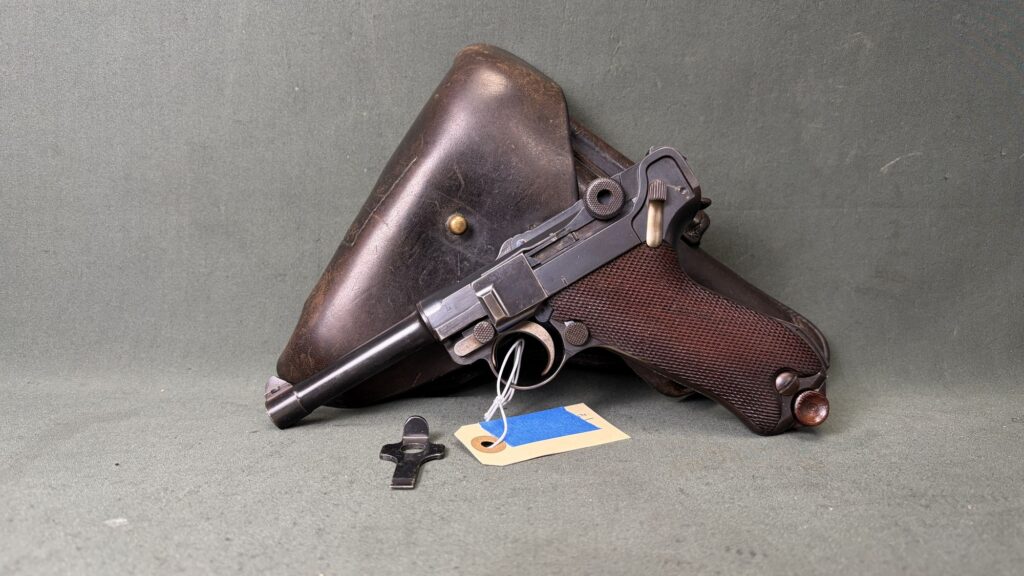 DWM Police Luger P08 9mm Unit Marked with 1933 Robert Larsen Berlin Holster$2,650.00
The short version is on our Instagram. Watch it on Instagram.
General information for collectors, not legal advice. Production and delivery figures for the M30 come from published secondary sources and are reported, not confirmed from factory records.
Common Questions
What does "drilling" mean?
Drilling comes from the German word drei, three. It is a break-open gun with three barrels, usually two shotgun barrels and one rifle barrel.What calibers is the M30 Luftwaffe Drilling chambered in?
The M30 has two 12-gauge shotgun barrels side by side on top and one 9.3x74R rifle barrel underneath.Who made the M30 Luftwaffe Drilling?
J.P. Sauer & Sohn of Suhl, Germany. It was a militarized version of Sauer’s prewar Model 30 sporting drilling.How many M30 Luftwaffe Drillings were ordered and delivered?
According to American Rifleman, about 4,000 were ordered from Sauer, but apparently only 2,456 were delivered, in 1941 and 1942.Was the M30 drilling ever used as a survival gun?
American Rifleman’s 2017 account reports no recorded instance of an M30 being used in its intended survival role. No record is not the same as proof it never happened.What came in the M30 case?
The lid inventory lists the manual, the stock with action, the barrels with fore-end, a cleaning kit, a sling, 25 shotshells, 20 Brenneke slugs and 20 rifle cartridges in 9.3x74R.Sources
- American Rifleman, Garry James, “This Old Gun: M30 Luftwaffe Drilling” (2017) — https://www.americanrifleman.org/content/this-old-gun-m30-luftwaffe-drilling/ (drei; barrel layout; 9.3x74R history and .400/360 comparison; Sauer & Sohn, Suhl; Göring titles and “may explain”; militarized sporting arm; Krupp barrel steel, case-hardened engraved action, checkering; 7 lbs. 8 ozs., 42 in.; top lever, Greener crossbolt, two triggers; eagle marks; case stencil; ammunition and accessories; about 4,000 ordered, apparently 2,456 delivered 1941–42; no recorded survival use)
- American Rifleman Staff, “I Have This Old Gun: M30 Luftwaffe Drilling” (2024) — https://www.americanrifleman.org/content/i-have-this-old-gun-m30-luftwaffe-drilling/ (Model 30 in Sauer’s prewar lineup, in the U.S. before the war; downed aircrews in wilderness or behind enemy lines)
- Wikipedia, “Combination gun” — https://en.wikipedia.org/wiki/Combination_gun (drilling as a three-barrel combination gun; hunting use and gamekeepers; rimmed cartridges in break-actions)
- Wikipedia, “9.3×74mmR” — https://en.wikipedia.org/wiki/9.3%C3%9774mmR (9.3 mm bullet, 74 mm rimmed case, designed c. 1900)
- Wikipedia, “Brenneke” — https://en.wikipedia.org/wiki/Brenneke (founded 1895 by Wilhelm Brenneke; slug is its best-known product)