
Journal · Collector’s Guide
DWM 1902 Cartridge Counter Luger: The Army’s 50
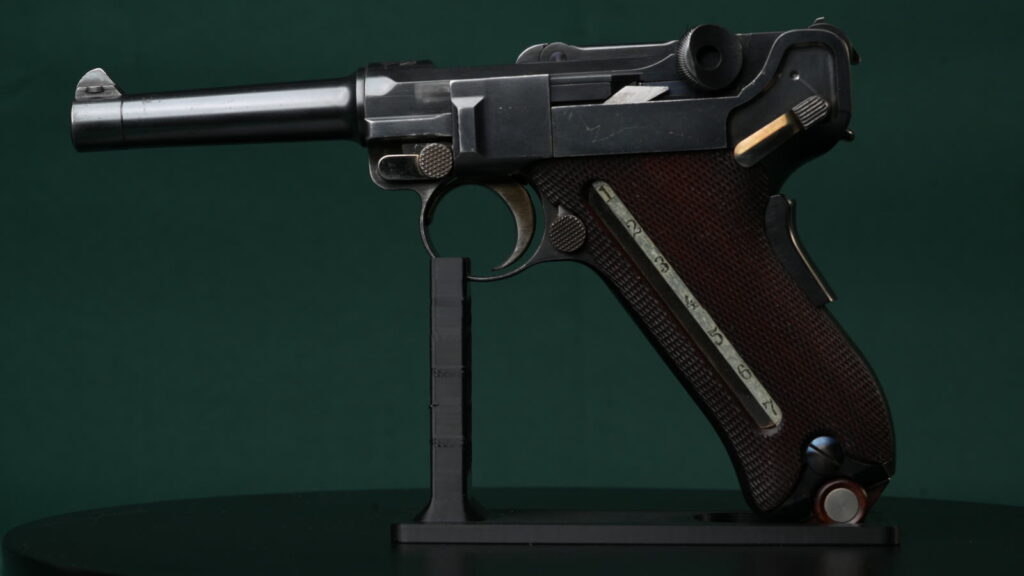
The cartridge counter Luger is one of the hardest American test Lugers for collectors to find: a DWM Model 1902 in 9mm with a little window in the left grip, numbered 1 to 7, that shows how many rounds are left in the magazine. The U.S. Army had only fifty made, serial numbers 22401 to 22450. Ours is serial 22429, and more than 120 years later it still looks almost new. It is part of the Old Steel Arsenal collection.
The U.S. Army and the Luger
The Army tried the Luger before it settled on the Colt. In 1901 the Ordnance Board took 1,000 Model 1900 Lugers in 7.65mm and issued them to mounted cavalry troops for field testing, with the rest going to the light artillery and to officers at West Point. The Luger was not popular with the troops, and those pistols were recalled in 1905. Wikipedia records a further 50 Model 1902 pistols with 4-inch barrels in 1902, again in 7.65mm. Then, in 1904, came 50 so-called cartridge counter pistols in 9×19mm, for Springfield Armory.
The Model 1902 itself was DWM’s update of the Model 1900, with the shorter 4-inch barrel, and it was the first Luger offered in 9×19mm Parabellum. The 9mm version also had a heavier barrel contour. Like other early Lugers, and unlike the later P.08, it has a grip safety in the back of the grip.
A straight swap for fifty pistols
The arrangement behind these fifty was a straight swap: the Army traded in fifty of its 7.65mm Model 1900 Lugers in good condition for fifty new 9mm pistols with the counter. According to Land of Borchardt, a Luger research site, a 1904 letter from DWM’s American agent asked for the traded pistols to be shipped to a New York firm. The same site suggests DWM went along with the counter because it was after a large Army contract.
Markings: the American eagle and the DWM monogram
The American eagle is stamped over the chamber, as on the earlier American test Lugers, and the toggle carries the DWM monogram. The eagle alone does not make a test pistol: commercial Lugers shipped to the United States were typically stamped with it too.


Fort Riley, 1904
The pistols went to Fort Riley, Kansas, and on April 19, 1904, the Army ordered tests by its cavalry and field artillery boards. On July 4, 1904, the Cavalry Board met at Fort Riley to consider the pistol. According to the report as quoted by Land of Borchardt, the board found it accurate at the distances tested, but the frequent jamming of cartridges made it practically useless, and it did not recommend adoption.
After that, the Army’s attention turned to caliber. Combat reports from the Philippines said the Army’s .38 revolvers lacked stopping power, and the 1906 and 1907 pistol trials asked for a .45. At the 1907 trials for a large-caliber pistol, Georg Luger brought pistols chambered in .45 ACP, but although invited to submit another 200 pistols, Luger and DWM withdrew, and the program ended with John Browning’s design, adopted as the Model of 1911.
How the Luger cartridge counter works
What set these fifty apart is on the left grip. A narrow window runs down the grip panel, numbered 1 through 7, with 1 at the top and 7 at the bottom. The system is known as the Powell indicating device, after its designer, Graham H. Powell.

The magazine is the other half. It has a slot cut down its side, and a pin on the follower rides in that slot and shows through the window. The more cartridges in the magazine, the lower the pin sits. As cartridges leave the magazine, the follower and the pin move up toward 1. The idea was that a soldier could check his remaining rounds at a glance. The counter reads the magazine only; it does not show whether there is a round in the chamber.
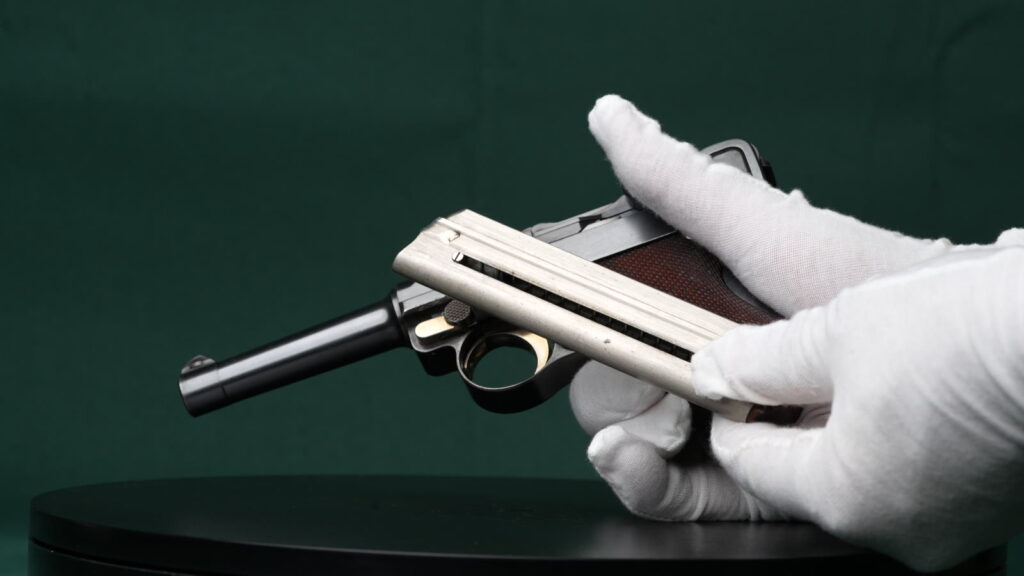

The serial is 22429, inside the 22401 to 22450 range of the fifty. The toggle carries 429, the last three digits of the serial.

We were honestly stunned the first time we picked it up. It feels brand new, and the toggle runs smooth as butter.

Specifications
| Item | DWM Model 1902 cartridge counter |
|---|---|
| Maker | DWM, Deutsche Waffen- und Munitionsfabriken |
| Made for | U.S. Army test, 1904 |
| Number made | 50 |
| Serial range | 22401–22450 |
| This pistol | Serial 22429, toggle 429 |
| Cartridge | 9×19mm Parabellum |
| Barrel | About 4 inches (the 1904 Ordnance report gives 3⅞) |
| Counter | Window in the left grip, 1 to 7, follower pin in a slotted magazine |
| Markings | American eagle over the chamber, DWM monogram on the toggle |
Collecting an American test Luger
Before the .45 trials of 1907, the Army’s Luger tests ran in three batches, each marked with the American eagle: the 1,000 Model 1900s of 1901, the 50 Model 1902s with 4-inch barrels recorded by Wikipedia, and the 50 cartridge counter pistols of 1904. For the counter guns, the serial should fall in the 22401 to 22450 range, the grip should have the window and the magazine its slot. Those are only a starting point. Land of Borchardt reports replicas in this serial range and fake counter magazines, so the numbers on the parts, the construction and any documents all need checking. For the marks found on later German service Lugers, see our Luger P08 markings guide. A Luger this old qualifies as a curio and relic; our curio and relic guide explains what that means.
On the floor at OSA
The cartridge counter Luger in these photos is part of the Old Steel Arsenal collection. If Lugers are your field, these pieces in our case come from the same maker:
- DWM commercial Luger P08: a DWM commercial Luger in .30 Luger, the 7.65mm cartridge the first American test guns used.
- 1911 DWM Luger P08, German Army accepted: the 9mm Luger as the German Army adopted it.
- DWM 1915 LP.08 Artillery Luger: the long-barreled First World War version.
- Waffenfabrik Bern Swiss Luger 06/29: the Luger as Switzerland later built it at home for its own army, in .30 Luger.
The grid below updates by itself as pieces come and go.
 Mauser byf 41 Black Widow Luger P08 9mm All Matching Rig with 1942 Holster Original price was: $3,950.00.$3,650.00Current price is: $3,650.00.
 DWM Police Luger P08 9mm Unit Marked with 1933 Robert Larsen Berlin Holster$2,650.00
 DWM P.08 Luger 9mm — 1918, Weimar Police, Matching$2,365.00
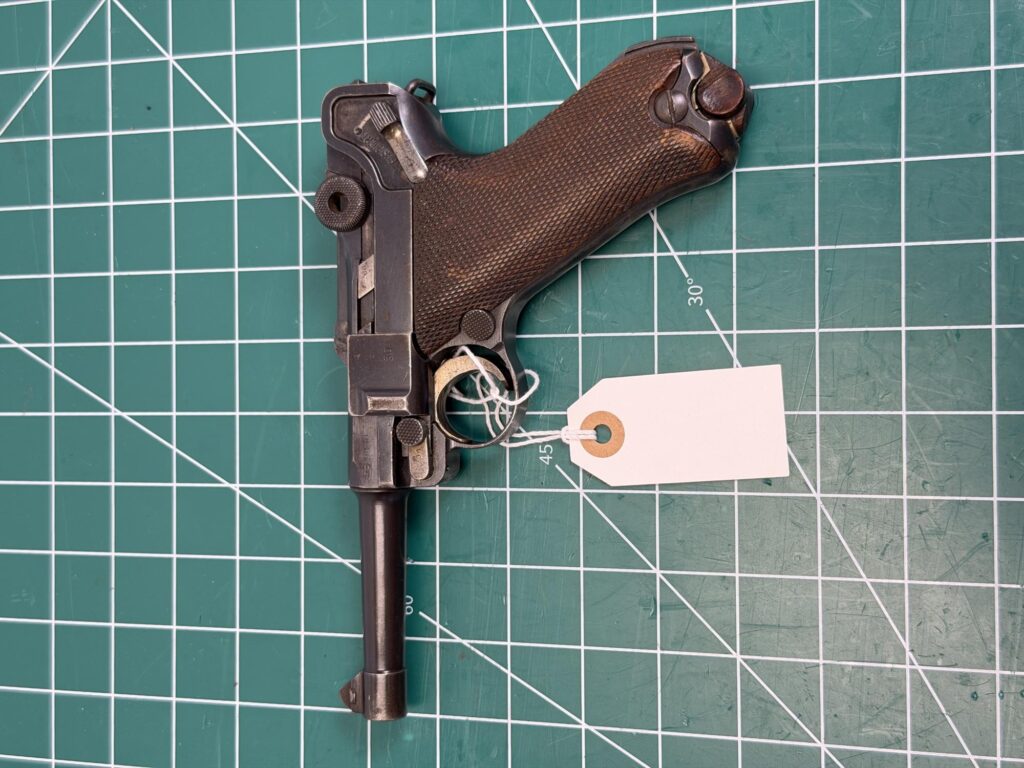 DWM commercial Luger P08 pistol$1,549.00
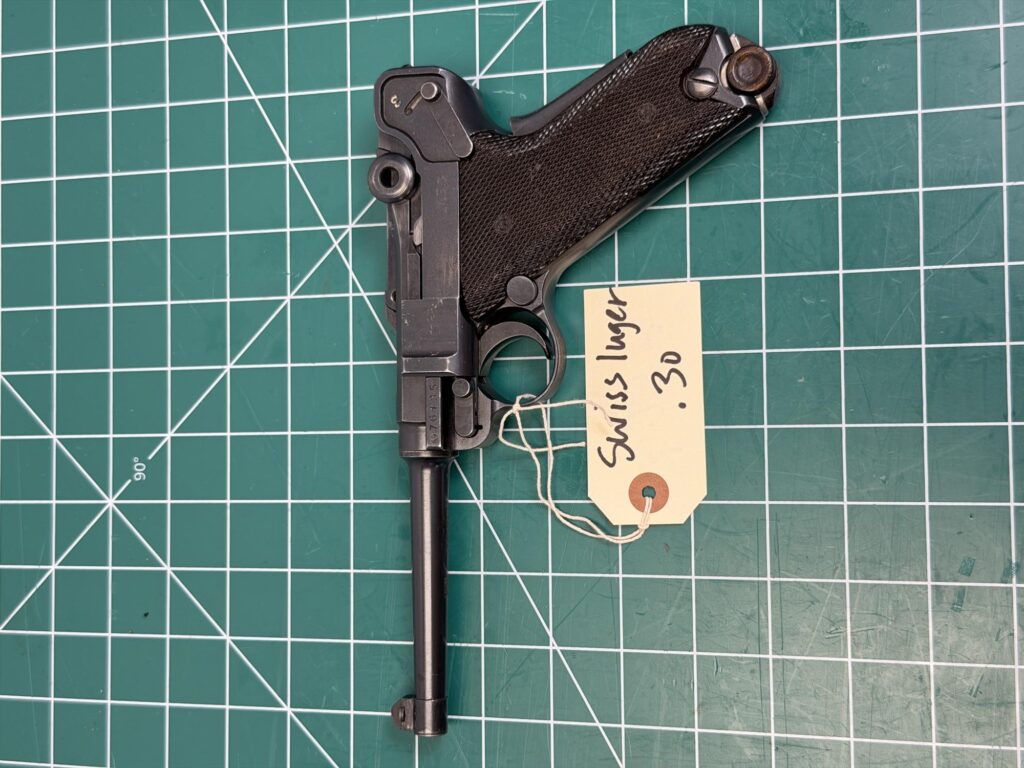 Waffenfabrik Bern Swiss Luger 06/29 pistol chambered in .30 Luger$2,379.00
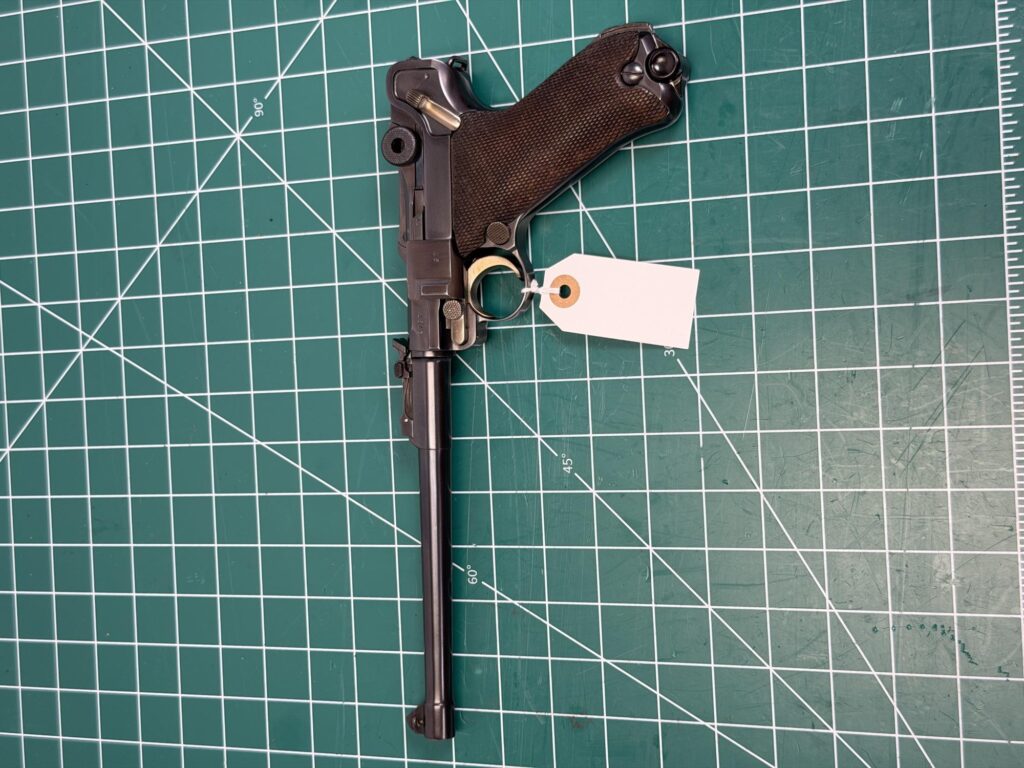 DWM 1915 LP.08 Artillery Luger pistol chambered in 9x19mm$2,799.00
See it on our Instagram. Watch it on Instagram.
General information for collectors, not legal advice. Trial dates and production figures come from secondary sources; check the individual pistol.
Common Questions
What is a cartridge counter Luger?
It is a DWM Model 1902 Luger in 9mm made for a 1904 U.S. Army test, with a window in the left grip numbered 1 to 7. A pin on the magazine follower shows through the window and indicates how many rounds are left in the magazine.How many cartridge counter Lugers were made?
DWM made fifty for the U.S. Army, numbered in the serial range 22401 to 22450.How does the Luger cartridge counter work?
The magazine has a slot down its side. A pin on the follower rides in the slot and shows through a numbered window in the grip; it sits low when the magazine is loaded and moves up toward 1 as cartridges leave the magazine. It does not show a round in the chamber.Why did the Army reject the 1904 cartridge counter Luger?
At Fort Riley in 1904 the Cavalry Board found the pistol accurate but jammed by frequent cartridge feeding failures, and recommended against adoption. The Army then moved to a .45-caliber requirement, which ended with the Colt Model of 1911.What is an American Eagle Luger?
A Luger with the American eagle crest stamped over the chamber. The American test pistols of 1901 to 1904 carried it, and Lugers shipped to the U.S. commercially were often stamped with it too.Sources
- Wikipedia, “Luger pistol” — https://en.wikipedia.org/wiki/Luger_pistol (1,000 Model 1900s in 1901 issued to cavalry, light artillery and West Point, recall in 1905, .38 revolvers and the .45 requirement, 50 Model 1902s with 4-inch barrels in 1902, 50 cartridge counter pistols in 9mm for Springfield Armory in 1904, Model 1902 the first 9mm Luger, American eagle over the chamber, 1907 .45 trials, invitation for 200 more .45 pistols declined, P.08 dropped the grip safety of earlier versions, commercial American Eagle Lugers)
- Land of Borchardt, “Early Old Model Commercial Production American Eagle Lugers” — https://www.landofborchardt.com/AEluger-article.html (exchange of 50 7.65mm pistols, 1904 letter asking for them to be shipped to a New York firm, 1904 Ordnance report: 3⅞-inch barrel, April 19, 1904 test instructions to the cavalry and field artillery boards, Cavalry Board meeting of July 4, 1904, accurate but frequent jamming, not recommended)
- Land of Borchardt, “The Basics of a U.S. Army M1902 AE Luger 9mm FAT barrel Cartridge Counter magazine” — https://www.landofborchardt.com/cc.html (serial range 22401–22450, heavier barrel, Graham H. Powell indicating device, pointer shows cartridges remaining in the magazine, DWM seeking a large Army contract, replicas in the range, fake magazines)
- 27 CFR 478.11, definition of curios or relics — https://www.ecfr.gov/current/title-27/chapter-II/subchapter-B/part-478/subpart-B/section-478.11 (firearms manufactured at least 50 years prior)