
Journal · Collector’s Guide
Finnish Artillery Luger: A 1918 LP08, Rebuilt
This DWM Luger, dated 1918 and serial 8690, has a short barrel today, but its receiver tells a different story: it started as an LP08, the long-barreled artillery Luger, and was later rebuilt with a Finnish barrel in .30 Luger. We think it is one of the artillery Lugers Finland got from Germany in 1918, though nothing on the gun proves which batch it came from. Two details point to its artillery past: a small step cut into the front of the receiver, and one rear toggle link that does not match the rest of the numbers.
Where a Finnish artillery Luger came from
The LP08, short for Lange Pistole 08, was the long-barreled Luger accepted for the German army in 1913. Its barrel is 200 mm long, against 100 mm on the standard P08, it was chambered in 9x19mm, and its adjustable tangent rear sight sits on the barrel itself, ahead of the receiver. It came with a removable shoulder stock. In Finland it is still called the artillery parabellum.
German troops fought in Finland during the 1918 Civil War. According to Waffenlager, Finland acquired about one hundred LP08s from Germany that year, intended for the Artillery School in Jakobstad, and named the model Parabellum m/1914. The Jaeger Platoon reference on Finnish army handguns says at least one hundred came from Germany in 1918, puts the total Finnish holding at roughly 100 to 200, and notes that a small number also arrived privately with returning Jaegers.

Finland kept its Lugers in use for a long time and changed barrels freely. Forgotten Weapons describes worn m/23 Lugers, Finland’s 7.65 mm contract guns, being refitted with new 9x19mm barrels from Sako and Tikkakoski once the Winter War began. Our gun went the other way, from a 9mm artillery barrel to a short .30 Luger barrel. We have not found a source that says how many LP08s were converted, or when this one was.
How to spot a rebuilt LP08: the receiver step
The first thing that caught our eye was a small cross groove, a step, on top of the receiver ring, just ahead of the 1918 date.
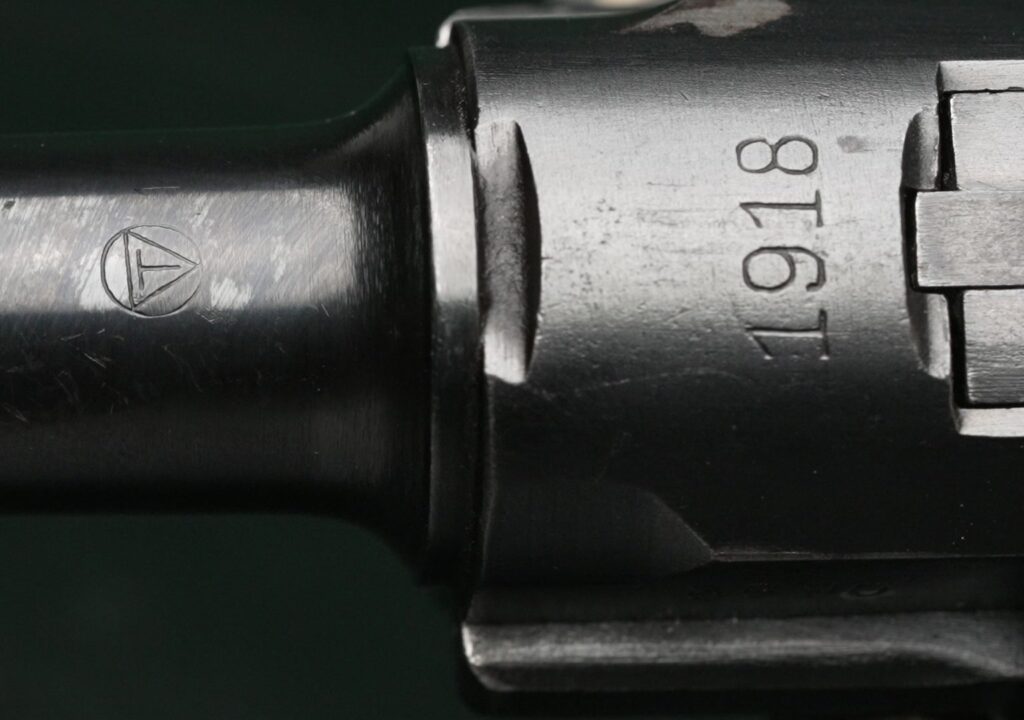
The standard Luger we compared it with has no step there; its receiver ring runs plain up to the barrel. On an artillery Luger, that step is cut to clear the long barrel’s tangent rear sight, and the back of the sight base reaches over it.
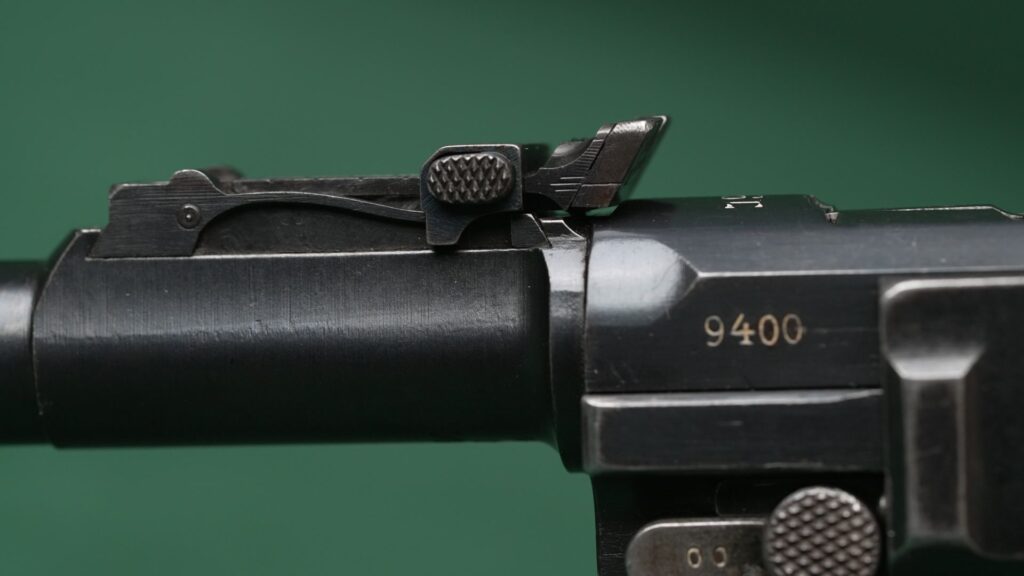
One caution. Land of Borchardt notes that Erfurt machined the same step into all of its Luger receivers dated 1916 to 1918, standard P08s included, so on an Erfurt gun the step alone does not mean a converted LP08. Ours is a DWM, and the step is only the first of two clues.
The rear sight itself belongs to the barrel. On the LP08 it is a tangent sight marked 1 through 8, adjustable in eight steps out to 800 meters.

Take the long barrel off and the rear sight goes with it. The cut in the receiver stays.
The mismatched toggle link
A standard P08 has its rear sight in a different place: a notch in the rear toggle link. An LP08 aims with the sight on its barrel, so its rear toggle link has no notch.

Put a short barrel on an LP08 and it has no rear sight at all, unless the rear toggle link is changed for one with a notch. This pistol has a notched rear link.
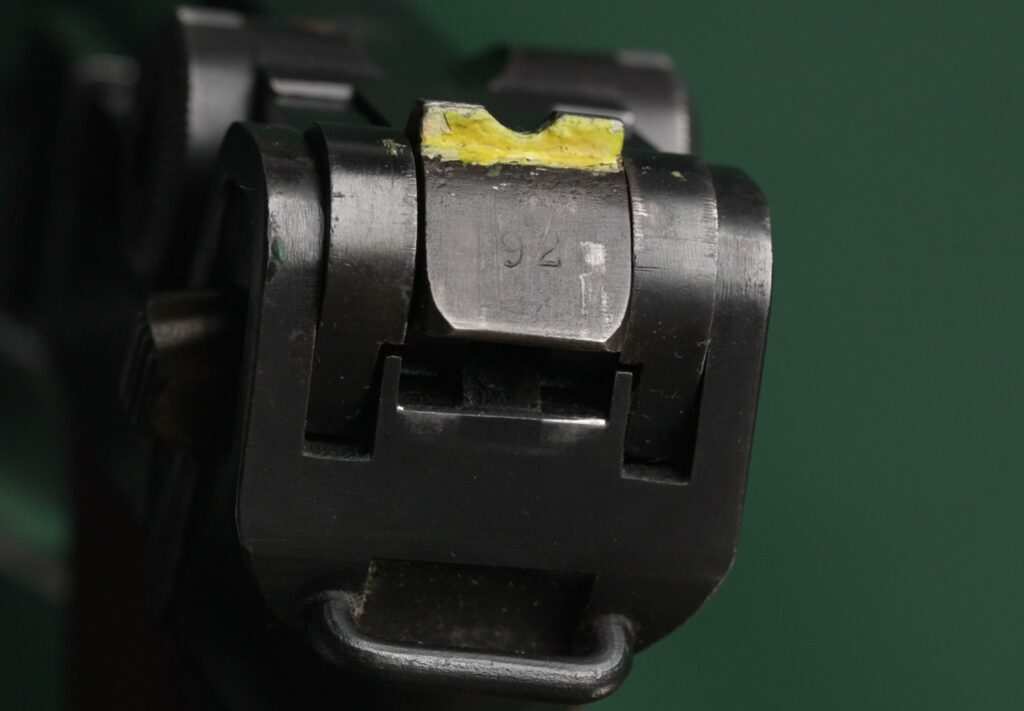
On a Luger, several small parts carry the last two digits of the serial number. This receiver is serial 8690, and the small parts we checked, including the side plate and the takedown lever, read 90.

The rear toggle link reads 92, the one numbered part we found that does not match. That fits a conversion: the link that had to change is the link that does not match. It does not tell us when the link was fitted or by whom. Together, the step and the link point to an artillery Luger rebuilt with a shorter barrel.
The Finnish barrel and front sight
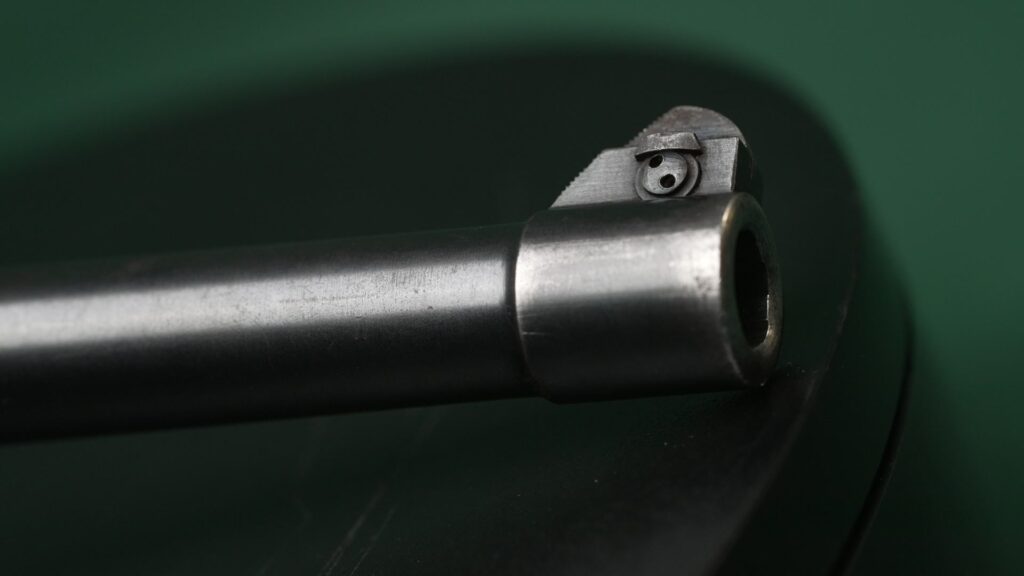
The barrel carries a T in a triangle inside a circle, the standard Tikkakoski mark. Tikkakoski was one of the Finnish makers of replacement Luger barrels. It is chambered in .30 Luger, the 7.65 mm Parabellum cartridge of Finland’s m/23 Lugers. We compared it with a standard Luger barrel, and it is slightly longer. Neither the replacement barrel nor the magazine carries a serial number.
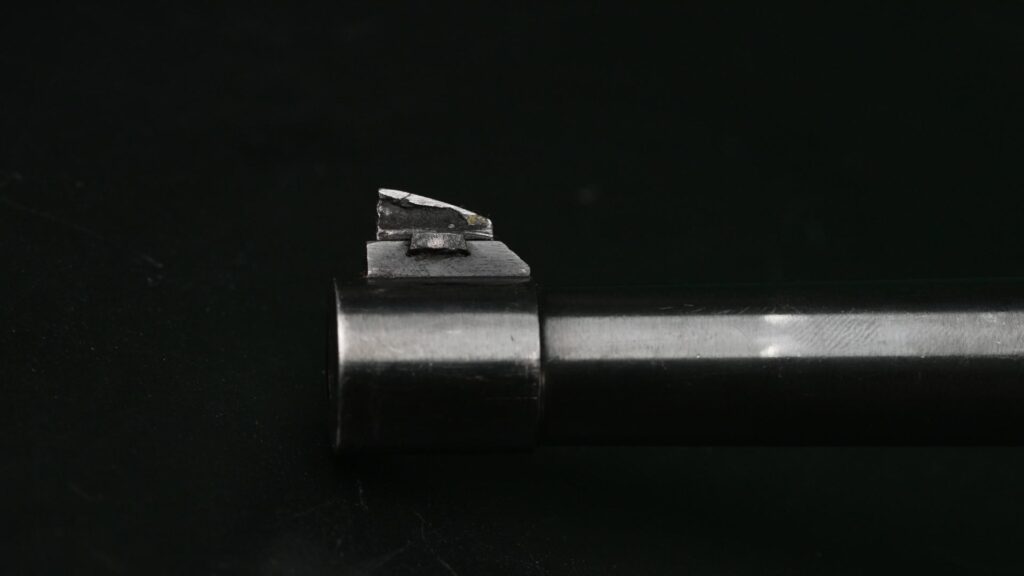
The front sights differ too. The Finnish barrel has a flatter-topped front sight than the LP08 we compared it with.
We think the yellow paint in the rear notch and the new front sight were added in Finland, but nothing on the gun dates them.

What the gun can’t tell us
The receiver says DWM, 1918, LP08. The barrel says Finland. What the metal does not say is when the conversion was done. Jaeger Platoon describes longer Tikkakoski barrels, bigger front sights and opened-up rear notches as typical later changes made by Finnish target shooters, during the end of military service or in civilian hands, so a conversion like this one could just as well be postwar. We read this gun from its parts, not from paperwork.
Condition
We have not fired this one ourselves. The bore is a mirror bore, and mechanically the pistol is in excellent order.
Specifications
| Item | Finnish artillery Luger, serial 8690 |
|---|---|
| Maker | DWM (Deutsche Waffen- und Munitionsfabriken) |
| Receiver date | 1918 |
| Original configuration | LP08 artillery Luger, 9x19mm, long barrel with tangent sight |
| Present configuration | Short-barreled pistol, Finnish replacement barrel |
| Caliber | .30 Luger (7.65x21mm Parabellum) |
| Barrel | Finnish replacement, standard Tikkakoski T mark, slightly longer than a standard Luger barrel, no serial number |
| Rear sight | Notch on the rear toggle link |
| Serial | 8690; small parts we checked numbered 90 |
| Non-matching part | Rear toggle link, numbered 92 |
| Action | Toggle-locked, short recoil, semi-automatic |
On the floor at OSA
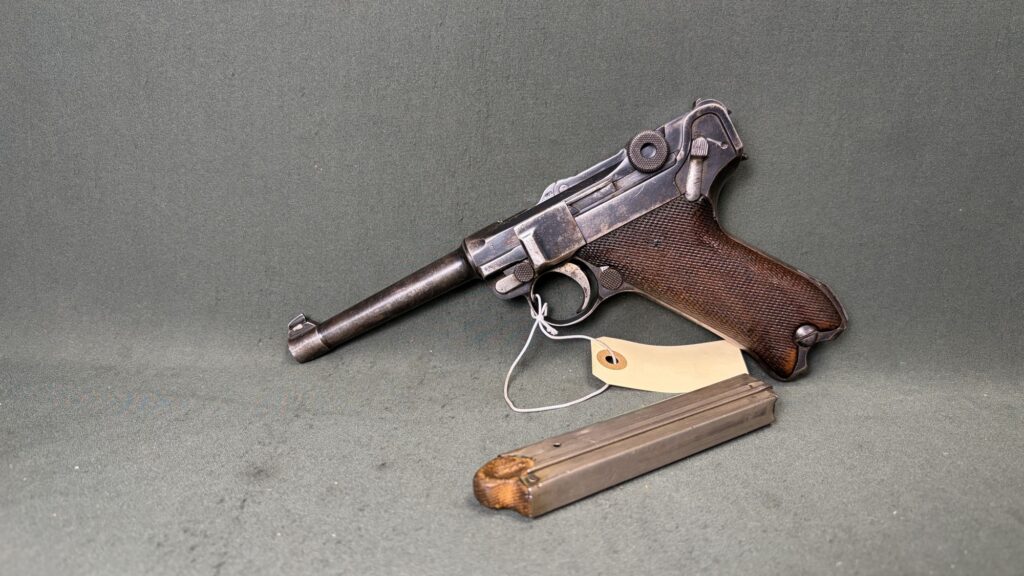
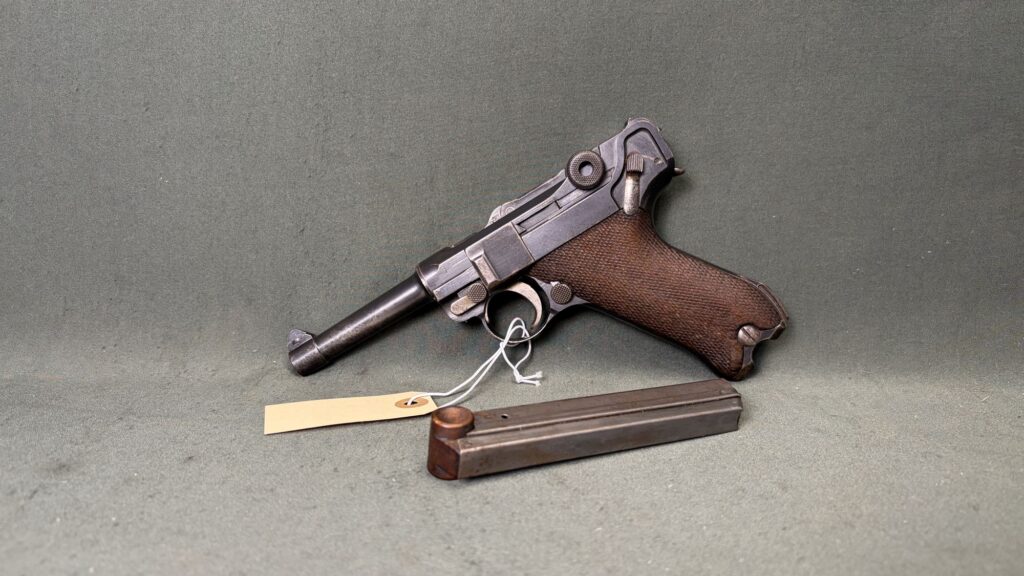
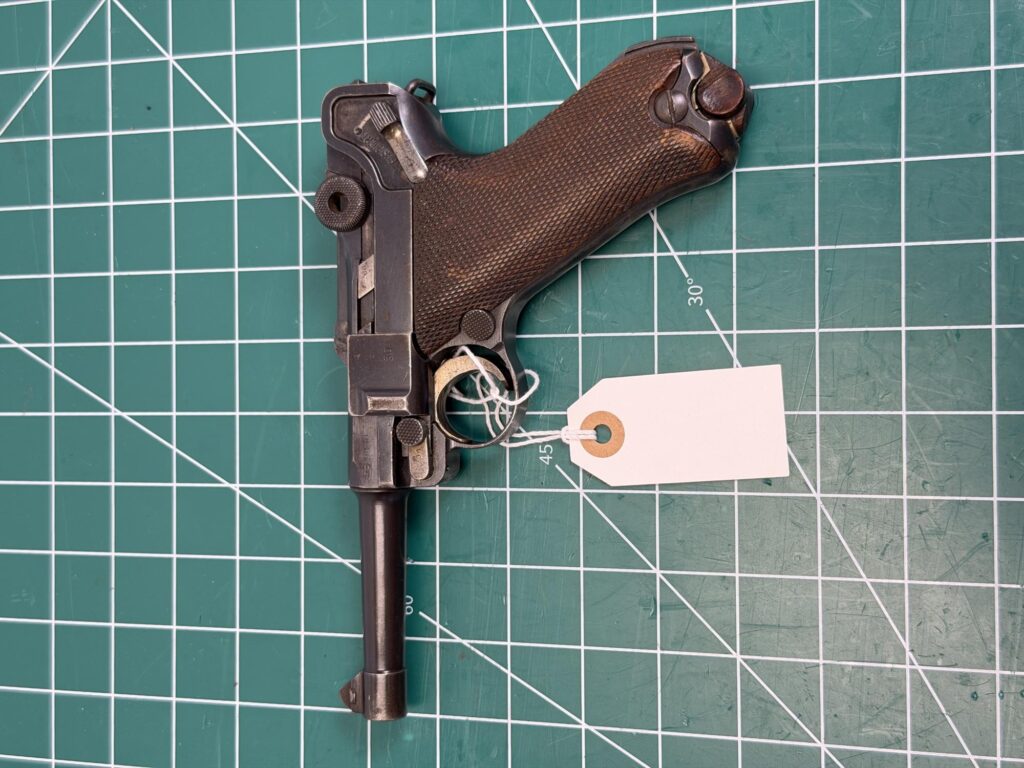
The pistol in this article is a shop gun, and it is with us for now: 1918 DWM Artillery Luger, converted to .30 Luger with a Finnish Tikka barrel. The 1916 LP08 in the comparison photos is a different gun and is not listed below.
Related pieces on the floor right now:
- DWM 1915 LP.08 Artillery Luger, 9mm: an intact long-barreled LP08 with its tangent sight, the configuration this gun started as.
- Finnish SA-marked Luger P08, 9mm, Tikka barrel: another Finnish service Luger with a Finnish replacement barrel.
- Late 1920s DWM Luger, .30 Luger, Finnish Tikka barrel: a later Finnish .30 Luger with all matching numbers.
- 1920s DWM Luger P08, serial 67, .30 Luger, Finnish service: a Finnish service pistol in the same caliber.
For how Luger markings work in general, see Luger P08 markings explained. Our Finnish Luger with SA and EK 59 marks is another Finnish gun we filmed. The grid below updates by itself as pieces come and go.
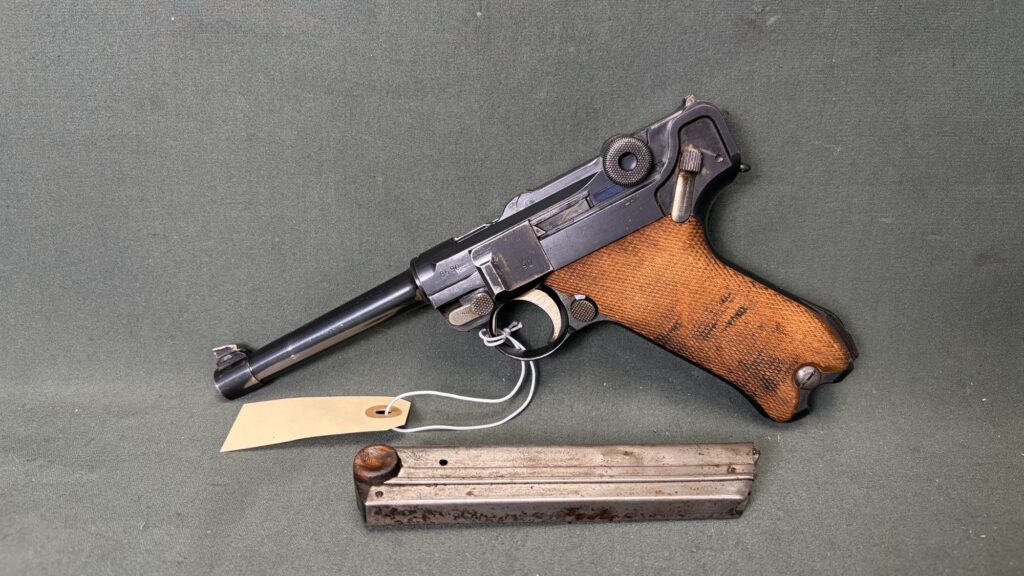 1918 DWM Artillery Luger Converted .30 Luger Finnish Service Tikka Barrel$1,475.00
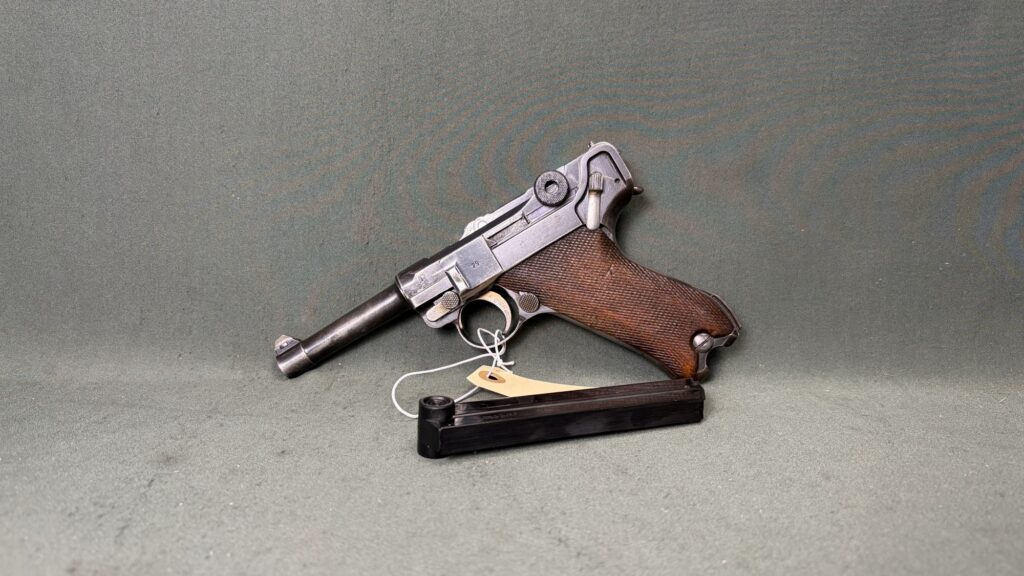 1929 Era Commercial Luger .30 Luger Finnish Service Mauser Banner Toggle$1,200.00
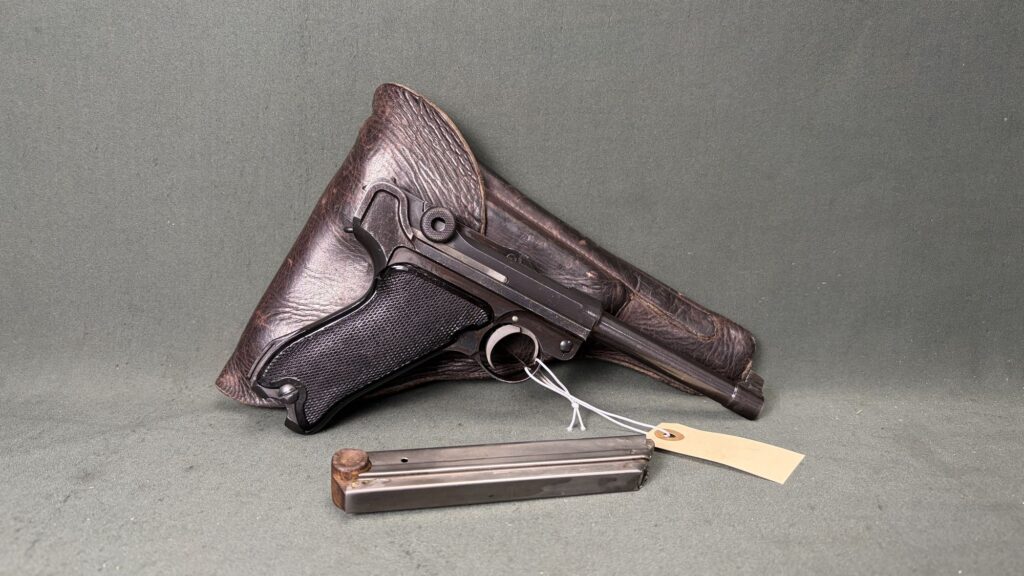 Finnish SA Marked Luger P08 9mm Tikka 4.75 in Barrel Bakelite Grips with Holster$1,725.00
 1920s DWM Commercial Luger .30 Luger 4.75 in Barrel Finnish Import Mirror Bore$1,175.00
 1920s DWM Luger P08 sn 67 .30 Luger Finnish Service All Matching Mirror Bore$1,467.00
 DWM commercial Luger P08 pistol$1,549.00
The short version is on our Instagram. Watch it on Instagram.
General information for collectors, not legal advice. Markings and parts history are read from this one pistol; other converted Lugers can differ.
Common Questions
What is an LP08 artillery Luger?
The LP08, or Lange Pistole 08, is the long-barreled 9mm Luger accepted by the German army in 1913, with a 200 mm barrel, a tangent rear sight on the barrel graduated to 800 meters, and a removable shoulder stock.How can you tell a Luger started out as an artillery Luger?
One clue is a small step on top of the receiver ring, just ahead of the date, cut to clear the LP08’s tangent sight. It is only a clue: Erfurt cut the same step into its 1916 to 1918 receivers for standard P08s too, so look for other evidence, such as a replaced rear toggle link on a short-barreled gun.Why does an LP08 rear toggle link have no sight notch?
The LP08 aims with the tangent sight on its long barrel, so its rear toggle link needs no notch. A converted LP08 with a short barrel needs a rear toggle link that has one.How many artillery Lugers did Finland get in 1918?
Waffenlager says Finland acquired about one hundred LP08s from Germany in 1918 for the Artillery School. Jaeger Platoon says at least one hundred came from Germany that year, and puts the total Finnish holding at roughly 100 to 200.What does the T in a triangle on a Finnish Luger barrel mean?
A T in a triangle inside a circle is the standard Tikkakoski mark. Tikkakoski was one of the Finnish companies that made replacement barrels for Lugers in Finnish service.What caliber is this rebuilt Finnish Luger?
The 1918 DWM pistol, serial 8690, now has a Finnish replacement barrel in .30 Luger, also called 7.65x21mm Parabellum. As an LP08 it was originally a 9x19mm pistol.Sources
- Waffenlager, “Lange Pistole 08” — https://waffenlager.net/en/handguns/lange_pistole_08.html (about 100 LP08 acquired by Finland in 1918 for the Artillery School, m/1914 name, 1913 acceptance, 200 mm vs 100 mm barrels, 9x19mm, eight-step sight to 800 m, removable stock, small parts numbered with the last two digits)
- Jaeger Platoon, “Finnish Army 1918–1945: Revolvers & Pistols Part 1” — https://www.jaegerplatoon.net/PISTOLS1.htm (at least 100 artillery Lugers from Germany in 1918, total 100–200, some with Jaegers; Tikkakoski and Sako replacement barrels; later target-shooter modifications)
- Forgotten Weapons, “The Luger in Finland” — https://www.forgottenweapons.com/the-luger-in-finland/ (m/23 in 7.65 mm; worn m/23s rebarreled to 9x19mm by Sako and Tikkakoski from the Winter War)
- Land of Borchardt, “LP08 holster” — https://www.landofborchardt.com/LP08_holster.html (receiver step cut to clear the LP08 tangent sight; Erfurt used the step on all 1916–1918 receivers)
- Wikimedia Commons, “Baltic Sea Division in Helsinki 1918” (public domain photo) — https://commons.wikimedia.org/wiki/File:Baltic_Sea_Division_in_Helsinki_1918.jpg (archival image)