Journal · Collector’s Guide
East German Sauer Shotguns: Two Engravers?
Both of these East German Sauer shotguns carry two lines on the barrel. The first reads VORM. SAUER-SUHL, “formerly Sauer, Suhl.” The line under it reads MADE IN GDR. Most collectors see the second line and keep walking. That’s their loss. We have two of these 12-gauge side-by-sides in the shop, one from 1972 and one from 1976. As far as I can tell they are the same model, with the same action, steel and walnut. The only real difference is the hand engraving, and once you start comparing the two, it is hard to stop.
From Sauer & Sohn to a state factory in Suhl
J. P. Sauer & Sohn is one of the oldest names in German gunmaking. According to the company’s Wikipedia history, Lorenz Sauer founded it in Suhl in 1751, and by 1938 it employed about 1,450 people. During the war the Suhl works built the Luftwaffe’s M30 three-barrel drilling, the survival gun we covered in our M30 Luftwaffe drilling guide.
In 1945 Suhl ended up in the Soviet zone. The same Wikipedia history says the company’s assets were confiscated without compensation and most of its machinery was dismantled and shipped east. What remained was renamed VEB Fortuna. The Sauer name started over in the West: in 1951 Rolf-Dietrich Sauer set up a new J. P. Sauer & Sohn in West Germany, first in Düsseldorf and then in Eckernförde, and experienced workers from Suhl joined it.
Back in Suhl, the state kept merging the old names. Wikipedia describes Fortuna (the former Sauer works) being combined with the former Haenel works, Merkel and others in the early 1950s, and all of them finally merging into VEB Fahrzeug- und Jagdwaffenwerk “Ernst Thälmann” in 1968. The Jagdfibel reference on East German hunting arms lists Fortuna, Haenel and Merkel as production divisions of the Ernst-Thälmann-Werk founded in 1953. Either way, by the time our two guns were built, Sauer’s old Suhl works was part of one big state enterprise.
Sporting guns from Suhl went West to bring in hard currency. Wikipedia says the old trademarks were still used on exports until 1970. Our two guns are dated 1972 and 1976 and still carry the VORM. SAUER stamp. The sources we checked do not explain that gap, and VORM. SAUER-SUHL is not quite the same wording as the old “Sauer & Sohn” trademark. If you know how long the VORM. stamp stayed in use, we would like to hear from you.

How to read East German Sauer shotgun markings
Start with the barrels. On these two guns, one barrel carries the maker line, VORM. SAUER-SUHL, with MADE IN GDR directly under it. “Vorm.” is short for vormals, German for “formerly.” The other barrel carries a steel marking, SPEZIAL-GEWEHRLAUFSTAHL (“special gun-barrel steel”). On one of the two, the stamp is actually struck SPECIAL-GEWEHRLAUFSTAHL, with a C.
Both guns also carry an importer’s mark, PRI.
A few quick checks if you find one of these yourself:
- The maker line. VORM. SAUER-SUHL plus MADE IN GDR means an East German state-era gun from Suhl, not a pre-war J. P. Sauer & Sohn and not a gun from the West German company.
- The action. These are boxlocks with a top lever and double triggers.
- The finish. The receivers are color case hardened and hand engraved; the top rib is file-cut.
- The wood. Checkered walnut with a pistol grip and a cheekpiece on the buttstock.

Five places the engraving splits
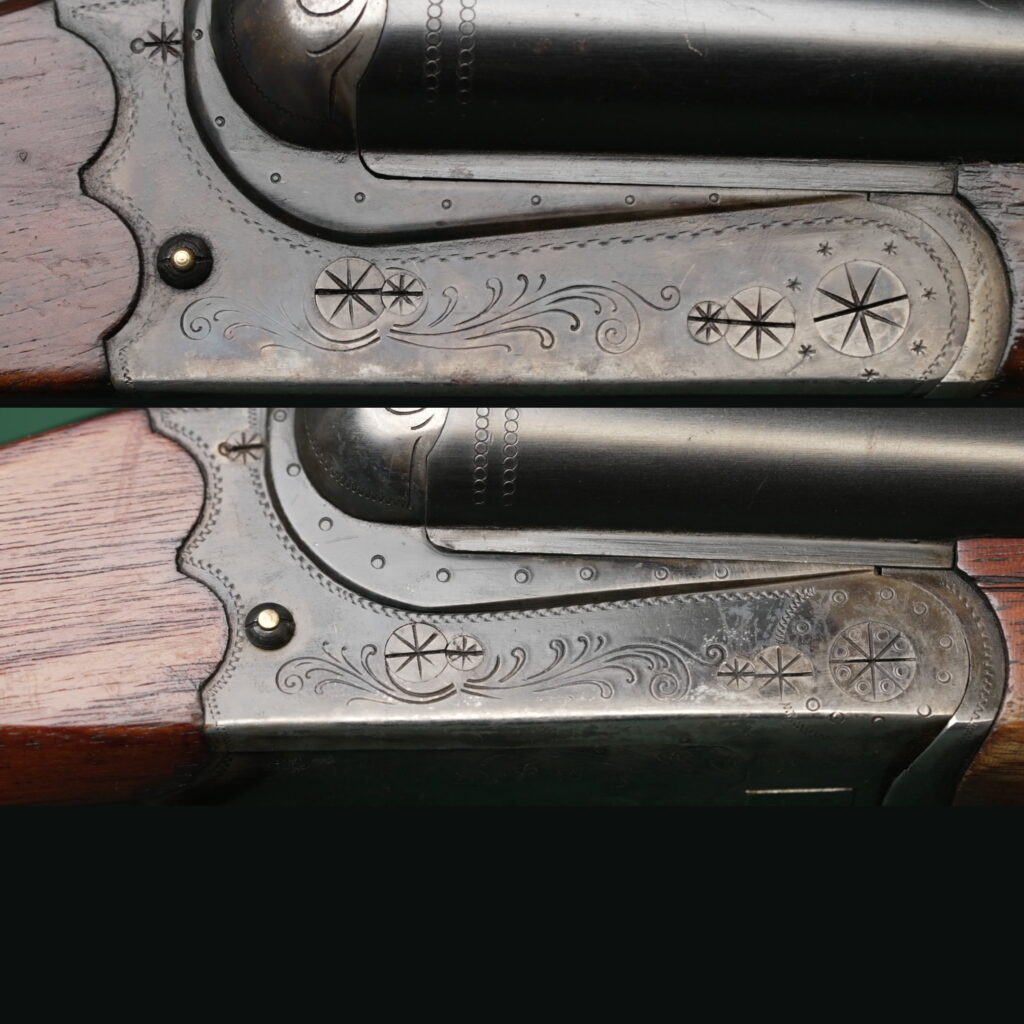
This is the part the video is built around. The overall layout of the engraving is close on both guns. The details are not. Here is what to look for, with the 1972 gun on top and the 1976 gun underneath in each comparison.
1. The big star on top of the action. Where the top lever pivots, each gun has a big star cut into the round boss. On the ’72 it is ringed with little stars. On the ’76 it is ringed with dots.

2. The underside. Flip the guns over and there is a smaller star on the bottom of the action. On the ’72 it sits in a ring of curls. On the ’76 it is little circles all the way around.
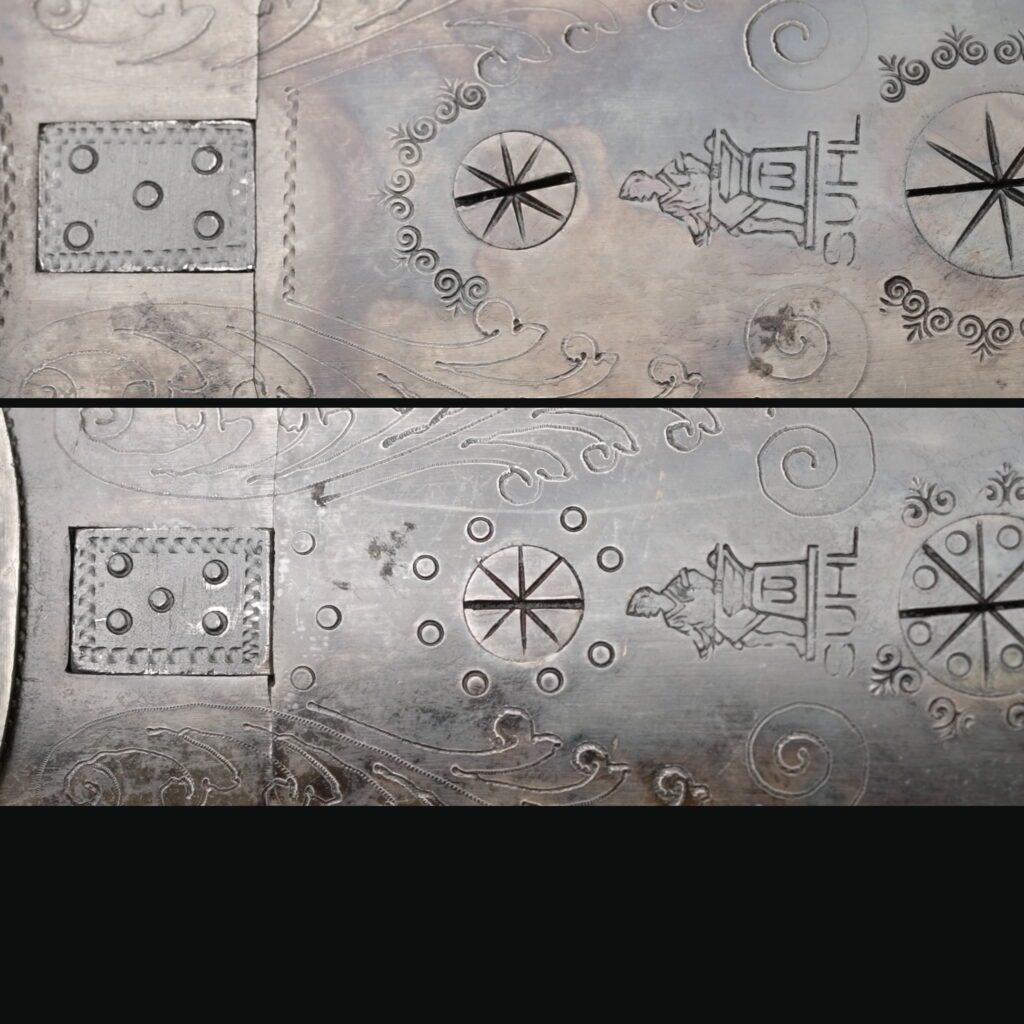
3. The forend iron. On the underside of the forend there is a steel plate around the release. The ’72 has a single wavy line cut along it. The ’76 has ovals and diamonds.

4. The side of the action. On the side, the pattern from the top comes back: a big star with little stars on the ’72, a star ringed with dots on the ’76.
5. The trigger guards. Both trigger guards carry a scroll, but the scrolls start and stop in different spots.
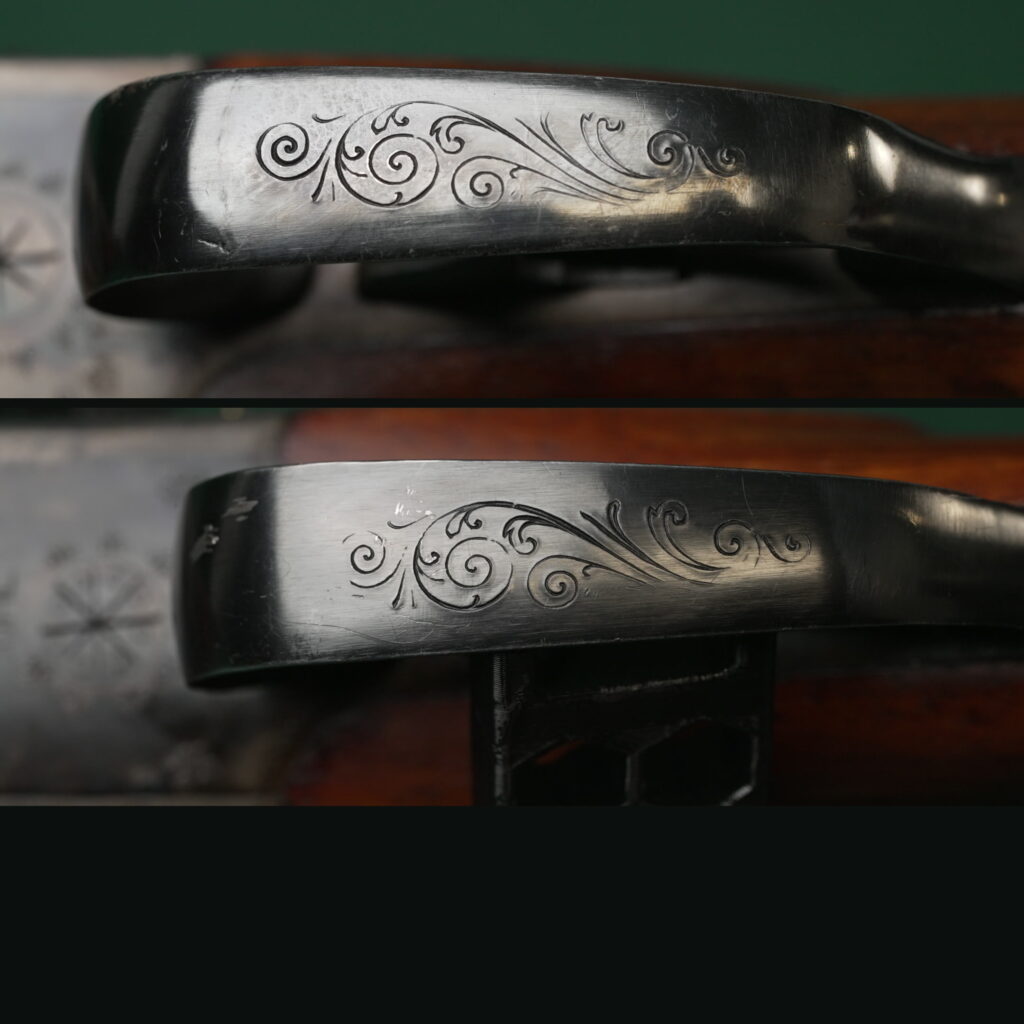
The way I read it, that’s two different engravers, each with their own habits: one reaching for little stars and curls, the other for dots and circles. It is my judgment, not a factory record. If you have seen either of these patterns on another Suhl gun, we would like to hear about it.

What they are like in the hand
These are not wall hangers. I’ve handled both: they are well balanced, and they open very smoothly.
A 12-gauge double like this is still a great bird gun, and a solid home-defense gun. As with any older shotgun, have it checked by a qualified gunsmith before you shoot it.

Specifications
| Item | East German Sauer side-by-side pair |
|---|---|
| Marking | VORM. SAUER-SUHL / MADE IN GDR |
| Made in | Suhl, East Germany |
| Years | 1972 and 1976 |
| Gauge | 12 |
| Action | Boxlock, side-by-side, top lever |
| Triggers | Double |
| Receiver | Color case hardened, hand engraved |
| Top rib | File-cut |
| Stock | Checkered walnut, pistol grip, cheekpiece |
| Importer’s mark | PRI |
On the floor at OSA
Both guns in this article are shop pieces, not part of our own collection. Here they are, along with a few relatives from the same town:
- The 1972 East German Vorm. Sauer Suhl side-by-side: the gun with little stars and curls.
- The 1976 East German Vorm. Sauer Suhl side-by-side: the gun with dots and circles.
- A 1985 East German Suhl side-by-side 12 gauge: a later East German boxlock double from Suhl.
- An East German Vorm. Sauer Suhl over/under 12 gauge: the same Vorm. Sauer name on a stacked-barrel gun.
- A J. P. Sauer & Sohn Suhl side-by-side 12 gauge: a gun under the name the VORM. stamp refers back to.
The grid below updates by itself as pieces come and go.
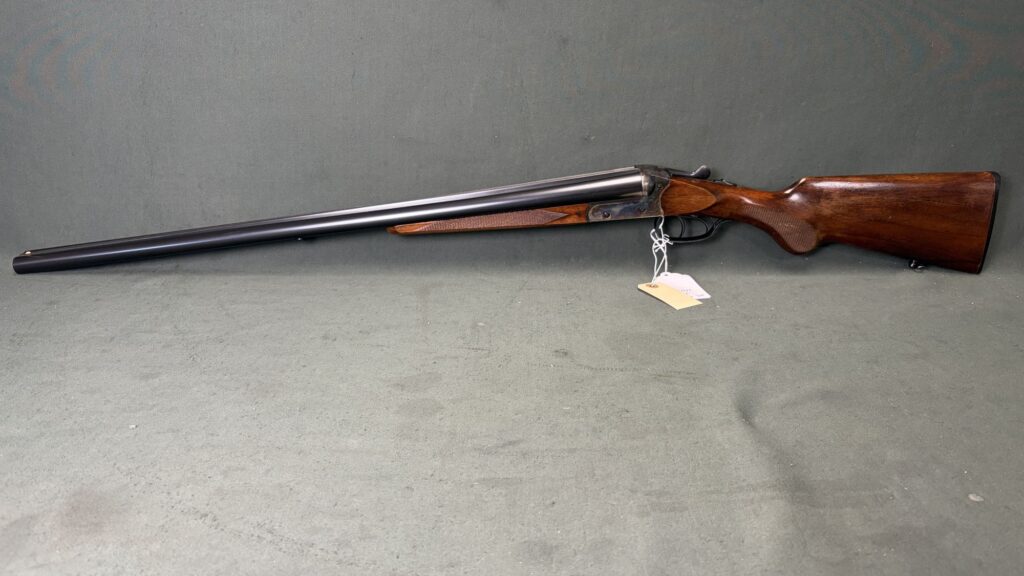 1985 East German Suhl SxS 12 Gauge Boxlock Shotgun Color Case Hardened$645.00
 1976 East German Vorm. Sauer Suhl SxS 12 Gauge Engraved Color Case Hardened$875.00
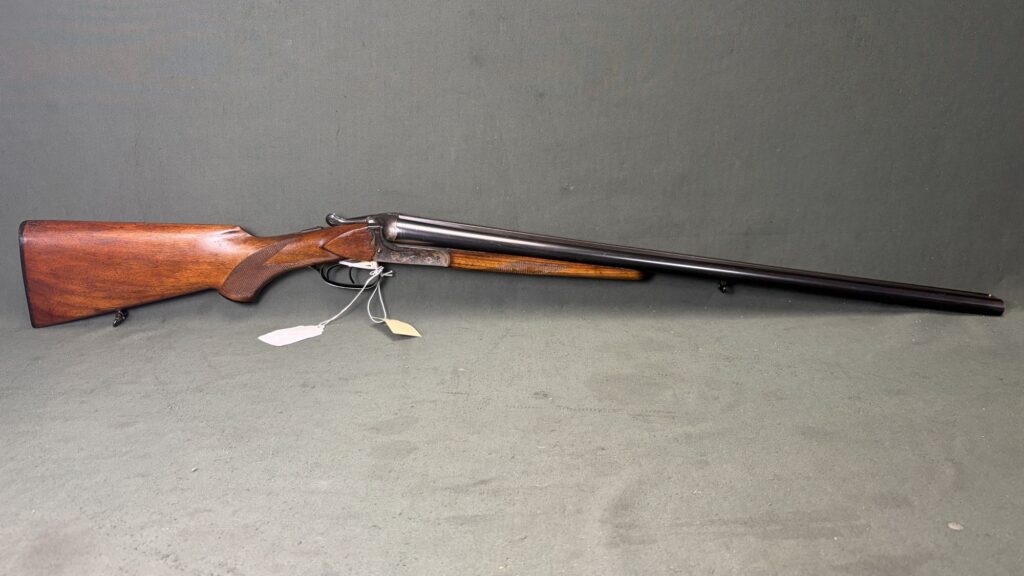 1972 East German Vorm. Sauer Suhl SxS 12 Gauge Engraved Color Case Hardened$850.00
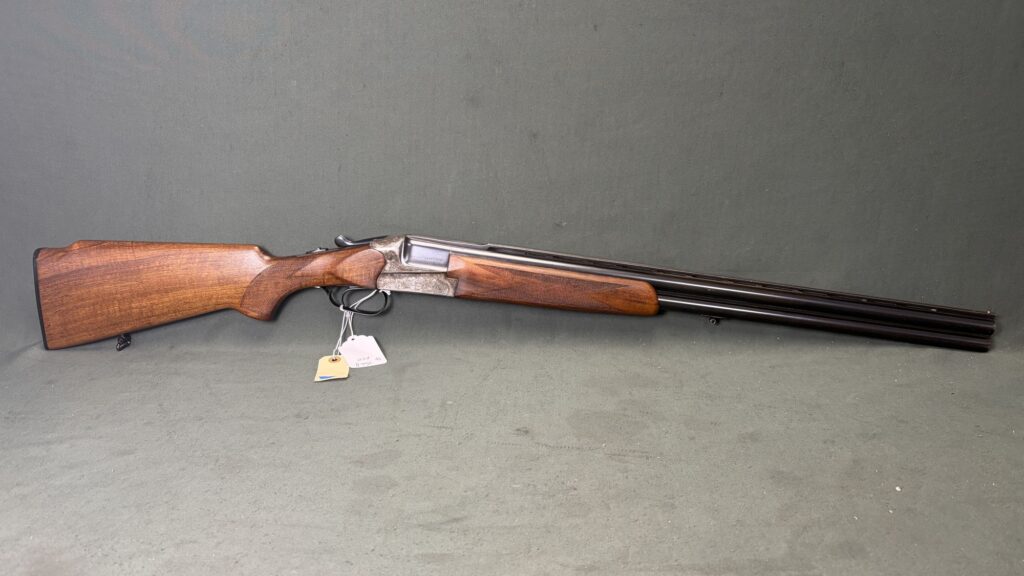 Suhl Vorm. Sauer Over Under 12 Gauge Shotgun Engraved Bright Bores Tight Action$800.00
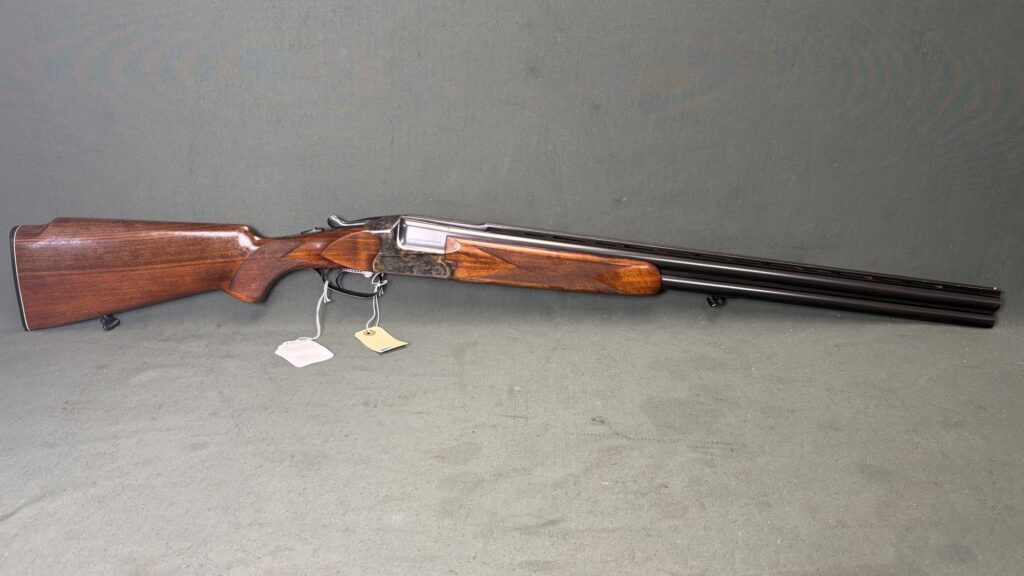 East German Vorm. Sauer Suhl Over Under 12 Gauge Case Colored Engraved Shotgun$925.00
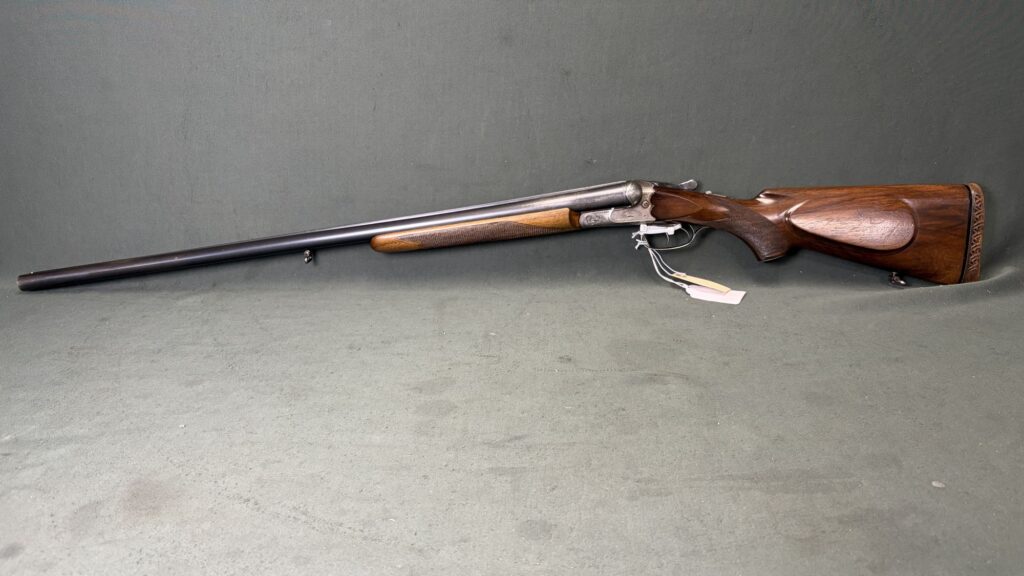 J.P. Sauer & Sohn Suhl Side by Side 12 Gauge Krupp Barrels Engraved Boxlock$1,150.00
The short version is on our Instagram. Watch it on Instagram.
General information for collectors, not legal advice. Markings can vary from gun to gun.
Common Questions
What does "VORM. SAUER" mean on an East German shotgun?
“Vorm.” is short for the German *vormals*, “formerly.” VORM. SAUER-SUHL marks a gun made in Suhl in East Germany after the old Sauer works there had become state property.Is an East German Sauer the same as a West German J. P. Sauer & Sohn shotgun?
No. After 1945 the Suhl works was nationalized in East Germany, while a separate J. P. Sauer & Sohn was set up in West Germany in 1951 and later based in Eckernförde.Who made East German shotguns in Suhl?
The old Sauer, Haenel and Merkel works were merged step by step into state enterprises, and in 1968 into VEB Fahrzeug- und Jagdwaffenwerk “Ernst Thälmann.”Why were East German shotguns exported to the West?
Sporting guns from Suhl were exported to the West to bring in hard currency for East Germany.Is the engraving on the 1972 and 1976 VORM. SAUER-SUHL shotguns done by hand?
Yes, the engraving on both guns is hand work, and the patterns differ in five places even though the model is the same.Is an East German side-by-side 12 gauge still a usable gun?
Yes. A sound 12-gauge double like these is a good bird gun and a solid home-defense gun; have any old shotgun checked by a qualified gunsmith before shooting it.Sources
- Wikipedia, “Sauer & Sohn” — https://en.wikipedia.org/wiki/Sauer_%26_Sohn (founding in 1751, 1938 workforce, 1945 confiscation and dismantling, VEB Fortuna, early-1950s mergers, 1968 Fahrzeug- und Jagdwaffenwerk, 1951 West German company in Düsseldorf then Eckernförde, old trademarks on exports until 1970)
- Jagdfibel, “VEB Fahrzeug- und Jagdwaffenwerk Ernst Thälmann” — https://jagdfibel.de/index.php/VEB_Fahrzeug-_und_Jagdwaffenwerk_%22Ernst_Th%C3%A4lmann%22 (Fortuna, Haenel and Merkel as production divisions of the 1953 Ernst-Thälmann-Werk)
- Old Steel Arsenal, “M30 Luftwaffe Drilling: The Three-Barrel Survival Gun” — /luftwaffe-m30-drilling/ (M30 built by Sauer in Suhl)