
Journal · Collector’s Guide
Thompson M1A1 vs M3A1 Grease Gun: We Counted the Shots
Thompson vs Grease Gun: we fired our M1A1 Thompson and our M3A1 Grease Gun on the same day and timed every shot on a field recorder. Our Tommy gun ran at about 800 rounds a minute. Our Grease Gun ran at about 400, roughly half. Below is how two very different answers to the same Army problem compare, what we measured, and how each one felt to shoot.
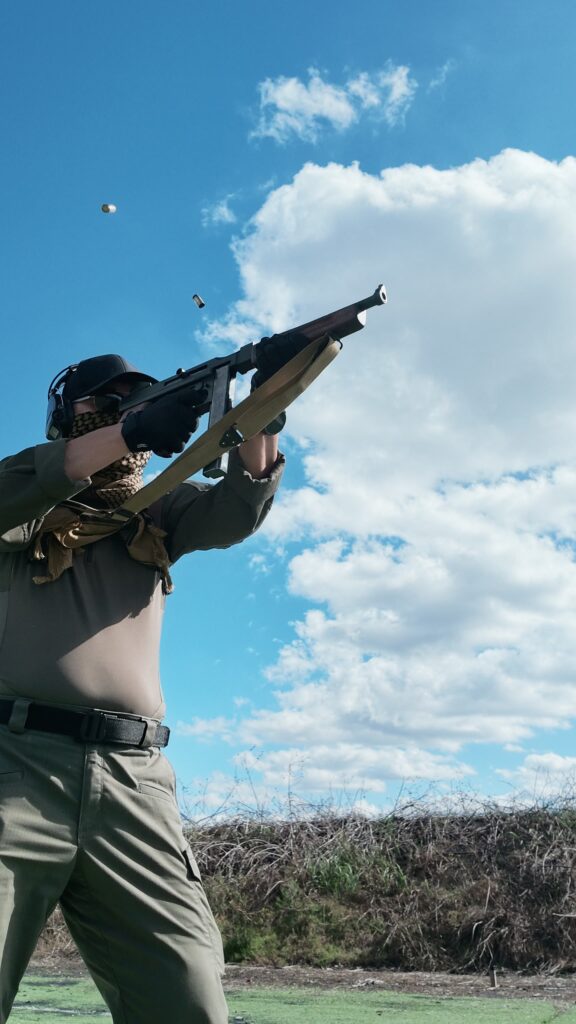
Why the Army wanted something simpler than the Thompson
By 1942 the U.S. Army needed submachine guns in numbers, and the Thompson was slow to make. Even after Savage and Auto-Ordnance stripped the design down into the M1 (adopted on April 24, 1942) and then the M1A1, with a fixed firing pin machined into the bolt face, it was still a gun built from machined steel and walnut.
The answer was the M3. It was recommended for adoption in December 1942 and formally approved in January 1943, and the production contract went to the Guide Lamp Division of General Motors in Anderson, Indiana, a plant that made car headlights and knew sheet-metal stamping. The first guns came off the line in May 1943. The Army’s requirement called for a heavy bolt to keep the cyclic rate under 500 rounds a minute, so the gun would stay controllable on full auto. The receiver is two stamped steel halves welded together, the stock is a bent steel wire, and soldiers said it looked like a mechanic’s grease gun. The name stuck. Guide Lamp built roughly 606,000 of the original M3.
If you want more Thompson history, we have written about the Shanxi Thompson from 1927 and a pair of Colt Thompsons one serial number apart.
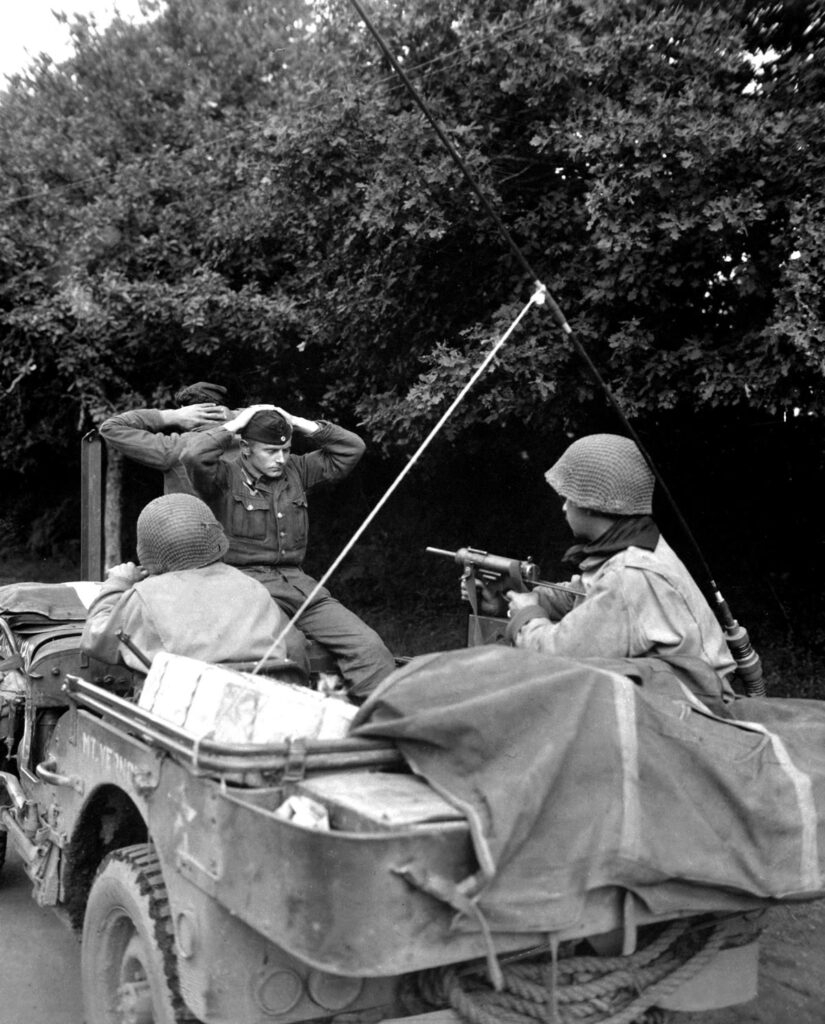
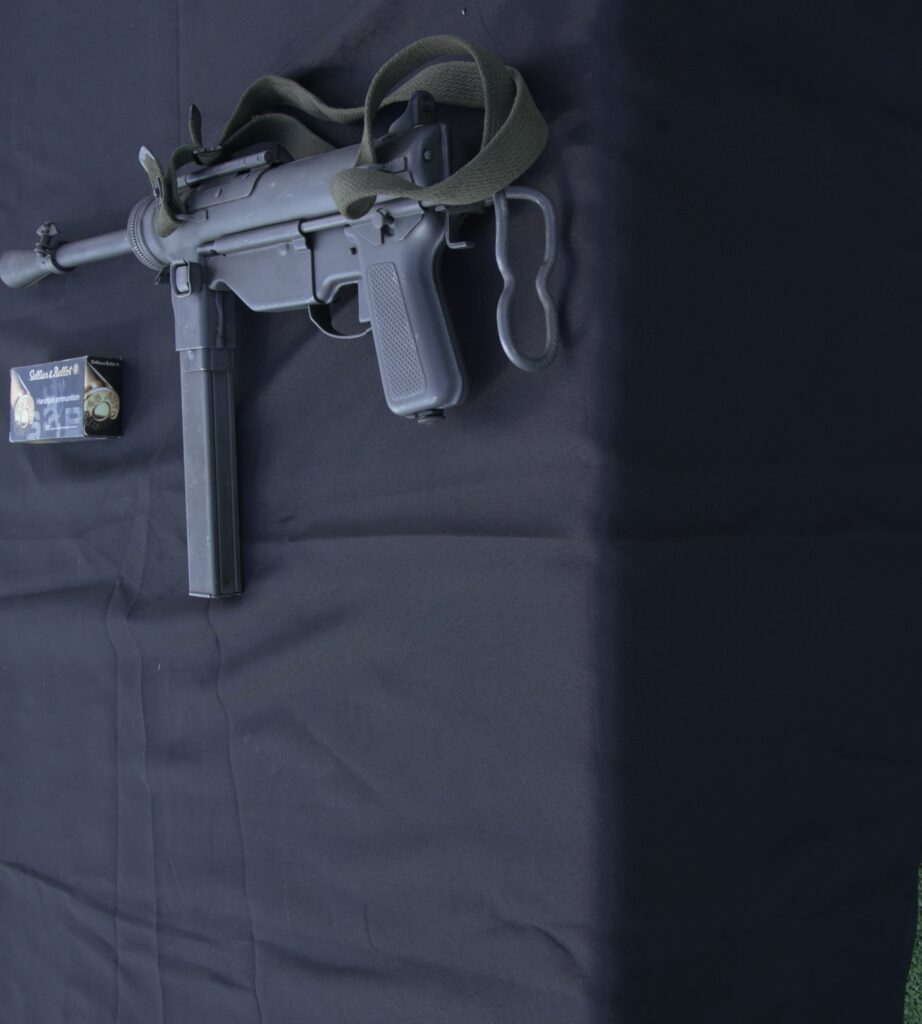
How to tell the M3A1 from the M3
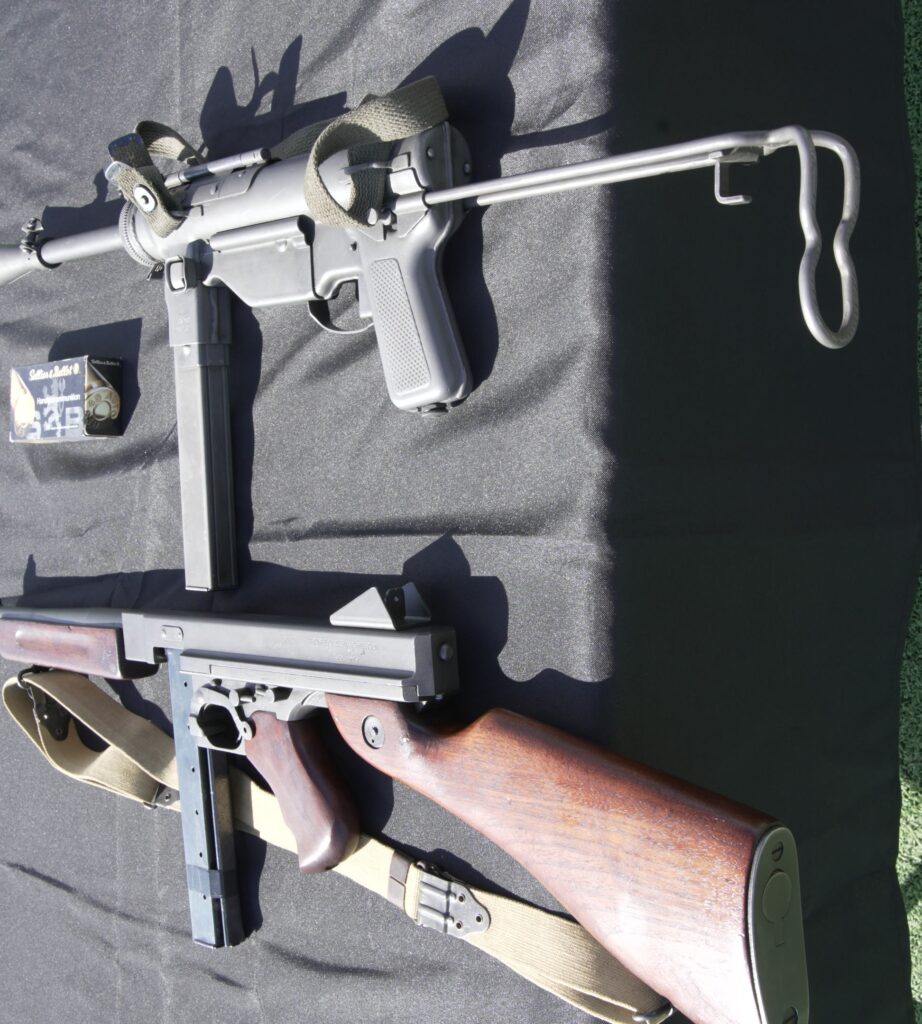
The original M3 has a crank-style cocking handle on the right side of the receiver. In training it gave trouble, and the late-war fix was the M3A1, approved on December 21, 1944. The M3A1 drops the crank entirely: you put a finger into a hole in the bolt and pull it back. To make room, the ejection port and its hinged cover got bigger. No crank on the right side is the first clue, not proof: a missing or removed crank does not make an M3 into an M3A1, so check for the finger hole in the bolt, the larger ejection port and the receiver markings. Ours is the later model.
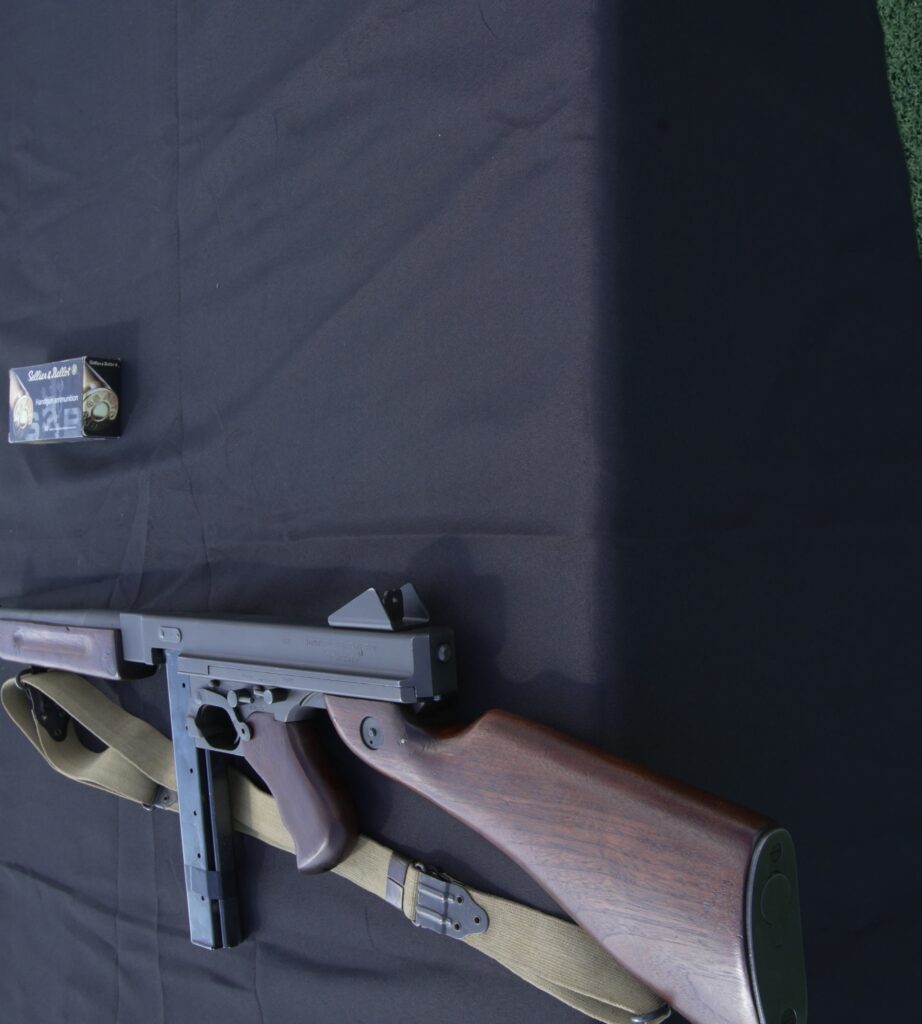
How the M1A1 differs from the 1928 Thompson
The M1 and M1A1 Thompsons are the wartime, simplified guns. They have no finned barrel, no Cutts compensator, a simple fixed rear sight, a cocking knob on the right side instead of the top, and they take stick magazines only. The drum magazine you see in gangster films belongs to the earlier 1921 and 1928 pattern guns. The M1A1 adds the fixed firing pin on the bolt face, which let the factories drop the separate hammer and firing pin parts. That change is inside the bolt, so from the outside an M1 and an M1A1 look almost the same; the receiver marking is the place to check.
Rate of fire: what we measured
Both guns fire the same .45 ACP round, and both fire from an open bolt. The difference is speed.
We recorded every string on a Zoom F3 field recorder at the firing line, marked the onset of each shot in the waveform, and divided the time from the first shot to the last by the number of gaps between them (one fewer than the round count). On the Grease Gun every shot is followed about 46 ms later by a smaller echo peak; we did not count those as shots.
| String | Rounds | Average gap between shots | Rate it works out to |
|---|---|---|---|
| Our Thompson, string 1 | 15 | 72.2 ms | about 830 rounds a minute |
| Our Thompson, string 2 | 18 | 72.5 ms | about 830 rounds a minute |
| Our Thompson, string 3 | 20 | 78.5 ms | about 765 rounds a minute |
| Our Thompson, string 4 | 20 | 77.2 ms | about 775 rounds a minute |
| Our Grease Gun, string 1 | 25 | 144.4 ms | about 415 rounds a minute |
| Our Grease Gun, string 2 | 19 | 147.0 ms | about 410 rounds a minute |
“Rounds a minute” here is the cyclic rate, the speed the gun would run if it never stopped. Nobody fires a full minute.
Both numbers sit inside the published figures. Forgotten Weapons cites a period source giving 700 to 800 rounds a minute for the M1A1, and American Rifleman gives about 700 to 800 for the M1. A 1942 Aberdeen test reported in Small Arms Review averaged 775 for a standard M1 and found the M1A1 fixed-firing-pin bolt about 60 rounds a minute slower; later testing in the same article ran from the low 740s to the 990s depending on ammunition. For the Grease Gun, the references we checked range from about 350 to 450. Springs, ammunition and wear all move these numbers, so treat ours as what these two guns did on one day.
The useful part for anyone watching range footage: you can hear the difference. A Thompson burst is a fast roll. A Grease Gun is slow enough that you can almost count the shots.
What they felt like
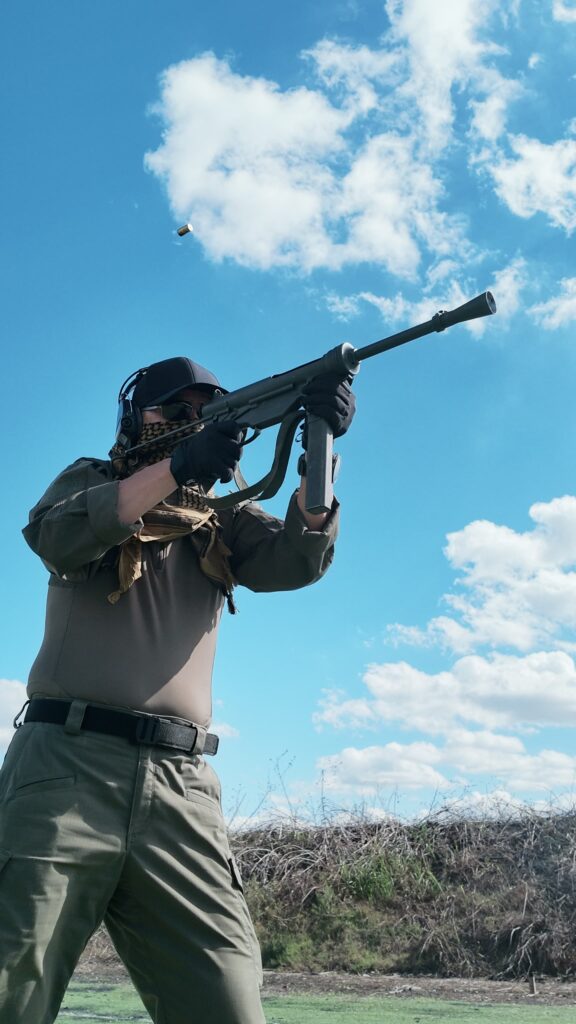
This is how it felt from behind the guns. The first Thompson burst caught me off balance. The Grease Gun felt much easier to control, and I put that down to the slower rate. Later that day I settled in with the Tommy gun and ran it steadier, but I would still pick the Grease Gun.
How long the Grease Gun lasted
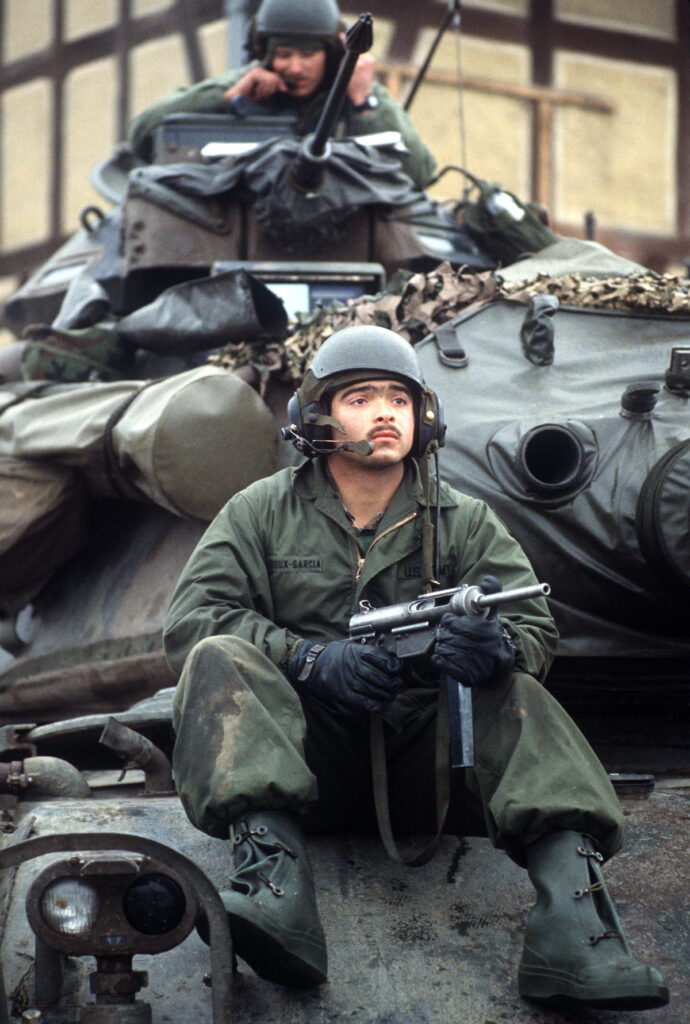
The Grease Gun stayed in service long after World War II as a compact weapon for vehicle crews. According to Wikipedia, it was still issued as equipment aboard armored vehicles, the M60 tank among them, until at least the 1991 Gulf War. The photo below is from 1985: a tanker in West Germany with an M3A1 on his M60A3.
Specifications
| Item | Thompson M1A1 | M3A1 Grease Gun |
|---|---|---|
| Cartridge | .45 ACP | .45 ACP |
| Action | Open bolt, blowback | Open bolt, blowback |
| Construction | Machined steel, walnut stock | Stamped and welded steel, wire stock |
| Cocking | Knob on the right side | Finger hole in the bolt |
| Magazine | Stick magazine | Stick magazine |
| Published rate | About 700 to 800 rounds a minute | About 350 to 450 rounds a minute |
| Our measured rate | About 765 to 830 rounds a minute | About 410 to 415 rounds a minute |
| Adopted | M1 April 1942, M1A1 late 1942 | M3 December 1942 (approved January 1943), M3A1 December 1944 |
On the floor at OSA
Both guns in this article are part of our own collection. They stay with us.
If the World War II .45 story is your thing, these pieces in our case are close relatives:
- Auto-Ordnance 1911A1 .45 ACP: Auto-Ordnance is the company name on the Thompson, and this is its take on the GI .45 pistol.
- Inland M1 Carbine with M1A1 paratrooper stock: another General Motors division, another World War II U.S. Army arm.
- 1942 Kongsberg M/1914 .45 ACP: the same .45 ACP cartridge in a Norwegian-built 1911 pattern pistol from the same war.
- 1917 Webley Mark VI .45 ACP conversion: a British service revolver converted to the American .45 round.
For another odd submachine gun from our collection, see the Hotchkiss Type Universal.
The grid below updates by itself as pieces come and go.
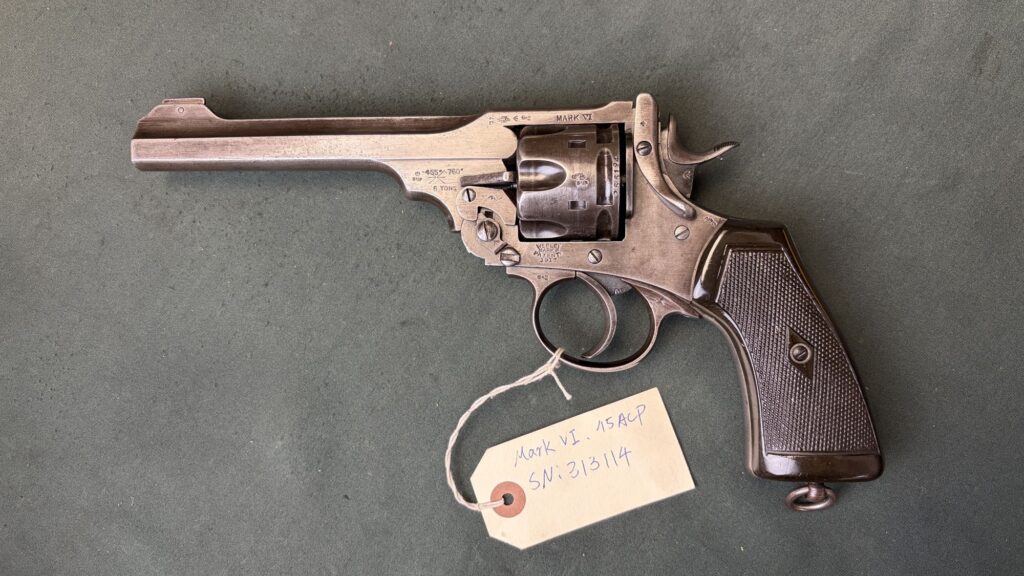 1917 Webley Mark VI Revolver .45 ACP Conversion British WWI Service Revolver$849.00
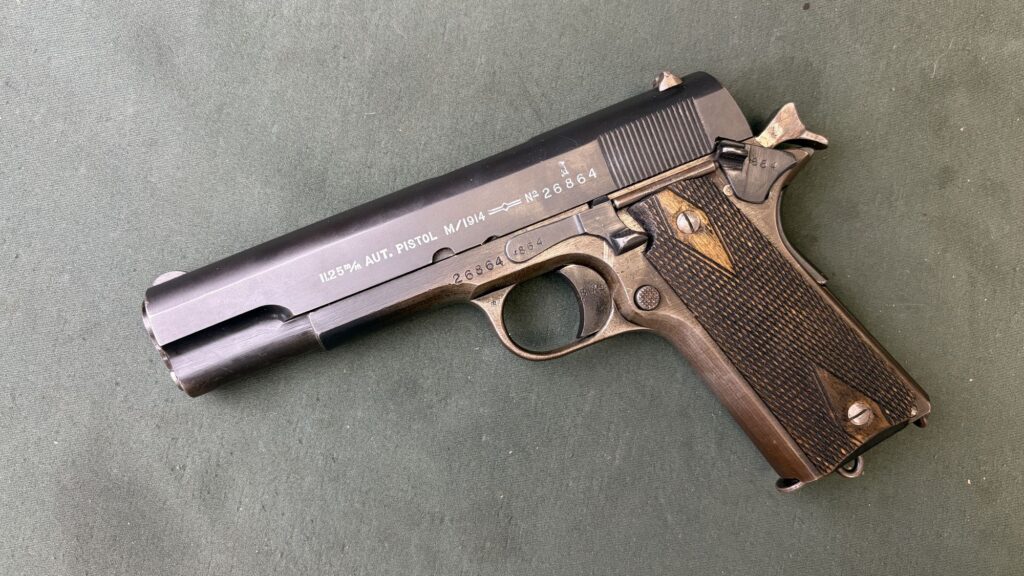 Black Friday1942 Kongsberg M/1914 .45 ACP Matching with Signed Factory Archive Letter Original price was: $4,950.00.$4,450.00Current price is: $4,450.00.
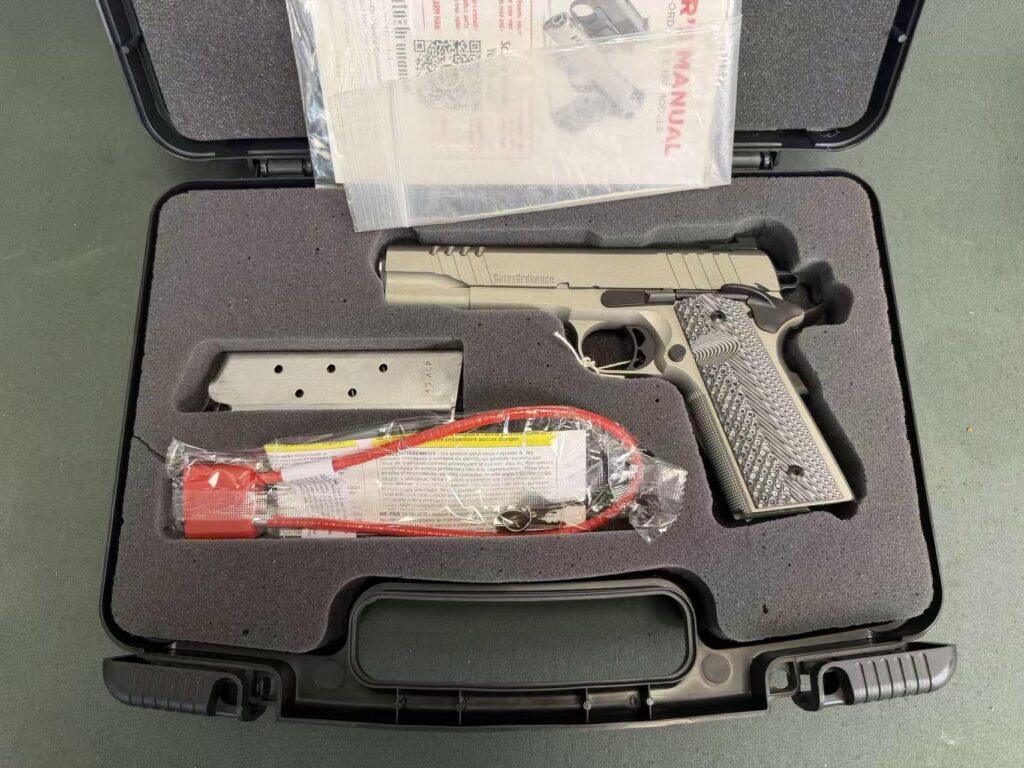 Black FridayAuto-Ordnance 1911TCAC6 .45 ACP Stainless Cerakote TruGlo Night Sights Original price was: $649.00.$639.00Current price is: $639.00.
The short version, with both guns firing, is on our Instagram. Watch it on Instagram.
General information for collectors, not legal advice. Both guns shown are registered machine guns under federal law; rates of fire are from our own recording on one day.
Common Questions
What is the rate of fire of the M3 Grease Gun?
The references we checked range from about 350 to 450 rounds a minute; the design requirement was under 500. Our M3A1 measured about 410 to 415 rounds a minute on our recorder.What is the rate of fire of the M1A1 Thompson?
Published figures are about 700 to 800 rounds a minute. Our M1A1 measured about 765 to 830 rounds a minute on our recorder.Why is it called the Grease Gun?
Soldiers said its stubby stamped-steel shape looked like a mechanic’s grease gun, and the nickname stuck.Who made the M3 Grease Gun?
The Guide Lamp Division of General Motors in Anderson, Indiana, a plant that made car headlights, built the M3 starting in 1943.How do you tell an M3A1 from an M3?
The M3 has a crank cocking handle on the right side. The M3A1 has no crank; you cock it with a finger in a hole in the bolt, and its ejection port is larger. Check the markings too, since a crank can be removed.Do the Thompson and the Grease Gun use the same ammunition?
Yes. Both fire the .45 ACP cartridge.Sources
- American Rifleman, “The M3 & M3A1 ‘Grease Guns’” — https://www.americanrifleman.org/articles/2016/5/20/the-m3-and-m3a1-grease-guns (M3 recommended December 1942, approved January 11, 1943; M3A1 changes, finger hole, larger ejection port)
- Small Arms Review (Frank Iannamico), M3 history — https://smallarmsreview.com/?p=134 (Guide Lamp contract, first guns May 1943, M3 production 606,694, M3A1 approval December 21, 1944, 350–400 rpm)
- The American Automobile Industry in World War Two, Guide Lamp — https://www.usautoindustryworldwartwo.com/General%20Motors/guidelamp.htm (Guide Lamp in Anderson, Indiana; sheet-metal stamping)
- American Rifleman, “The G.I. Thompson In World War II” — https://www.americanrifleman.org/articles/2019/2/20/the-gi-thompson-in-world-war-ii (M1 adopted April 24, 1942; M1A1 features)
- Small Arms Review (Frank Iannamico), M1/M1A1 Thompson — https://smallarmsreview.com/?p=3164 (fixed firing pin bolt; 1942 Aberdeen test, M1 775 rpm, M1A1 bolt about 61 rpm slower; later tests 742–993 rpm)
- Forgotten Weapons, “The Iconic American WW2 Thompson: the M1A1” — https://www.forgottenweapons.com/the-iconic-american-ww2-thompson-the-m1a1/ (M1A1 simplifications, stick magazines only; period figure 700–800 rpm for the M1A1)
- Wikipedia, “M3 submachine gun” — https://en.wikipedia.org/wiki/M3_submachine_gun (design requirement under 500 rpm with a heavy bolt; 450 rpm nominal; armored crews into 1991)
- NARA 531358, Battle of Brittany, 28 August 1944 — https://commons.wikimedia.org/wiki/File:Battle_of_Brittany_-_Lorient_01.jpg (France 1944 photo)
- NARA 6390253, REFORGER ’85, 22 January 1985 — https://commons.wikimedia.org/wiki/File:A_soldier_guards_his_tank_during_REFORGER_85_DF-ST-85-13234.jpg (West Germany 1985 photo, M3A1 and M60A3)