
Journal · Collector’s Guide
Shanxi Thompson: China’s 1927 Taiyuan Tommy Gun
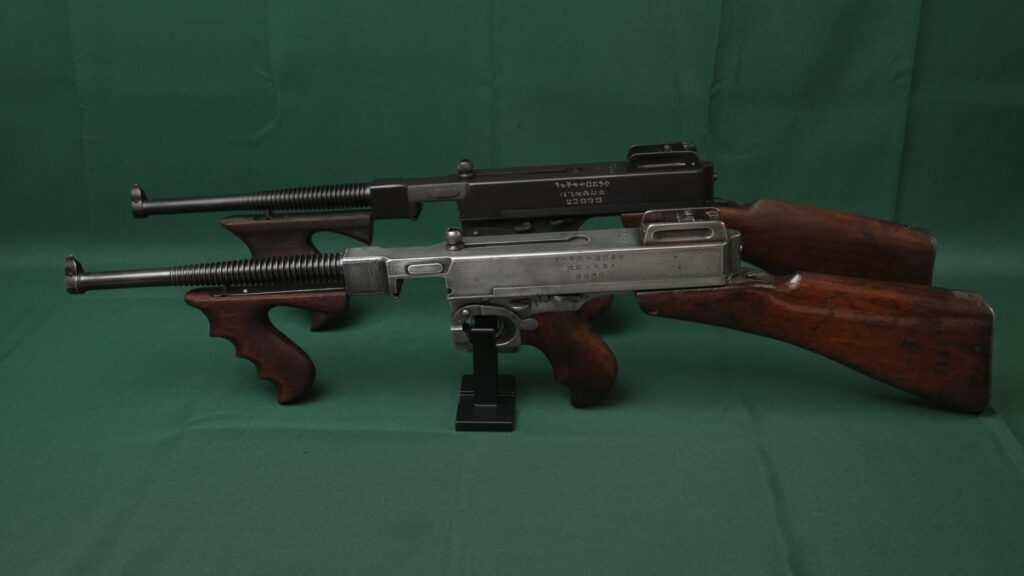
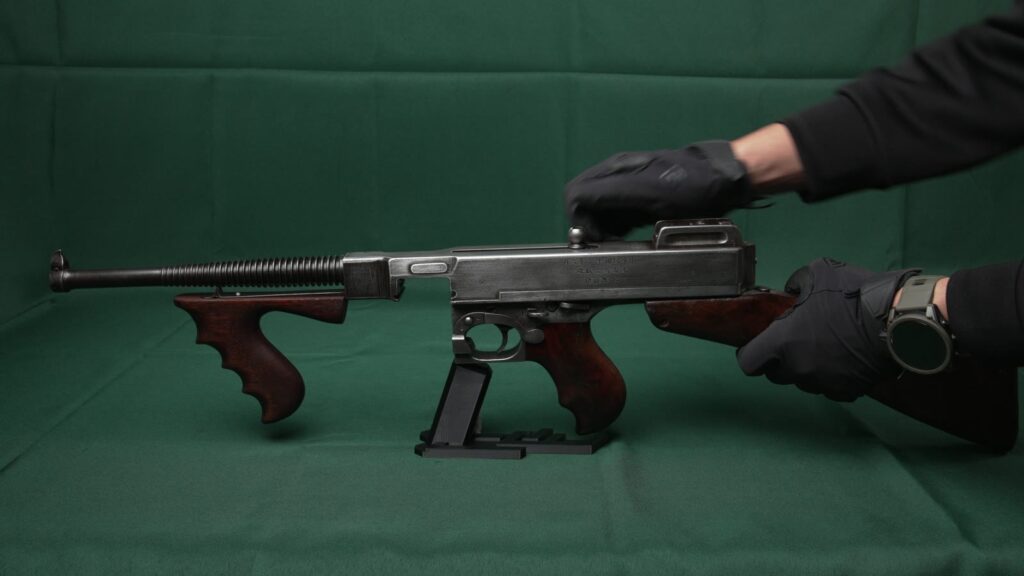
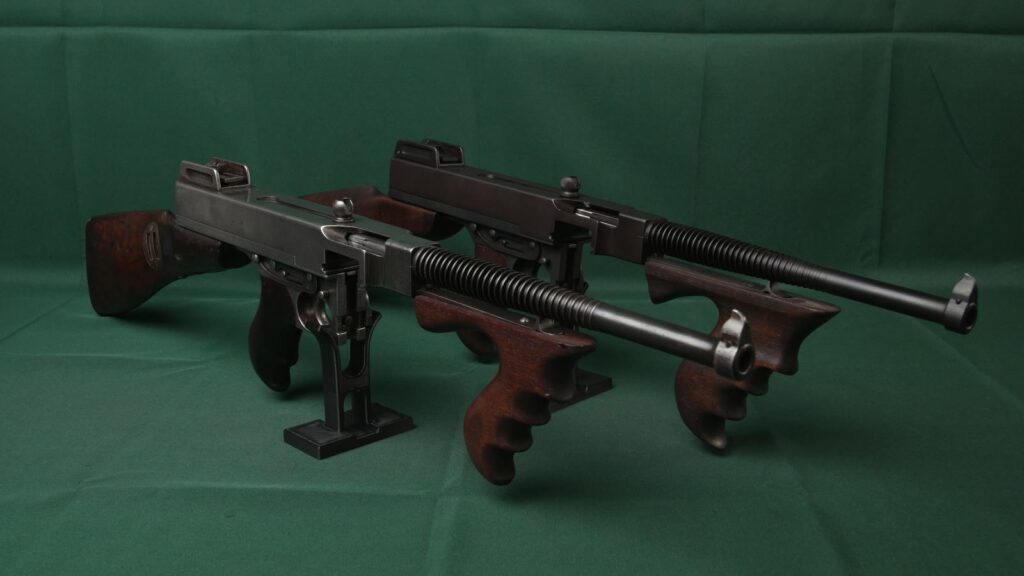
A Shanxi Thompson is a Chinese copy of the American Model 1921 Thompson submachine gun, built without a license at Taiyuan Arsenal in Shanxi province, and we keep two of them side by side. Serial number 9300 is dated June 1927 on its receiver and carries a 1952 letter that puts it in a burned-out bunker, in the arms of an enemy captain. Serial number 16653 is dated July 1928, with its lettering picked out in gold. Both are part of our own collection.
A warlord’s arsenal and an American design
The Thompson is an American design, developed by Auto-Ordnance under Brigadier General John T. Thompson during and just after the First World War, and the Model 1921 was the first major production model: fifteen thousand were made by Colt for Auto-Ordnance, with a finned barrel, a vertical foregrip and an adjustable rear sight.
China in the 1920s was split between regional warlords and the Nationalist government, and several warlord factions acquired Thompsons and then built local copies. Shanxi was controlled by the warlord Yan Xishan, and construction of his arsenal at Taiyuan began in 1912. According to the Wikipedia history of the plant, it had about 15,000 workers by 1930 and was a major producer of Thompson copies.
The 2005 Small Arms Review article on 9300 adds a detail about how Shanxi used these guns. Shanxi’s roads were poor, so trains carried most of the province’s goods, and Yan put armed guards on them against bandits. Some of those guards, the article says, carried Taiyuan copies of the Model 1921. The same article notes the arsenal also built a .45 ACP version of the Mauser 1896 pistol.
In our judgment, Shanxi made the best unlicensed Thompsons anywhere, and many of the parts even interchange with an original. That is our own assessment. The 2005 teardown showed something narrower: when the magazine writer took 9300 apart next to a Colt-made Model 1921, every part in the Chinese gun had a counterpart in the Colt. Where the Colt parts showed the highest standard of workmanship, many of the Chinese parts showed signs of having been made by hand.
How to read Shanxi Thompson markings
The markings are three lines of Chinese engraved on the left side of the receiver, above the fire controls. Each line reads from right to left, starting with the top line. On 9300 they read:
| Line | Reading (pinyin) | Meaning |
|---|---|---|
| 1 | Zhonghua Minguo shiliu nian liu yue | Republic of China, year 16, month 6 |
| 2 | Taiyuan Binggongchang zao | Made by Taiyuan Arsenal |
| 3 | Chongfeng jiguanqiang | Submachine gun |
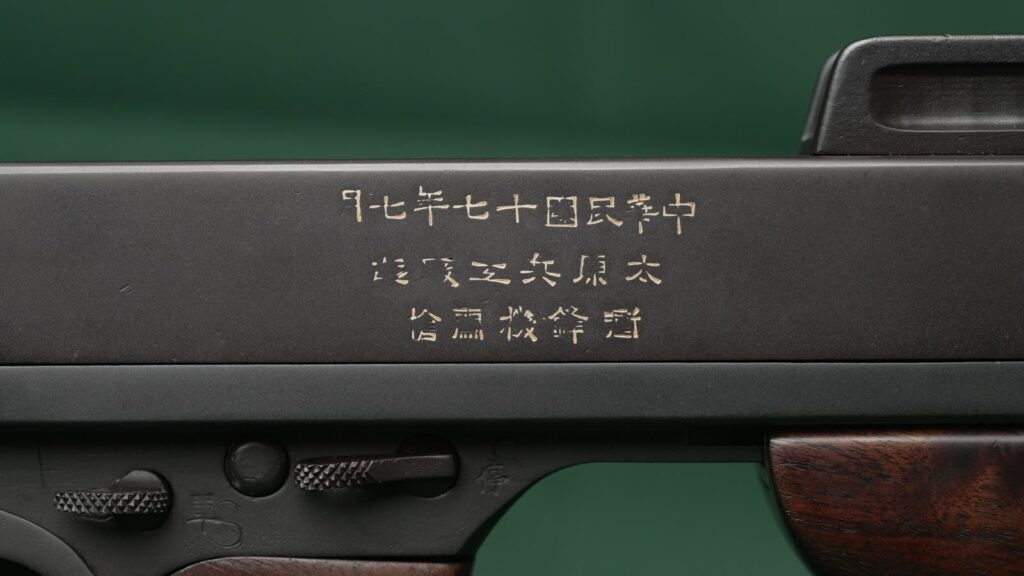
The date is in the Republic of China calendar, which counts from 1912 as year 1. Add 1911 to the year: year 16 is 1927, so 9300 was made in June 1927. On 16653 the first line reads year 17, month 7: July 1928.
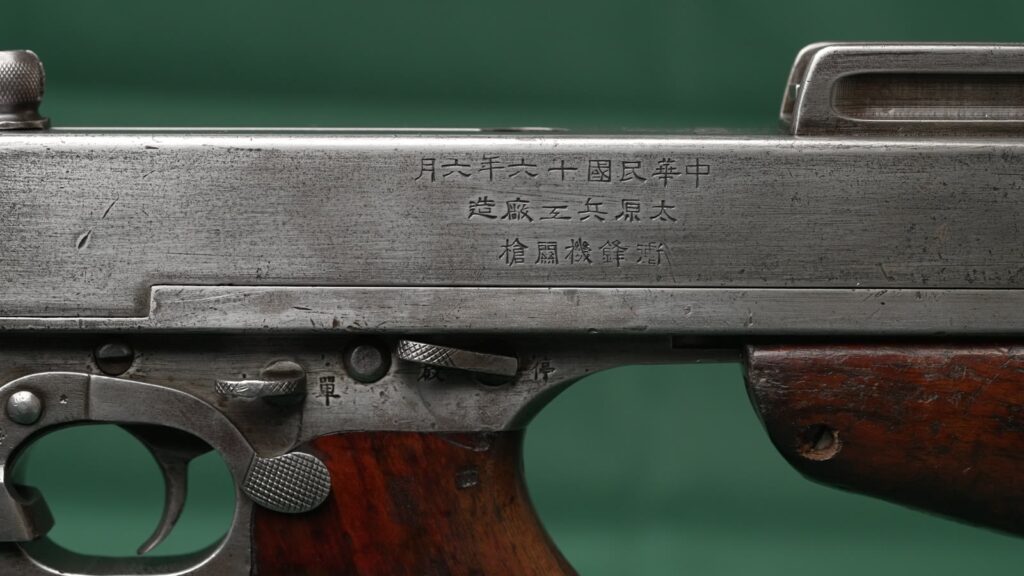
The fire controls are marked in Chinese too. The selector carries the characters for continuous and single, read lian and dan. The safety carries the characters for fire and stop, read fang and ting.
On 16653 the three lines have been filled with gold, which stands out against the blued receiver. The blue is not the arsenal’s original finish: 16653 was reblued later in its life.
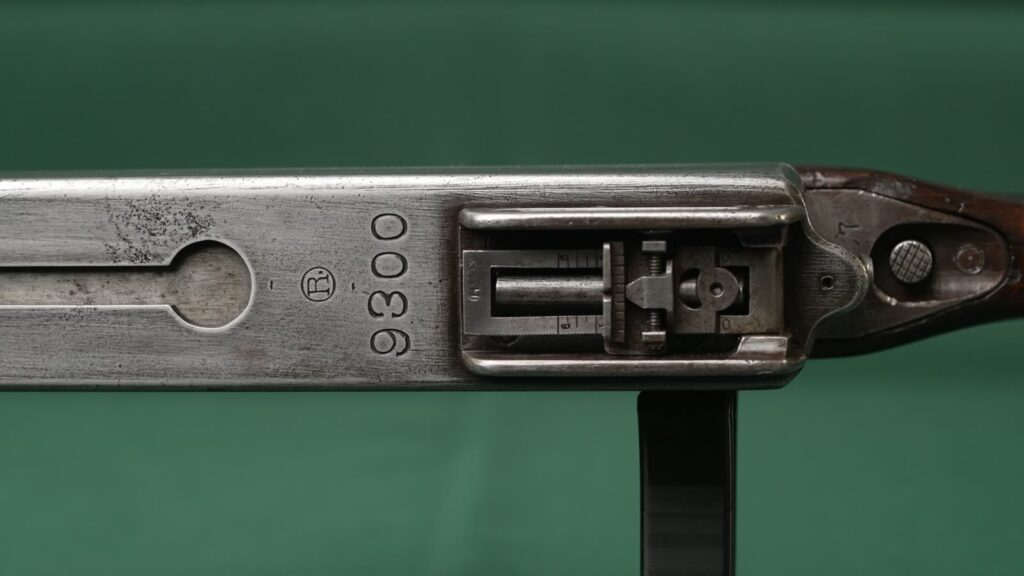
The serial number is stamped on top of the receiver, just ahead of the rear sight. On 9300 the number is easy to read, and it matches the number in every one of the papers. Every Chinese Tommy gun video we’ve found online is 9300.
What the 1952 letter says
Serial 9300 came to us with its paperwork. The core document is a two-page letter dated 17 December 1952 from Hy Hunter, a Californian who had handled the gun, to Patrick J. Given of Illinois, telling him the gun had been registered in his name. Here is what the letter itself says:
- The gun was captured from a cement bunker put out of action by American flamethrowers and hand grenades, in an attack that lasted two days.
- The three men inside were burned to death.
- A casualty list compiled after the fight showed 25 American soldiers killed attacking the bunker, and 11 of them were shot with the gun bearing serial number 9300.
- The gun was found in the arms of an enemy captain.
- Only two of these Chinese Thompsons had been captured before, and 9300 went to a U.S. Army proving ground for study.
- The barrel is chambered for the U.S. .45 cartridge, and the gun takes an American magazine.
- Hunter had two different translations of the inscription, and they disagreed. He never learned where in China the gun was made, and called it “an interesting puzzle.”
The letter gives no date and no place for the fight. It does not name Iwo Jima, it does not say the defenders were Japanese, and it does not name Aberdeen. The 11 deaths are the letter’s claim; we have not seen a casualty list.
The answer to Hunter’s puzzle was engraved on the receiver: made by Taiyuan Arsenal. By 1968, when Given registered the gun again, the form already gave its maker as “Shensai Arsenal – China.”
Where Iwo Jima comes from
Iwo Jima enters the story in January 2005, in Captain Monty Mendenhall’s article “Made in China? Chinese Thompson SMG” in Small Arms Review, Vol. 8 No. 4. The article puts the bunker on Iwo Jima, names the dead officer as a Japanese captain, and says the gun was sent to the Army’s proving ground at Aberdeen, Maryland. It also says that, because of the Chinese characters, Americans at the time assumed the gun had been made in Japan.
The article also notes the gaps. It says no record of Aberdeen’s evaluation had been found, and no record of how the gun reached its next owner. Its route from China to the Pacific is presented as an assumption: the gun and some .45 ammunition may have been captured in the fighting of 1937, and it was “possibly” taken by the captain or issued to him because Japan had few submachine guns of its own. Taiyuan itself fell to the Japanese in November 1937, after the Battle of Taiyuan.
If that’s right, 9300 went from Chinese troops to the Japanese, then out to the Pacific, where Americans took it. Until a record turns up, we treat the Iwo Jima part as unconfirmed.
From war trophy to registered machine gun
The 2005 article traces the rest of 9300’s American life. In 1952 Gaylord Wesseck registered it as a DEWAT, a deactivated war trophy, and the article puts Hy Hunter’s handling of the Wesseck collection in 1953. The dates in the papers don’t line up neatly: Hunter’s letter is dated December 1952, while the 1968 registration gives 13 January 1953 as the date Given acquired the gun. Given later filed a Form 1 and reactivated it, and kept it for about fifty years. After his death it went to Jerry Prasser of Recon Ordnance in Wisconsin, who let the magazine take it apart and photograph it.
We have no early history for 16653. Its serial number is on the receiver and the buttplate.
The 2005 article, citing Thomas Nelson’s The World’s Submachine Guns, says these Chinese copies were made periodically from the late 1920s to the mid-1940s, and that most had horizontal forends. 9300 has the vertical foregrip of the Model 1921, and so does 16653.
The magazine also flagged one mechanical difference. For an unknown reason, 9300’s operating spring was much stronger than the one in the Colt gun. No firing tests were done, but the writer thought the stronger spring would likely give the Chinese gun a faster rate of fire.
What the fire did to 9300
9300 has little of its original finish left. In our judgment, that’s the fire: the bunker was burned out with flamethrowers, and the bluing went with it. The fire is also why its stock isn’t original. Set next to 16653, the difference is plain: one gun gray, the other reblued later, with gold in the engraving.
Handling the pair
The cocking knob on top still runs smooth, and when we checked the headspace on both guns after they arrived, it checked out. They’d shoot. We just can’t bring ourselves to.
We handle them gently. When we pull the knob back, a hand rides the bolt forward again rather than letting it slam home, and we don’t dry fire them.
How many are in the U.S.
In 2005, the Small Arms Review article said only three registered Chinese Thompsons were known to exist in the United States. That was its count, not ours. Today it’s said that only three are transferable in the US, and two of them are right here. That is word of mouth among collectors; there is no official count.
Specifications
| Item | Shanxi Thompson 9300 | Shanxi Thompson 16653 |
|---|---|---|
| Maker | Taiyuan Arsenal, Shanxi, China | Taiyuan Arsenal, Shanxi, China |
| Date on receiver | Year 16, month 6 (June 1927) | Year 17, month 7 (July 1928) |
| Pattern | Copy of the Thompson Model 1921 | Copy of the Thompson Model 1921 |
| Cartridge | .45 ACP | Not stated in our papers |
| Barrel / overall length | 10½ in / 32 in, per its 1968 registration | Not recorded here |
| Finish | Burned off; stock not original | Reblued later, gold-filled lettering |
| Paperwork | 1952 letter, 1968 registration, 2005 magazine article | No early history |
On the floor at OSA
Both Shanxi Thompsons, 9300 and 16653, stay in our own collection. If the story pulls you toward the guns around it, these pieces in our case are related:
- 1942 Kongsberg M/1914 in .45 ACP with a signed factory archive letter: a foreign-built, licensed copy of an American design in .45 ACP, the Thompson’s cartridge, with papers of its own.
- 1943 Standard Products M1 Carbine: a wartime American carbine of the kind the Thompson served beside in the Pacific.
- 1943 Springfield Armory M1 Garand: the U.S. service rifle of the same war.
- Chinese Type 56 SKS from Factory 26, circa 1978: a later Chinese arsenal copy of a foreign design.
The grid below updates by itself as pieces come and go.
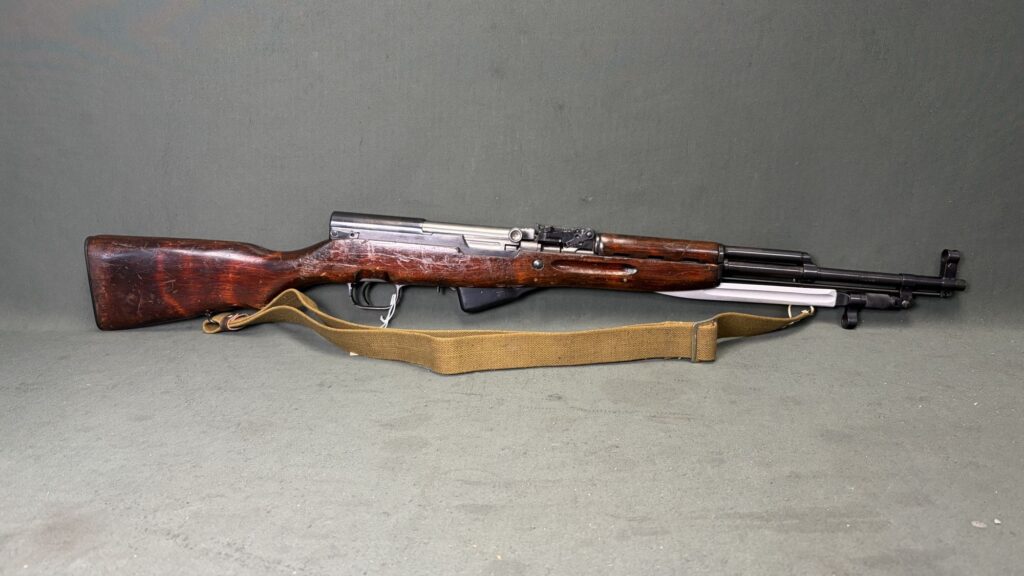 Black FridayRussian Tula SKS 7.62×39 Late Production All Matching Mirror Bore with Sling Original price was: $895.00.$880.00Current price is: $880.00.
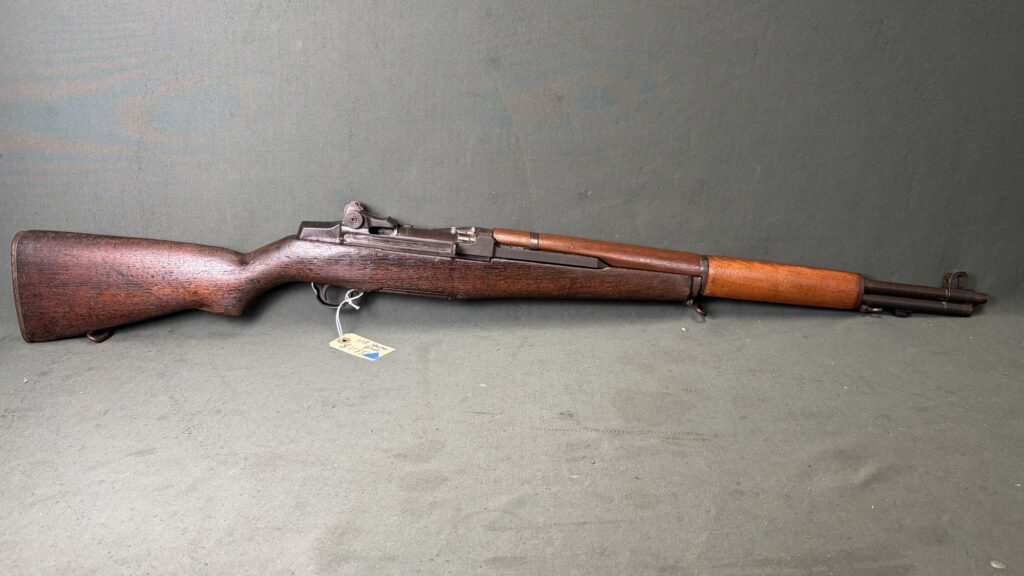 Black Friday1950s Harrington and Richardson M1 Garand 30-06 with LMR 11-54 Barrel Original price was: $1,185.00.$1,150.00Current price is: $1,150.00.
 Black Friday1944 Springfield M1 Garand 30-06 Letterkenny 1965 Arsenal Rebuild Original price was: $1,525.00.$1,425.00Current price is: $1,425.00.
 Black Friday1942 Springfield M1 Garand 30-06 Danish Return with 1966 VAR Barrel Original price was: $1,695.00.$1,645.00Current price is: $1,645.00.
 Black Friday1942 Springfield Armory M1 Garand 30-06 with Springfield Barrel and Sling Original price was: $1,585.00.$1,485.00Current price is: $1,485.00.
 Black Friday1978 Chinese Factory 26 Type 56 SKS 7.62×39 All Matching with Bayonet Original price was: $675.00.$595.00Current price is: $595.00.
The short version is on our Instagram. Watch it on Instagram.
General information for collectors, not legal advice. The bunker account comes from a 1952 letter and the Iwo Jima account from a 2005 magazine article; the papers with this gun include no military record backing either.
Common Questions
What is a Shanxi Thompson?
It is an unlicensed Chinese copy of the American Model 1921 Thompson submachine gun, made at Taiyuan Arsenal in Shanxi province for the warlord Yan Xishan’s forces. Ours are chambered in .45 ACP and dated 1927 and 1928 on the receiver.How do you read the date on a Shanxi Thompson?
The top line on the left side of the receiver, read from right to left, gives the year and month in the Republic of China calendar, which starts in 1912. Add 1911 to the year: year 16 is 1927 and year 17 is 1928.What do the Chinese characters on a Shanxi Thompson mean?
The three lines read Republic of China year and month, made by Taiyuan Arsenal, and submachine gun. The selector is marked with the characters for continuous and single fire, and the safety with the characters for fire and stop.Was the Shanxi Thompson serial 9300 really captured on Iwo Jima?
Unconfirmed. A 1952 letter says it was taken from a burned-out bunker, in the arms of an enemy captain, but it does not name Iwo Jima. Iwo Jima comes from a 2005 Small Arms Review article, whose writer could not find the Army’s records.How rare are Shanxi Thompsons in the United States?
Very rare. A 2005 Small Arms Review article said only three registered Chinese Thompsons were known in the United States. It’s said that only three are transferable today, two of them in our collection, but there is no official count.Are Shanxi Thompson parts interchangeable with a Colt Thompson?
In our judgment, many parts interchange. When a Colt-made Model 1921 and serial 9300 were taken apart side by side for a 2005 magazine article, every Chinese part had a counterpart in the Colt, though many of the Chinese parts showed signs of being made by hand; the article did not report swapping parts.Sources
- Hy Hunter, letter to Patrick J. Given, 17 December 1952, two pages, original in the paperwork of serial 9300 (bunker, flamethrowers and grenades, two-day attack, 3 dead inside, 25 killed and 11 with 9300, enemy captain, 2 captured before, Army proving ground, .45 chambering and American magazine, two translations, never learned where it was made)
- Capt. Monty Mendenhall, “Made in China? Chinese Thompson SMG,” Small Arms Review, Vol. 8 No. 4, January 2005, pp. 26–28, original copy in the paperwork of serial 9300 (Iwo Jima, Japanese captain, Aberdeen, assumed Japanese-made, no Aberdeen record, 1937 capture as an assumption, train guards, .45 Mauser 1896, Wesseck DEWAT 1952, Hunter 1953, Given and Form 1, Prasser, part-by-part comparison with a Colt, stronger operating spring, Nelson on production years and forends, three known in the U.S.)
- Form 4467 registration of serial 9300, 25 November 1968, in the gun’s paperwork (10½-inch barrel, 32-inch overall length, .45, maker given as Shensai Arsenal, acquired 13 January 1953)
- Wikipedia, “Taiyuan Arsenal” — https://en.wikipedia.org/wiki/Taiyuan_Arsenal (construction begun by Yan Xishan in 1912, about 15,000 workers by 1930, major producer of Thompson copies, captured by Japan in November 1937 after the Battle of Taiyuan)
- Wikipedia, “Thompson submachine gun” — https://en.wikipedia.org/wiki/Thompson_submachine_gun (Auto-Ordnance and John T. Thompson, development 1917–1920, Model 1921 as first major production model, 15,000 by Colt for Auto-Ordnance, finned barrel and vertical foregrip, Chinese warlords acquiring Thompsons and making local copies)