
Journal · Collector’s Guide
K98k Mauser Buyer’s Guide — German, Czech, Yugo & G33/40
The K98k is the rifle of the Wehrmacht — the Mauser 98 action at its peak, chambered in 8mm, the benchmark every other twentieth-century bolt gun is measured against. But “a K98k” runs a wide range: a matching-numbers Mauser Oberndorf, a Czech Brno build, a postwar Yugoslav rebuild on German parts, or the rare mountain-troop carbine. The codes stamped on the receiver tell you exactly which one you’re holding. Here’s how to read them, from a Plano shop that handles surplus every week.
The K98k is the German service rifle of the Second World War: a Mauser 98 bolt action chambered in 8mm Mauser, with a 600 mm barrel and a five-round internal magazine. German-made examples are not marked Mauser. They carry a letter maker code and a two-digit year on the receiver, so byf 41 reads Mauser Oberndorf 1941 and dot 44 reads Waffenwerke Brünn 1944. Alongside wartime German rifles the market holds Yugoslav postwar rebuilds assembled on German parts and stamped with the Yugoslav crest over the eagle, and the scarce G33/40, a short Brno-built mountain carbine derived from the Czech vz.33.
At a glance
- Caliber & action — 8mm Mauser (7.92×57 / 8×57 IS); Mauser 98 bolt action, 5-round internal magazine
- How German rifles are marked — not with the name Mauser, but a letter maker code plus a two-digit year: byf 41 = Mauser Oberndorf 1941, dot 44 = Waffenwerke Brünn 1944
- Common maker codes — byf and svw (Mauser Oberndorf), bcd (Gustloff, Weimar), dot and dou (Waffenwerke Brünn), ar (Mauser Borsigwalde), bnz (Steyr), ce (J.P. Sauer, Suhl)
- Acceptance stamps — eagle-over-WaA Waffenamt inspection marks across the metal; Yugoslav rebuilds carry the Yugoslav crest stamped over the German eagle
- Matching numbers — bolt, floorplate and small parts share the receiver serial or its last two digits; an all-matching rifle commands a strong premium
- C&R threshold (2026) — made 1976 or earlier; every wartime K98k and G33/40 qualifies on age
- Most often confused with — the Yugoslav M48, a Yugoslav-manufactured intermediate-action Mauser that is not a K98k and shares no receiver parts with one
Reading the receiver code — who made it, and when
German K98ks aren’t marked “Mauser” — they wear a maker code and a two-digit year on the receiver. byf is Mauser Oberndorf, bcd is Gustloff, dou and dot are the Brno works in occupied Czechoslovakia, ar is Mauser Borsigwalde — followed by the year, so “byf 41” reads Mauser Oberndorf, 1941 and “dot 44” reads Brno, 1944. That code is the first thing a collector reads: it sets the maker, the year, and the whole context of the rifle before you ever count a serial number.
German, Czech (Brno) or Yugoslav — the three K98ks you’ll see
Most K98ks fall into three camps. Wartime German guns — the byf, bcd, dot and dou-coded rifles — are the core of the field and the ones collectors chase for matching numbers and Waffenamt proofs. Czech Brno rifles come from the same famous Zbrojovka Brno plant that built Mausers before, during, and after the war, and are superbly made. Yugoslav K98ks are postwar rebuilds assembled from captured German parts and stamped with the Yugoslav crest over the eagle — an affordable, honest way into a real K98k with genuine WWII German components.
Variants compared — German K98k, Yugoslav rebuild, G33/40
| Feature | German K98k (wartime) | Yugoslav M98/48 (K98k rebuild) | G33/40 |
|---|---|---|---|
| Caliber | 8mm Mauser (7.92×57 / 8×57 IS) | 8mm Mauser (7.92×57 / 8×57 IS) | 8mm Mauser (7.92×57 / 8×57 IS) |
| Barrel length | 23.6 in (600 mm) | 23.6 in (600 mm) | 19.2 in (490 mm) |
| Overall length | ≈43.7 in (1,110 mm) | ≈43.7 in (1,110 mm) | ≈39.1 in (993 mm) |
| Weight, unloaded | ≈8.6 lb (3.9 kg) | ≈8.6 lb (3.9 kg) | ≈7.9 lb (3.6 kg) |
| Production years | 1935–1945 | Postwar Yugoslav rebuild programme | 1940–1942 |
| Origin & arsenals | Germany and occupied Europe — Mauser Oberndorf (byf, svw), Gustloff Weimar (bcd), Waffenwerke Brünn (dot, dou), Mauser Borsigwalde (ar), Steyr (bnz), J.P. Sauer, Suhl (ce) | Yugoslavia — Preduzeće 44, Kragujevac, working on captured German rifles and parts | Waffenwerke Brünn, code dot |
| Receiver markings | Letter maker code plus a two-digit year (byf 41, dot 44); eagle-over-WaA Waffenamt acceptance stamps | Yugoslav crest stamped over the German eagle; the German maker code is often still readable underneath | dot code and year, as for German production |
| Identifying features | Solid walnut or laminated stock; bolt takedown disc; stock cartouches; duffle cut common on GI bring-backs | German wartime components reassembled to Yugoslav arsenal standard; mixed parts are normal | Short, light mountain carbine derived from the Czech vz.33; sheet-steel cap wrapping the left side of the buttstock |
| Matching numbers | Bolt, floorplate and small parts share the receiver serial or its last two digits; all-matching commands a strong premium | Generally not matching, since rifles were assembled from mixed parts | German convention as at left; survivors are scarce |
| C&R status in 2026 | Eligible | Eligible | Eligible |
Dimensions are nominal service specifications for each pattern; individual rifles vary with maker, year and later rebuild work. The Yugoslav M98/48 above is a rebuild of a captured German K98k and is not the same rifle as the Yugoslav M48, which Yugoslavia manufactured itself on a shorter, intermediate-length Mauser action. Russian-capture K98ks — wartime German rifles refurbished on Soviet lines and usually force-matched — are a further common category not shown as a separate column. Curio & Relic status is determined by an individual rifle’s year of manufacture — confirm current requirements with the ATF.
The G33/40 mountain carbine
The G33/40 is the connoisseur’s Mauser: a short, lightweight carbine built at Brno for the German Gebirgsjäger mountain troops, derived from the Czech vz.33. It’s notably handier than a full K98k, with a distinctive sheet-steel buttstock cap that wraps the left side of the butt to survive alpine hard use. Low production and heavy wartime service make survivors scarce and valuable — our DOT 1942 G33/40 is exactly the kind of piece that anchors a serious Mauser collection.
Matching numbers & Waffenamt — what drives value
On a German K98k, value is built from two things: matching numbers and Waffenamt acceptance. The bolt, floorplate, and small parts should share the receiver’s serial (or its last two digits), and an all-matching rifle commands a strong premium over a “parts gun.” The little eagle-over-WaA inspection stamps scattered across the metal are the wartime acceptance marks that prove originality. Import marks are common on U.S.-market guns and don’t hurt a shooter-grade rifle — but on a collector piece, originality of finish and matching numbers is most of the price.
Stocks, finish & the bring-back story
Wartime K98ks used both solid walnut and laminated stocks — the plywood-laminate wood is original and correct, not a repair, and actually more durable than solid walnut. Many rifles that came home with GIs show a “duffle cut” where the stock was sawn to fit a duffle bag and later reglued; it’s part of the bring-back story, not a defect. Look at whether the metal is honest wartime blue or a later refinish, and whether the stock cartouches and disc are intact — those details separate a collector rifle from a rebuilt shooter.
What to inspect before you buy
- Matching numbers — bolt, floorplate, and small parts against the receiver serial; all-matching is the premium.
- Maker code & Waffenamts — decode the receiver code, and confirm the eagle/WaA acceptance stamps read correctly for the maker and year.
- The bore — 8mm bores should be bright with strong rifling; these are shooters when the bore is right.
- Stock & cartouches — laminated or walnut, duffle cut or not, cartouches and stock disc intact.
- Crest (Yugoslav guns) — the Yugo crest over the eagle confirms a postwar rebuild on German parts.
Caliber & shooting — 8mm Mauser
Every K98k here is chambered in 8mm Mauser (7.92×57 / 8×57 IS), one of the great military cartridges — still in production, widely available as surplus and new commercial loads, and hitting right in the class of .30-06 and .308. A matching-numbers K98k with a bright bore isn’t just a wall piece; it’s a superbly accurate, hard-hitting rifle you can take to the range whenever you like. One distinction matters before buying ammunition: the wartime German round is 8×57 IS, sometimes written JS, with a .323-inch bullet, while the older 8×57 J uses a .318-inch bore. They are not interchangeable, and modern commercial 8mm Mauser sold in the United States is loaded to the IS specification. Surplus 8mm is frequently corrosive-primed, which is harmless provided the bore is cleaned with a water-based solvent the same day it is shot.
Also on the rack — other Mausers
The Mauser 98 action armed half the world, and the K98k is only one branch of the family. If you want a different flavor of the same rugged action, we usually keep other Mausers on the rack — like a Turkish Ankara 1938 Mauser, a long-rifle take on the 98 at an entry-level price. The 98 action was licensed, copied and rebuilt across the world, and the family is wide: Turkey rebuilt and produced Mausers at Ankara and Kirikkale, Czechoslovakia built the vz.24 at Brno, Belgium’s FN supplied contract rifles to a dozen countries, and Yugoslavia produced its own M48 on a shorter intermediate-length action. All share the same controlled-round-feed bolt with dual front locking lugs and a third safety lug, the feature that made the design the template for bolt-action rifles ever since. Chamberings vary by country, so the caliber marking is worth reading rather than assumed. Browse the full rifle inventory for whatever’s in now.
C&R eligible — and the FFL part is easy
Every K98k here is over fifty years old and Curio & Relic eligible — with a C&R license these can ship straight to your door. Otherwise it’s the normal, painless routine: we ship fully insured to your local FFL, who runs the background check at pickup. In the Dallas area? Pick up in store in Plano and handle the rifle first. Every K98k is inspected in-house — browse the full rack of surplus & collectible rifles, or email sales@oldsteelarsenal.com for photos of the codes, Waffenamts, and matching numbers.
In the Case Right Now
Live inventory — every K98k and G33/40 currently on the floor. Each is one of one; when it sells, it is gone.
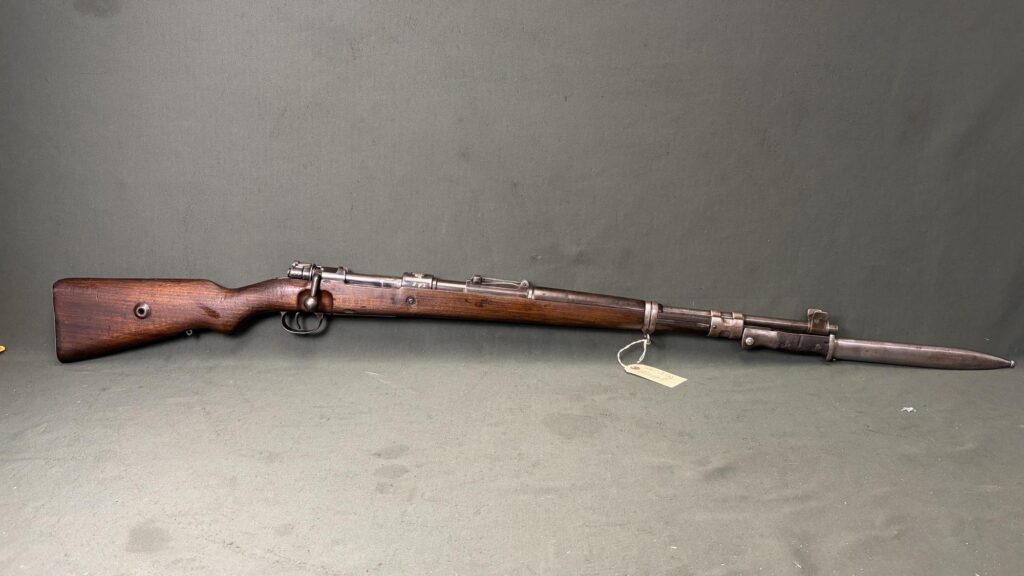 1937 Mauser Portuguese Contract K98k 8mm Mauser with Matching Bayonet Original price was: $1,585.00.$1,475.00Current price is: $1,475.00.
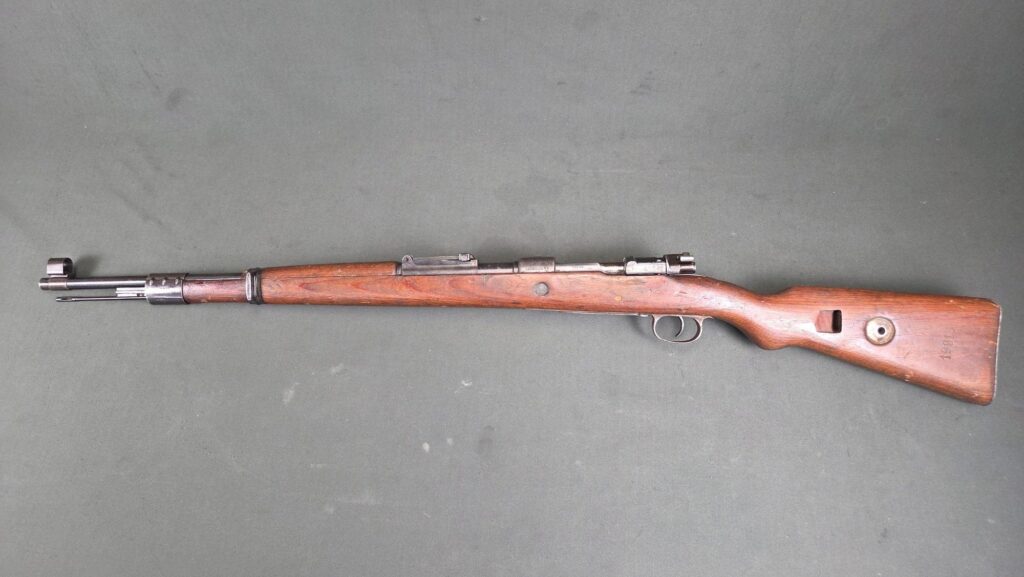 Shooter-grade Yugoslavian K98k rifle$825.00
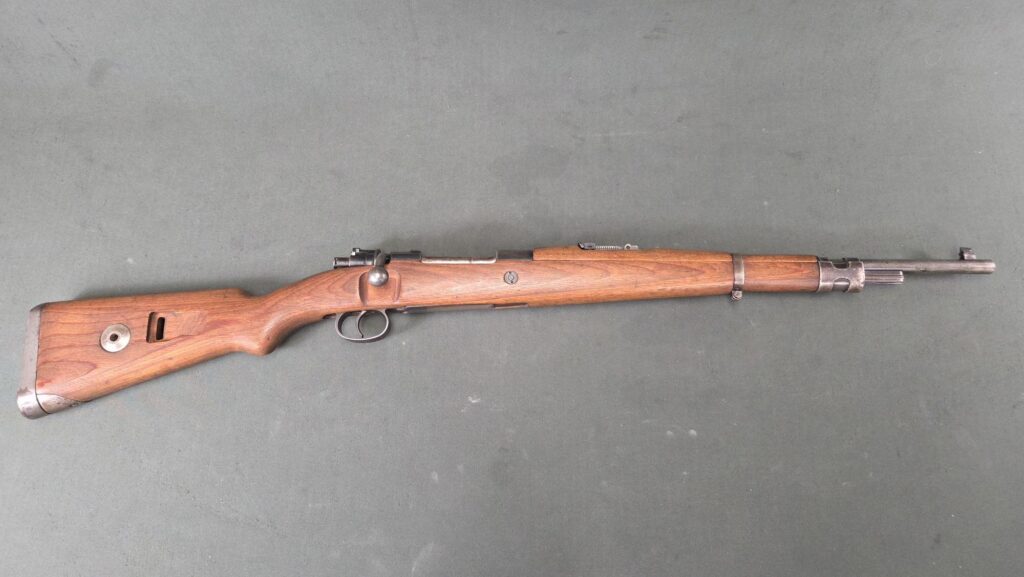 G33/40 8MM$3,750.00
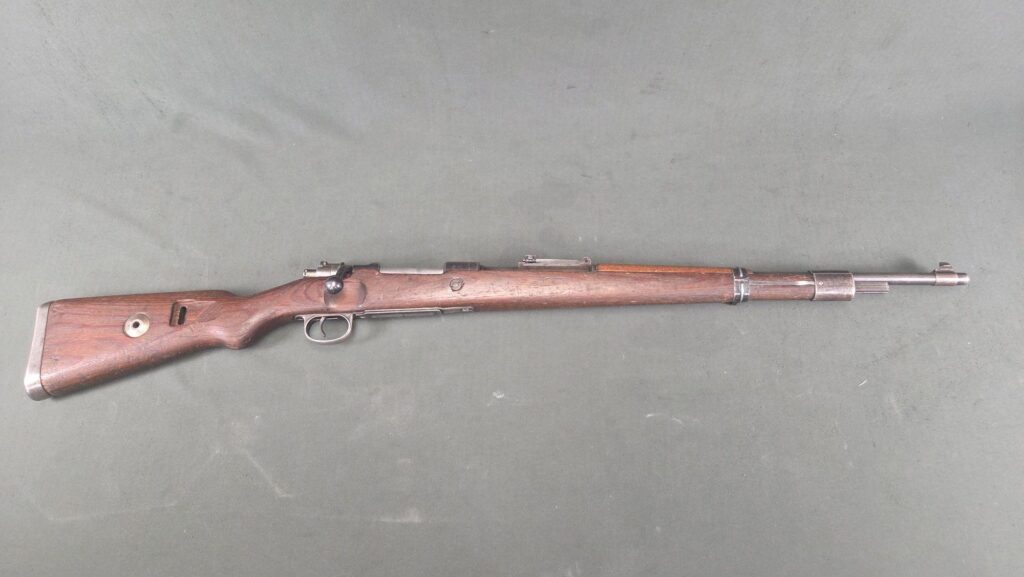 DOT 44 K98k rifle 8mm Mauser$1,285.00
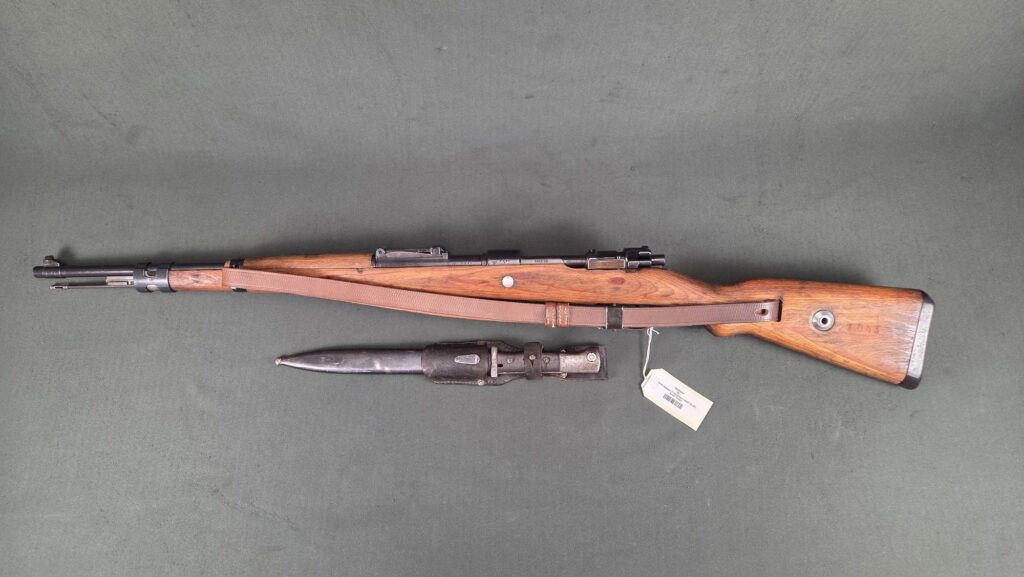 BYF 41 Mauser K98k$1,585.00
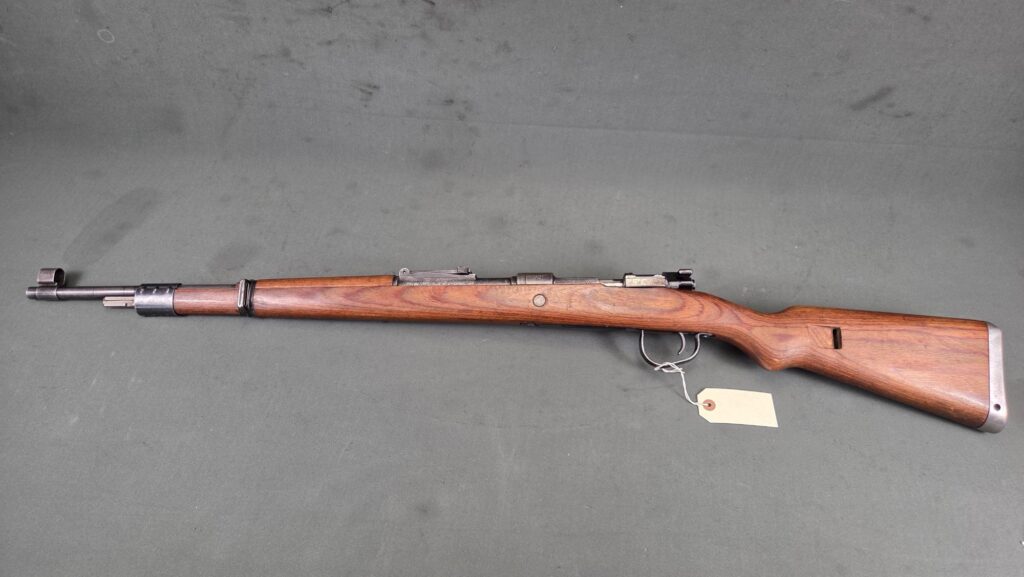 BRNO factory-manufactured K98k rifle with Czech lion stamps$1,249.00
Shop K98k Mauser rifles in stock now →