
Journal · Collector’s Guide
Walther PDP Meister Manufaktur: The Buffalo Hunt
Most Walther PDPs leave the factory as plain service pistols. This Walther PDP Meister Manufaktur pistol, serial MM01017, is covered in hand-cut relief engraving by the German master engraver Jürgen Göser, who signed it on the frame. It tells a story of the American West, with a buffalo hunt down one side and wild horses down the other, and pistols like it are extremely rare. This one is part of the Old Steel Arsenal collection.
What is the Walther PDP Meister Manufaktur?
The Meister Manufaktur is Walther’s master workshop, inside the company’s factory in Ulm, Germany. According to a report all4shooters published in November 2024, the factory is built mainly for series production, and the Meister Manufaktur is where one-off and small-series guns are made in consultation with the customer: engraving, special coatings, tuned triggers, alternative controls and sights. The program is young by Walther’s standards. Walther was founded in 1886; the Meister Manufaktur first showed its work at the IWA trade show in 2015.
In that report, all4shooters described the PDP Steel Frame as gradually replacing the Q5 Match as a base for the workshop’s upgrades, and showed a PDP Steel Frame engraved right down to the magazine base. Ours is built on a steel-frame PDP, and the MM at the start of its serial stands for Meister Manufaktur.
The engraver: Jürgen Göser
Jürgen Göser runs his own engraving studio, the Atelier Jürgen Göser, in Ebershausen, Germany. On the studio’s site he gives his career in a few lines: he began his training at Krieghoff in Ulm in December 1966, passed his journeyman’s exam in May 1970 as the best of his year with the grade “very good,” stayed with Krieghoff until 1976, then passed his master’s exam, also with “very good,” and went independent. The studio cites more than 50 years of experience.
He has worked for Walther’s workshop before. The same all4shooters report shows a “Boston Tea Party” Q5 Match Steel Frame from the Meister Manufaktur, a one-off fully engraved by him (the report spells his name Gösner).
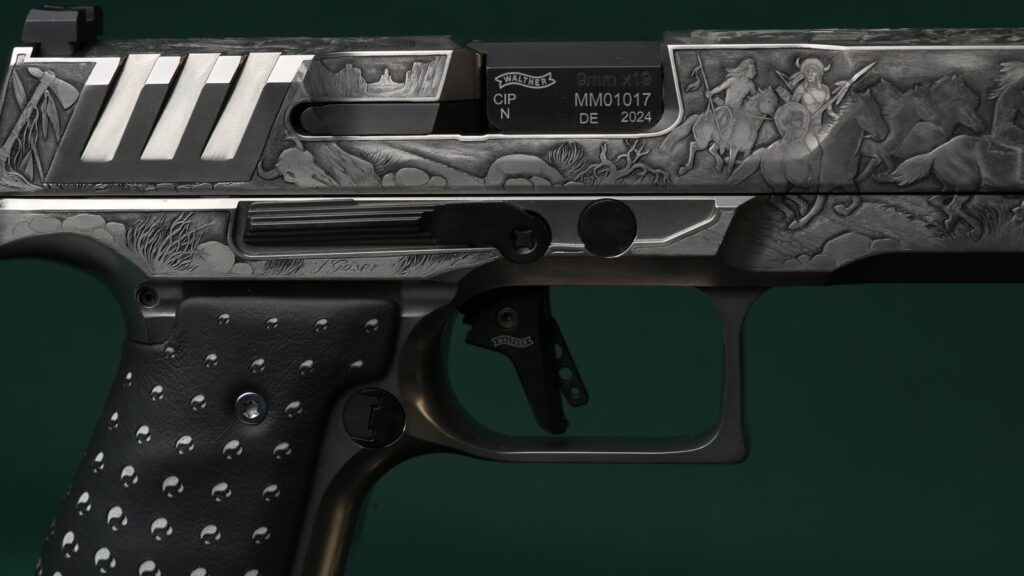
He signed this pistol. The signature, J. Göser, is cut into the frame on the right side, just above the trigger guard.
Hand engraving in relief
This engraving was cut by hand. In relief engraving, the background around a figure is cut away and lowered, so the figure stands above it, and the raised figure is then shaped and shaded. On this pistol the main figures, the riders, horses and bison, are done that way. Göser’s studio lists relief engraving and bulino, the fine-line technique used for shading, among its specialties, and says he developed his own combination of the two for a three-dimensional look.
You see it best when light rakes across the slide. The bison have rounded backs and shoulders, and the grass and rocks along the frame are cut in finer lines than the figures above them. On the right side, the horses run across the joint between slide and frame, so the scene carries on from one part to the next.
Left side: the buffalo hunt
The left side, muzzle to the left, is the buffalo hunt. Toward the rear, a rider draws his bow at full gallop beside a bison that is going down; farther forward, another rider carries a lance, and the herd runs ahead of them with a WALTHER ribbon cut into the scene. Mesas stand on the horizon, a dreamcatcher hangs behind the cocking serrations, and buffalo skulls lie in the grass on the frame below.
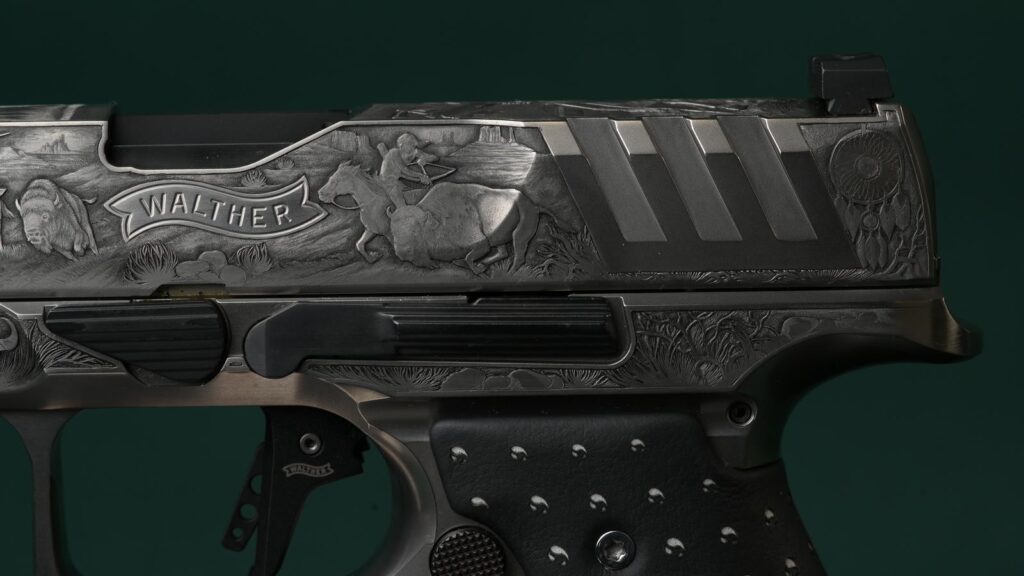
The scene has roots in history. The horses of the Plains peoples were of Spanish descent, and many oral histories say they reached Indigenous groups by way of trade networks or as runaways from Spanish camps, often before those groups met the Spanish themselves. A 2023 study of horse remains from sites ranging from New Mexico to Idaho to Kansas found horses being ridden and raised by Indigenous groups in the Great Plains and northern Rockies by the early 1600s, earlier than many written histories had put it.
Right side: wild horses
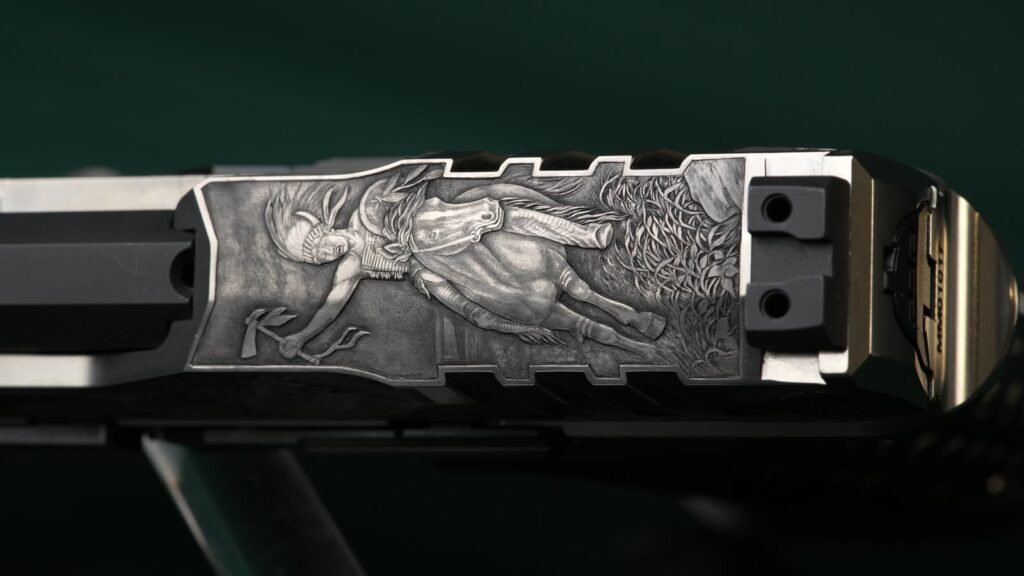
The right side carries wild horses. A rider swings his rope over the running herd, and two riders with round shields follow behind. At the back of the slide, behind the ejection port and above the extractor, Göser cut a mesa landscape, and a tomahawk hung with feathers sits behind the serrations.
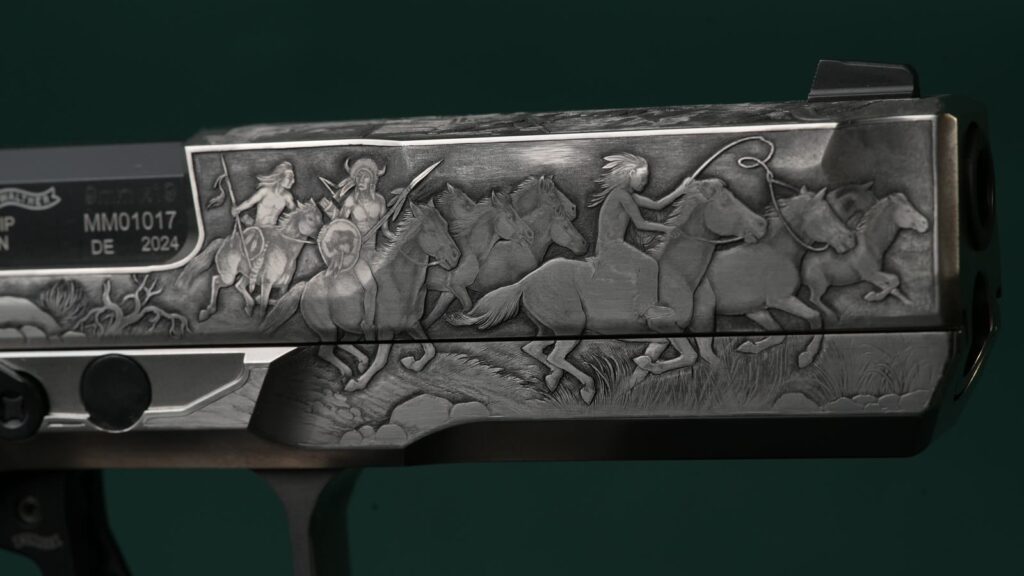
Through the ejection port you can read the markings on the barrel: 9mm x19, the Walther banner, CIP over N, MM01017, DE and 2024. CIP refers to the C.I.P., the international proof commission whose member states, Germany among them, recognize each other’s proof marks.
On top of the slide
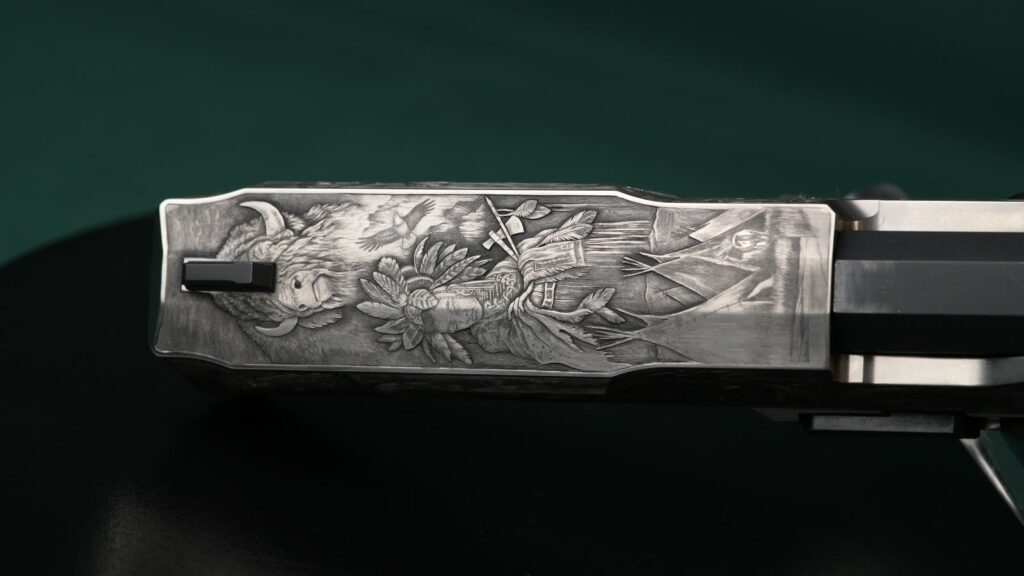
Looking down at the front of the slide, Göser cut a buffalo head, an eagle in flight and a war bonnet, with crossed tomahawks and a tipi beside them. Farther back, ahead of the rear sight, a rider at full gallop carries a tomahawk.
The magazine baseplates
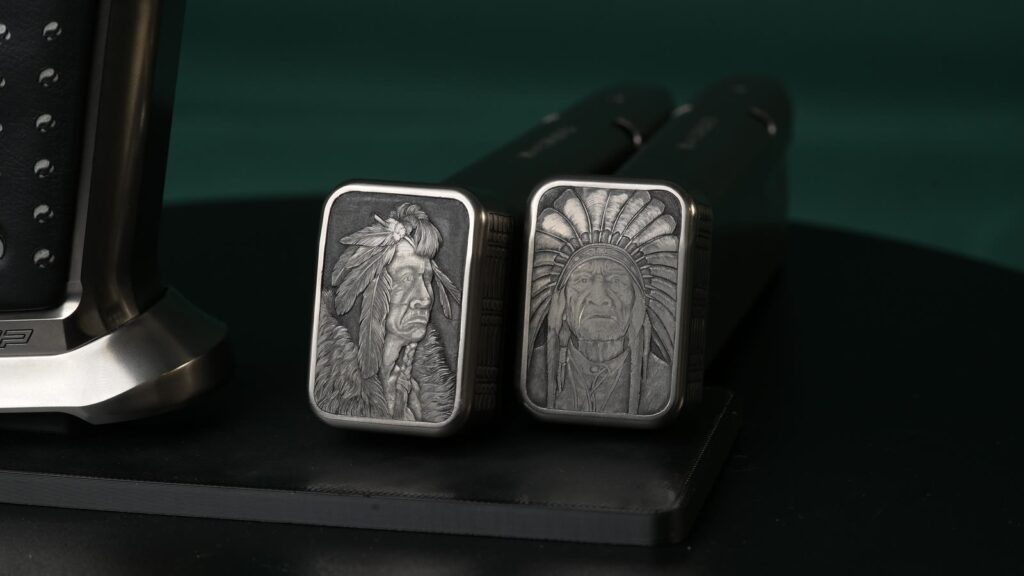
The two magazine baseplates each carry a portrait. One shows a warrior wrapped in a fur robe, with feathers and a braid, in three-quarter view. The other shows a chief in a full war bonnet, staring straight back at you.
Specifications
| Item | This pistol |
|---|---|
| Maker | Carl Walther, Ulm, Germany |
| Workshop | Meister Manufaktur |
| Base pistol | Walther PDP, steel frame |
| Serial | MM01017 |
| Cartridge | 9×19mm |
| Engraver | Jürgen Göser, signed J. Göser on the frame |
| Engraved parts | Slide (both sides and top), frame, both magazine baseplates |
| Technique | Hand engraving in relief |
| Theme | Buffalo hunt and wild horses of the American West |
On the floor at OSA
The PDP in these photos is part of the Old Steel Arsenal collection. If custom-shop and factory-dressed pistols are what you like, these pieces in our case are related to it:
- HK VP9L 9mm long slide: another German striker-fired 9mm, from Heckler & Koch.
- Nighthawk Custom Lady Hawk 1911 in 9mm: a pistol from a custom shop rather than a production line.
- Kimber 45th Anniversary 1911 .45 ACP: a limited anniversary edition 1911.
- 1963 Browning Baby Lightweight with factory chrome and pearl grips: a pistol dressed up at the factory, in its case.
The grid below updates by itself as pieces come and go.
Buffalo hunt or wild horses: which side faces up in your case? Tell us on our Instagram. Watch it on Instagram.
General information for collectors, not legal advice. What we say about this pistol comes from the gun itself; background on the workshop and the engraver comes from the sources below.
Common Questions
What is the Walther Meister Manufaktur?
It is Walther’s master workshop at its factory in Ulm, Germany, where one-off and small-series pistols are made in consultation with customers, including hand-engraved guns. It first showed its work at the IWA trade show in 2015.What does the MM prefix mean on a Meister Manufaktur PDP?
On our engraved PDP, serial MM01017, the MM prefix stands for Meister Manufaktur, Walther’s master workshop.Who is Jürgen Göser?
A German master engraver with a studio in Ebershausen. He began his training at Krieghoff in Ulm in December 1966, worked there until 1976, then passed his master’s exam and set up on his own. He has engraved pistols for Walther’s Meister Manufaktur.What is relief engraving on a pistol?
Relief engraving cuts away and lowers the background around a figure so the figure stands above it, then shapes and shades the raised figure. It can be cut by hand with gravers, as on our PDP.Can a Walther PDP be engraved down to the magazine?
Yes. all4shooters showed a Meister Manufaktur PDP Steel Frame engraved down to the magazine base, and both magazine baseplates on our engraved PDP carry their own portraits.Is the Meister Manufaktur PDP a steel-frame pistol?
Ours is built on a steel-frame PDP, and all4shooters reported in 2024 that the PDP Steel Frame was gradually replacing the Q5 Match as a base for the workshop’s upgrades.Sources
- all4shooters, “Customised sporting guns and engraved luxury pistols: the Carl Walther Meister Manufaktur in Ulm” — https://www.all4shooters.com/en/shooting/culture/visit-to-the-walther-master-manufactory-with-video/ (workshop in Ulm, one-offs made with customers, services, IWA 2015 debut, Walther founded 1886, PDP Steel Frame replacing the Q5 as a base, engraving down to the magazine base, “Boston Tea Party” one-off engraved by Göser)
- Atelier Jürgen Göser, “Über uns” — https://www.goeser-gravuren.de/%C3%BCber-uns/ (Ebershausen studio, training at Krieghoff in Ulm from December 1966, journeyman’s exam May 1970, at Krieghoff until 1976, master’s exam, independent, more than 50 years’ experience, relief and bulino techniques and his combination of them)
- Associated Press via PBS NewsHour, “Indigenous groups in the American West lived alongside horses by the early 1600s, study finds” — https://www.pbs.org/newshour/nation/indigenous-groups-in-the-american-west-engaged-with-horses-by-the-early-1600s-study-finds (horses ridden and raised by Indigenous groups by the early 1600s, remains from New Mexico to Idaho to Kansas, Spanish descent, oral histories of trade and runaway horses)
- Wikipedia, “Commission internationale permanente pour l’épreuve des armes à feu portatives” — https://en.wikipedia.org/wiki/Commission_internationale_permanente_pour_l%27%C3%A9preuve_des_armes_%C3%A0_feu_portatives (C.I.P. member states including Germany, reciprocal recognition of proof marks)