
Journal · Collector’s Guide
HK P7M13: How the Squeeze-Cocker Pistol Works
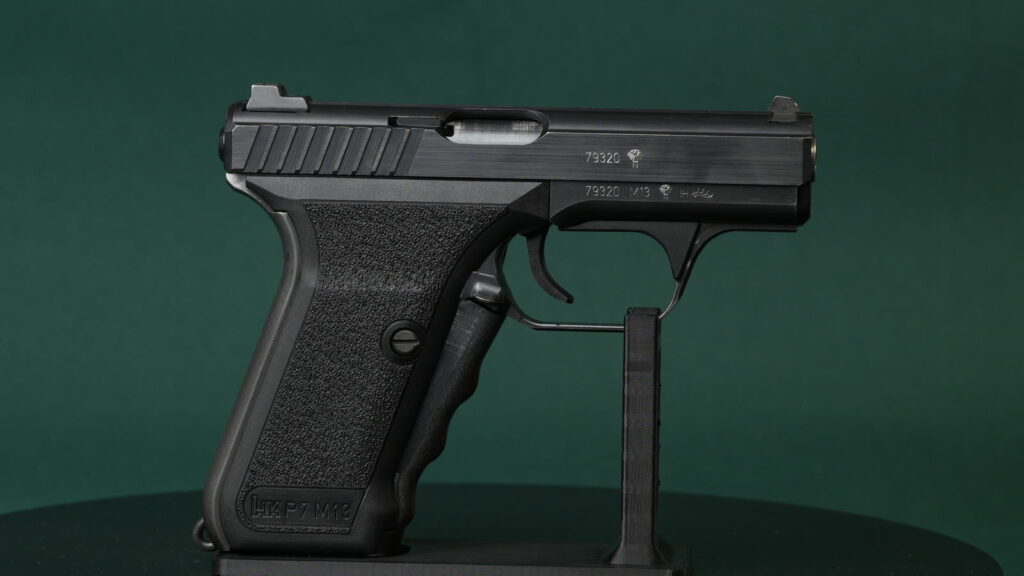
The HK P7M13 is the 13-round, double-stack version of the Heckler & Koch P7, the West German police pistol you cock by squeezing the grip. The front strap is a lever: close your hand and it cocks the striker, open your hand and the pistol decocks itself. Inside, gas tapped from the barrel pushes on a piston and resists the slide’s rearward movement, and the barrel itself is fixed in the frame. The pistol in our photos and video is a blued P7M13 marked “Made in W-Germany,” with a proof date of 1987.
A police pistol for the post-Munich requirements
After the 1972 Munich Olympics massacre, the West German police forces decided to replace the .32 ACP Walther PP with a pistol of about the same size in 9x19mm. The requirements were strict: no more than 1,000 grams (about 2 pounds, 3 ounces), no larger than 180 by 130 by 34 millimeters, fully ambidextrous, and safe to carry with a round in the chamber, in a holster or a pocket, yet ready to fire the instant it was drawn.
Heckler & Koch’s answer was designed by Helmut Weldle and announced in 1976 as the PSP, for Polizei-Selbstlade-Pistole, “police self-loading pistol.” The German police selected three pistols: the SIG Sauer P225 as the P6, the Walther P5, and H&K’s PSP as the P7. American Rifleman dates the official adoption to 1978. Series production followed at the end of the decade (most published accounts say 1979), and the federal counter-terror unit GSG 9 took the pistol up soon after. According to American Rifleman, the German police order was so large that civilian P7s did not reach the market until 1981.
From the PSP to the P7M13
The original PSP and P7 held eight rounds in a single-stack magazine released by a catch at the heel of the grip. In the early 1980s H&K introduced the P7M8 and the P7M13. Both moved the magazine release to a lever just below the trigger guard, usable from either side, and both added a synthetic heat shield to the trigger guard and a lanyard loop at the heel.
The difference between the two is the magazine. The P7M13’s double-stack magazine holds 13 rounds, which makes the frame about 33 millimeters across instead of 29. H&K entered the P7M13 in the U.S. Army’s XM9 trials to replace the M1911; the Beretta 92 won and became the M9. A small number of P7M13SD pistols with a longer, threaded barrel and a suppressor were built for German special forces. Wikipedia gives 2000 as the end of P7M13 production, and American Rifleman says the P7 was discontinued in 2008.
How the HK P7M13 squeeze-cocker works
When the lever is out, a strip of silver metal shows between it and the grip on the pistol in our video; squeezed fully home, the lever sits flush and the strip disappears. That full squeeze cocks the striker, and a cocking indicator pin stands out of the back of the slide. The pin tells you whether the striker is cocked, not whether there is a round in the chamber. Let go of the lever and the pin drops back: the pistol has decocked.
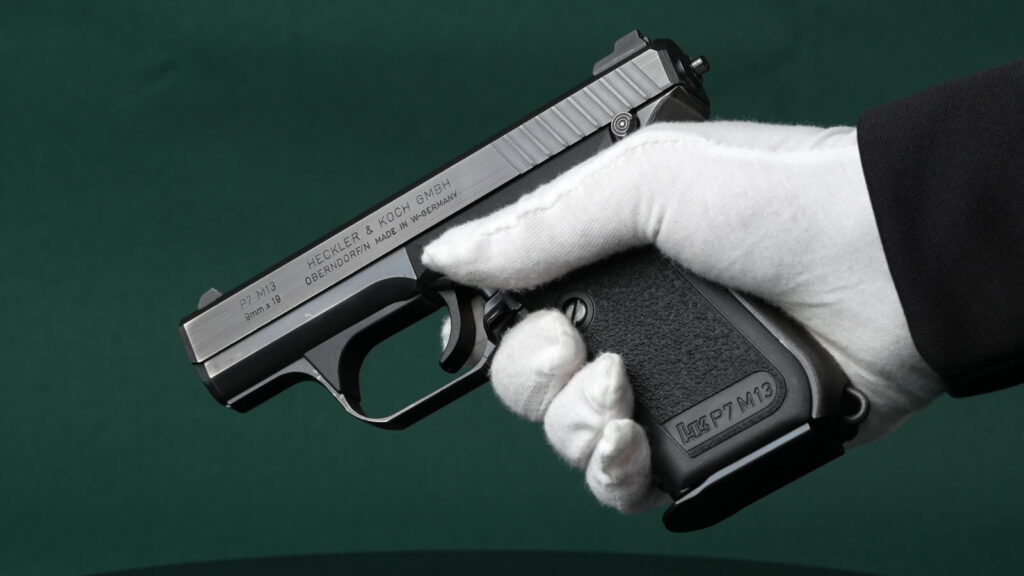
The first squeeze is the heavy part, and the published figures differ. Wikipedia gives 70 newtons, about 15.7 pounds, to cock and about 2 pounds to hold the lever in; American Rifleman gives 13 pounds and 1.5 pounds. These are general figures for the P7, not measurements of our pistol. Because the lever does the cocking, the trigger only has to release a striker that is already cocked.
The lever does several jobs. American Rifleman lists it as the cocking lever, decocker, grip safety and slide release; the only other controls are the slide stop, the magazine release and the takedown latch. On a standard P7M13 there is no separate manual safety lever.
The gas-delayed blowback system
A 9mm blowback pistol normally needs a heavy slide and a stiff spring to keep the breech closed until pressure drops. That weight would not fit under the police limit, so H&K used gas to do the delaying.
There is a small port in the barrel just ahead of the chamber. Gas from the fired cartridge flows down through it into a cylinder under the barrel, where it pushes against a piston pinned to the slide. That pressure opposes the slide’s rearward movement until the bullet has left the barrel and pressure falls. Wikipedia traces the idea to the Swiss Pistole 47 W+F prototype and, before that, to the Barnitzke system of the wartime Volkssturmgewehr 1-5.
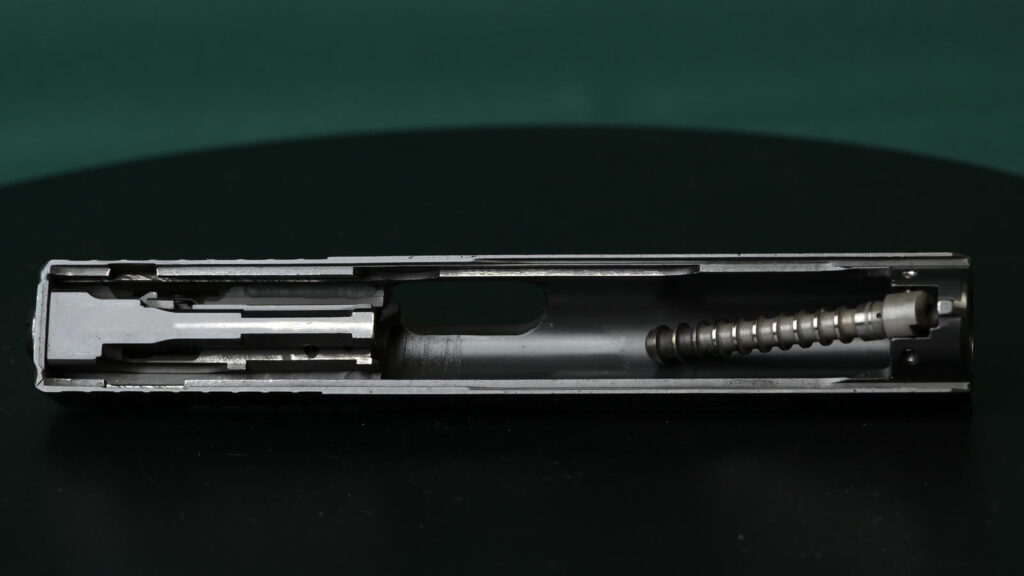
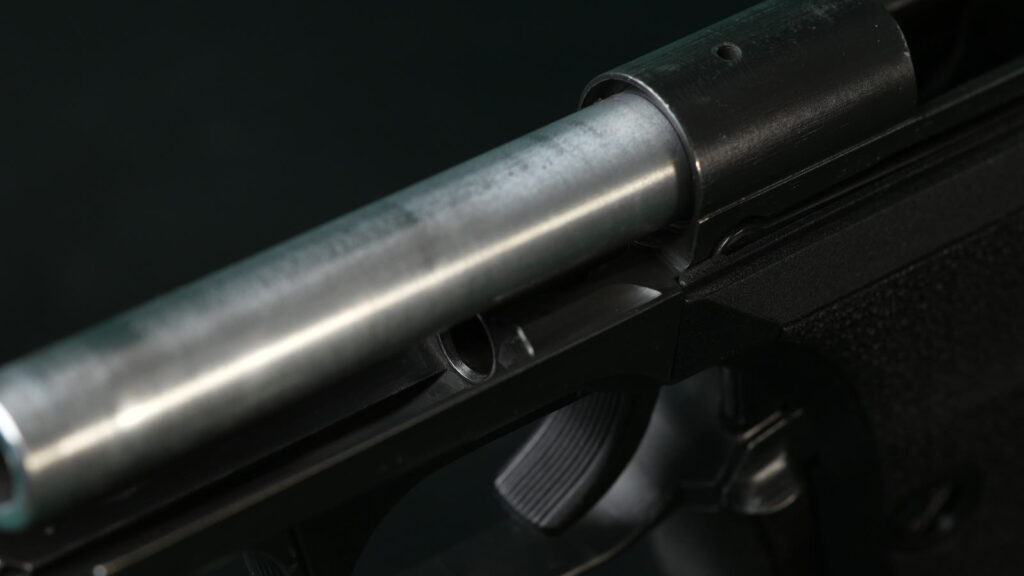
With no locking system to open, the barrel is fixed in the frame and does not tilt or move during firing, which Wikipedia credits for the P7’s mechanical accuracy. The barrel has polygonal rifling, and the chamber is cut with 18 flutes so gas can flow around the fired case and keep it from sticking.
Why the P7M13 has a heat shield
The gas cylinder sits between the chamber area and the trigger. According to Wikipedia, some shooters found the early pistols uncomfortable after extended firing because of the heat that builds up there. The P7M8 and P7M13 got a synthetic heat shield on top of the trigger guard, the black angular piece in our photo. The gas system still heats up; the shield keeps the trigger finger off the hot metal.
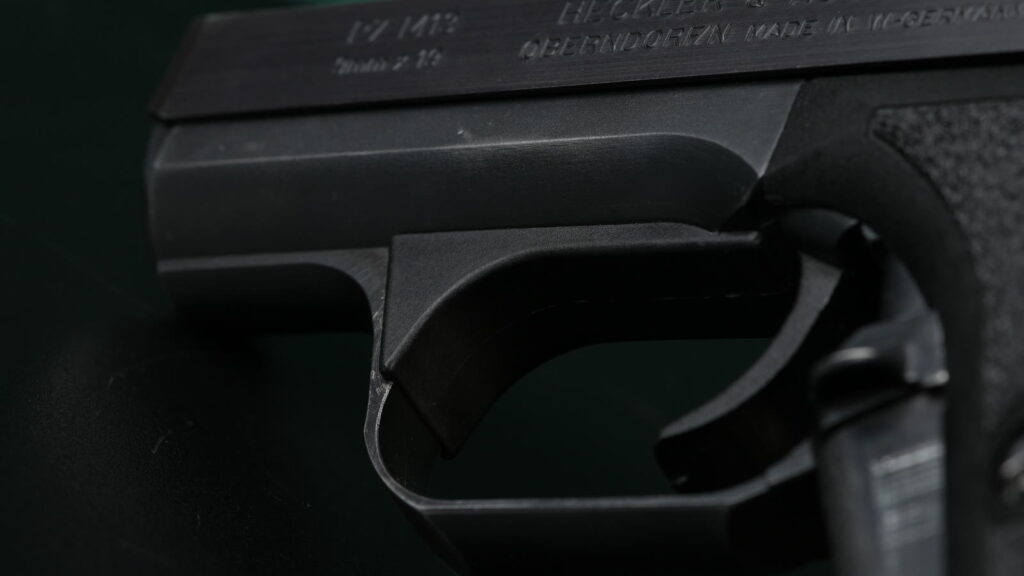
How to read HK P7M13 markings
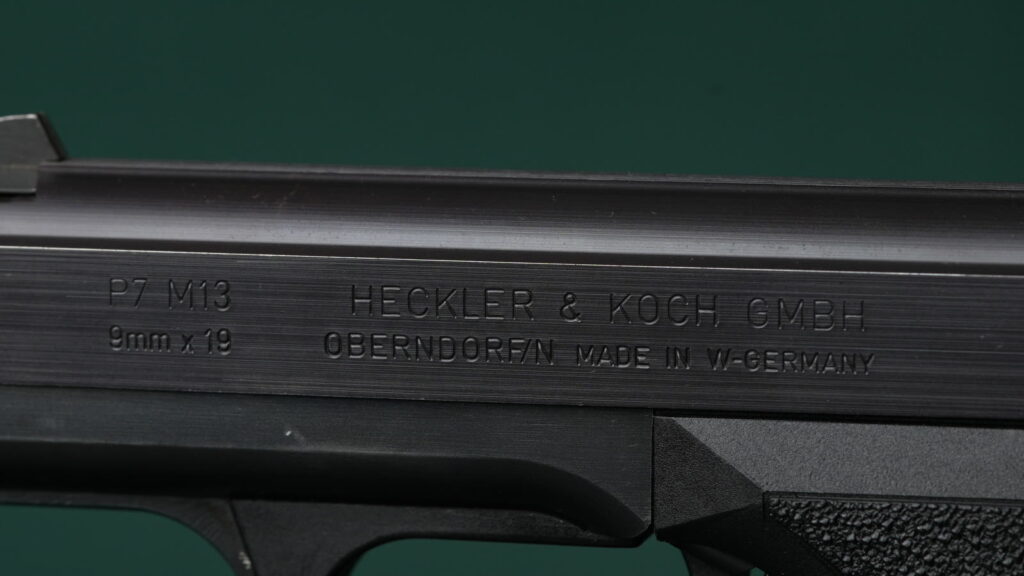
The left side of the slide reads P7 M13 and 9mm x 19, then HECKLER & KOCH GMBH over OBERNDORF/N MADE IN W-GERMANY. Oberndorf/N is Oberndorf am Neckar, the town where former Mauser engineers founded Heckler & Koch in 1949.
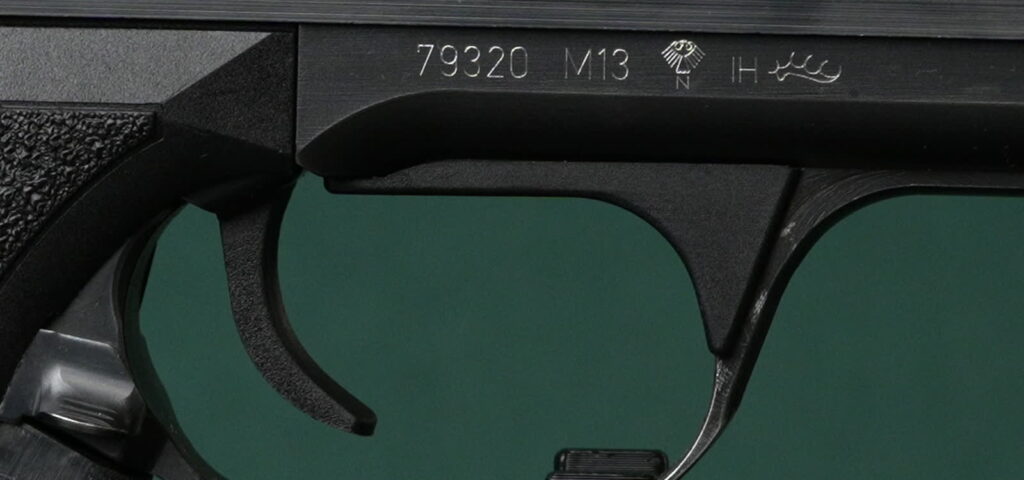
The right side of the frame carries the serial number, M13, and the German proof marks. The eagle over N is the German proof for smokeless (nitro) powder. The antlers are the emblem of the Ulm proof house, which Heckler & Koch guns go through. Between them is a two-letter date code. Since 1968 German proof houses have coded the year as letters, A for 0 through K for 9, with no J: on our pistol IH reads 8 and 7, a proof year of 1987.
The grip panels carry the HK logo and P7 M13 moulded into them. Against a P7M8, the P7M13 is told apart by the model name and by its wider double-stack grip and magazine. The magazine release under the trigger guard separates both of them from the original heel-release PSP and P7.
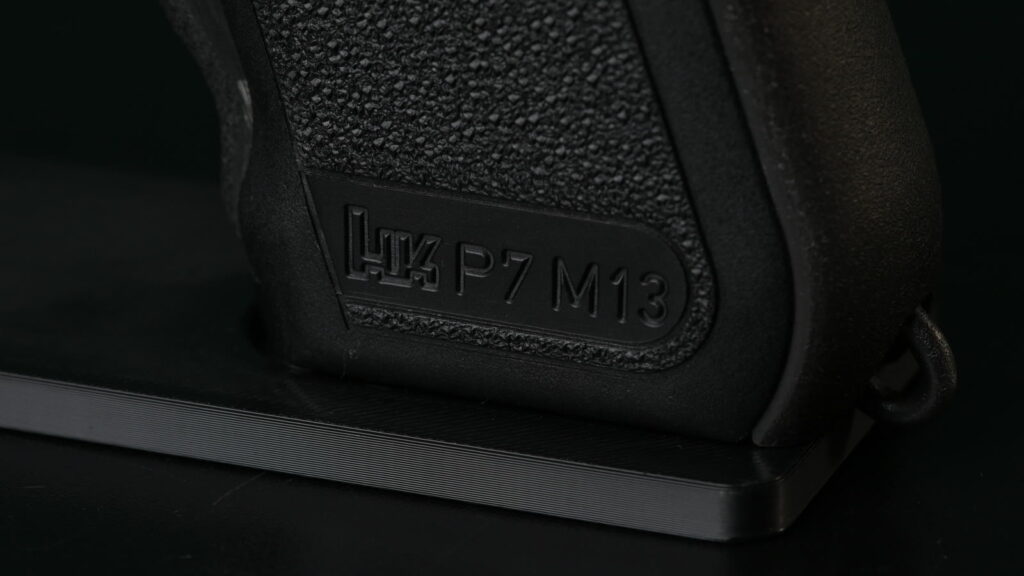
The Die Hard P7M13
Hans Gruber’s pistol in Die Hard (1988) was a P7M13. Small Arms Review, which featured the screen gun courtesy of Mike Papac of Cinema Weaponry, describes it as hard-chromed and notes that its silencer was a fake. Its slide carries the same HECKLER & KOCH GMBH, OBERNDORF/N MADE IN W-GERMANY line, plus HK T&E ONLY and HK CHANTILLY VA, marking it as one of the guns H&K kept for testing and evaluation. The pistol in our video is a standard blued P7M13, not the movie gun. The National Firearms Museum has shown a Die Hard P7 in its Hollywood Guns gallery.
Getting used to the squeeze-cocker
Our owner shoots IPSC competition, but the P7 took some getting used to. That initial squeeze with his shooting hand felt unfamiliar, even though holding the lever down takes much less force.
Specifications
| Item | HK P7M13 |
|---|---|
| Maker | Heckler & Koch GmbH, Oberndorf am Neckar |
| Cartridge | 9x19mm |
| Magazine | 13-round double stack |
| Operation | Gas-delayed blowback, fixed barrel |
| Firing system | Striker, cocked by the grip lever |
| Barrel | 105 mm (4.1 in), polygonal rifling |
| Length | 175 mm (6.9 in) |
| Width | 33 mm (1.3 in) |
| Produced | Early 1980s to 2000 |
On the floor at OSA
The P7M13 in this article is part of the Old Steel Arsenal collection and is not one of the pieces linked below. These are related pistols in our case:
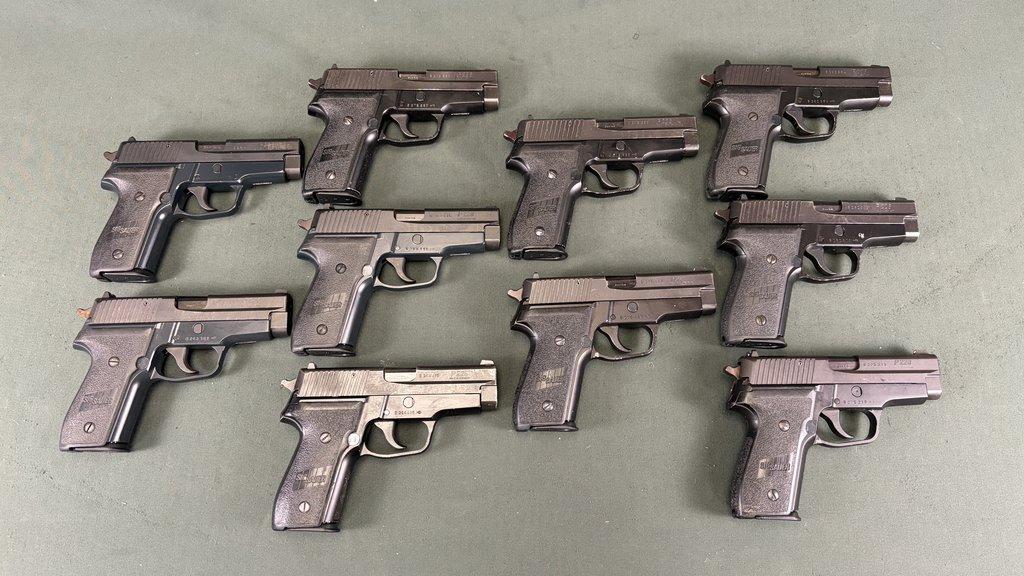
- A German-made SIG P228 from German police and Israeli service and a German-made SIG P226 in stainless two-tone. SIG’s P225, as the P6, was one of the three pistols selected in the same West German police program as the P7; the P226 and P228 are later SIG service pistols. Our guide to SIG P228 vs P226 and West German date codes covers how to tell them apart.
- A German-made SIG P228 with a Swiss Ticino police crest, another European police pistol.
- An HK VP9L 9mm long slide, a modern striker-fired Heckler & Koch.
The grid below updates by itself as pieces come and go.
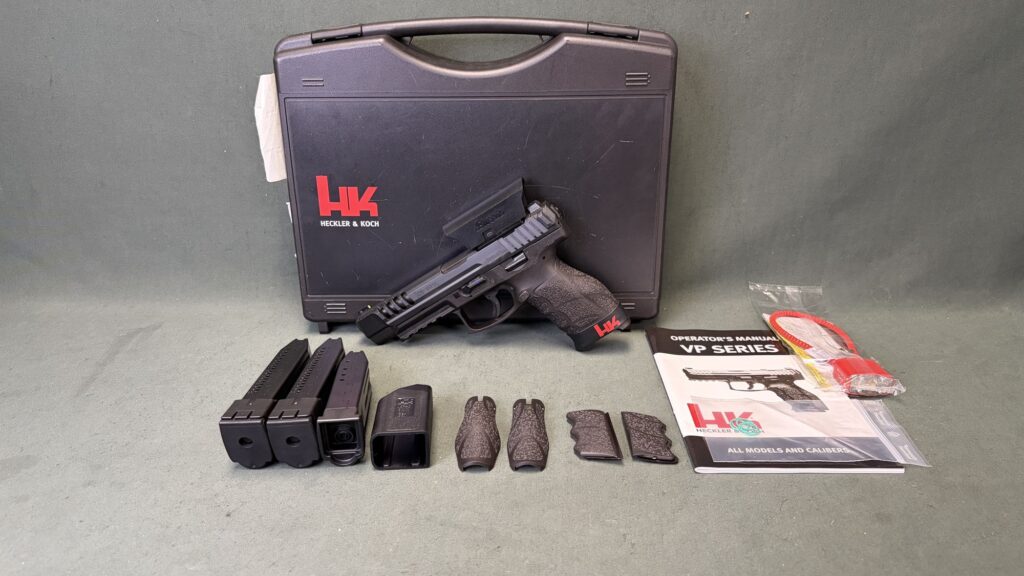 HK VP9L 9mm Long Slide with Burris FastFire 3 and Three Magazines$849.00
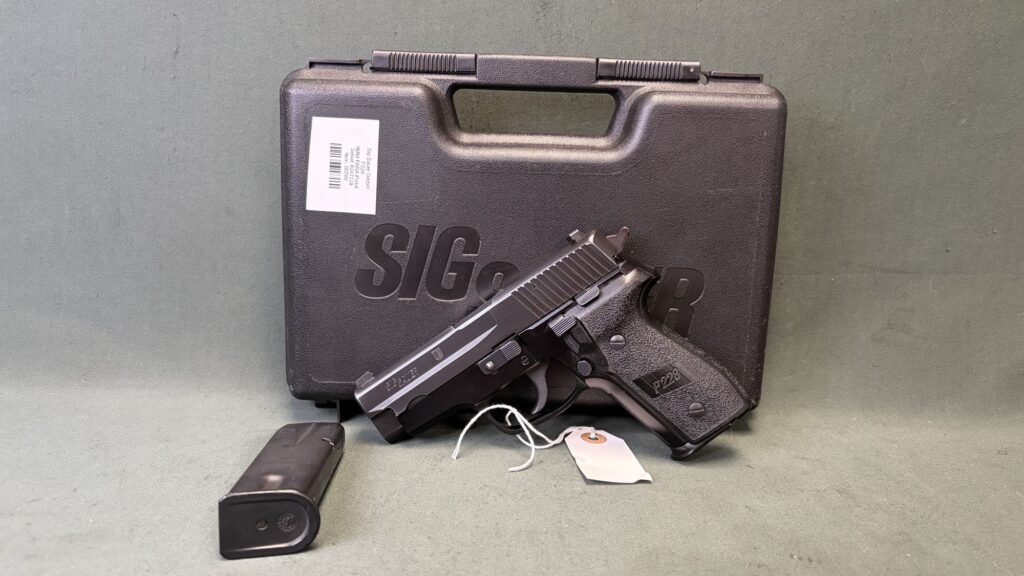 SIG Sauer P228 9mm 1995 German Ticino Police Crest No Import Mark Box$1,249.00
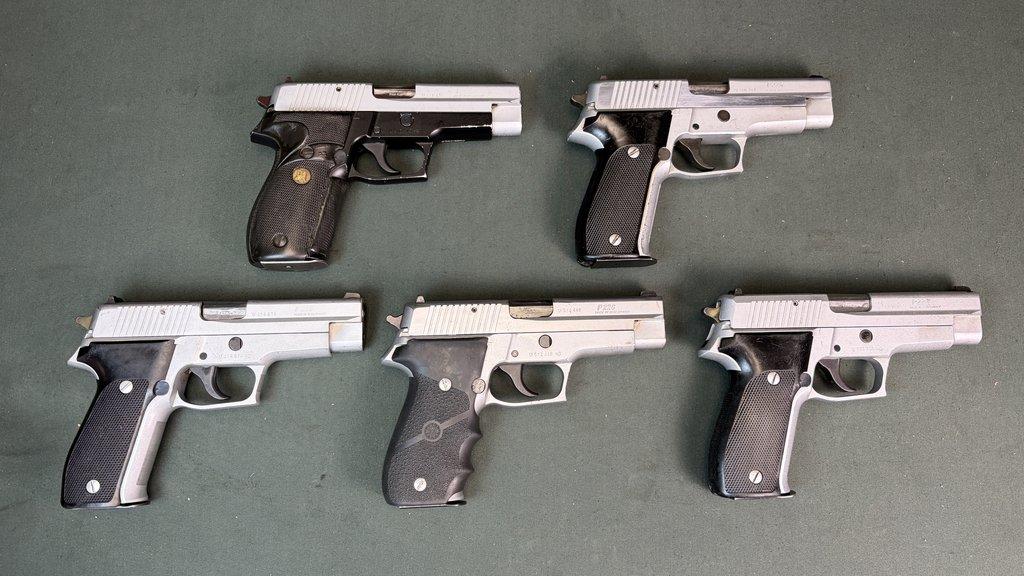 Free ShippingGerman P226 Stainless/Two Tone$699.00
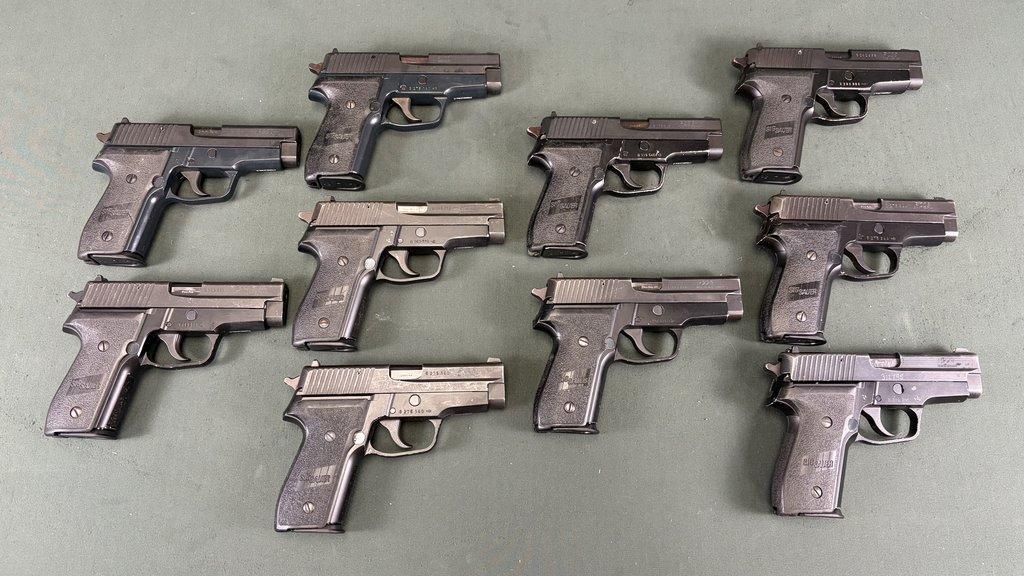 Free ShippingSIG Sauer P228 9mm German Police Israeli IDF Surplus Grade B Mirror Bore Original price was: $629.00.$569.00Current price is: $569.00.
 Free ShippingSIG Sauer P228 9mm German Police Israeli IDF Surplus Grade A Mirror Bore Original price was: $679.00.$629.00Current price is: $629.00.
The short version is on our Instagram. Watch it on Instagram.
General information for collectors, not legal advice. Force figures and production dates are from published secondary sources, which do not always agree.
Common Questions
How does the HK P7M13 squeeze-cocker work?
The front strap of the grip is a lever. Squeezing it fully cocks the striker, holding it keeps the pistol ready to fire, and releasing it decocks the pistol at once. A pin at the back of the slide shows when the striker is cocked.Does the HK P7M13 have a manual safety?
A standard P7M13 has no separate manual safety lever. The squeeze-cocker acts as the cocking lever, decocker, grip safety and slide release.How hard is it to squeeze the P7 cocking lever?
The first squeeze is heavy, roughly 13 to 16 pounds depending on the source, and holding the lever in takes only about 1.5 to 2 pounds.What is the difference between the P7M8 and the P7M13?
The magazine. The P7M8 takes an 8-round single-stack magazine; the P7M13 takes a 13-round double-stack magazine and has a wider grip. Both have the magazine release under the trigger guard and a heat shield on the trigger guard.How do I read the date code on an HK P7?
Look next to the German proof marks on the frame for two letters. Each stands for a digit, A for 0 through K for 9 with no J, giving the last two digits of the proof year: IH is 1987.What pistol did Hans Gruber use in Die Hard?
A Heckler & Koch P7M13. Small Arms Review describes the screen gun as a hard-chromed, H&K test-and-evaluation pistol and notes that its silencer was a fake.When was the HK P7M13 discontinued?
Wikipedia gives 2000 as the end of P7M13 production; American Rifleman says the P7 family was discontinued in 2008.Sources
- Wikipedia, “Heckler & Koch P7” — https://en.wikipedia.org/wiki/Heckler_%26_Koch_P7 (Munich background, Walther PP, police requirements, three selected pistols, 1976 PSP announcement, 1979 series production, GSG 9, Weldle, gas-delay mechanism and its origins, fixed barrel, 18 chamber flutes, 70 N / 2 lbf lever figures, heat in early pistols, M8/M13 changes, XM9 trials, P7M13SD, P7M13 production until 2000, dimensions)
- American Rifleman, “Heckler & Koch P7 Pistol” — https://www.americanrifleman.org/content/heckler-koch-p7-pistol (weight limit of 2 lb 3 oz, gas port, piston pinned to the slide, polygonal rifling, 13 lb / 1.5 lb lever, lever functions and other controls, adopted 1978, no civilian guns until 1981, P7 M13 13-round magazine)
- Guy J. Sagi, American Rifleman, “Heckler & Koch P7: H&K’s ‘Squeeze-Cocking’ Pistol” — https://americanrifleman.org/content/heckler-koch-p7-h-k-s-squeeze-cocking-pistol (adopted 1978, P7 M13 double stack, discontinued in 2008)
- Gun Tests, “Heckler & Koch P7 PSP 9mm” — https://gun-tests.com/?p=26534 (Polizei Selbstlade-Pistole, 1976, production from 1979, releasing the lever decocks)
- Athlon Outdoors, “History of the H&K P7 PSP” — https://athlonoutdoors.com/article/hk-p7-psp/ (cocking indicator through the back of the slide, heat shielding on the M8 and M13)
- Carl Walther, defense service FAQ — https://carl-walther.com/company/contact/defenseservice (two-letter German proof year code since 1968, A=0 through K=9, no J)
- International Sportsman, “Proof Marks, Date Codes, and German Firearms” — https://internationalsportsman.com/proof-marks-date-codes-and-german-firearms (eagle over N nitro proof, Ulm antlers on Heckler & Koch guns, H&K uses the same date code system)
- Small Arms Review, “Guns of the Silver Screen: Die Hard” — https://smallarmsreview.com/?p=13974 (Hans Gruber’s P7 M13, hard-chromed, fake silencer, HK T&E ONLY and HK CHANTILLY VA markings, Cinema Weaponry)
- NRA National Firearms Museum, “Die Hard (1988) HK P 7” — https://nramuseum.org/guns/the-galleries/hollywood-guns/cops,-robbers-and-a-galaxy-far-far-away/die-hard-(1988)-hk-p-7.aspx (Die Hard P7 in the Hollywood Guns gallery)
- Wikipedia, “Heckler & Koch” — https://en.wikipedia.org/wiki/Heckler_%26_Koch (founded 1949 in Oberndorf am Neckar by former Mauser engineers)